


Written by Will Duru, BSc (Hons) Sport and Exercise Science, award-winning Personal Trainer with over 10 years of experience in strength training and optimising recovery
This 12-week push pull legs workout plan gives you three gym sessions a week: a push day for chest, shoulders and triceps, a pull day for back and biceps, and a leg day. It runs in three 4-week phases. You learn the lifts first, then lift heavier, then move to harder exercises, so you always know what to do next.
Most people don’t fail because their workout plan is bad. They fail because the plan does not fit their life. Push, pull, legs works because it is simple, structured and easy to repeat.
Who this 12-week plan is for
This plan suits you if you can already do the main lifts with control and want a clear structure for the next three months. Each session takes six exercises and four sets of each.
- New to the gym? Start with the beginner push pull legs program, which adds a full-body fourth day.
- Experienced and able to train more often? Read who a 6-day split suits before you double the plan.
- Only want an upper-body session? Try the push pull workout that pairs presses with rows.
How the push pull legs workout plan works
You train three non-consecutive days a week. A rest day between sessions gives each muscle group time to recover before you train it again.
| Day | Session | Main muscles |
|---|---|---|
| Monday | Push | Chest, shoulders, triceps |
| Tuesday | Rest | Walk or light activity |
| Wednesday | Pull | Back, rear shoulders, biceps |
| Thursday | Rest | Walk or light activity |
| Friday | Legs | Quads, hamstrings, glutes, calves |
| Weekend | Rest | Recover |
Any three days work. Just keep one rest day between sessions where you can.
Is once a week per muscle enough?
With three sessions, you train each muscle group directly once a week. One meta-analysis found that training a muscle twice a week led to more growth than once a week. A later review found that when weekly sets were the same, frequency made little difference.
So the number of hard sets you do each week matters most. Muscle growth tends to increase with more weekly sets, and the American College of Sports Medicine (ACSM) suggests around 10 sets per muscle group per week for muscle growth. This plan gives most muscle groups about 8 to 12 direct sets a week.
How heavy should you lift?
Pick a weight that lets you finish the listed reps with good form, with a rep or two still in the tank. Coaches call this reps in reserve (RIR). You do not need to go to failure on every set. ACSM’s 2026 guidance found training to failure did not consistently change results for most healthy adults.

Phase 1: Foundation (Weeks 1-4)
Phase 1 is about learning the movements and finding your starting weights. Reps are a little higher so you can practice each lift and feel the right muscles working.
Push day (Weeks 1-4)
Two chest presses, two shoulder exercises and two triceps exercises. Start with the presses while you are fresh.
| Exercise | Sets | Reps | Notes |
|---|---|---|---|
| Dumbbell Bench Press | 4 | 10-12 | Lower with control, press up smoothly |
| Incline Barbell Press | 4 | 8-10 | Upper chest focus |
| Dumbbell Shoulder Press | 4 | 10-12 | Full range of motion, brace your core |
| Lateral Raises | 4 | 12-15 | Slow and controlled, lead with the elbows |
| Triceps Rope Pushdowns | 4 | 12-15 | Lock out fully at the bottom |
| Overhead Triceps Extension | 4 | 10-12 | Keep the elbows still |
Pull day (Weeks 1-4)
A vertical pull, two rows, face pulls for the rear shoulders, then two curls. Focus on moving the shoulder blades, not just the arms.
| Exercise | Sets | Reps | Notes |
|---|---|---|---|
| Lat Pulldowns | 4 | 10-12 | Wide grip, pull to the upper chest |
| Seated Cable Rows | 4 | 10-12 | Squeeze the shoulder blades, control the return |
| T-Bar Rows | 4 | 8-10 | Flat back, drive the elbows back |
| Face Pulls | 4 | 15-20 | Rear shoulders, pull toward your eyes |
| Dumbbell Biceps Curls | 4 | 10-12 | Strict form, no swinging |
| Hammer Curls | 4 | 12-15 | Neutral grip, palms facing in |
Leg day (Weeks 1-4)
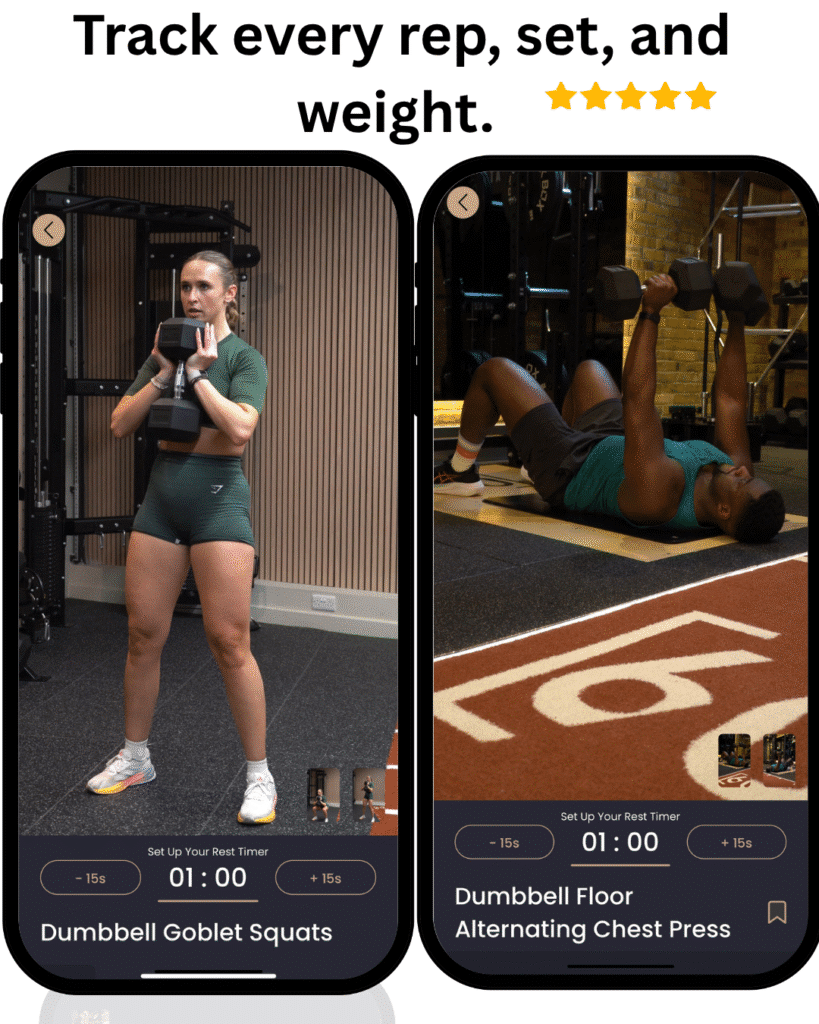
A squat pattern, a hip hinge, then machines for quads, hamstrings and calves. The Romanian deadlift (RDL) is a hip hinge: you push your hips back with a soft knee bend.
| Exercise | Sets | Reps | Notes |
|---|---|---|---|
| Goblet Squats | 4 | 12-15 | Chest up, squat as deep as you can control |
| Romanian Deadlifts | 4 | 10-12 | Hips back, feel the hamstrings stretch |
| Leg Press | 4 | 15-20 | Full range, controlled tempo |
| Leg Curls | 4 | 12-15 | Squeeze the hamstrings at the top |
| Leg Extensions | 4 | 12-15 | Control the weight on the way down |
| Standing Calf Raises | 4 | 15-20 | Full stretch at the bottom, pause at the top |
Video: How to do a Romanian deadlift. Watch this before your first leg day to see how far the hips travel back and where the bar should stay.
Phase 2: Strength Development (Weeks 5-8)
Phase 2 lowers the reps on the big lifts so you can use heavier weights. Because the reps drop, most people can lift more than they did in Phase 1. Choose a weight that lets you hit the new rep range with good form.
Push day (Weeks 5-8)
| Exercise | Sets | Reps | Notes |
|---|---|---|---|
| Barbell Bench Press | 4 | 6-8 | Heavier than Phase 1, same clean technique |
| Incline Dumbbell Flyes | 4 | 10-12 | Deep stretch, controlled movement |
| Military Press | 4 | 6-8 | Strict overhead press, glutes and core tight |
| Arnold Press | 4 | 8-10 | Rotate the palms as you press |
| Close-Grip Bench Press | 4 | 8-10 | Narrow grip for more triceps work |
| Diamond Push-Ups | 4 | 10-15 | Bodyweight finisher for the triceps |
Pull day (Weeks 5-8)
| Exercise | Sets | Reps | Notes |
|---|---|---|---|
| Pull-Ups or Assisted Pull-Ups | 4 | 6-10 | Full range, controlled tempo |
| Barbell Rows | 4 | 6-8 | Heavier weight, flat back |
| Single-Arm Dumbbell Rows | 4 | 8-10 | Each arm, pull the elbow toward the hip |
| Reverse Flyes | 4 | 12-15 | Rear shoulders, pause at the top |
| Barbell Curls | 4 | 8-10 | Heavier than Phase 1 |
| Cable Hammer Curls | 4 | 10-12 | Constant tension through the range |
Leg day (Weeks 5-8)
| Exercise | Sets | Reps | Notes |
|---|---|---|---|
| Barbell Back Squats | 4 | 6-8 | Heavier than your goblet squats |
| Stiff-Leg Deadlifts | 4 | 8-10 | Long hamstring stretch, flat back |
| Bulgarian Split Squats | 4 | 10-12 | Each leg, add dumbbells when ready |
| Walking Lunges | 4 | 12-15 | Each leg, control and balance |
| Calf Press on Leg Press | 4 | 15-20 | Full range of motion |
| Seated Calf Raises | 4 | 15-20 | Pause at the top |
Phase 3: Advanced Strength (Weeks 9-12)
Phase 3 uses the hardest exercises and the heaviest loads of the plan. It is not about ego lifting. Every rep should still look like your warm-up reps.
Push day (Weeks 9-12)
| Exercise | Sets | Reps | Notes |
|---|---|---|---|
| Incline Barbell Press | 4 | 5-6 | Heaviest weight you can lift with good form |
| Dumbbell Flyes | 4 | 8-10 | Deep stretch, slow lowering |
| Handstand Push-Ups or Pike Push-Ups | 4 | 6-10 | Use pike push-ups if handstands are not safe for you yet |
| Lateral Raise to Front Raise | 4 | 10-12 | Combination move, keep tension on |
| Triceps Dips | 4 | 8-12 | Full range, add weight if you can |
| Skull Crushers | 4 | 8-10 | Control the lowering |
Pull day (Weeks 9-12)
| Exercise | Sets | Reps | Notes |
|---|---|---|---|
| Weighted Pull-Ups | 4 | 5-8 | Add weight only when bodyweight reps feel solid |
| Deadlifts | 4 | 5-6 | Heavy, with clean technique on every rep |
| Wide-Grip Cable Rows | 4 | 8-10 | Pull the elbows wide |
| Shrugs | 4 | 10-12 | Upper traps, pause at the top |
| 21s Biceps Curls | 4 | 21 | 7 bottom-half reps, 7 top-half reps, 7 full reps |
| Preacher Curls | 4 | 8-10 | Strict form, squeeze at the top |
Leg day (Weeks 9-12)
| Exercise | Sets | Reps | Notes |
|---|---|---|---|
| Front Squats | 4 | 6-8 | Upright torso, quads do more of the work |
| Sumo Deadlifts | 4 | 6-8 | Wide stance, glutes and hamstrings |
| Step-Ups | 4 | 10-12 | Each leg, drive up through the front foot |
| Glute Ham Raises | 4 | 8-12 | Hamstrings and glutes |
| Jump Squats | 4 | 10-15 | Land softly, reset between reps |
| Single-Leg Calf Raises | 4 | 12-15 | Each leg, hold a support for balance |
How to progress through the 12 weeks
Progress does not come from changing exercises every week. It comes from getting better at the right exercises over time. That is progressive overload: adding a little more demand so your body has a reason to adapt.
Within each phase: stay with a weight until you can hit the top of the rep range on every set with good form. Then add the smallest jump your gym has and work back up the range. A 2022 study in trained lifters found that adding reps or adding load both built muscle and strength.
Between phases: the reps drop and the exercises get harder. Start each new phase with a weight you can control, then build again.
Rest between sets: rest 2 to 3 minutes after big compound lifts such as squats, presses and rows. Rest 1 to 2 minutes after smaller isolation exercises. A 2024 meta-analysis found a small muscle-growth benefit from resting longer than 60 seconds, with no clear extra gain beyond 90 seconds. Longer rests on heavy lifts help you keep your reps up.
Track every session. Write down the weight and reps for each set so you know what to beat next time. Our guide to progressive overload explains more ways to progress.
Recovery and nutrition during the plan
Training gives your body the signal to change. Recovery and food let the change happen.
- Sleep: adults aged 18 to 60 should aim for at least 7 hours a night, according to sleep experts cited by the CDC.
- Protein: a large meta-analysis found that extra protein stopped adding muscle beyond about 1.6 g per kg of body weight a day. Spread it across your meals, from foods such as chicken, eggs, fish, lean beef, Greek yogurt or tofu.
- Calories: if you want to lose fat, use a moderate calorie deficit rather than eating as little as possible. You still need energy to train well. Our guide on how many calories to eat shows how to set a target.
- Easier weeks: if you feel run down at the end of a phase, a lighter week can help. Coaches call this a deload: a short period of reduced training stress. See our deload week guide.
If you have a medical condition or take medication, check with your doctor before you change your diet or training.
Video: How long does it take to build muscle? Watch this to set realistic expectations for what 12 weeks can do.
Start your 12-week plan
Most people don’t need a perfect workout plan. They need a plan they can repeat long enough to see change. This 12-week push pull legs plan gives your training structure, progression and enough recovery to keep going.
Your result will not come from one hard session. It will come from showing up, tracking your lifts and making small progress week after week.
Want this structure without carrying tables around? 12REPS sets out each session and shows a trainer demonstration for every exercise. It also remembers what you lifted, so you always have a number to beat.
Push pull legs plan FAQs
What if I miss a session?
Do the missed session next time and carry on in order. Push, pull and legs always rotate, so nothing gets skipped.
Can I run this plan twice a week, six days in total?
You can, but only if you recover well and have the time. Read our 6-day PPL plan for a version built for that schedule.
Is push pull legs better than full body or upper/lower?
Not by itself. The best split is the one you can stick with. Our split comparison explains the trade-offs.
Sources
- Effects of Resistance Training Frequency on Measures of Muscle Hypertrophy: A Systematic Review and Meta-Analysis. Schoenfeld BJ, Ogborn D, Krieger JW. Sports Medicine, 2016. https://pubmed.ncbi.nlm.nih.gov/27102172/
- How many times per week should a muscle be trained to maximize muscle hypertrophy? A systematic review and meta-analysis of studies examining the effects of resistance training frequency. Schoenfeld BJ, Grgic J, Krieger J. Journal of Sports Sciences, 2019. https://pubmed.ncbi.nlm.nih.gov/30558493/
- Dose-response relationship between weekly resistance training volume and increases in muscle mass: A systematic review and meta-analysis. Schoenfeld BJ, Ogborn D, Krieger JW. Journal of Sports Sciences, 2017. https://pubmed.ncbi.nlm.nih.gov/27433992/
- 5 Things to Know About Creating an Effective Resistance Training Plan (2026 resistance training position stand infographic). American College of Sports Medicine, 2026. https://acsm.org/wp-content/uploads/2026/03/Resistance-Training-Position-Stand-infographic.pdf
- Progressive overload without progressing load? The effects of load or repetition progression on muscular adaptations. Plotkin D et al. PeerJ, 2022. https://peerj.com/articles/14142
- Give it a rest: a systematic review with Bayesian meta-analysis on the effect of inter-set rest interval duration on muscle hypertrophy. Singer A et al. Frontiers in Sports and Active Living, 2024. https://frontiersin.org/journals/sports-and-active-living/articles/10.3389/fspor.2024.1429789/abstract
- 1 in 3 adults don’t get enough sleep. Centers for Disease Control and Prevention, 2016. https://archive.cdc.gov/www_cdc_gov/media/releases/2016/p0215-enough-sleep.html
- A systematic review, meta-analysis and meta-regression of the effect of protein supplementation on resistance training-induced gains in muscle mass and strength in healthy adults. Morton RW et al. British Journal of Sports Medicine, 2018. https://pubmed.ncbi.nlm.nih.gov/28698222/