

Written by Will Duru, BSc (Hons) Sport and Exercise Science, award-winning Personal Trainer with over 10 years of experience in strength training and optimising recovery .
A 3-day gym workout split spreads your training over three sessions a week. This plan uses push, pull and legs: one day for chest, shoulders and triceps, one for back and biceps, and one for legs and abs.
It suits beginners who are ready for more structure and intermediate lifters who want more work per muscle in each session. Below you will find the full plan, how to schedule it, and how to progress.

Why Choose a 3-Day Gym Workout Split?
Moving from a 2-day full-body split to a 3-day split is a common next step. If you are starting out, our 12-week 2-day gym workout split is a good place to build your base first.
A 3-day split lets you do more total sets in a week. With push/pull/legs (PPL), each session focuses on one group of muscles, so each muscle gets more direct work in that session.
The trade-off: each muscle is trained once a week
In this PPL plan, each muscle group is trained once a week, then rests until the next week. A 2016 meta-analysis found that, with equal volume, training a muscle twice a week led to more growth than once a week.
A larger 2019 meta-analysis found that, when weekly volume was equal, frequency made little difference to muscle growth. So the main thing is getting enough hard sets each week. The 2026 ACSM position stand suggests about 10 sets per muscle group per week for muscle growth.
This plan gives most muscles 8 to 12 direct sets in their session, so it meets that target. If you would rather train each muscle twice a week, an upper/lower/full-body week is another option. Our guide to how often you should lift explains the research in more detail.
Who this split suits
- Intermediate lifters: More volume per session can help you keep progressing.
- Beginners ready for more: It teaches you how to train different muscle groups on different days.
- Busy schedules: Three sessions with rest days between them are easier to fit into a week.

Understanding Your Workout: Sets, Reps and Form
Good form is the base of any training program. It’s not about how much weight you can lift, but how well you lift it. Good technique keeps the work on the right muscles and helps you control the weight. Put technique ahead of ego; the weight will come.
Sets are the number of groups of repetitions you do. Reps are the number of times you do an exercise within a set. The rep range you choose shapes how your body adapts:
- Strength: Lower reps (1 to 5) with heavier loads.
- Hypertrophy (muscle growth): Moderate reps (6 to 12) with a challenging weight.
- Endurance: Higher reps (15 or more) with lighter weight.
These ranges are a guide, not hard limits. A 2017 meta-analysis found heavier loads gave bigger gains in maximal strength. Muscle growth was similar across a wide range of loads, as long as the sets were hard.

How to Schedule Your 3-Day Split
Spread your three sessions across the week with rest days in between. For example:
- Monday: Day 1, Push
- Wednesday: Day 2, Pull
- Friday: Day 3, Legs and Abs
Tuesday, Thursday and Saturday also work, or any pattern that gives you a day off after most sessions. Warm up before each session and cool down afterward.
Want to compare this with training more often? See our 3-day vs 5-day workout split guide.
Your 3-Day Gym Workout Split: The Plan
This push/pull/legs split gives each muscle group focused attention and time to recover. Warm up before each session and cool down afterward. Choose weights that let you keep good form for every set and rep.
Workout Day 1: Push (Chest, Shoulders, Triceps)
| Exercise | Sets | Reps | Notes |
|---|---|---|---|
| Barbell Bench Press or Smith machine press | 4 | 8-12 | Lower with control and squeeze your chest at the top. |
| Incline Dumbbell Press | 4 | 8-12 | Focus on your upper chest. |
| Seated Overhead Dumbbell Press | 4 | 8-12 | Keep your core tight and press directly overhead. |
| Lateral Raises (Dumbbell) | 4 | 12-15 | Focus on your side delts. |
| Triceps Pushdowns (Cable) | 4 | 10-15 | Fully extend and squeeze your triceps at the bottom. |
| Overhead Dumbbell Extension | 4 | 10-15 | Controlled movement. Keep your elbows tucked. |
Workout Day 2: Pull (Back, Biceps)
| Exercise | Sets | Reps | Notes |
|---|---|---|---|
| Pull-ups / Lat Pulldowns | 4 | 8-12 | Get a full stretch at the top and pull with your back muscles. |
| Bent-Over Barbell Rows | 4 | 8-12 | Keep a flat back and pull toward your lower abs. |
| Seated Cable Rows | 4 | 10-15 | Squeeze your shoulder blades together. |
| Face Pulls (Cable) | 4 | 15-20 | Focus on external rotation and your rear delts. |
| Barbell Biceps Curls | 4 | 10-15 | Keep your elbows tucked and avoid swinging. |
| Hammer Curls (Dumbbell) | 4 | 10-15 | Neutral grip. Works the brachialis and forearms. |
Workout Day 3: Legs and Abs
| Exercise | Sets | Reps | Notes |
|---|---|---|---|
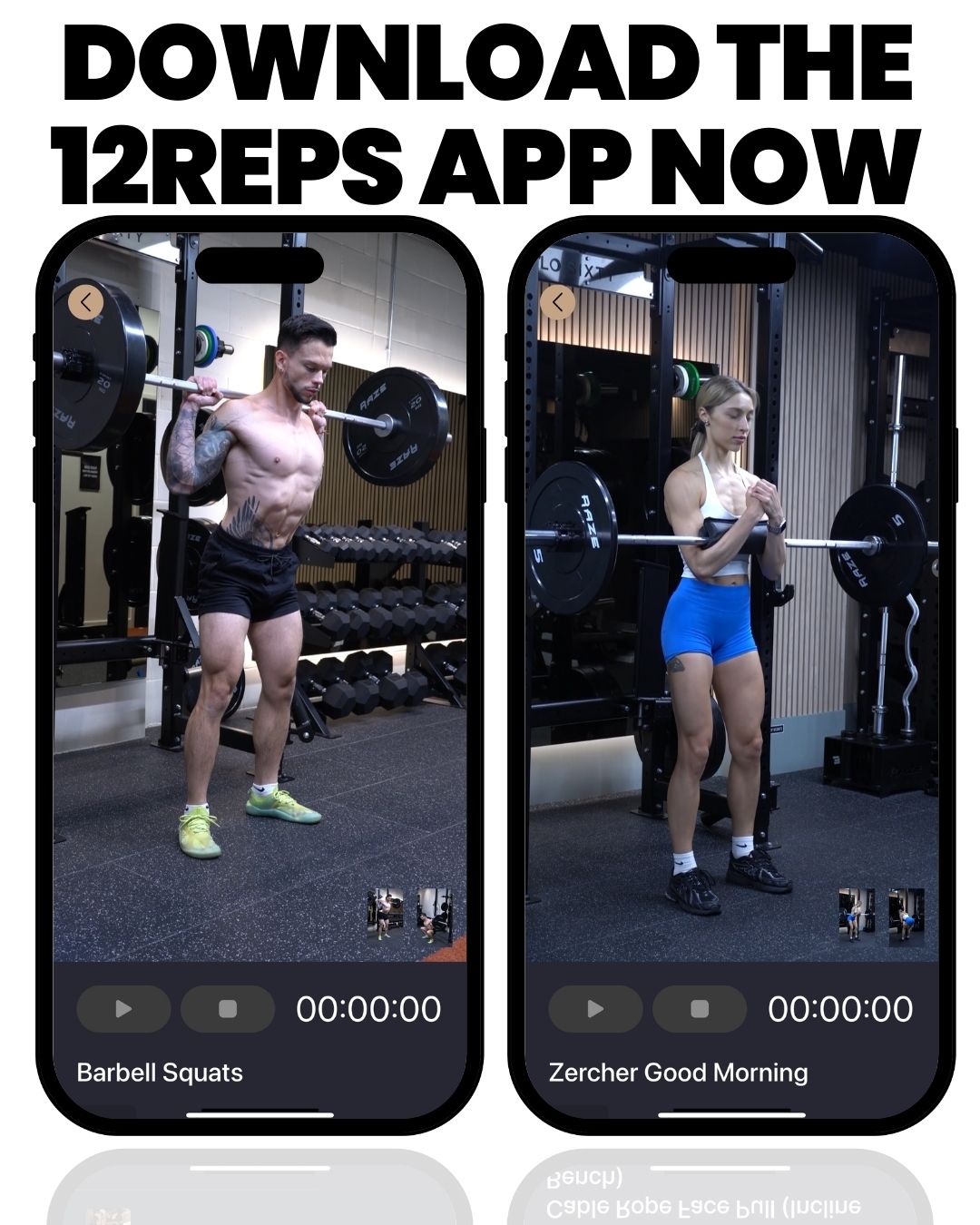
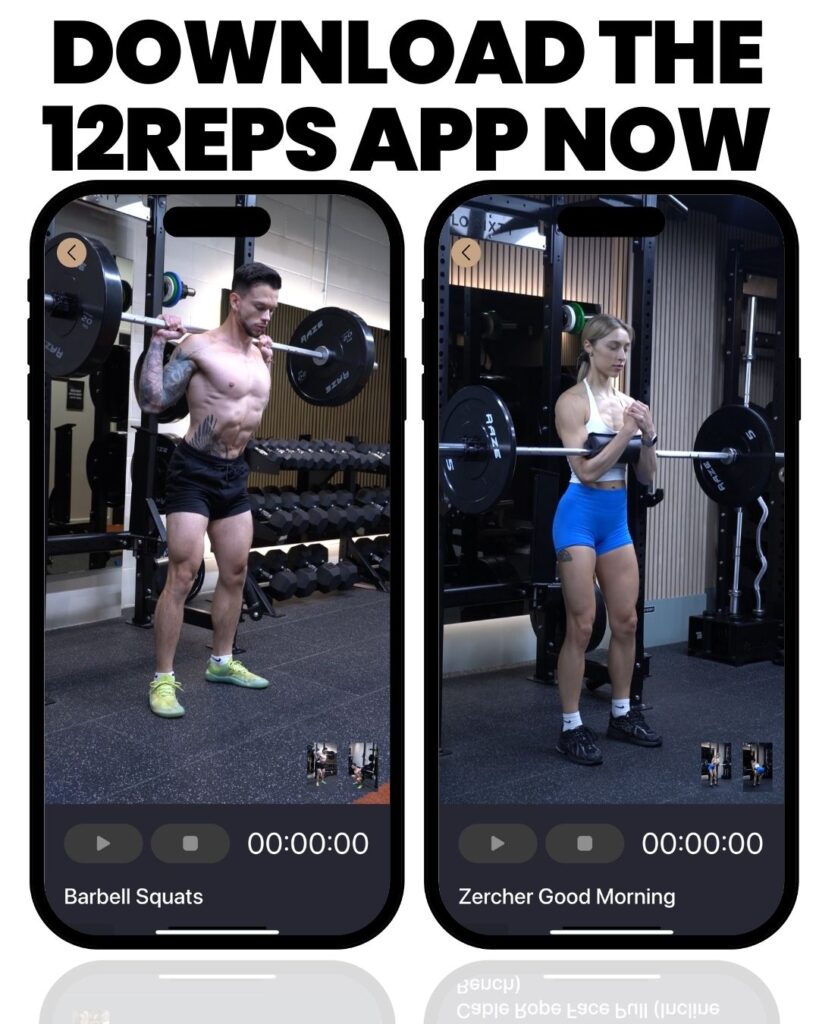
| Barbell Back Squats | 4 | 8-12 | Focus on depth, with knees tracking over your toes. Watch the 12REPS demo first. |
| Romanian Deadlifts (Barbell/Dumbbell) | 4 | 8-12 | Hinge at the hips and feel the stretch in your hamstrings. |
| Leg Press | 4 | 10-15 | Push through your heels and don’t lock out your knees. |
| Leg Extensions | 4 | 12-15 | Squeeze your quads at the top. |
| Hamstring Curls | 4 | 12-15 | Control the movement and squeeze your hamstrings. |
| Standing Calf Raises | 4 | 15-20 | Full range of motion, with a deep stretch and strong squeeze. |
| Plank | 4 | 30-60 sec | Keep a rigid, straight line from head to heels. |
| Cable Crunches | 4 | 15-20 | Curl your ribs toward your hips. Don’t just bend at the hips. |
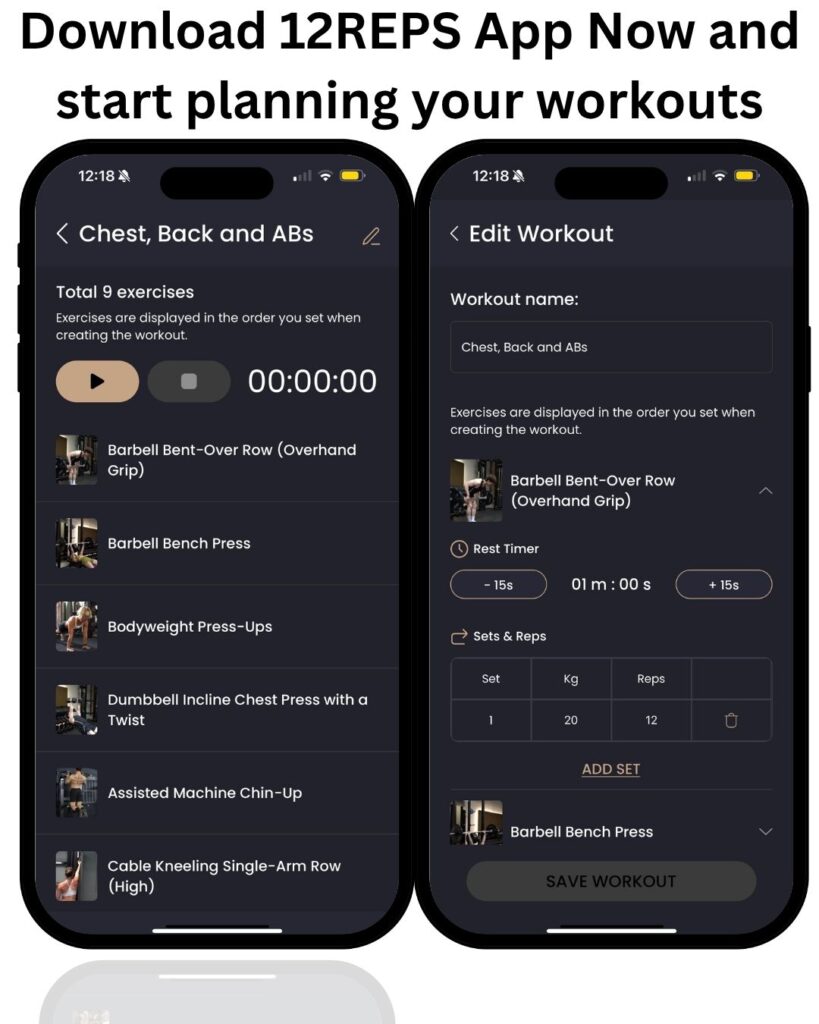
Log every workout in the 12REPS app. It records your reps and weights for each set and remembers what you lifted, so you always have a number to beat next time.
How to progress
Once you can hit the top of the rep range for all sets with good form, add a small amount of weight next session. You can also add reps first, then weight. A 2022 study found both approaches improved muscle size and strength. Our guide to progressive overload explains more.
Watch the technique
Here are 12REPS demonstrations of two lifts from this plan.
Barbell bench press (Day 1):
Lat pulldown (Day 2):
Beyond the Gym: Nutrition, Recovery and Consistency
What you do outside the gym matters as much as your sessions. Your body needs the right fuel and enough rest to recover and adapt. Pay attention to these three areas:
Nutrition
Your diet supports your progress. Eat enough protein, plenty of carbohydrates for energy, and some healthy fats.
A 2018 meta-analysis found that, on average, protein intakes above about 1.6 g per kg of body weight a day (about 0.7 g per pound) gave no further muscle gains. Drink regularly through the day. The NHS suggests 6 to 8 cups or glasses of fluid a day, and more if you are active for long periods.
Recovery
Your body adapts between sessions, not during them. Adults aged 18 to 60 are advised to sleep at least 7 hours a night.
Light activity on rest days, such as walking or gentle stretching, is fine. Listen to your body. If you feel very tired or sore, an extra rest day or a lighter session may help more than pushing through.
Consistency
Consistency is one of the most important factors for long-term progress. Showing up week after week, even when motivation dips, is what builds results.
Don’t aim for perfection. Aim for consistency. The 12REPS app tracks your workouts, streaks and weekly goal, so you can see how consistent you have been.

Next Steps
This 3-day gym workout split gives beginners and intermediate lifters a clear framework to build strength and muscle. It balances training volume with recovery, so you can keep it up week after week.
If you are new to planning your own training, read how to build a strength training program. It covers goals, splits and progression step by step.
If you want a plan built around your goal, your equipment and the time you have, 12REPS sets out each session and shows a real trainer demonstrating every exercise. Log your sets as you go, and you will always know what to beat next time.
Sources
- Schoenfeld BJ, Ogborn D, Krieger JW. Effects of Resistance Training Frequency on Measures of Muscle Hypertrophy: A Systematic Review and Meta-Analysis. Sports Medicine, 2016. https://pubmed.ncbi.nlm.nih.gov/27102172/
- Schoenfeld BJ, Grgic J, Krieger J. How many times per week should a muscle be trained to maximize muscle hypertrophy? A systematic review and meta-analysis of studies examining the effects of resistance training frequency. Journal of Sports Sciences, 2019. https://www.pubmed.gov/30558493/
- ACSM Unveils Landmark 2026 Resistance Training Guidelines (Resistance Training Prescription for Muscle Function, Hypertrophy, and Physical Performance in Healthy Adults). American College of Sports Medicine via Newswise, 2026. https://www.newswise.com/articles/acsm-unveils-landmark-2026-resistance-training-guidelines-first-update-in-17-years
- Schoenfeld BJ, Grgic J, Ogborn D, Krieger JW. Strength and hypertrophy adaptations between low- vs. high-load resistance training: a systematic review and meta-analysis. Journal of Strength and Conditioning Research, 2017. https://www.pubmed.gov/28834797/
- Plotkin D, et al. Progressive overload without progressing load? The effects of load or repetition progression on muscular adaptations. PeerJ, 2022. https://peerj.com/articles/14142
- Morton RW, et al. A systematic review, meta-analysis and meta-regression of the effect of protein supplementation on resistance training-induced gains in muscle mass and strength in healthy adults. British Journal of Sports Medicine, 2018. https://bjsm.bmj.com/content/52/6/376.abstract
- Water, drinks and hydration. NHS. https://www.nhs.uk/live-well/eat-well/food-guidelines-and-food-labels/water-drinks-nutrition/
- 1 in 3 adults don’t get enough sleep. Centers for Disease Control and Prevention, 2016. https://archive.cdc.gov/www_cdc_gov/media/releases/2016/p0215-enough-sleep.html