


Written by Will Duru, BSc (Hons) Sport and Exercise Science, award-winning Personal Trainer with over 10 years of experience in strength training and optimising recovery.
A 6-day split means strength training six days a week, most often by running push, pull and legs twice. It can work for experienced lifters who recover well and have the time. But it is not required to build muscle: when weekly sets are equal, training frequency makes little difference to muscle growth.
Most people do not need 6-day split strength training. More workouts do not automatically build more muscle. Many people simply end up tired, under-recovered and frustrated that nothing changes.
A real 6-day split is not six random workouts squeezed into a week. It is planned stress with planned recovery. Most lifters think they need more motivation when the real issue is recovery.
What a 6-day push pull legs week looks like
| Day | Session |
|---|---|
| Monday | Push (chest, shoulders, triceps) |
| Tuesday | Pull (back, rear shoulders, biceps) |
| Wednesday | Legs (quads, hamstrings, glutes, calves) |
| Thursday | Push |
| Friday | Pull |
| Saturday | Legs |
| Sunday | Rest |
Each muscle group gets trained twice a week, with the weekly sets spread across shorter sessions. For full workouts, see our 6-day push pull legs split. If three days suit you better, the 12-week push pull legs plan runs the same rotation once a week.

Who should use a 6-day split? An honest checklist
A 6-day split is a big commitment. Be honest about your experience, recovery and schedule before you start.
Experience
- You have trained consistently for several years and made progress on 3- or 4-day plans first.
- You can squat, deadlift, bench press, overhead press and row with good form.
- You understand progressive overload, training volume and when to back off.
If you are newer to lifting, build your base first with a 4-day beginner push pull legs program.
Recovery
- Sleep: you regularly get at least 7 hours a night, the minimum recommended for adults.
- Food: you eat enough protein and total calories to fuel six sessions.
- Stress: work and life stress are under control. High stress outside the gym makes recovery harder.
Time
Expect to be in the gym six days a week for around 60 to 90 minutes a session. That needs a steady schedule and some flexibility when life gets in the way. If your week is unpredictable, a plan you can keep is better than one you keep missing.
Benefits and trade-offs of training six days a week
Possible benefits
- Shorter sessions for the same weekly work. Spreading your sets over six days keeps each workout manageable. Growth tends to rise with more weekly sets.
- More practice. Doing a lift twice a week gives you more chances to refine your technique.
- Each muscle twice a week. One meta-analysis found training a muscle twice a week beat once a week for growth. You can also get twice-weekly training from a 4-day plan.
Trade-offs
- Fatigue builds up. Each session may feel fine, but the total over a week can be high.
- Less spare time. Six sessions can squeeze out work, family and social plans.
- Mental fatigue. Training almost every day can feel like a chore over time.
Overreaching and overtraining
Short dips in performance after hard training are normal and recover with rest. This is called functional overreaching. A joint ECSS and ACSM consensus describes overtraining syndrome as a prolonged state of poor adaptation, with fatigue, performance drops and mood changes.
Signs worth watching:
- Feeling tired even after rest days
- Lifts going backward for more than a week or two
- Low mood or irritability
- Trouble sleeping
- Frequent colds or nagging aches
If you notice these, cut back your training and rest. If symptoms last, see a doctor to rule out other causes. A planned lighter week, called a deload, gives your body a break from hard training. Our deload week guide shows how to run one.
Video: Why you’re not gaining muscle. Watch this if you train often but your progress has stalled. It covers the most common reasons.
Short on time? A 12-week, 2-day full-body plan
If six days does not fit your life, this plan uses two non-consecutive days a week, for example Monday and Thursday. You do two full-body workouts, A and B, every week. Each one covers chest, back, shoulders, legs, glutes and core.
That means every major muscle group is trained twice a week. This matches the WHO recommendation of muscle-strengthening activities for all major muscle groups on 2 or more days a week. For a shorter office-friendly version, see the twice-weekly full-body workout.
Video: Kettlebell goblet squats. The goblet squat is the main leg exercise in Workout A. Watch this before your first session to see the depth and upright chest position.
Weeks 1-4: foundation
Do Workout A on Day 1 and Workout B on Day 2, every week. AMRAP means as many reps as possible with good form.
Workout A: full body
| Exercise | Sets | Reps | Rest | Equipment |
|---|---|---|---|---|
| Dumbbell Bench Press | 3 | 10-12 | 90s | Dumbbell |
| Lat Pulldown | 3 | 10-12 | 90s | Machine |
| Kettlebell Goblet Squat | 3 | 10-12 | 90s | Kettlebell |
| Bodyweight Glute Bridges | 3 | 15-20 | 60s | Bodyweight |
| Mini Band Pull-Aparts | 3 | 15-20 | 60s | Mini resistance band |
| Plank | 3 | 30-45s hold | 60s | Bodyweight |
Workout B: full body
| Exercise | Sets | Reps | Rest | Equipment |
|---|---|---|---|---|
| Seated Machine Shoulder Press | 3 | 10-12 | 90s | Machine |
| Seated Cable Row | 3 | 10-12 | 90s | Machine |
| Leg Press Machine | 3 | 10-12 | 90s | Machine |
| Dumbbell Lunges | 3 | 10-12 per leg | 90s | Dumbbell |
| Push-Ups (or on knees) | 3 | AMRAP | 90s | Bodyweight |
| Bird-Dog | 3 | 10-12 per side | 60s | Bodyweight |
Weeks 5-8: building phase
Keep the same two workouts. When you can finish every set at the top of the rep range with good form, add a little weight next session.
Weeks 9-12: strength phase
The main compound lifts move to 4 sets of 8 to 10 reps. Everything else stays the same.
Workout A: full body (strength phase)
| Exercise | Sets | Reps | Rest | Equipment |
|---|---|---|---|---|
| Dumbbell Bench Press | 4 | 8-10 | 90s | Dumbbell |
| Lat Pulldown | 4 | 8-10 | 90s | Machine |
| Kettlebell Goblet Squat | 4 | 8-10 | 90s | Kettlebell |
| Bodyweight Glute Bridges | 3 | 15-20 | 60s | Bodyweight |
| Mini Band Pull-Aparts | 3 | 15-20 | 60s | Mini resistance band |
| Plank | 3 | 45-60s hold | 60s | Bodyweight |
Workout B: full body (strength phase)
| Exercise | Sets | Reps | Rest | Equipment |
|---|---|---|---|---|
| Seated Machine Shoulder Press | 4 | 8-10 | 90s | Machine |
| Seated Cable Row | 4 | 8-10 | 90s | Machine |
| Leg Press Machine | 4 | 8-10 | 90s | Machine |
| Dumbbell Lunges | 3 | 10-12 per leg | 90s | Dumbbell |
| Push-Ups (or on knees) | 3 | AMRAP | 90s | Bodyweight |
| Bird-Dog | 3 | 12-15 per side | 60s | Bodyweight |
Recovery for high-frequency training
On a 6-day split, recovery is what lets you keep progressing. If you don’t recover, you get tired, your lifts stall and training starts to feel like a grind.
Sleep
Aim for at least 7 hours a night. Some lifters need more when training volume is high. To help:
- Go to bed and wake up at roughly the same time each day, even on rest days.
- Keep your bedroom dark, quiet and cool.
- Put your phone away for a while before bed.
- Avoid caffeine and big meals late in the evening.
Food
- Enough calories: to build muscle, you usually need to eat a little more than you burn. Too little food makes recovery harder.
- Protein: a large meta-analysis found that extra protein stopped adding muscle beyond about 1.6 g per kg of body weight a day. Spread it across the day, including meals around training.
- Carbohydrates: they fuel hard training. Choose whole grains, fruit and vegetables, and eat some around your sessions.
- Fats: include foods such as avocado, nuts, seeds, olive oil and oily fish.
- Fluids: drink water through the day, with extra around your workouts.
6-day split FAQs
Is a 6-day split better for muscle growth than 3 or 4 days?
Not by itself. Reviews suggest the total number of hard sets per week matters more than how many days you spread them over. Pick the schedule you can recover from and repeat.
How do I know if I should drop to fewer days?
If your lifts stall for weeks, you feel run down or you keep missing sessions, drop to 4 or 5 days. Our comparison of 3-day vs 5-day splits can help you choose.
Which exercises should I use on push and pull days?
Start with a horizontal press, an overhead press, a row and a vertical pull. Our guide to the best push pull exercises explains how to choose.
The bottom line
A 6-day split can help experienced lifters who sleep well, eat well and have the time. For most people, 3 to 4 well-planned days give similar results with less fatigue. Whatever you choose, track your training, watch your recovery and back off before you burn out.
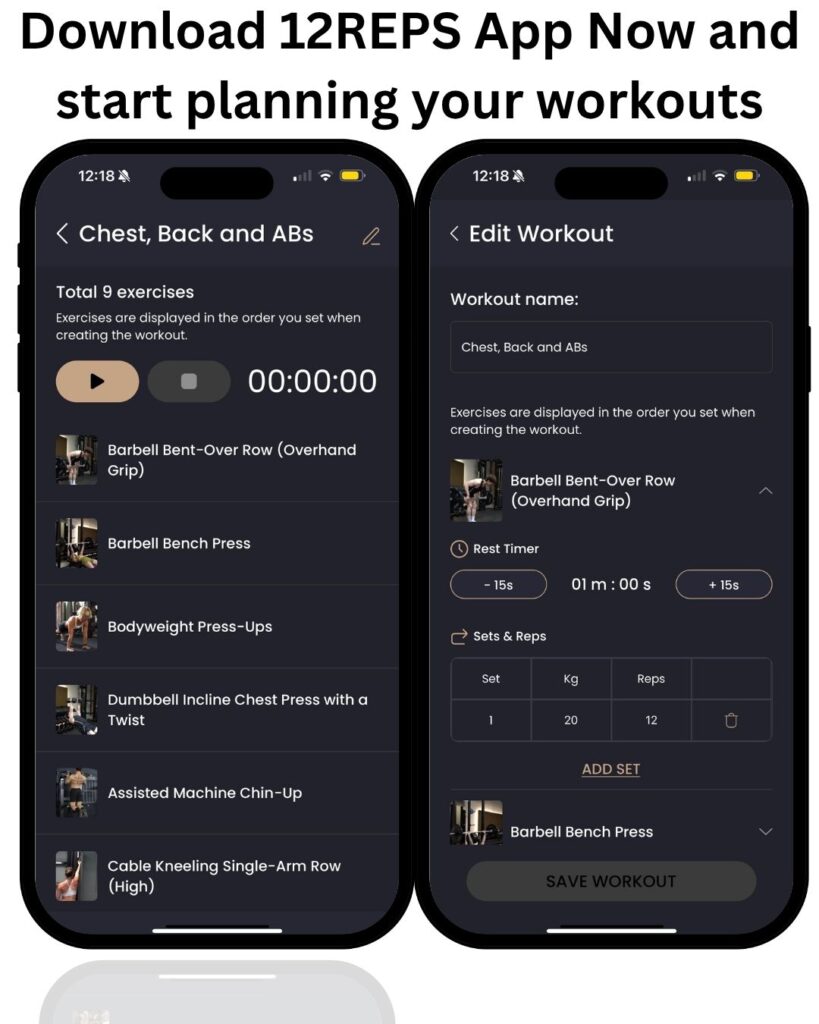
If you want your sessions planned around your goal, your equipment and the time you have, 12REPS sets out each workout and logs your sets, reps and weights. You can see your streaks and weekly goal at a glance, which makes it easier to spot when you need to back off.
Sources
- How many times per week should a muscle be trained to maximize muscle hypertrophy? A systematic review and meta-analysis of studies examining the effects of resistance training frequency. Schoenfeld BJ, Grgic J, Krieger J. Journal of Sports Sciences, 2019. https://pubmed.ncbi.nlm.nih.gov/30558493/
- Effects of Resistance Training Frequency on Measures of Muscle Hypertrophy: A Systematic Review and Meta-Analysis. Schoenfeld BJ, Ogborn D, Krieger JW. Sports Medicine, 2016. https://pubmed.ncbi.nlm.nih.gov/27102172/
- Dose-response relationship between weekly resistance training volume and increases in muscle mass: A systematic review and meta-analysis. Schoenfeld BJ, Ogborn D, Krieger JW. Journal of Sports Sciences, 2017. https://pubmed.ncbi.nlm.nih.gov/27433992/
- 1 in 3 adults don’t get enough sleep. Centers for Disease Control and Prevention, 2016. https://archive.cdc.gov/www_cdc_gov/media/releases/2016/p0215-enough-sleep.html
- Prevention, diagnosis and treatment of the overtraining syndrome: Joint consensus statement of the European College of Sport Science and the American College of Sports Medicine. Meeusen R et al. European Journal of Sport Science, 2013. https://doi.org/10.1080/17461391.2012.730061
- Physical activity (Be He@lthy, Be Mobile). World Health Organization, n.d. https://www.who.int/initiatives/behealthy/physical-activity
- A systematic review, meta-analysis and meta-regression of the effect of protein supplementation on resistance training-induced gains in muscle mass and strength in healthy adults. Morton RW et al. British Journal of Sports Medicine, 2018. https://doi.org/10.1136/bjsports-2017-097608