



By Will Duru, BSc (Hons) Sport and Exercise Science, Award-winning Personal Trainer with over 10 years of experience in strength training and optimising recovery.
Running More Is Not Always the Answer
You can improve your fitness by running more miles. But extra mileage alone may not fix weak hips, poor single-leg control, collapsing posture or the loss of power you feel near the end of a race.
A stronger runner can produce more force, hold better form and tolerate the repeated demands of training. That is why this programme combines running with three focused strength sessions each week.
The plan takes you through 12 weeks of push, pull, legs and core training. You will first establish control, then build strength before finishing with a performance phase focused on power and running resilience.
What Strength Training Gives a Runner
- Stronger glutes, quadriceps and hamstrings to support every stride.
- Better upper-body posture when fatigue begins to affect your form.
- More single-leg stability around the hips, knees and ankles.
- Greater force production for hills, acceleration and finishing speed.
- A measurable training plan that complements your running rather than replacing it.

The “Why” Behind Strength Training for Runners
The Weekly Split
Day | Session | Main focus |
Monday | Push | Chest, shoulders, triceps and posture |
Wednesday | Pull | Back, rear shoulders, arms and posture |
Friday | Legs and Core | Glutes, legs, calves and mid-section |
Place your hardest running session and longest run away from the leg workout where possible. An example week is strength on Monday, Wednesday and Friday, with running on Tuesday, Thursday and Saturday.
Warm-Up Before Each Session
- Five to ten minutes of easy rowing, cycling or incline walking.
- Cat-cow for controlled spinal movement.
- World’s greatest stretch for hips and upper-back rotation.
- Bodyweight squats, reverse lunges and glute bridges before the leg session.

The Complete 12-Week Strength Plan
Phase One: Build Control and Stability
Weeks 1 to 4 establish technique and training consistency. Use manageable loads and leave two to three good repetitions in reserve.
Workout A: Push
Exercise | Sets | Reps | Rest | Purpose |
3 | 10-12 | 75 sec | Chest and triceps | |
3 | 10-12 | 75 sec | Upper chest | |
3 | 8-15 | 60 sec | Chest and mid-section | |
3 | 10-12 | 75 sec | Shoulders and stability | |
3 | 12-15 | 45 sec | Side shoulders | |
3 | 12-15 | 45 sec | Triceps |
Workout B: Pull
Exercise | Sets | Reps | Rest | Purpose |
3 | 10-12 | 75 sec | Lats | |
3 | 10-12 | 75 sec | Upper back | |
3 | 8-12 | 60 sec | Back and body control | |
3 | 12-15 | 45 sec | Rear shoulders | |
3 | 10-15 | 45 sec | Biceps | |
3 | 10-15 | 45 sec | Biceps and forearms |
Workout C: Legs and Core
Exercise | Sets | Reps | Rest | Purpose |
3 | 10-12 | 90 sec | Quadriceps and glutes | |
3 | 10 each leg | 75 sec | Single-leg control | |
3 | 10-12 | 90 sec | Hamstrings and glutes | |
3 | 12-15 | 60 sec | Glutes | |
3 | 30-45 sec | 45 sec | Mid-section stability | |
3 | 10-15 | 45 sec | Lower mid-section |
Phase Two: Build Strength and Muscle
Weeks 5 to 8 increase the working load. Complete four sets of the first four movements and use controlled accessory work.
Workout A: Push
Exercise | Sets | Reps | Rest | Purpose |
4 | 8-10 | 90 sec | Chest and triceps | |
4 | 8-10 | 90 sec | Upper chest | |
4 | 8-15 | 75 sec | Chest and mid-section | |
4 | 8-10 | 90 sec | Shoulders and stability | |
3 | 12-15 | 45 sec | Side shoulders | |
3 | 10-15 | 45 sec | Triceps |
Workout B: Pull
Exercise | Sets | Reps | Rest | Purpose |
4 | 8-10 | 90 sec | Lats | |
4 | 8-10 | 90 sec | Upper back | |
4 | 8-12 | 75 sec | Back and body control | |
4 | 10-15 | 60 sec | Rear shoulders | |
3 | 8-12 | 60 sec | Biceps | |
3 | 10-15 | 45 sec | Biceps and forearms |
Workout C: Legs and Core
Exercise | Sets | Reps | Rest | Purpose |
4 | 8-10 | 120 sec | Quadriceps and glutes | |
4 | 8-10 each leg | 90 sec | Single-leg control | |
4 | 8-10 | 120 sec | Hamstrings and glutes | |
4 | 10-15 | 75 sec | Glutes | |
3 | 40-60 sec | 45 sec | Mid-section stability | |
3 | 10-15 | 45 sec | Lower mid-section |
Phase Three: Strength, Power and Running Resilience
Weeks 9 to 12 complete the programme. Use heavier controlled sets on the first two exercises. Move with intent, but stop when technique or speed drops.
Workout A: Push
Exercise | Sets | Reps | Rest | Purpose |
4 | 6-8 | 120 sec | Chest and triceps | |
4 | 6-8 | 120 sec | Upper chest | |
4 | 8-15 | 75 sec | Chest and mid-section | |
4 | 6-8 | 120 sec | Shoulders and stability | |
3 | 10-15 | 60 sec | Side shoulders | |
3 | 8-12 | 60 sec | Triceps |
Workout B: Pull
Exercise | Sets | Reps | Rest | Purpose |
4 | 6-8 | 120 sec | Lats | |
4 | 6-8 | 120 sec | Upper back | |
4 | 8-12 | 90 sec | Back and body control | |
4 | 10-12 | 60 sec | Rear shoulders | |
3 | 8-12 | 60 sec | Biceps | |
3 | 8-12 | 60 sec | Biceps and forearms |
Workout C: Legs and Core
Exercise | Sets | Reps | Rest | Purpose |
4 | 6-8 | 150 sec | Quadriceps and glutes | |
4 | 6-8 each leg | 120 sec | Single-leg control | |
4 | 6-8 | 150 sec | Hamstrings and glutes | |
4 | 8-12 | 90 sec | Glutes | |
3 | 45-60 sec | 60 sec | Mid-section stability | |
3 | 10-15 | 60 sec | Lower mid-section |
How to Progress Without Ruining Your Runs
Use double progression. Begin at the lower end of the repetition range. When you complete the top number of repetitions across every set with strong technique, add a small amount of weight next time.
Phase | Weeks | Goal | Effort | Rest |
Foundation | 1-4 | Control and stability | 2-3 reps left | 45-90 sec |
Strength | 5-8 | More load and volume | 1-2 reps left | 45-120 sec |
Performance | 9-12 | Strength and resilience | 1-2 reps left | 60-150 sec |
Rules That Protect Your Running Performance
- Do not take every strength set to failure.
- Avoid the hardest leg session the day before intervals or your long run.
- Reduce one set from each leg exercise during a high-mileage week.
- Keep easy runs easy so you can recover from both forms of training.
- Track sleep, leg soreness and running pace alongside your gym performance.
Common Mistakes Runners Make in the Gym
Turning strength work into cardio
Take the prescribed rest. Rushed sets reduce the weight and quality you can use.
Avoiding upper-body training
Your back, shoulders and arms help you maintain posture and rhythm while running.
Adding too much volume
More exercises are not always better. Complete the planned work and recover.
Changing exercises too often
Repeated movements give you a clear way to measure strength.
Ignoring single-leg control
Running happens one leg at a time. Lunges help expose and improve side-to-side differences.
Follow the Programme With 12REPS
Use the 12REPS strength training exercise library to watch each exercise demonstration, check coaching cues and find suitable alternatives when equipment is busy.
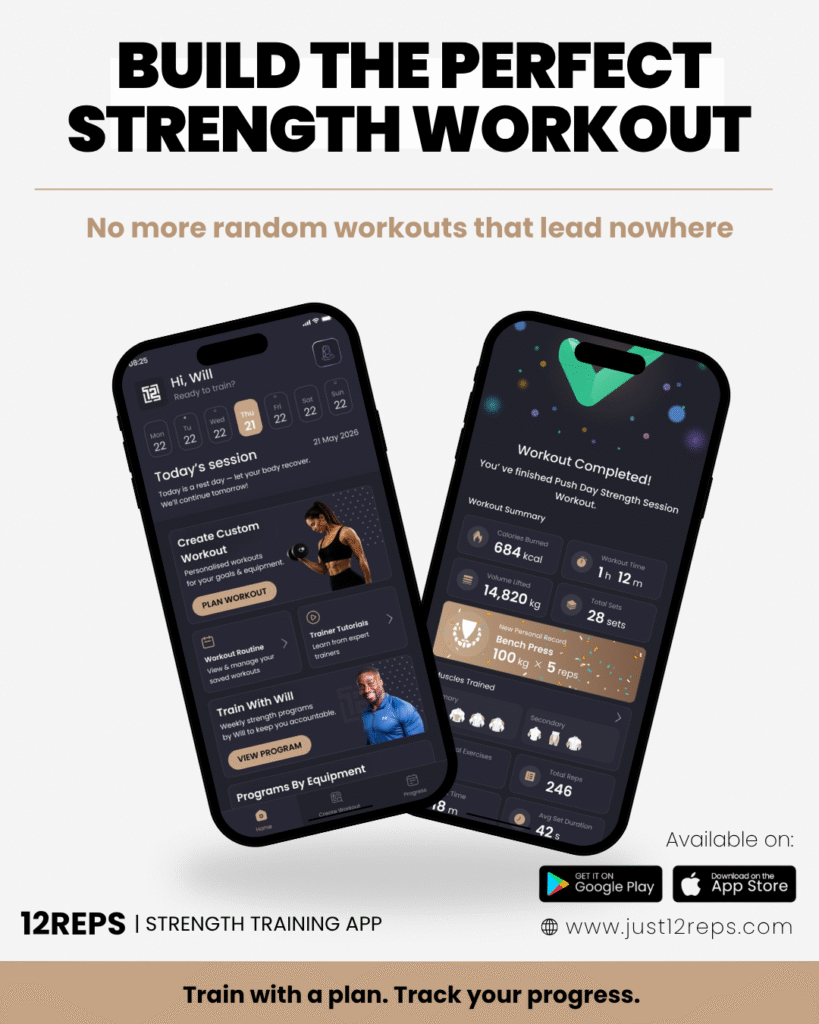
You can also download the 12REPS app to build the three workouts, record sets and weights, and track your progress across all 12 weeks.
Your Next 12 Weeks
Choose your three strength days and put them in your calendar. Start with weights you can control. Record every session and make small improvements when your performance allows it.
You are not trying to become tired for the sake of it. You are building the strength to run with more power, control and confidence.
About PT Will Duru
Will Duru is a personal trainer with more than a decade of experience and a Sport and Exercise Science BSc (Hons). Learn more at PTWill.com.
Will has been featured in Men’s Health, The Times, The Telegraph and Men’s Fitness.