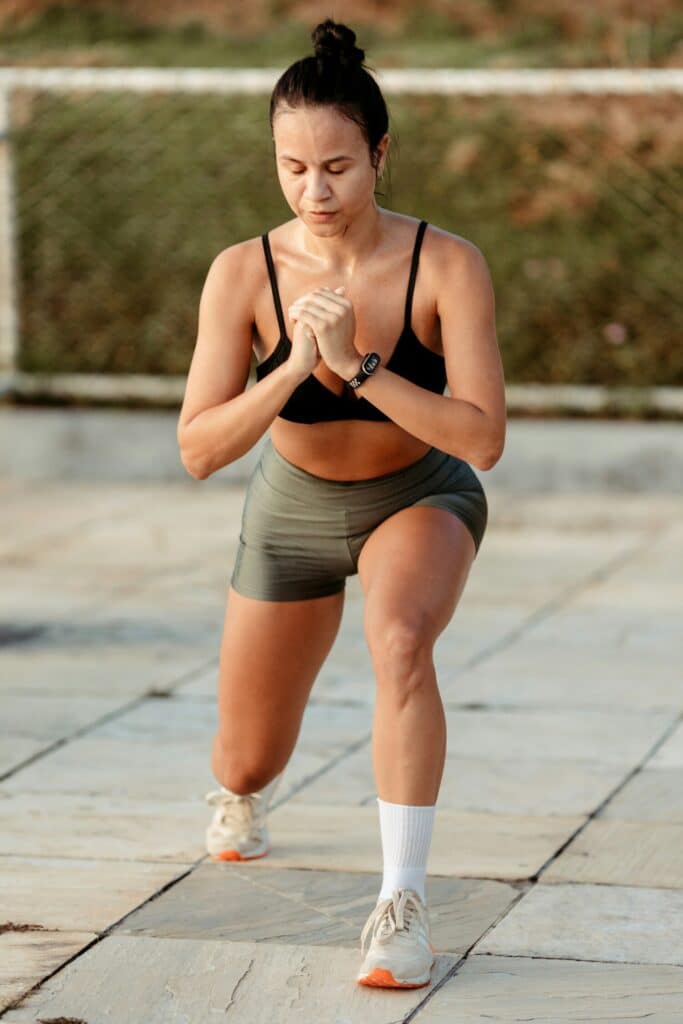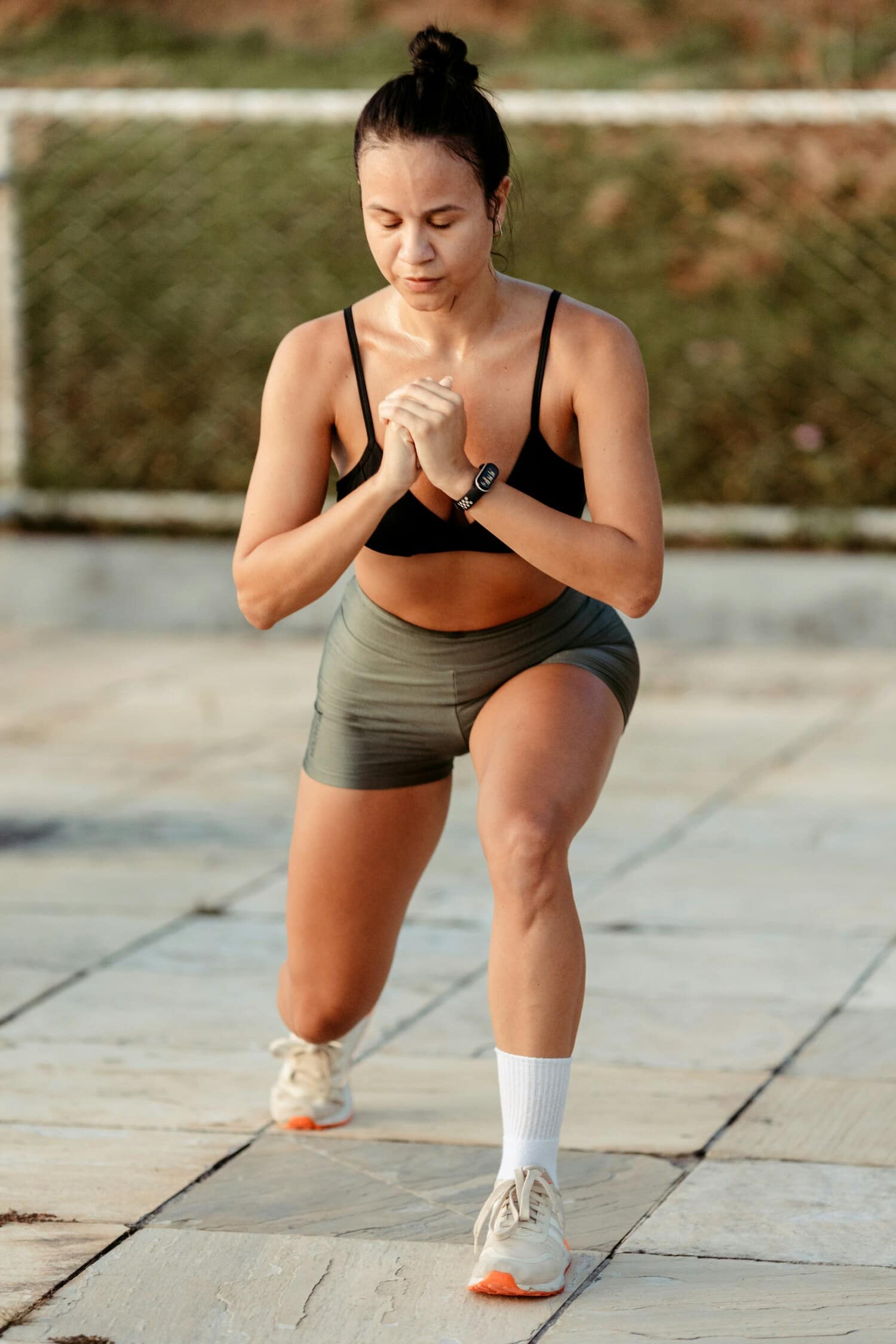



To do a lunge, stand tall with your feet hip-width apart and take a long step. Lower your back knee toward the floor until your front thigh is about parallel to the floor. Keep your chest up and your front knee in line with your toes. Then push through your front foot to return. If you are new to lunges, start with the reverse lunge, where you step back, then move on to forward and walking lunges.
Lunges look simple, so most people just start doing them. Then the front knee drifts, the back knee bumps the floor and balance goes. These are the lunge mistakes I correct again and again in the gym, and most of them come from the setup, not a lack of strength.
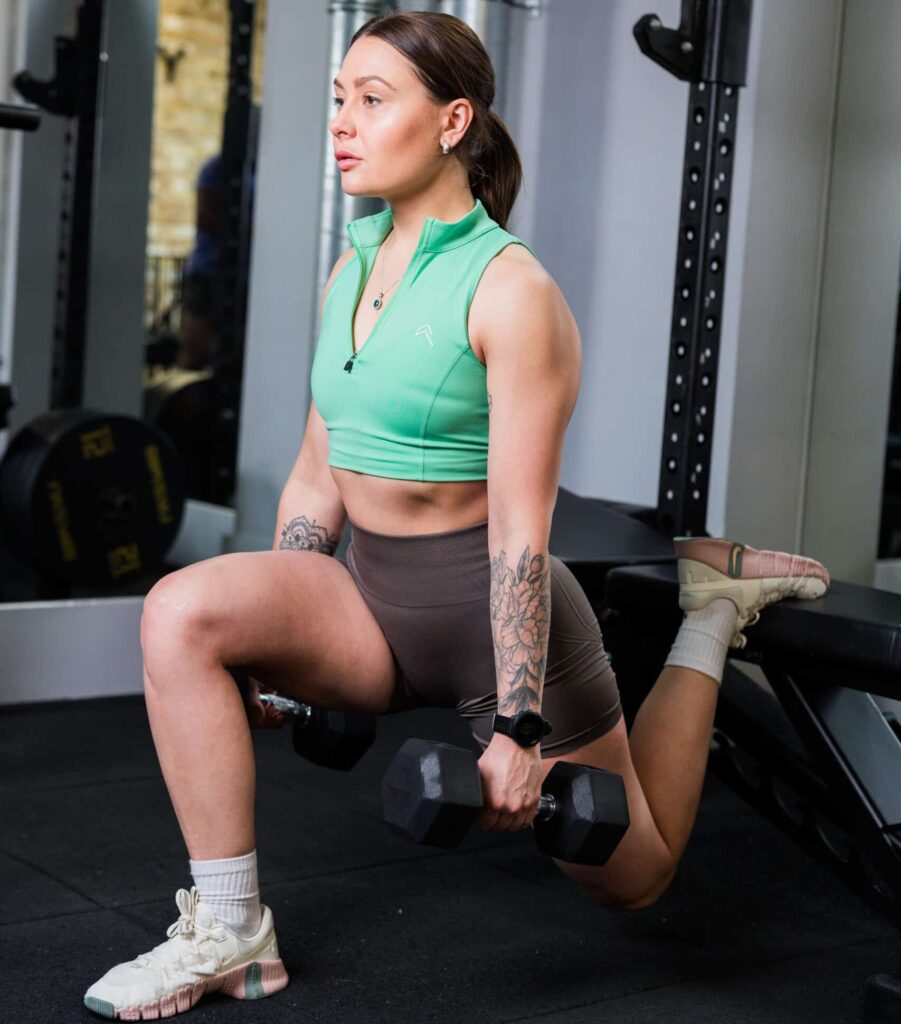
This guide covers how to do lunges step by step: which lunge to learn first, the three main variations, common mistakes, and easier and harder options. Lunges are part of the split-stance family, with the split squat and the Bulgarian split squat shown below. For the squat itself, see how to squat properly.
What muscles do lunges work?
Lunges mainly work your quadriceps (front of the thigh) and glutes, with the hamstrings (back of the thigh) helping at the hip. Because you train one leg at a time, your hips and trunk also work to keep you balanced.
- Glutes: a systematic review of gluteus maximus activity listed the traditional lunge, in-line lunge and split squat among exercises with very high glute activation.
- Quads and glutes together: a small lab study of nine men measured the load at the hip and knee during forward lunges, reverse lunges and single-leg squats. Both lunges loaded the knee and hip extensors, and the forward lunge loaded the hip and knee more than the reverse lunge.
- More hip, less knee: leaning your trunk slightly forward during a forward lunge increased glute and hamstring activity in a study of 10 adults.
These studies were small, and most measured muscle activity rather than muscle growth. They show where the work goes, not how much muscle you will build.
Reverse, forward or walking lunge: which should you learn first?
Start with the reverse lunge. You step back, so your front foot stays planted and you never have to stop your body moving forward. That makes it the most stable of the three.
| Lunge | How it moves | Difficulty | Best for |
|---|---|---|---|
| Reverse lunge | Step back, lower, step forward to finish | Easiest to control | Learning the pattern; beginners |
| Forward lunge | Step forward, lower, push back to start | Moderate | Once reverse lunges feel steady |
| Walking lunge | Step forward into each rep and keep moving | Hardest | Balance, coordination and longer sets |
The study above found the forward lunge put more load on the knee than the reverse lunge. For loading the knee, its authors suggested starting with the reverse lunge and moving on to the forward lunge. It tested only nine healthy men, so treat it as a guide, not a rule.
A practical test: move on to forward lunges when you can do about 3 sets of 10 controlled reverse lunges on each leg.
How to do a reverse lunge
- Set up. Stand with your feet hip-width apart, like standing on train tracks, not a tightrope. Hands on your hips, or a dumbbell in each hand at your sides.
- Step back. Take a long step back with one foot and land on the ball of that foot. Keep your front foot flat.
- Lower. Drop straight down until your back knee is just above the floor and your front thigh is about level with it.
- Drive up. Push through the whole front foot, especially the heel, and bring your back foot forward to standing.
- Repeat. Do all your reps on one leg, then switch, or alternate legs.
See the bodyweight reverse lunge exercise page for a short demo without weights.
Video: Dumbbell reverse lunges. Watch how the back foot lands on its toes and the trainer lowers straight down, then stands up through the front foot.
Reverse lunge form checklist
- Front foot: flat on the floor, with your weight through the middle of the foot and the heel.
- Front knee: points the same way as your toes. It can move forward a little, but it should not cave inward.
- Back knee: lowers under control to just above the floor. Use a mat if you are still learning.
- Hips: stay level and face forward.
- Trunk: tall, with a slight forward lean if it feels natural.
- Breathing: breathe in on the way down and out as you stand. The main thing is not to hold your breath for the whole set.
How to add weight
Start with bodyweight until every rep looks the same. Then add load in this order:
- Dumbbells at your sides. Palms facing your legs, shoulders back.
- Goblet hold. One dumbbell or kettlebell held at your chest. It helps you stay upright.
- Weight plate or barbell. For more load once balance is solid. See the plate reverse lunge.
Video: Barbell reverse lunges. This shows the same pattern with the bar on the upper back. Only try it once dumbbell reverse lunges feel steady.
Common lunge mistakes and how to fix them
1. Feet in a straight line
A narrow, tightrope stance makes you wobble, so the set becomes a balance test. Keep your feet hip-width apart when you step, both forward and back.
2. Front knee caving inward
Your front knee drifts toward the middle as you lower. Think “knee over the second toe” and reduce the weight or depth until you can hold that line.
3. Step too short
A short step pushes the front knee far forward and lifts the front heel. Take a longer step so your front shin stays closer to upright. In one lab study, a short-step forward lunge put more force through the kneecap joint than a long step at deeper knee bend.
4. Back knee crashing into the floor
Dropping fast means you are not controlling the lowering. Take about two seconds to lower and stop just short of the floor.
5. Pushing off the back foot
Your back leg is there for balance. Push through the front foot to stand. If you cannot, the weight is too heavy for now.
6. Folding over
A slight forward lean is fine and shifts more work to the hips. A big fold, with the chest dropping toward the knee, usually means the load is too heavy. Brace and keep your chest up.
Film yourself from the side for one set. It is the simplest way to check your step length and trunk angle.
How to do a forward lunge
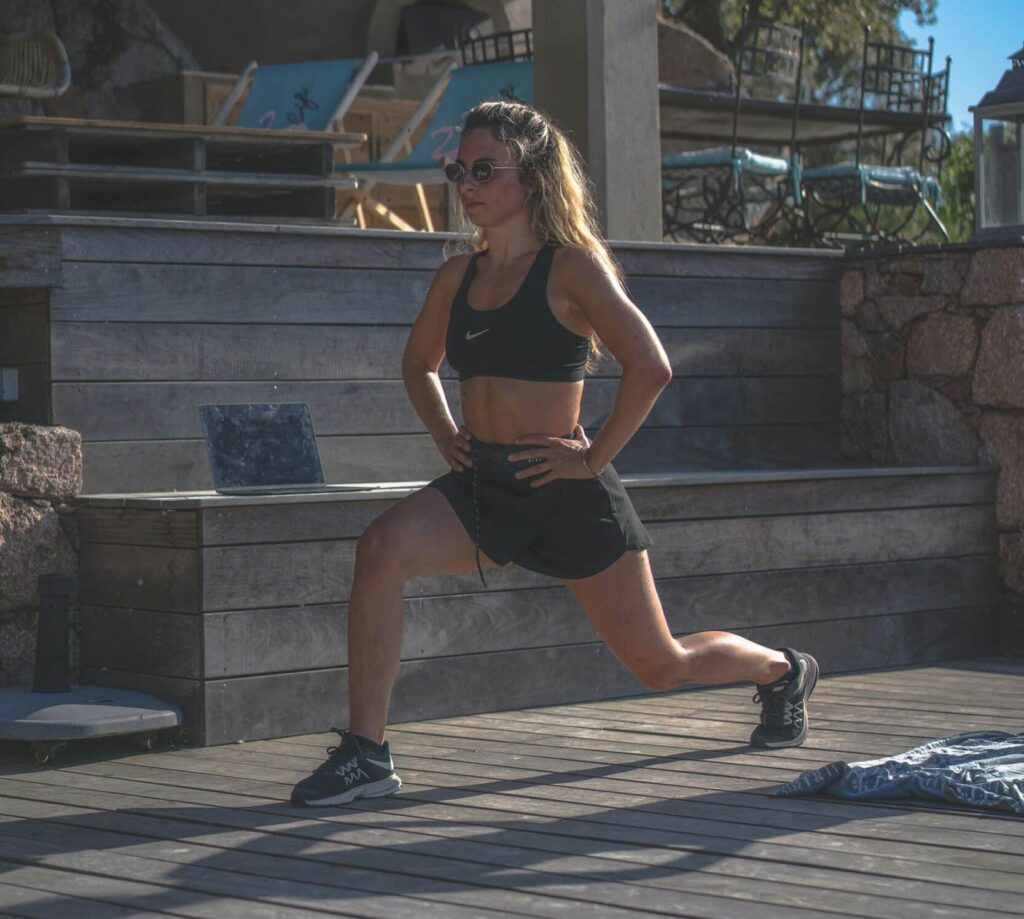
- Set up. Feet hip-width apart, hands on your hips or dumbbells at your sides.
- Step forward. Take a long step and land heel first, then let the whole foot settle.
- Lower. Drop straight down until your back knee is just above the floor. Your back heel will lift.
- Push back. Drive through your front foot to push yourself back to the start. Stand tall before the next rep.
The forward lunge is harder because your front leg has to stop your body moving forward, then push it back. Expect it to feel less steady than the reverse lunge at first.
Forward lunge tips
- Find your step length. At the bottom, your front shin should be close to upright. If your knee is far past your toes and your heel lifts, step further.
- Pause after you land. Land, settle for a moment, then lower. This stops you from dropping into the rep.
- Use the lean. If you want more glute work, a slight forward trunk lean shifts more effort to the hips.
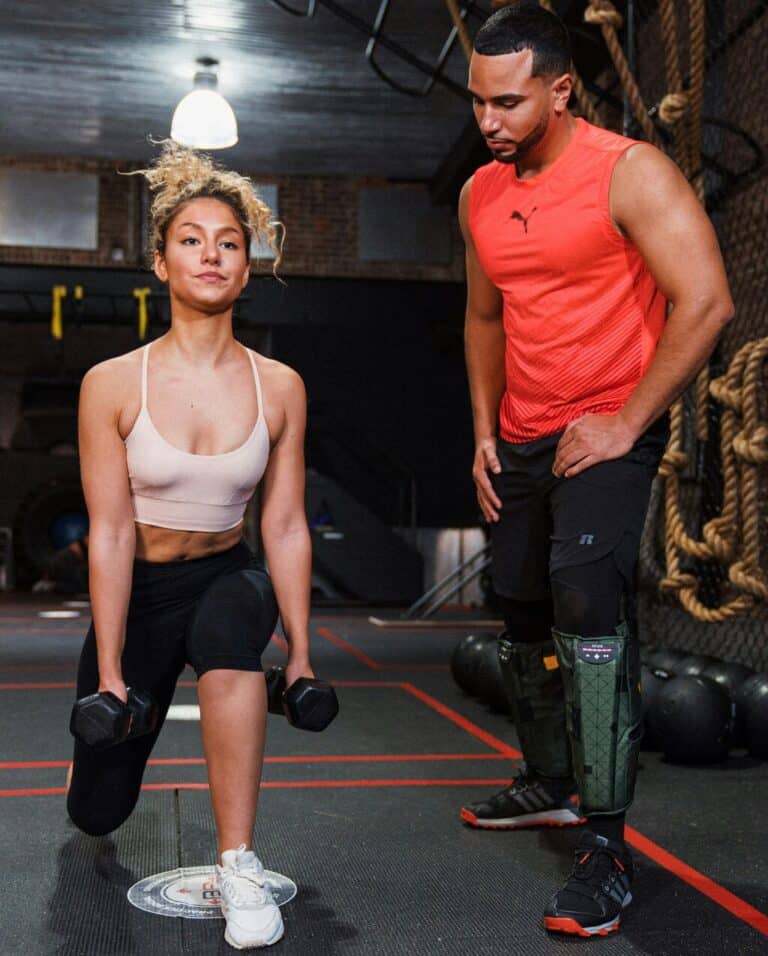
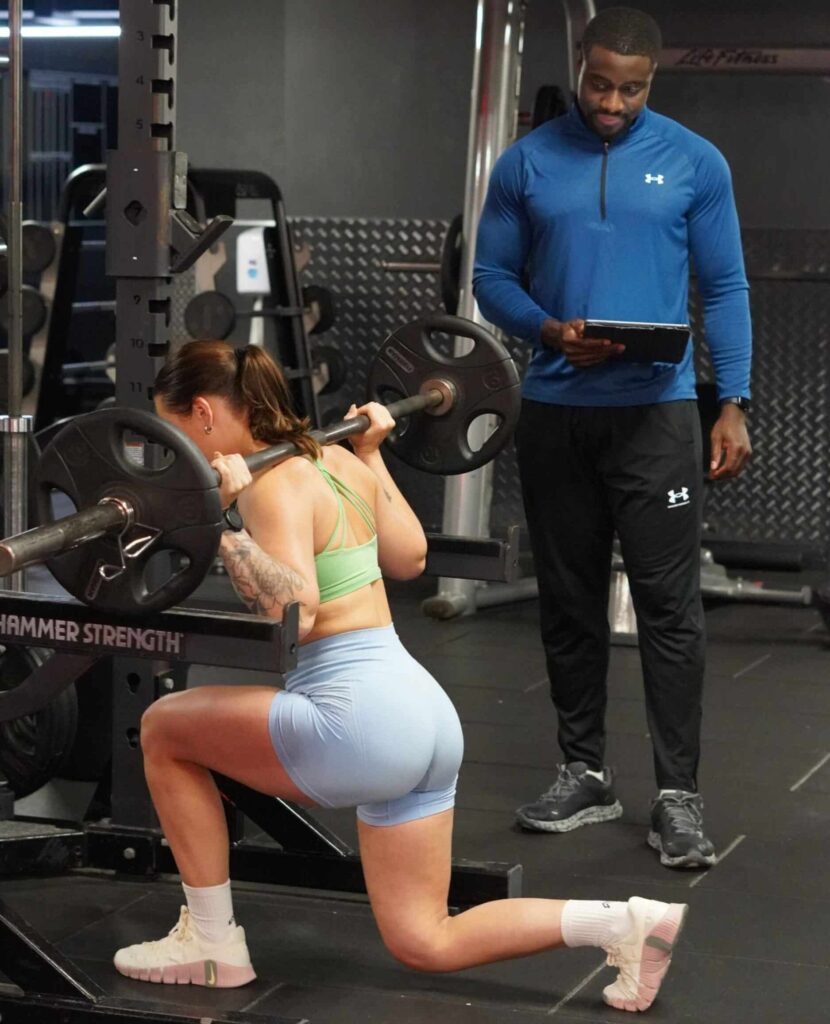
The bodyweight forward lunge exercise page shows the movement. If forward lunges still feel unstable, go back to a split squat, where both feet stay in place, as shown below with a trainer checking form.
How to do a walking lunge
A walking lunge is a forward lunge that keeps moving. Instead of pushing back to the start, you step through into the next rep. You need clear space: about 10 to 15 meters of floor.
- First rep. Step forward and lower, as in a forward lunge.
- Step through. Push through your front foot and bring your back leg forward. Let it land a long step ahead.
- Next rep. Lower straight away on the new front leg.
- Keep going. Alternate legs as you walk. Each step counts as one rep.
For an easier version, bring your feet together between reps and pause before the next step. Walking lunges are often counted by distance or time rather than reps, for example 15 to 20 meters a set.
The kettlebell walking lunge exercise page shows a loaded version.
Video: Dumbbell walking lunges. Watch how each rep flows into the next, with the trunk staying tall and the steps staying long.
Other lunge variations to try
Once the three main lunges feel solid, these variations change the direction or the range.
Lateral lunge
Step out to the side, sit your hips back over the bent leg and keep the other leg straight. Push back to the middle. It trains the same muscles in a side-to-side direction and needs some hip mobility.
Video: Bodyweight lateral lunges. Watch where the hips go: back and over the bent knee, with the chest staying up.
Curtsy lunge
Step one leg back and across, behind the front leg, as if you were curtsying, then lower. Go slowly, since the crossed stance is less stable. See the curtsy lunge exercise page.
Deficit reverse lunge
Stand on a low, sturdy step and lunge back to the floor. The step lets you go deeper. Try it once standard reverse lunges feel easy. See the bodyweight deficit reverse lunge.
Goblet lunge
Hold one dumbbell or kettlebell at your chest. It is a useful way to add weight if dumbbells at your sides pull you forward.
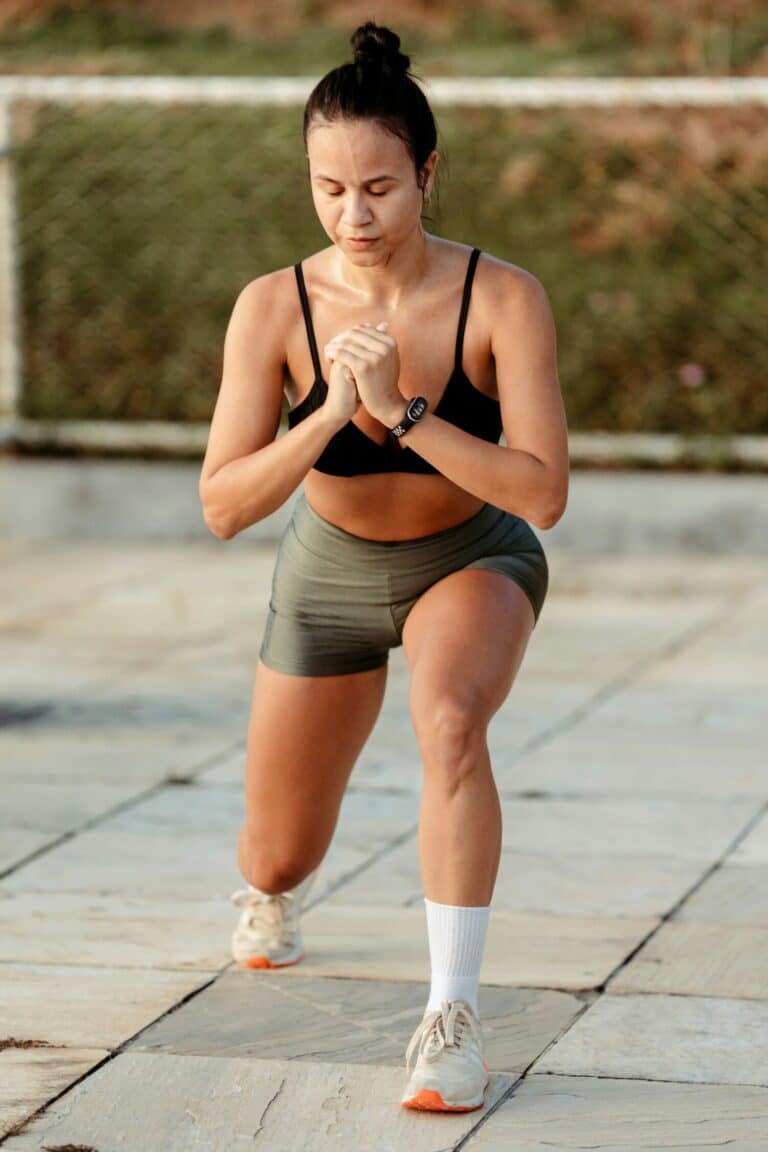
All of these work at home with bodyweight first, like the forward lunge below.
Easier and harder lunge options
Make it easier: the split squat
The split squat, also called a static lunge, is a lunge without the step. You set your feet in a split stance and stay there for every rep. It takes away the hardest part, controlling the step, so you can focus on lowering and standing.
- Hold a wall or a chair with one hand for balance while you learn.
- Shorten the depth: lower only as far as you can control.
- Slow down, and look straight ahead rather than at your feet.
Video: Static lunges. Watch the feet stay fixed while the body moves straight up and down.
Once bodyweight split squats feel steady, hold dumbbells and keep the same stance.
Video: Split squats. This shows the split squat as a strength exercise in its own right, a good step before you return to stepping lunges.
Make it harder
- Add load: heavier dumbbells, a goblet hold or a barbell.
- Add range: the deficit reverse lunge.
- Raise the back foot: the Bulgarian split squat puts more of your weight on the front leg.
- Keep moving: walking lunges.
Sets, reps and where lunges fit
Lunges fit in any lower-body or full-body session, once or twice a week. Do them after your main lift, such as squats or Romanian deadlifts, or as the first leg exercise on a lighter day.
| Goal | Sets | Reps per leg |
|---|---|---|
| Strength | 3 to 4 | 6 to 8 |
| Muscle | 3 to 4 | 10 to 12 |
| Muscular endurance | 2 to 3 | 15 to 20 |
Pick a weight that feels challenging by the last few reps, while every rep still looks the same. If one leg is weaker, start each set with that leg and match the reps on the other side.
For a full leg session built around lunges and other dumbbell moves, see this dumbbell lower body workout.
Train lunges with a plan
You get better at lunges by doing them regularly and adding a little load or a few reps over time. If you want that planned for you, 12REPS builds each session around your goal, your equipment and the time you have. Every exercise has a trainer demonstration, and the app remembers what you lifted last time so you have a number to beat.
Lunge FAQs
Are reverse lunges better than forward lunges?
Neither is better for everyone. The reverse lunge is easier to control, so it is a good place to start. The forward lunge put more load on the hip and knee in one small study of nine men, so it is a natural next step.
Should my back knee touch the floor?
Aim to stop just above the floor. A light touch on a mat is fine. Banging the knee down means you are dropping, not lowering.
Can my front knee go past my toes?
A little forward knee travel is normal, especially in taller or longer-legged lifters. If your front heel lifts, lengthen your step. Our squat guide explains more about knees past toes.
Why do lunges hurt my knees?
Try a longer step, reverse lunges instead of forward ones, less depth and less weight. If pain continues or you have a knee condition, see a physiotherapist or doctor before you keep lunging.
Lunges or squats?
Both. Squats let you lift more with both legs together. Lunges train one leg at a time and challenge your balance. Most lower-body plans use a squat and a lunge or split squat each week.
Sources
- Joint kinetics and kinematics during common lower limb rehabilitation exercises. Comfort P, Jones PA, Smith LC, Herrington L, Journal of Athletic Training, 2015. https://doi.org/10.4085/1062-6050-50.9.05
- Patellofemoral joint force and stress between a short- and long-step forward lunge. Escamilla RF et al., Journal of Orthopaedic and Sports Physical Therapy, 2008. https://doi.org/10.2519/jospt.2008.2694
- Trunk position influences the kinematics, kinetics, and muscle activity of the lead lower extremity during the forward lunge exercise. Farrokhi S et al., Journal of Orthopaedic and Sports Physical Therapy, 2008. https://doi.org/10.2519/jospt.2008.2634
- Gluteus maximus activation during common strength and hypertrophy exercises: a systematic review. Krause Neto W et al., Journal of Sports Science and Medicine, 2020. https://pubmed.ncbi.nlm.nih.gov/32132843/