




By Will Duru, BSc (Hons) Sport and Exercise Science, Award-winning Personal Trainer with over 10 years of experience in strength training and optimising recovery
The best strength exercises for marathon runners train one leg at a time and build your calves, hips and trunk. This guide covers five: the dumbbell split squat, farmer’s carry, weighted calf raise, kettlebell goblet squat and kettlebell static split lunge. Do them two or three times a week alongside your running.

Why marathon runners need strength training
Running builds your aerobic fitness. Strength training adds what running alone does not: more force from your legs and better control of your hips and trunk.
A 2018 systematic review of 24 studies in middle- and long-distance runners found that strength training often improved running economy by about 2 to 8%. Running economy is how much energy you use to hold a given pace. Better economy means the same pace costs you less.
Most of those studies tested races of 1.5 to 10 km, so the evidence for the marathon is less direct. Still, using less energy at your race pace helps over any distance. The same review found that body composition was not harmed, so lifting is unlikely to bulk you up.
Strength work is often sold as injury protection, but the evidence in runners is less clear. A 2024 review of prevention programs in endurance runners found no clear drop in injury risk overall. Supervised programs looked more promising, though most studies were low quality.

5 strength exercises for marathon runners
You need a pair of dumbbells and a kettlebell. A trainer demo video follows each exercise.
The sets and reps are a starting point. Pick a weight you can lift with good form and finish each set feeling you could do one or two more reps. Trainers call this reps in reserve (RIR).
1. Dumbbell split squat
Starting point: 4 sets of 12 reps on each leg
Works: quads and glutes, with help from your hamstrings. Your trunk works to keep you balanced.
Why it helps: Running is a series of single-leg landings and push-offs. Training one leg at a time builds strength in a similar position. It also shows you if one side is weaker.
- Hold a dumbbell in each hand and take a long step forward into a staggered stance.
- Lower your back knee toward the floor. Keep your chest tall.
- Push through your front foot to stand back up. Finish all reps, then switch legs.
Want a harder version? Rest your back foot on a bench for a Bulgarian split squat.
2. Dumbbell farmer's carry
Starting point: 4 sets of 40-meter walks
Works: grip, forearms, upper back, shoulders and trunk.
Why it helps: Walking with heavy weights trains your trunk to keep you upright while you move. It also builds grip and upper-back strength.
- Pick up a heavy dumbbell in each hand with a flat back.
- Stand tall with your shoulders down and back.
- Walk with short, steady steps. Don’t let the weights pull you to one side.
- Put the weights down with control at the end.
3. Weighted calf raise
Starting point: 4 sets of 12 reps
Works: calves (the gastrocnemius and soleus).
Why it helps: Your calves do a lot of work with every stride. A 2012 study that modeled muscle forces in running found that the soleus and gastrocnemius gave the most vertical support at speeds up to about 7 meters per second. That is far faster than marathon pace.
- Hold a dumbbell and stand with the balls of your feet on a step. Hold on to something for balance if you need to.
- Rise as high as you can onto your toes.
- Lower slowly until your heels drop just below the step, then repeat.
Training in a gym? The machine standing calf raise lets you load your calves more heavily.
4. Kettlebell goblet squat
Starting point: 4 sets of 12 reps
Works: quads, glutes and trunk. Your upper back works to hold the weight.
Why it helps: A two-leg squat lets you lift more weight than single-leg moves, so it builds general leg strength. Holding the kettlebell at your chest helps you stay upright and learn good squat form.
- Hold the kettlebell by the handle at chest height. Stand with your feet about shoulder-width apart.
- Sit down between your heels, keeping your chest up and knees in line with your toes.
- Drive through your whole foot to stand up.
When you outgrow the kettlebell, the barbell squat is the next step.
5. Kettlebell static split lunge
Starting point: 4 sets of 12 reps
Works: quads, glutes and trunk.
Why it helps: Like the split squat, it builds strength one leg at a time. Using a kettlebell gives you a different way to hold the load, which adds variety to your week.
- Hold the kettlebell as shown in the video and set up in a split stance.
- Keep your feet still. Lower straight down until both knees are bent.
- Press back up through your front foot. Complete your reps, then switch sides.
Use this on a different day from the split squat, or swap between them. A bodyweight reverse lunge is an easier option. The kettlebell walking lunge is a harder one.
How to add these exercises to marathon training
- Aim for two or three sessions a week. Most studies in the 2018 review used two or three strength sessions a week for 6 to 14 weeks.
- Start light. If you are new to lifting, learn each move with bodyweight first.
- Progress gradually. When a set feels easier, add a little weight or a rep or two. This is called progressive overload.
- Work toward heavier loads. A 2024 meta-analysis found that heavy strength training and plyometrics (jumps and hops) improved running economy. Lighter training did not show a clear benefit.
- Protect your key runs. Avoid hard leg work the day before your long run. If you run and lift on the same day, leave a few hours between them. A 2022 meta-analysis found that combining both in one session can blunt gains in explosive strength. That effect was not significant when sessions were at least 3 hours apart.
- Go lighter in race week. Stick to familiar moves and lighter weights so your legs feel fresh.
Need help fitting this into your week? See how to use Strava and strength training together, which includes a sample week. For three full sessions with demo videos, try the best strength training exercises for runners. Ready for a longer plan? Read how to choose a strength training program for runners.
Build strength for every mile
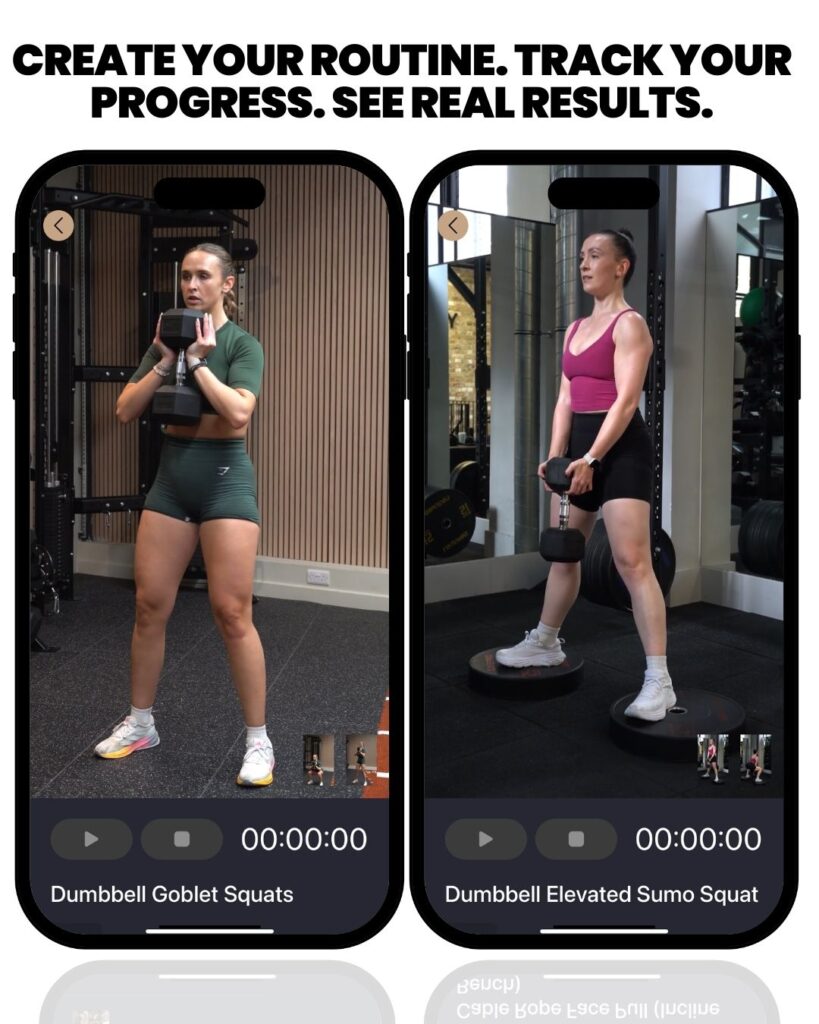
If you want each session set out for you, 12REPS builds training around your goal, your equipment and the time you have. Every exercise has a trainer demonstration, and the app remembers what you lifted, so you always have a number to beat. See how the 12REPS app works.
Sources
- Effects of Strength Training on the Physiological Determinants of Middle- and Long-Distance Running Performance: A Systematic Review. Sports Medicine (Blagrove RC, Howatson G, Hayes PR), 2018. https://pmc.ncbi.nlm.nih.gov/articles/PMC5889786/
- Effect of Strength Training Programs in Middle- and Long-Distance Runners’ Economy at Different Running Speeds: A Systematic Review with Meta-analysis. Sports Medicine (Llanos-Lagos C, Ramirez-Campillo R, Moran J, Sáez de Villarreal E), 2024. https://repository.essex.ac.uk/37272/
- Do Exercise-Based Prevention Programs Reduce Injury in Endurance Runners? A Systematic Review and Meta-Analysis. Sports Medicine (Wu H, Brooke-Wavell K, Fong DTP, Paquette MR, Blagrove RC), 2024. https://lida.sport-iat.de/ta/Record/4086976
- Muscular strategy shift in human running: dependence of running speed on hip and ankle muscle performance. Journal of Experimental Biology (Dorn TW, Schache AG, Pandy MG), 2012. https://cob.silverchair.com/jeb/article-pdf/215/11/1944/1445059/1944.pdf
- Compatibility of Concurrent Aerobic and Strength Training for Skeletal Muscle Size and Function: An Updated Systematic Review and Meta-Analysis. Sports Medicine (Schumann M, et al.), 2022. https://researchonline.jcu.edu.au/71546/
