


By Will Duru, BSc (Hons) Sport and Exercise Science, Award-winning Personal Trainer with over 10 years of experience in strength training and optimising recovery
The science of muscle building comes down to this: muscles grow when you repeatedly give them hard work, then recover with enough protein and rest. Research shows that weekly sets, effort close to failure and gradual progression shape how much you grow. The exact load matters less than most people think.
In over a decade of coaching, I’ve seen that building muscle is not about endless hours in the gym or the latest fitness fad. It is about applying a few well-tested principles, week after week. This article explains what the research says in plain English, then shows how to use it in your own training.
How muscles grow: the three proposed drivers
Muscle hypertrophy is the scientific term for muscle growth. In a widely cited review, Brad Schoenfeld described three factors thought to drive it: mechanical tension, metabolic stress and muscle damage (Schoenfeld, 2010). Newer research has changed how we see each one.
Mechanical tension
Mechanical tension is the force your muscle fibers produce and resist when you lift. It is the signal that tells a muscle it needs to adapt.
Tension is not only about heavy weights. A meta-analysis found that light and heavy loads built similar muscle when sets were taken to failure. Heavy loads still gave bigger strength gains (Schoenfeld et al., 2017). In practice, how hard a set is matters as much as the weight on the bar.
Metabolic stress
Metabolic stress is the “pump” and burning feeling during high-rep sets, when byproducts build up in the muscle. It was once thought to work partly through hormone spikes after training.
That idea has not held up well. A 12-week study of trained men measured hormones such as testosterone and growth hormone after training. These short-term rises were not related to gains in muscle or strength (Morton et al., 2016). A pump may come with effective training, but chasing it is not required.
Muscle damage
Muscle damage means small disruptions to muscle fibers after unfamiliar or hard training. It is often linked with soreness.
More damage is not better. In one study, muscle protein synthesis (the process of building new muscle protein) was highest in the first week of training, when damage was greatest. But it only lined up with muscle growth from week 3 onward, once damage had faded (Damas et al., 2016). So you do not need to feel sore to grow.

What the research says about training for muscle growth
Knowing the drivers is useful. The training variables below are where you can act on them.
Weekly sets (training volume)
Training volume here means the number of hard sets per muscle group each week. A meta-analysis found a graded dose-response: more weekly sets produced more growth. The authors suggested at least 10 weekly sets per muscle group to maximize gains (Schoenfeld et al., 2017).
Spread those sets over two or more sessions if you can. For how to schedule that, read strength training frequency.
Effort: how close to failure
Failure means you cannot complete another rep with good form. Reps in reserve (RIR) is how many more reps you could have done when you stop a set.
A 2023 meta-analysis found no clear evidence that going to failure builds more muscle than stopping a little short. Closer to failure did not always mean more growth (Refalo et al., 2023). So most sets do not need to go all the way to failure, as long as they are genuinely hard. For more, see training to failure and RPE vs RIR.
Progressive overload
Progressive overload means gradually asking more of your muscles over time. You can add weight, add reps or add sets.
In an 8-week study of trained adults, adding reps with the same weight built similar muscle to adding weight. Adding load gave a slightly better squat strength result (Plotkin et al., 2022). So if you cannot add weight, adding reps still counts. Read the beginner’s guide to progressive overload for a step-by-step method.
Rest between sets
A 2024 meta-analysis found a small benefit for muscle growth when resting longer than 60 seconds between sets. It found no clear extra benefit beyond about 90 seconds (Singer et al., 2024). Short rests are fine when time is tight, but they make it harder to keep your reps up. See how long to rest between sets.
Recovery: protein, sleep and rest days
Training starts the process. Recovery is when the building happens.
- Protein: A meta-analysis looked at protein supplements and gains in fat-free mass. Above a total intake of about 1.6 g per kg of body weight per day, it found no further gains (Morton et al., 2018). See how much protein you need to build muscle for daily targets, and what to eat before and after a workout for timing.
- Sleep: Aim for a regular routine with enough sleep to feel recovered. Poor sleep makes hard sessions harder to repeat.
- Rest days: Most people grow well training each muscle about twice a week, with a day or two before training it hard again. Read how many days a week to work out to plan your week.
A simple muscle-building plan structure
Here is how the principles fit together in a typical week for an intermediate lifter:
- Training split: A push/pull/legs split works well for intermediate and advanced lifters. Run it twice a week to train each muscle twice.
- Exercises: Build each session around compound lifts such as squats, deadlifts, bench press and overhead press. These train several muscle groups at once.
- Sets and reps: For main compound lifts, 3 to 5 sets of 5 to 8 reps. For accessory exercises, 3 to 4 sets of 10 to 15 reps.
- Optional techniques: Drop sets and supersets can add hard sets in less time.
Newer to the gym? A full-body plan two or three times a week can be a simpler place to start. Compare options in full body vs upper/lower vs push/pull/legs.
Video: Why you’re not gaining muscle: the real reasons. Watch this if you have been training for a while without much change. It covers the common gaps that stall progress.
Putting the science into practice
Building muscle is a science, but it does not have to be complicated. Use this checklist:
- Do at least 10 hard sets per muscle group each week, spread over two or more sessions.
- Take most sets close to failure, with good form.
- Add a rep or a little weight when you can.
- Rest long enough to keep your reps up, usually 1 to 2 minutes or more.
- Eat enough protein across the day and get enough sleep.
- Write down what you lift so you know what to beat next time.
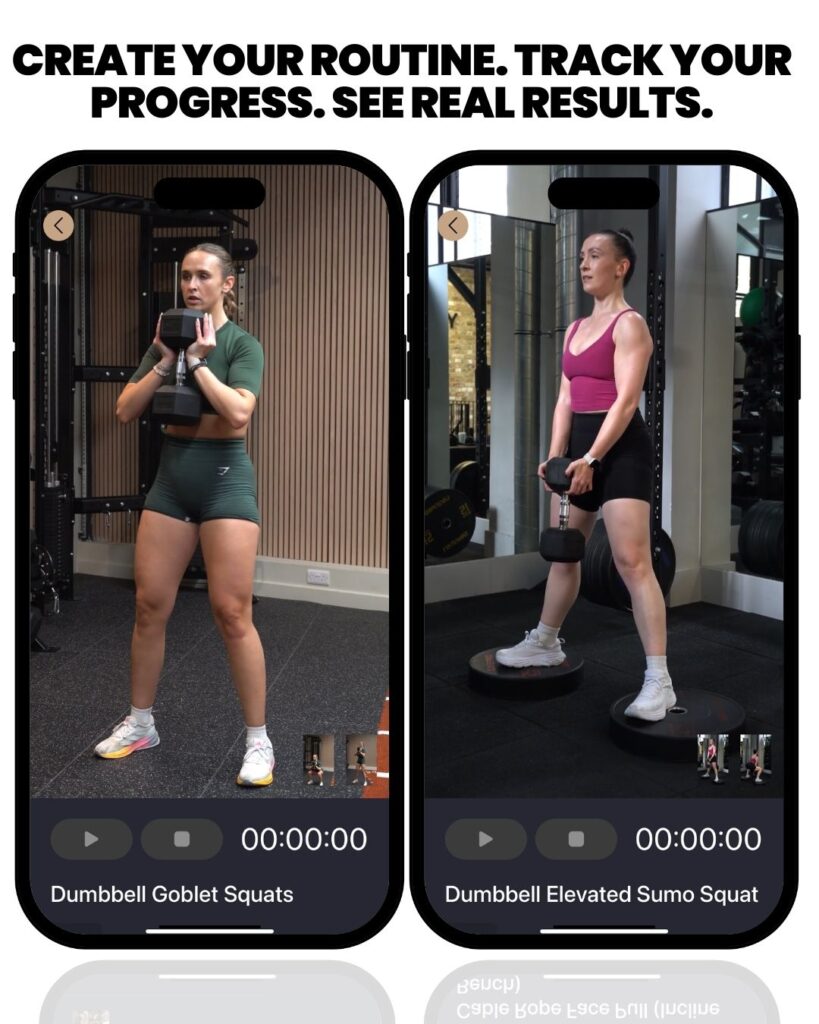
That last step is where a plan helps. 12REPS builds each workout around your goal, your equipment and your time. It shows a trainer demonstration for every exercise and remembers what you lifted, so you always have a number to beat.

Frequently asked questions
How long does it take to build muscle?
Strength often improves within weeks. Visible muscle change usually takes a few months of consistent training. For a realistic timeline, read how long it takes to build noticeable muscle.
Video: How long does it take to build muscle? A short answer to one of the most common questions new lifters ask.
Do I need to be sore to build muscle?
No. Soreness reflects muscle damage, and growth lines up better with muscle protein synthesis once damage has faded (Damas et al., 2016).
Do women build muscle the same way as men?
The same principles apply. A meta-analysis found similar muscle growth in men and women, and larger relative upper-body strength gains in women (Roberts et al., 2020). For a full plan, see the 12-week weight training routine for women.
Are heavy weights better than light weights?
For muscle size, both work when sets are hard. For maximal strength, heavier loads have the edge (Schoenfeld et al., 2017).
Sources
- The mechanisms of muscle hypertrophy and their application to resistance training. Schoenfeld BJ, Journal of Strength and Conditioning Research, 2010. https://doi.org/10.1519/JSC.0b013e3181e840f3
- Resistance training-induced changes in integrated myofibrillar protein synthesis are related to hypertrophy only after attenuation of muscle damage. Damas F et al., The Journal of Physiology, 2016. https://doi.org/10.1113/JP272472
- Neither load nor systemic hormones determine resistance training-mediated hypertrophy or strength gains in resistance-trained young men. Morton RW et al., Journal of Applied Physiology, 2016. https://doi.org/10.1152/japplphysiol.00154.2016
- Dose-response relationship between weekly resistance training volume and increases in muscle mass: a systematic review and meta-analysis. Schoenfeld BJ, Ogborn D, Krieger JW, Journal of Sports Sciences, 2017. https://doi.org/10.1080/02640414.2016.1210197
- Strength and hypertrophy adaptations between low- vs. high-load resistance training: a systematic review and meta-analysis. Schoenfeld BJ, Grgic J, Ogborn D, Krieger JW, Journal of Strength and Conditioning Research, 2017. https://pubmed.ncbi.nlm.nih.gov/28834797/
- Influence of resistance training proximity-to-failure on skeletal muscle hypertrophy: a systematic review with meta-analysis. Refalo MC et al., Sports Medicine, 2023. https://pubmed.ncbi.nlm.nih.gov/36334240/
- Progressive overload without progressing load? The effects of load or repetition progression on muscular adaptations. Plotkin D et al., PeerJ, 2022. https://peerj.com/articles/14142/
- Give it a rest: a systematic review with Bayesian meta-analysis on the effect of inter-set rest interval duration on muscle hypertrophy. Singer A et al., Frontiers in Sports and Active Living, 2024. https://doi.org/10.3389/fspor.2024.1429789
- A systematic review, meta-analysis and meta-regression of the effect of protein supplementation on resistance training-induced gains in muscle mass and strength in healthy adults. Morton RW et al., British Journal of Sports Medicine, 2018. https://doi.org/10.1136/bjsports-2017-097608
- Sex differences in resistance training: a systematic review and meta-analysis. Roberts BM, Nuckols G, Krieger JW, Journal of Strength and Conditioning Research, 2020. https://doi.org/10.1519/JSC.0000000000003521