



Training to failure means doing reps until you cannot complete another one with good form. You do not need to take every set to failure to build muscle or strength. Sets that stop 1 to 3 reps short build about as much muscle with less fatigue. Save failure for the last set of safer exercises, such as machines and curls.
In my coaching, two patterns come up again and again. Some people stop with five or six easy reps left. Others take every set to failure and feel flat by the end of the week.
This guide explains what the research says about training to failure, when it is worth doing, and how close to failure most of your sets should be.
What does training to failure mean?
There are two common definitions. Most coaches use the first one.
- Technical failure: you cannot do another rep without your form breaking down. For example, your hips shoot up in a squat or your back arches in a press.
- Momentary muscular failure: you try another rep and the weight does not move, even with a full effort.
Coaches describe how close you stop with reps in reserve (RIR). RIR is the number of good reps you could still have done when you racked the weight. Zero RIR is failure. Two RIR means you stopped with two good reps left. If you want to rate effort with a 1 to 10 scale instead, see RPE vs RIR.
Machines make failure easier to reach safely, because the path of the weight is fixed and you can stop without dropping a bar.

Does training to failure build more muscle?
Only a little, if at all. A 2023 meta-analysis of 15 studies found that going to failure gave at most a trivial extra gain in muscle size compared with stopping short. When the authors looked only at momentary muscular failure, it showed no clear advantage.
Effort still counts, though. Pooling many studies, a 2024 set of meta-regressions saw muscle size go up a little more the closer sets got to failure. The authors called this exploratory, because they had to estimate how many reps people had left in each study.
Put together, effort matters for muscle growth. But the last one or two reps of a set seem to add little. In a 2024 study of 18 trained men and women, one leg trained to failure and the other stopped with 1 to 2 reps in reserve. After eight weeks, both legs grew by almost the same amount.
One 2022 meta-analysis found no clear difference in muscle size overall. But in people with lifting experience, failure training gave a small extra gain. That is one more reason to use failure selectively rather than never.

Does training to failure make you stronger?
Not in a meaningful way. The same 2024 analysis saw almost no link between how close sets got to failure and how much stronger people became. The 2022 meta-analysis found no difference in strength between failure and non-failure training overall.
The 2026 American College of Sports Medicine (ACSM) position stand on resistance training reached a similar view. It concluded that taking sets to failure does not add to gains in strength, muscle size or power, so it is not needed for results. It still recommends training with high effort.
The cost of failure: more fatigue and slower recovery
Failure sets take more out of you. In a 2017 study of 10 trained men, three sets of 10 squats and bench presses taken to failure slowed recovery. The difference showed over the next 24 to 48 hours, compared with sessions that stopped short. Jump height took 72 hours to return to normal after the failure session, but only 6 hours after the others.
Fatigue also carries over within a workout. In the 2024 leg study, the leg trained to failure lost more reps and lifting speed across sets. If set one goes to failure, sets two and three usually suffer.
That matters if you train the same muscles two or three times a week. If Monday’s session leaves you drained on Wednesday, it is harder to add weight or reps. Our guide to how long to rest between sets covers how rest time affects your next set.

When training to failure makes sense
Failure is a tool. Use it where the payoff is highest and the risk to your technique is lowest.
- The last set of an exercise. You are finished with that movement, so the extra fatigue will not cost you later sets of it.
- Machines, cables and isolation exercises. Leg extensions, leg curls, biceps curls, lateral raises and machine presses are simple to control near failure.
- An occasional effort check. Many people guess they are close to failure when they still have several reps left. Once in a while, take the last set of a machine exercise to failure. It shows you what zero reps in reserve really feels like.
For example, if you do three sets of leg extensions, stop the first two sets with about two good reps left. Then take the last set to failure.
Video: Stronger legs and glutes, a guide to lower body strength training for women. Use it with the effort targets later in this article when you plan your leg sessions.
When to stop short of failure
Stop 2 to 3 reps short in these cases:
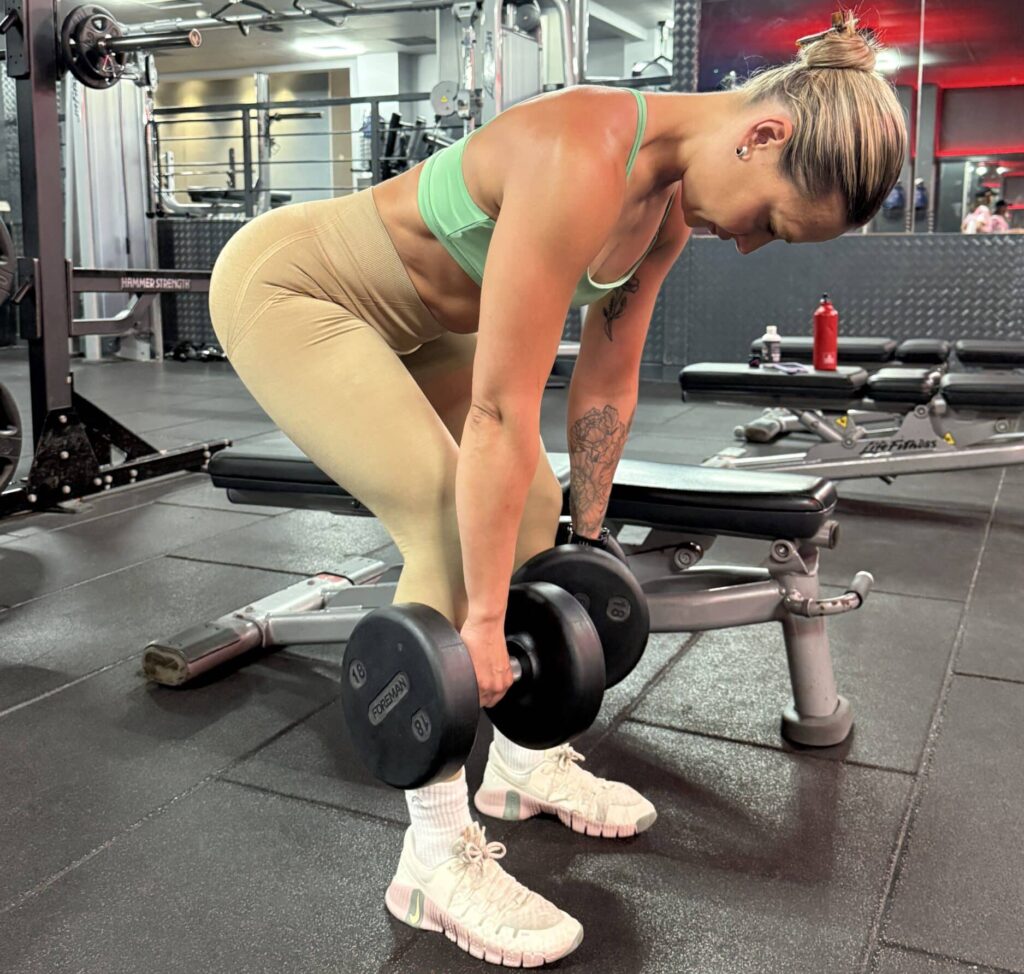
- Heavy free-weight lifts. In squats, deadlifts, Romanian deadlifts and overhead presses, form tends to slip on the last grinding reps. Stop while every rep still looks like your first.
- While you learn a lift. In your first months, good reps build the skill. Leave a few reps in the tank while the movement is new.
- When you train the same muscles again soon. Stopping short leaves you fresher for the next session.
- If you are an older adult. The ACSM position stand notes that lifting to failure may be inadvisable for some groups, such as older people.
Good technique is what lets you stop at the right moment. Our guide to good form vs lifting heavy shows what clean reps look like.
How close to failure should you train?
The ACSM position stand says there is not enough evidence to set exact reps-in-reserve targets. It mentions 2 to 3 reps in reserve as one way to reach enough effort. The ranges below are the ones I use when I program sessions. They fit the research above.
| Situation | Reps in reserve | What it feels like |
|---|---|---|
| Learning a new lift, first few months | 3 to 4 | Challenging, but reps stay smooth |
| Most working sets | 1 to 3 | Last reps slow down, form stays solid |
| Heavy squats, deadlifts and overhead presses | 2 to 3 | Hard, with no grinding reps |
| Last set of a machine or isolation exercise | 0 to 1 | You could not do another good rep |
As a rule of thumb, if you could do five or more extra reps, the set was too easy. Add weight or reps next time. Our article on how to know if you are training hard enough lists more signs to check.

Common mistakes with training to failure
Stopping far too early
Ending a set with five or more good reps left gives your muscles less reason to adapt. Pick a weight that makes the last few reps slow and hard.
Taking every set to failure
This piles up fatigue and can cut the reps you manage in later sets. Keep failure for the last set of one or two safer exercises per session.
Grinding ugly reps on heavy lifts
A rep where your knees cave or your back rounds is not a better rep. On big free-weight lifts, the set ends when your form changes.
Confusing the burn with failure
A burning feeling does not mean you are at failure. Many people still have several good reps left when the burn starts. Keep going until the reps slow down.
Video: Back workout with the 12REPS app. Follow the session and, after each set, ask yourself how many good reps you had left.

The bottom line
- Training to failure is not needed for most sets. Stopping 1 to 3 reps short builds about as much muscle and strength with less fatigue.
- Effort still matters. If you finish sets with five or more easy reps left, push harder.
- Use failure on the last set of machine, cable and isolation exercises.
- Stop heavy squats, deadlifts and overhead presses 2 to 3 reps short, while your form is still clean.
Planning when to push and when to hold back is part of a bigger picture. Pair this with a progressive overload plan, and take a deload week when fatigue builds up.
Knowing when to stop starts with good technique. 12REPS shows a trainer demonstration and technique breakdown for each exercise in your session. You log the reps and weight of every set, so you can see whether last week’s “hard” set really moved you forward.

Sources
- Resistance Training Prescription for Muscle Function, Hypertrophy, and Physical Performance in Healthy Adults: An Overview of Reviews (ACSM position stand). Currier BS, D’Souza AC, Fiatarone Singh MA, et al., American College of Sports Medicine. Medicine & Science in Sports & Exercise, 2026. https://doi.org/10.1249/MSS.0000000000003897
- Influence of Resistance Training Proximity-to-Failure on Skeletal Muscle Hypertrophy: A Systematic Review with Meta-analysis. Refalo MC, Helms ER, Trexler ET, Hamilton DL, Fyfe JJ. Sports Medicine, 2023. https://doi.org/10.1007/s40279-022-01784-y
- Exploring the Dose-Response Relationship Between Estimated Resistance Training Proximity to Failure, Strength Gain, and Muscle Hypertrophy: A Series of Meta-regressions. Robinson ZP, Pelland JC, Remmert JF, et al. Sports Medicine, 2024. https://doi.org/10.1007/s40279-024-02069-2
- Similar muscle hypertrophy following eight weeks of resistance training to momentary muscular failure or with repetitions-in-reserve in resistance-trained individuals. Refalo MC, Helms ER, Robinson ZP, Hamilton DL, Fyfe JJ. Journal of Sports Sciences, 2024. https://doi.org/10.1080/02640414.2024.2321021
- Effects of resistance training performed to repetition failure or non-failure on muscular strength and hypertrophy: A systematic review and meta-analysis. Grgic J, Schoenfeld BJ, Orazem J, Sabol F. Journal of Sport and Health Science, 2022. https://doi.org/10.1016/j.jshs.2021.01.007
- Time course of recovery following resistance training leading or not to failure. Moran-Navarro R, Perez CE, Mora-Rodriguez R, et al. European Journal of Applied Physiology, 2017. https://doi.org/10.1007/s00421-017-3725-7