

Written by Will Duru, BSc (Hons) Sport and Exercise Science, Level 3 Personal Trainer.
The best workout split for a busy schedule is the one that matches the number of days you can reliably train. With two or three days a week, a full-body split usually works best. With four days, try an upper/lower split. Push/pull/legs suits people who can train three to six days.
A workout split is how you divide your training across the week. Research suggests full-body and split routines build similar strength and muscle when weekly volume is the same (Ramos-Campo et al., 2024). So the right split depends mostly on your time, your routine and what you will stick with.
This guide shows you how to pick a split for your week and compares the three most common options. It also explains how to get more from each session when time is short.

Why Your Workout Split Matters When You Are Short on Time
Your split decides how often each muscle gets trained, how much work you do in each session and how well your plan copes with a missed day. When time is tight, these three things matter more than the exact exercises.
1. Training frequency
Frequency means how often you train a muscle group each week. The NHS advises strengthening activities that work all the major muscle groups on at least two days a week (NHS). The American College of Sports Medicine (ACSM) also recommends training each major muscle group at least twice a week (ACSM, 2026).
When weekly volume is matched, training a muscle more often does not seem to add much extra growth (Schoenfeld et al., 2019). Frequency is mainly a way to spread your work across the week. For more detail, read how often you should lift for muscle growth.
2. Volume and recovery
Volume is the total amount of work you do, often counted as hard sets per muscle per week. Recovery is how well your body bounces back between sessions.
A 2021 review on time-saving training concluded that weekly volume matters more than frequency. It suggested at least four weekly sets per muscle group (Iversen et al., 2021). A good split lets you reach your weekly sets without making any one session too long or too tiring.
3. Consistency over perfection
Meetings run late, children get sick and trains get delayed. A plan that needs five long sessions a week is easy to fall behind on. It’s better to do a good, shorter workout every week than a perfect, long one now and then.
For example, if you can reliably train on Monday and Thursday, a two-day full-body plan will serve you better than a four-day split you only finish half the time.
Start with an honest number: how many days a week can you train, even in a busy week? Then use this table as a starting point.
| Days you can train | Split to consider | Each muscle trained | If you miss a session |
|---|---|---|---|
| 2 | Full body | 2 times a week | Every muscle still gets one session |
| 3 | Full body, or push/pull/legs | 3 times a week (once with push/pull/legs) | Little impact with full body |
| 4 | Upper/lower | 2 times a week | Half your body trains once that week |
| 5 to 6 | Push/pull/legs | Up to 2 times a week | Harder to keep balanced |
1. Full-body split (2 to 3 days a week)
You train all major muscle groups in each session. This is often the best fit for beginners and for anyone with very little time. Even two sessions train every muscle twice a week.
Pros:
- High frequency: each muscle is trained two or three times a week.
- Fewer gym days: two or three sessions cover your whole body.
- Recovery: you do fewer sets per muscle in each session, so no single muscle is worn out.
- Flexible: if you miss a day, you train those muscles again in the next session.
Cons:
- Demanding sessions: working your whole body in one go can feel tiring.
- Less volume per muscle per session: you usually do fewer exercises for each muscle.
Sample structure (3 days a week):
- Monday: squats, bench press, rows, overhead press, biceps curls, triceps extensions
- Wednesday: deadlifts, pull-ups, dips, lunges, shoulder press, calf raises
- Friday: leg press, incline press, cable rows, lateral raises, plank
For the full case for this approach, read the benefits of full-body workouts. If two days is all you have, the 12-week 2-day gym workout split sets out a complete plan.
2. Upper/lower split (4 days a week)
You alternate upper-body and lower-body sessions, usually two of each per week. This gives you more time for each muscle in a session, while still training every muscle twice a week.
Pros:
- Good balance: you get both frequency and more volume per muscle group.
- More focused sessions: you can give more exercises and sets to your upper or lower body.
Cons:
- More days: you need to get to the gym four times a week.
- Less forgiving: missing one session means half your body only trains once that week.
Sample structure (4 days a week):
- Monday: Upper body (bench press, rows, overhead press, biceps curls, triceps pushdowns)
- Tuesday: Lower body (squats, Romanian deadlifts, leg press, hamstring curls, calf raises)
- Wednesday: Rest
- Thursday: Upper body (incline dumbbell press, pull-ups, lateral raises, face pulls, dips)
- Friday: Lower body (deadlifts, lunges, leg extensions, glute bridges)
- Saturday and Sunday: Rest
3. Push/pull/legs split (3 to 6 days a week)
You group workouts by movement: push (chest, shoulders, triceps), pull (back, biceps) and legs (quads, hamstrings, glutes, calves). Busy people often run it over three days, with each muscle trained once a week, or six days, with each muscle trained twice.
Pros:
- Logical grouping: muscles that work together are trained together.
- Room for volume: you can do more exercises and sets for each muscle group in a session.
- Recovery: each muscle gets a full week to recover on three days, or three to four days on six days.
Cons:
- Lower frequency on three days: each muscle is trained only once a week, below the usual twice-a-week guideline.
- Longer sessions: sessions can run long if you add lots of exercises.
- Big commitment on six days: a six-day plan is hard to keep up when life gets busy.
Sample structure (3 days a week):
- Monday: Push (bench press, overhead press, dumbbell flyes, triceps pushdowns)
- Wednesday: Pull (deadlifts, pull-ups, barbell rows, biceps curls, face pulls)
- Friday: Legs (squats, leg press, hamstring curls, leg extensions, calf raises)
Sample structure (6 days a week): Monday push, Tuesday pull, Wednesday legs, Thursday push, Friday pull, Saturday legs, Sunday rest.
If you train three days a week and want a ready-made plan, see the 3-day gym workout split.
Whichever split you choose, the key is a schedule you can repeat week after week.

How 12REPS Fits Training Around Your Week
Once you know how many days you can train, the next question is what to do in each session. That is the gap 12REPS is built to fill.
- A plan built around your time: your training is built around your goal, your equipment and the time you have. Open the app and your workout is ready, for example Chest & Back, 60 minutes, six exercises.
- Build your own session: on a short day, use the body map to choose the muscle, the equipment and the time you have, and 12REPS builds the session.
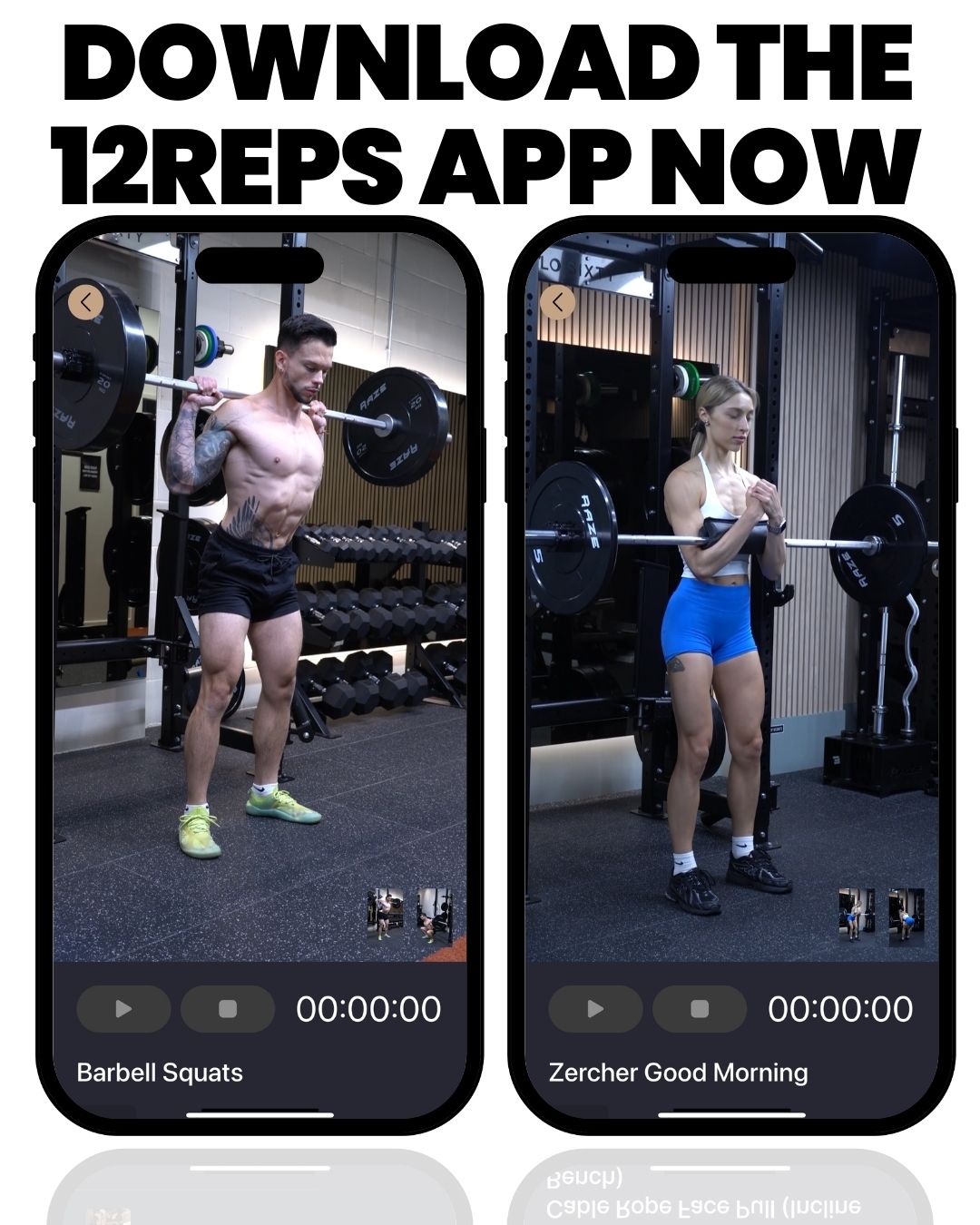
- Trainer demonstrations: every exercise comes with a demonstration and technique breakdown from qualified personal trainers.
- A number to beat: you enter your reps and weight for each set, and the app remembers what you lifted. That makes progressive overload (adding a little weight or a few reps over time) simple to track.
- Accountability: set a weekly goal and track your workouts, streaks and challenges, so one busy week does not turn into a missed month.

How to Get More From Each Session
Choosing a split is the first step. These habits help you get the most from the time you do have, whatever split you follow.
1. Start with compound lifts
Compound lifts work several joints and muscle groups at once, for example squats, deadlifts, bench press, overhead press and rows. The 2021 review on time-saving training recommends prioritizing multi-joint exercises. It suggests at least one leg-pressing, one upper-body pulling and one upper-body pushing exercise (Iversen et al., 2021). Do these first, while you are fresh. Our guide to compound lifts and how to do them covers the main ones.
2. Use supersets where they fit
A superset means doing two exercises back to back with little rest in between. Pairing exercises for different muscles, such as a chest press with a row, saves time. The same review found that supersets and similar methods can roughly halve session time while keeping the same volume. They appear better suited to muscle growth than to maximal strength. Avoid pairing two heavy lifts that tire the same muscles. Read more in the guide to supersets.
3. Keep rest periods purposeful
Rest long enough to perform well, but don’t let rest drift into phone time. For muscle growth, a 2024 meta-analysis found a small benefit to resting longer than 60 seconds. It found no clear extra gain beyond about 90 seconds (Singer et al., 2024). For heavy compound lifts, longer rests help. In one study of trained men, 3-minute rests led to greater strength gains than 1-minute rests (Schoenfeld et al., 2016). A simple timer keeps you on track.
4. Put form before weight
Lift a weight you can control through the full range of motion. Add load only when your technique stays the same from the first rep to the last. A lighter weight with good form keeps the work on the muscles you want to train.
5. Keep your warm-up short and specific
Don’t skip your warm-up, but keep it focused. A few minutes of light movement and some lighter sets of your first exercise usually do the job. The 2021 review suggests limiting warm-ups to exercise-specific movements, and saving longer stretching for when flexibility is a goal. See why warm-up sets matter for how to build them.
Choosing Your Split: The Short Version
- 2 days a week: full body.
- 3 days a week: full body, or push/pull/legs if you prefer focused sessions.
- 4 days a week: upper/lower.
- 5 to 6 days a week: push/pull/legs.
Full-body and split routines give similar results when weekly volume is matched. So choose the one that fits your calendar, and change it when your schedule changes.
If you want sessions that fit the time you have, 12REPS builds your plan around your goal, your equipment and your schedule, with a trainer demonstration for every exercise.
Sources
- Efficacy of Split Versus Full-Body Resistance Training on Strength and Muscle Growth: A Systematic Review With Meta-Analysis. Journal of Strength and Conditioning Research, 2024. https://pubmed.ncbi.nlm.nih.gov/38595233/
- How many times per week should a muscle be trained to maximize muscle hypertrophy? A systematic review and meta-analysis of studies examining the effects of resistance training frequency. Journal of Sports Sciences, 2019. https://lida.sport-iat.de/ta/Record/4052540?lng=en
- No Time to Lift? Designing Time-Efficient Training Programs for Strength and Hypertrophy: A Narrative Review. Sports Medicine, 2021. https://lida.sport-iat.de/ta/Record/4073965
- Physical activity guidelines for adults aged 19 to 64. NHS, 2024. https://www.nhs.uk/live-well/exercise/physical-activity-guidelines-for-adults-aged-19-to-64/
- 5 Things to Know About Creating an Effective Resistance Training Plan (ACSM position stand infographic). American College of Sports Medicine, 2026. https://acsm.org/wp-content/uploads/2026/03/Resistance-Training-Position-Stand-infographic.pdf
- Give it a rest: a systematic review with Bayesian meta-analysis on the effect of inter-set rest interval duration on muscle hypertrophy. Frontiers in Sports and Active Living, 2024. https://www.frontiersin.org/articles/10.3389/fspor.2024.1429789/full
- Longer Interset Rest Periods Enhance Muscle Strength and Hypertrophy in Resistance-Trained Men. Journal of Strength and Conditioning Research, 2016. https://www.pubmed.gov/26605807/