

The best leg exercises for strength cover each main lower-body movement: a squat, a single-leg squat, a hip thrust, a lunge and a hip hinge. These five exercises train your quads, glutes, hamstrings and inner thighs from different angles. Do them two to three times a week and add weight gradually to build strength and muscle.
Strong legs help with everyday tasks like climbing stairs, carrying shopping and getting up from the floor. They also give you a solid base for most other lifts. The NHS recommends strengthening activities that work all major muscle groups, including your legs and hips, on at least 2 days a week.
Your leg muscles at a glance
- Quadriceps (quads): the front of your thigh. They straighten your knee.
- Hamstrings: the back of your thigh. They bend your knee and help extend your hip.
- Glutes: your buttock muscles. They extend your hip, for example when you stand up from a squat.
- Adductors: your inner thigh. They pull your legs together and help in squats and lunges.
A balanced routine includes knee-dominant exercises, like squats and lunges, and hip-dominant exercises, like hip thrusts and Romanian deadlifts. The five below cover both.
5 leg exercises for strength and muscle
1. Barbell squat
Why: The squat trains your quads, glutes and adductors together and lets you lift heavy loads. In a 2023 training study, squats built more quad and inner-thigh muscle than hip thrusts did.
How to do it:
- Set the bar in a rack at about chest height. Step under it and rest it across your upper back, not your neck.
- Grip the bar a little wider than your shoulders. Stand up to lift it off the rack and take a step or two back.
- Place your feet about shoulder-width apart, toes turned out slightly.
- Brace your core, keep your chest up and bend your knees and hips to sit down between your heels.
- Lower until your thighs are about parallel to the floor, or as deep as you can go with a neutral back and heels down.
- Push through your whole foot to stand back up.
Sets and reps: 4 working sets, starting at 10 reps and working down to 6, adding weight as the reps drop.
Watch the demonstration on the barbell squat exercise page.
2. Bulgarian split squat
Why: This single-leg exercise trains the quads and glutes of your front leg and challenges your balance. Working one leg at a time also shows you if one side is weaker.
A 2016 study in academy rugby players compared rear-foot elevated split squats with back squats. Over 5 weeks, both groups improved squat strength, 40-meter sprint times and agility by similar amounts.
How to do it:
- Stand about two feet in front of a bench, holding a dumbbell in each hand.
- Place the top of one foot on the bench behind you.
- Bend your front knee to lower your body until your front thigh is about parallel to the floor.
- Push through your front foot to stand back up. Finish all reps, then switch legs.
Sets and reps: 4 sets of 12 reps per leg, adding weight as you get stronger.
Learn the movement first with the bodyweight Bulgarian split squat.
3. Barbell hip thrust
Why: The hip thrust trains your glutes hard at the top of the movement, with help from your hamstrings. The 2023 study found hip thrusts and squats built similar glute muscle in beginners.
Each exercise mainly improved its own strength. The hip thrust group got better at hip thrusts, and the squat group got better at squats. So both have a place in a leg routine.
How to do it:
- Sit on the floor with your upper back against a bench and a padded barbell across your hips.
- Place your feet flat on the floor, about shoulder-width apart, with your knees bent.
- Drive through your heels to lift your hips until your body forms a straight line from shoulders to knees.
- Squeeze your glutes at the top, then lower with control.
Sets and reps: 4 sets of 12 reps, adding weight as you get stronger.
New to hip thrusts? Start with the bodyweight hip thrust.
4. Walking lunges
Why: Walking lunges train your quads and glutes one leg at a time while you move forward. They also test your balance and coordination.
How to do it:
- Stand tall with a dumbbell in each hand.
- Step forward with your right foot. Lower until your right thigh is about parallel to the floor and your left knee is just above the ground.
- Push through your right foot to stand, then step forward with your left foot.
- Keep alternating legs as you walk.
Sets and reps: 4 sets, starting at 20 reps per leg and working down to 12, adding weight as the reps drop.
Prefer a kettlebell? See the kettlebell walking lunge.
5. Barbell Romanian deadlift (RDL)
Why: The RDL is a hip hinge, which means you bend mainly at your hips, not your knees. It trains your hamstrings and glutes and gives the back of your thighs a long stretch under load.
How to do it:
- Stand with your feet hip-width apart, holding a barbell in front of your thighs with an overhand grip.
- Keep a slight bend in your knees. Push your hips back and slide the bar down your thighs.
- Keep the bar close to your legs and your back neutral.
- Stop when you feel a strong stretch in your hamstrings, then drive your hips forward to stand tall.
Sets and reps: 4 sets, starting at 12 reps and working down to 8, adding weight as the reps drop.
No barbell free? The cable straight bar Romanian deadlift trains the same movement.
How to add these leg exercises to your week
You can do all five in one leg session, in the order above. Start with the squat while you are fresh, because it is usually the heaviest lift. Warm up with light sets first, as our guide to warming up before strength training explains.
Aim to train your legs 2 to 3 times a week. A 2016 meta-analysis found that training a muscle twice a week led to more growth than once a week. If five exercises feel like too much for one session, split them across two days:
| Day | Exercises |
|---|---|
| Leg day A | Barbell squat, barbell hip thrust, walking lunges. |
| Leg day B | Romanian deadlift, Bulgarian split squat. |
Start with lighter weights while you learn good form. Then add weight or reps a little at a time. This is called progressive overload, and our beginner’s guide to progressive overload shows you how to do it.
Common mistakes to avoid
- Cutting depth short: lower only as far as you can control, and work toward a fuller range of motion over time.
- Rounding your back in the RDL: stop lowering the bar as soon as your back starts to round.
- Lifting your heels: keep your whole foot on the floor in squats and lunges.
- Adding weight too fast: go heavier only when every rep looks the same.
If calf or hamstring cramps interrupt your leg day, read our guide to what causes leg cramps and how to get rid of them.
Build your leg day with 12REPS
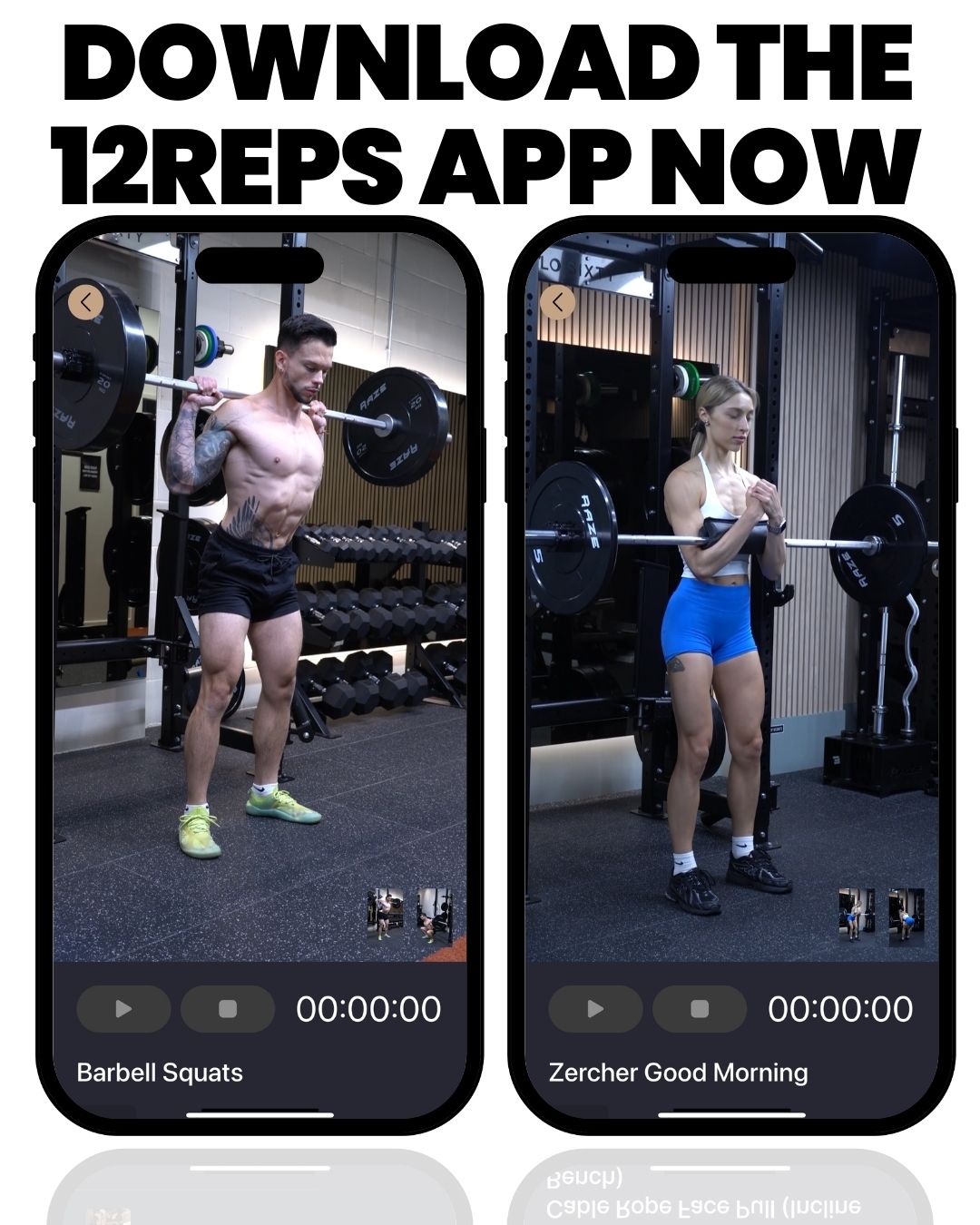
Want each leg session set out for you? 12REPS builds your plan around your goal, the equipment you have and the time you’ve got. Every exercise comes with a trainer demonstration, and the app remembers your weights, so you always have a number to beat.
Sources
- Physical activity guidelines for adults aged 19 to 64. NHS, accessed 2026. https://www.nhs.uk/live-well/exercise/physical-activity-guidelines-for-adults-aged-19-to-64/
- Plotkin DL, et al. Hip thrust and back squat training elicit similar gluteus muscle hypertrophy and transfer similarly to the deadlift. Frontiers in Physiology, 2023. https://www.frontiersin.org/journals/physiology/articles/10.3389/fphys.2023.1279170/full
- Speirs DE, et al. Unilateral vs. Bilateral Squat Training for Strength, Sprints, and Agility in Academy Rugby Players. Journal of Strength and Conditioning Research, 2016. https://read.qxmd.com/read/26200193/unilateral-vs-bilateral-squat-training-for-strength-sprints-and-agility-in-academy-rugby-players
- Schoenfeld BJ, et al. Effects of Resistance Training Frequency on Measures of Muscle Hypertrophy: A Systematic Review and Meta-Analysis. Sports Medicine, 2016. https://pubmed.ncbi.nlm.nih.gov/27102172/