

By Will Duru, BSc (Hons) Sport and Exercise Science, Award-winning Personal Trainer with over 10 years of experience in strength training and optimising recovery
This 12-week push pull legs plan gives you three gym workouts a week: a push day, a pull day, and a legs and core day. It runs in three 4-week phases. You keep the same exercises and 4 sets of 10 to 12 reps, and each phase gets harder through heavier weights, longer rests and tougher exercise versions.
I’ve been helping people get stronger for over 10 years. This plan uses dumbbells, machines, kettlebells and a TRX suspension trainer, so it suits most commercial gyms. It is a good fit if you know the basic lifts and want a clear structure to follow.
If you have a health condition or an injury, or take regular medication, check with your doctor before starting a new training plan.

Why follow a 12-week strength plan?
The World Health Organization recommends muscle-strengthening activities for all major muscle groups on 2 or more days a week (WHO guidelines, 2020). This plan gives you strength training on three days a week. Each day trains different muscles, so most muscle groups get their main work once a week (more on that below).
A review of cohort studies linked muscle-strengthening activities with a 10 to 17% lower risk of early death, heart disease, cancer and diabetes. For early death, heart disease and cancer, the biggest drop was at around 30 to 60 minutes a week (Momma et al., 2022). These studies show an association, not proof of cause, but the pattern is encouraging.
A fixed plan also takes the guesswork out of training. You know what to do each day, and you can see your numbers move from week to week.
Twelve weeks is long enough to learn the lifts, build a habit and notice real changes in strength. It is also short enough to stay focused.

Strength training and body composition
Strength training builds and keeps muscle. That matters for how you look and how you move. One review reported what 10 weeks of resistance training may do. Lean weight went up by about 1.4 kg, resting metabolic rate rose by about 7%, and fat weight fell by about 1.8 kg (Westcott, 2012).
Results like these vary a lot between people. If fat loss is your goal, what you eat still matters most. Strength training helps you keep muscle while you eat a little less, and cardio can sit alongside it. It doesn’t have to be one or the other.

How the 12-week push/pull/legs plan works
Push/pull/legs, often shortened to PPL, splits your training by movement:
- Push day: chest, shoulders and triceps, with presses and extensions.
- Pull day: back, biceps and rear shoulders, with rows, pulldowns and curls.
- Legs and core day: quads, hamstrings, glutes and calves, plus core work.
The 12 weeks are split into three phases:
- Phase 1, weeks 1 to 4 (Foundation): learn every exercise with lighter weights and shorter rests.
- Phase 2, weeks 5 to 8 (Strength building): heavier weights, longer rests and harder versions of the bodyweight moves.
- Phase 3, weeks 9 to 12 (Peak): the heaviest weights of the plan, with the longest rests.

Is a 3-day push/pull/legs split right for you?
A 3-day PPL is simple to follow and fits a busy week. The trade-off is frequency. Each muscle group gets its main work once a week.
A meta-analysis found that training a muscle group at least twice a week tends to build more muscle than once a week (Schoenfeld et al., 2016). In this plan, some muscles get extra work on other days. For example, your shoulders work on push day and your rear shoulders on pull day.
If you can train more often, you could run the cycle twice a week, or choose a different split. This guide compares the options: upper/lower vs push/pull/legs vs full body.

How to choose your starting weights
The tables show a weight range for each exercise, in pounds (1 kg is about 2.2 lb). Treat these as starting guides, not targets. Everyone’s starting point is different.
- Start at the lighter end of the range in week 1.
- Pick a weight you can lift for 10 to 12 reps with good form. The last rep or two of each set should feel hard.
- If you can’t reach 10 reps, go lighter. If 12 reps feel easy on every set, go heavier next session.
- If a range feels far too heavy or light for you, ignore it and use your own number.
Warm up before each session with some light cardio and lighter sets of your first exercise.
Your weekly schedule
Train three times a week, with at least one rest day between sessions. Each workout takes about 45 to 60 minutes.
| Day | Session |
|---|---|
| Monday | Push day |
| Tuesday | Rest or light activity |
| Wednesday | Pull day |
| Thursday | Rest or light activity |
| Friday | Legs and core day |
| Weekend | Rest or light activity |
Any three days work, as long as you leave a rest day between them.

The complete 12-week push/pull/legs program
How to read the tables: do 4 sets of 10 to 12 reps for every exercise unless the table says otherwise. “Each” means each dumbbell, arm or leg. Each phase column shows the weight range and the rest between sets.
Increase the weight only when you complete every set and rep with good form. Stay with the same weight until you do.

Push day: chest, shoulders, triceps and core
| Exercise | Equipment | Weeks 1-4 | Weeks 5-8 | Weeks 9-12 |
|---|---|---|---|---|
| Dumbbell bench press | Dumbbells | 15-30 lb each, rest 90 s | 20-40 lb each, rest 2 min | 25-50 lb each, rest 2-3 min |
| Dumbbell shoulder press | Dumbbells | 10-20 lb each, rest 90 s | 15-25 lb each, rest 2 min | 20-35 lb each, rest 2-3 min |
| Chest press machine | Machine | 40-80 lb, rest 90 s | 60-120 lb, rest 2 min | 80-150 lb, rest 2-3 min |
| Dumbbell lateral raise | Dumbbells | 5-15 lb each, rest 60 s | 8-20 lb each, rest 90 s | 10-25 lb each, rest 2 min |
| TRX chest press | TRX | Bodyweight, rest 60 s | Decline version, rest 90 s | Single-arm version, 10-12 each arm, rest 2 min |
| Dumbbell triceps extension | Dumbbells | 8-15 lb each, rest 60 s | 12-20 lb each, rest 90 s | 15-25 lb each, rest 2 min |
| Kettlebell overhead press | Kettlebell | 15-35 lb, rest 90 s | 25-45 lb, rest 2 min | 35-55 lb, rest 2-3 min |
| Core | Bodyweight | Plank hold, 4 x 30-60 s, rest 60 s | Plank to push-up, 4 x 10-12, rest 90 s | Plank to push-up with weight vest, rest 2 min |
Want a single push-style session to try first? The chest and biceps workout uses barbell and cable presses.
Pull day: back, biceps, rear shoulders and core
| Exercise | Equipment | Weeks 1-4 | Weeks 5-8 | Weeks 9-12 |
|---|---|---|---|---|
| Lat pulldown machine | Machine | 50-90 lb, rest 90 s | 70-120 lb, rest 2 min | 90-150 lb, rest 2-3 min |
| Dumbbell bent-over row | Dumbbells | 15-30 lb each, rest 90 s | 20-40 lb each, rest 2 min | 25-50 lb each, rest 2-3 min |
| TRX inverted row | TRX | Bodyweight, rest 60 s | Feet elevated, rest 90 s | Single-arm version, 10-12 each arm, rest 2 min |
| Dumbbell biceps curl | Dumbbells | 8-20 lb each, rest 60 s | 12-25 lb each, rest 90 s | 15-30 lb each, rest 2 min |
| Cable or machine seated row | Machine | 40-80 lb, rest 90 s | 60-100 lb, rest 2 min | 80-130 lb, rest 2-3 min |
| Dumbbell reverse fly | Dumbbells | 5-12 lb each, rest 60 s | 8-15 lb each, rest 90 s | 10-20 lb each, rest 2 min |
| Kettlebell high pull | Kettlebell | 20-40 lb, rest 90 s | 30-50 lb, rest 2 min | 40-65 lb, rest 2-3 min |
| Russian twist, 10-12 each side | Kettlebell | 10-25 lb, rest 60 s | 15-35 lb, rest 90 s | 20-45 lb, rest 2 min |
Legs and core day: quads, hamstrings, glutes, calves and core
| Exercise | Equipment | Weeks 1-4 | Weeks 5-8 | Weeks 9-12 |
|---|---|---|---|---|
| Dumbbell goblet squat | Dumbbell | 25-50 lb, rest 90 s | 35-65 lb, rest 2 min | 45-80 lb, rest 2-3 min |
| Leg press machine | Machine | 100-200 lb, rest 90 s | 150-300 lb, rest 2 min | 200-400 lb, rest 2-3 min |
| Dumbbell Romanian deadlift | Dumbbells | 20-40 lb each, rest 90 s | 30-50 lb each, rest 2 min | 40-65 lb each, rest 2-3 min |
| TRX pistol squat, 10-12 each leg | TRX | Assisted, bodyweight, rest 60 s | Bodyweight, rest 90 s | Weighted, rest 2 min |
| Kettlebell swing | Kettlebell | 25-50 lb, rest 60 s | 35-65 lb, rest 90 s | 45-80 lb, rest 2 min |
| Dumbbell walking lunge, 10-12 each leg | Dumbbells | 10-25 lb each, rest 90 s | 15-35 lb each, rest 2 min | 20-45 lb each, rest 2-3 min |
| Calf raise machine | Machine | 80-150 lb, rest 60 s | 120-200 lb, rest 90 s | 150-250 lb, rest 2 min |
| TRX mountain climbers, 10-12 each leg | TRX | Bodyweight, rest 60 s | Bodyweight, rest 90 s | Bodyweight plus weight vest, rest 2 min |
Kettlebell swings are a hip hinge, not a squat. If they are new to you, learn the pattern first with this guide on how to do a kettlebell swing.
How to progress through the phases
Progressive overload means making your training a little harder over time. This plan builds it in. The sets and reps stay the same, while the weights go up and the bodyweight moves get harder.
- Within a phase: add a rep, or a little weight, when you complete all 4 sets of 12 with good form. The ACSM suggests raising the load by 2 to 10% once you can do one or two reps more than your target (ACSM position stand, 2009).
- Between phases: move into the next weight range only if you are ready. It is fine to repeat a phase.
- Rest: rest periods get longer as the weights rise. In one study of trained men, 3-minute rests led to bigger strength gains than 1-minute rests (Schoenfeld et al., 2016).
Track every set. Write down the weight and reps so you know what to beat next session.
Video: Why you’re not gaining muscle. If your progress stalls on a push/pull/legs plan, this 12REPS video covers common reasons.
What to expect over 12 weeks
Most people find their lifts go up in the first few weeks as they learn the movements. Visible changes in muscle usually take longer. How fast they come depends on your starting point, your sleep, what you eat and how consistent you are.
Judge progress by your training log as well as the mirror. If the numbers are moving up, the plan is working.
Video: How long does it take to build muscle. This short 12REPS video covers how long building muscle usually takes.
After week 12
Take an easier week, then start a new 12-week block. You can repeat this plan with heavier starting weights, or try a different split. The habits you build here, such as showing up, tracking and progressing, carry over to any plan.

Single sessions to try
Want to try one workout before starting the full plan? These 12REPS sessions use a similar style:
- Dumbbell shoulder and back workout: a push/pull upper-body session with dumbbells.
- Lower body strength workout: squats, lunges, RDLs, step-ups and hip thrusts.
- Legs and pull workout: leg work plus rows, pull-ups and pulldowns.
Follow this plan with 12REPS
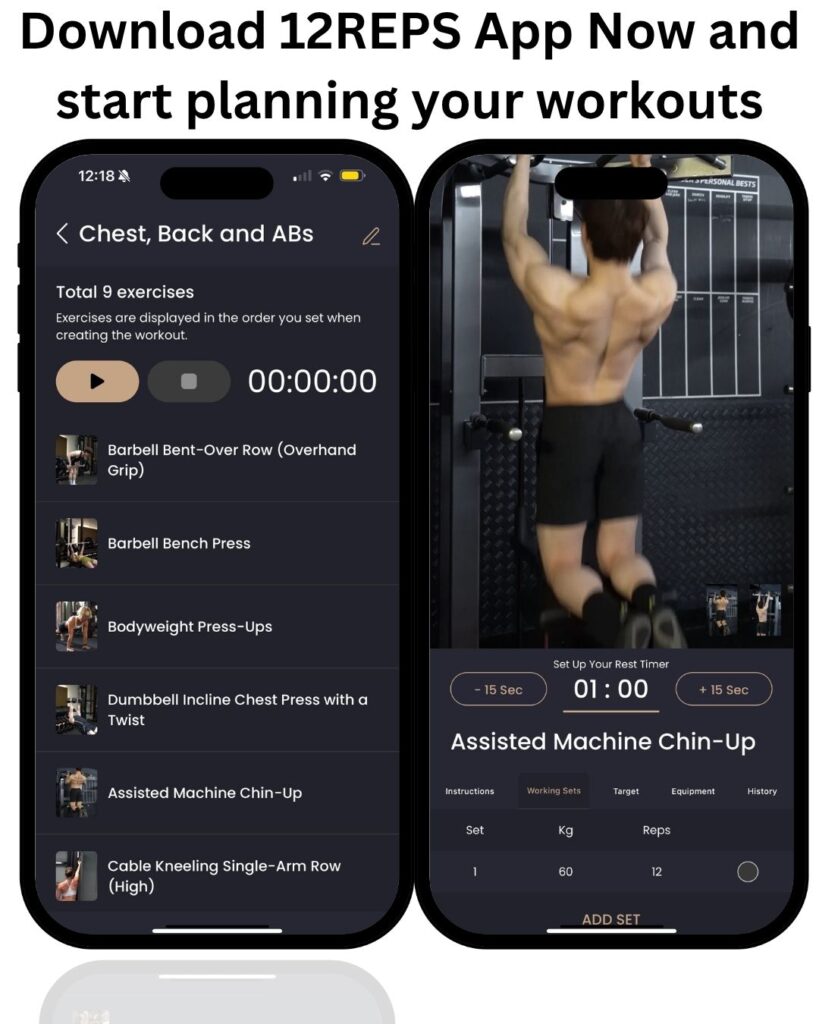
If you’d like your training set out for you, 12REPS builds a plan around your goal, the equipment you have and your time. Open the app and your workout is ready. Each exercise has a demonstration from a qualified personal trainer, and the app remembers what you lifted, so you have a number to beat. You can also track streaks and set a weekly goal. See how the 12REPS app works.
12-week push/pull/legs plan FAQs
Is this plan good for beginners?
It suits beginners who know the basic lifts and have gym access. If you are brand new, start at the lightest end of each range, or repeat Phase 1 before moving on.
Can I do this plan with dumbbells only?
Partly. You can swap the machines for dumbbell versions, such as dumbbell rows for seated rows. The TRX and kettlebell exercises need that equipment or a suitable swap.
What if I miss a workout?
Do the next session in order when you are back. Don’t try to fit two sessions into one day.
Sources
- WHO Guidelines on Physical Activity and Sedentary Behaviour. World Health Organization, 2020. https://www.who.int/publications/i/item/9789240015128
- Muscle-strengthening activities are associated with lower risk and mortality in major non-communicable diseases: a systematic review and meta-analysis of cohort studies. Momma H, Kawakami R, Honda T, Sawada SS. British Journal of Sports Medicine, 2022. https://bjsm.bmj.com/content/56/13/755
- Resistance training is medicine: effects of strength training on health. Westcott WL. Current Sports Medicine Reports, 2012. https://pubmed.ncbi.nlm.nih.gov/22777332/
- Effects of Resistance Training Frequency on Measures of Muscle Hypertrophy: A Systematic Review and Meta-Analysis. Schoenfeld BJ, Ogborn D, Krieger JW. Sports Medicine, 2016. https://pubmed.ncbi.nlm.nih.gov/27102172/
- Progression models in resistance training for healthy adults (position stand). American College of Sports Medicine. Medicine & Science in Sports & Exercise, 2009. https://pubmed.ncbi.nlm.nih.gov/19204579/
- Longer Interset Rest Periods Enhance Muscle Strength and Hypertrophy in Resistance-Trained Men. Schoenfeld BJ, et al. Journal of Strength and Conditioning Research, 2016. https://pubmed.ncbi.nlm.nih.gov/26605807/