


To build muscle as a skinny guy, eat a little more than your body burns each day and get enough protein. Then follow a simple strength plan that adds weight or reps over time. Expect steady gains over months, not weeks. Many slim men who say they can’t gain are not yet eating as much as they think.
I’m Will Duru, a personal trainer with over 10 years’ experience in London. Slim guys often tell me they “eat loads” but never gain.
This guide is the long-term plan: how to eat enough, a 3-day push/pull/legs program and what to expect over a year. If you want a structured first month, start with our 30-day gym challenge for skinny guys.
If you are underweight, have lost weight without trying or use food to cope with feelings, speak to your doctor first. The NHS notes that sudden or unexplained weight loss could be a sign of an underlying health condition.
Why you are not gaining weight
You eat less than you think
A few big meals feel like a lot of food. But skipped breakfasts, busy days and small dinners pull your weekly average down. If your body weight has not changed in a month, you are eating about what you burn, however much it feels like.
Your body may burn more when you eat more
Some people move more without noticing when they overeat: fidgeting, standing and walking more. This is called non-exercise activity thermogenesis (NEAT). The ISSN position stand on diets notes that rising NEAT can offset a planned calorie surplus, so some people struggle to gain even when they eat more.
A small appetite
Many slim men feel full soon after starting a meal and rarely feel hungry. Three big plates a day can feel like a chore. Smaller, more frequent meals and calorie-dense foods help, as you will see below.
No plan in the gym
Random workouts at the same weights give your muscles no new reason to grow. Progressive overload, doing a little more over time, is what drives change. See why you are not gaining muscle for the training side in detail.
How to eat enough to build muscle
Step 1: Find your starting point
Write down everything you eat and drink for two weeks, and weigh yourself a few mornings each week. If your average weight stays flat, that intake is roughly your maintenance. Our guide to how many calories to eat to build muscle shows how to estimate and check it.
Step 2: Add a little more
The NHS suggests that adults who want to gain weight add around 300 to 500 calories a day, gradually. Check your weight trend every two to four weeks. If it has not moved, add a little more.
The ISSN notes that people new to training can often gain lean mass on a larger surplus than experienced lifters, who may gain more fat if they overdo it.
Step 3: Hit your protein every day
The ISSN protein position stand recommends 1.4 to 2.0 g of protein per kg of body weight a day for most people who exercise. It suggests spreading it over the day, with about 20 to 40 g every 3 to 4 hours.
For a 65 kg man, that is about 90 to 130 g a day. Good sources include eggs, milk, Greek yogurt, fish, chicken, lean meat, beans and lentils. See our protein guide for more.
Step 4: Make eating easier
- Eat little and often. The NHS suggests smaller meals more often, with snacks in between.
- Add calorie-dense foods. Cheese, nuts, seeds, nut butters, olive oil, oats and dried fruit add energy without much extra bulk on the plate.
- Drink some calories. The NHS suggests high-calorie drinks, such as milkshakes, between meals. A homemade shake is easy: whole milk, oats, a banana and peanut butter, blended.
- Do not rely on junk. The NHS advises against relying on chocolate, cakes and sugary drinks to gain weight.
- Do not fill up on drinks before meals. Have them between meals instead.
You do not need mass gainers or other supplements to build muscle. Normal food can cover your needs. If you are curious, read do you need supplements for strength training?
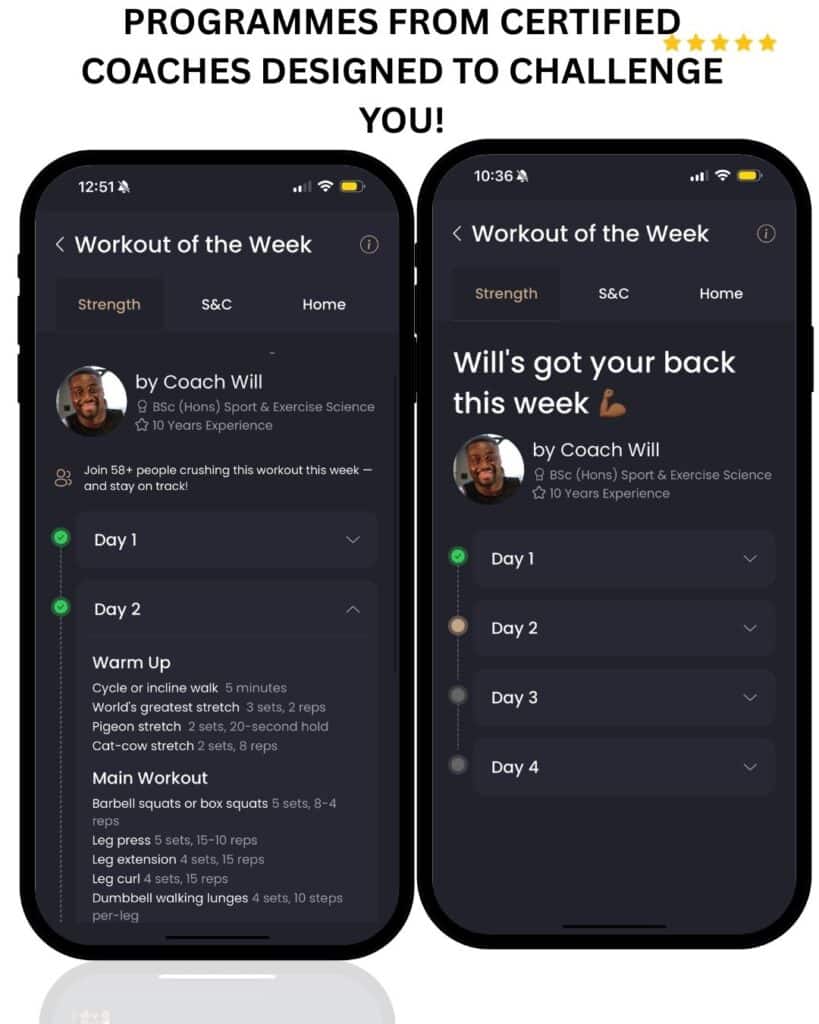
The 3-day push/pull/legs plan
Train three days a week with a rest day between sessions, for example Monday, Wednesday and Friday. Each workout trains one group of muscles:
- Push: chest, shoulders and triceps.
- Pull: back, biceps and rear shoulders.
- Legs: quads, glutes, hamstrings and calves.
This plan trains each muscle hard once a week, which fits a busy week. A meta-analysis on training frequency found that training a muscle twice a week led to more growth than once. So when you can train more often, move to a version that hits each muscle twice. Our split guide compares the options.
Day 1: Push
| Exercise | Sets | Reps | Rest |
|---|---|---|---|
| Barbell bench press | 4 | 6 to 8 | 3 min |
| Incline dumbbell press | 3 | 8 to 10 | 2.5 min |
| Machine or dumbbell shoulder press | 3 | 8 to 10 | 2 min |
| Dips (bars or TRX) | 3 | 6 to 12 | 2 min |
| Dumbbell or kettlebell lateral raise | 3 | 12 to 15 | 90 sec |
| Cable or machine triceps extension | 3 | 10 to 12 | 90 sec |
Touch the bar to your lower chest with your elbows about 45 degrees from your body. On dips, lean forward slightly and only go as deep as feels comfortable. For more on each muscle, see our guides to a bigger chest, broad shoulders and bigger arms.
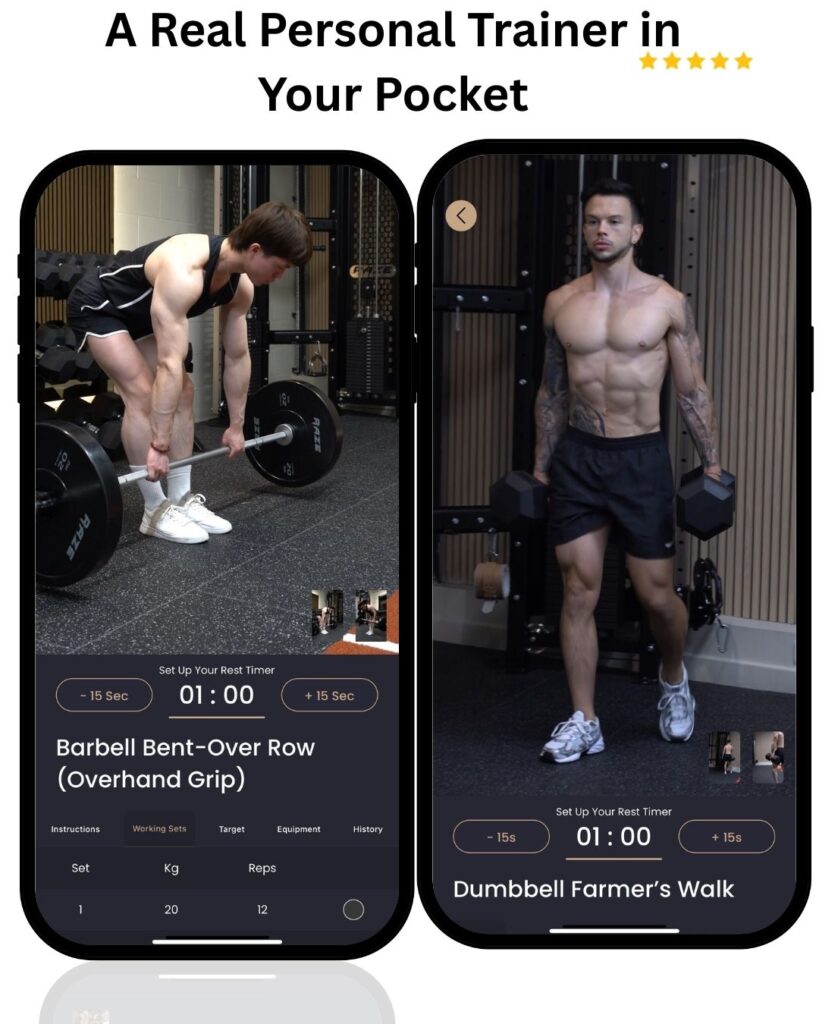
Day 2: Pull
| Exercise | Sets | Reps | Rest |
|---|---|---|---|
| Barbell or trap bar deadlift | 4 | 5 to 8 | 3 to 4 min |
| Barbell or dumbbell row | 4 | 8 to 10 | 2.5 min |
| Lat pulldown or pull-ups | 3 | 8 to 10 | 2 min |
| Face pull (cable or TRX) | 3 | 12 to 15 | 90 sec |
| Straight-arm cable pulldown | 3 | 10 to 12 | 90 sec |
| Dumbbell or barbell curl | 3 | 10 to 12 | 90 sec |
On the deadlift, keep the bar close to your legs and your back flat. On rows, pull toward your lower chest or hip and squeeze your shoulder blades together. Learn the barbell bent-over row and lat pulldown before you load them.
Day 3: Legs
| Exercise | Sets | Reps | Rest |
|---|---|---|---|
| Barbell back squat or leg press | 4 | 6 to 10 | 3 to 4 min |
| Romanian deadlift | 3 | 8 to 10 | 2.5 min |
| Dumbbell or barbell lunge | 3 | 10 to 12 each leg | 2 min |
| Leg extension | 3 | 12 to 15 | 90 sec |
| Leg curl or kettlebell swing | 3 | 12 to 15 | 90 sec |
| Standing calf raise | 4 | 12 to 15 | 60 sec |
Squat to at least thighs parallel if your mobility allows, and drive up through your whole foot. On the Romanian deadlift, push your hips back with a slight knee bend and keep your back flat. See the barbell squat page for a full demo.
Video: How to perform squats properly. Watch the stance, depth and knee path before your first leg day.
Each workout has 19 or 20 sets. If that is too much at first, drop one set from each exercise for the first few weeks and build back up.
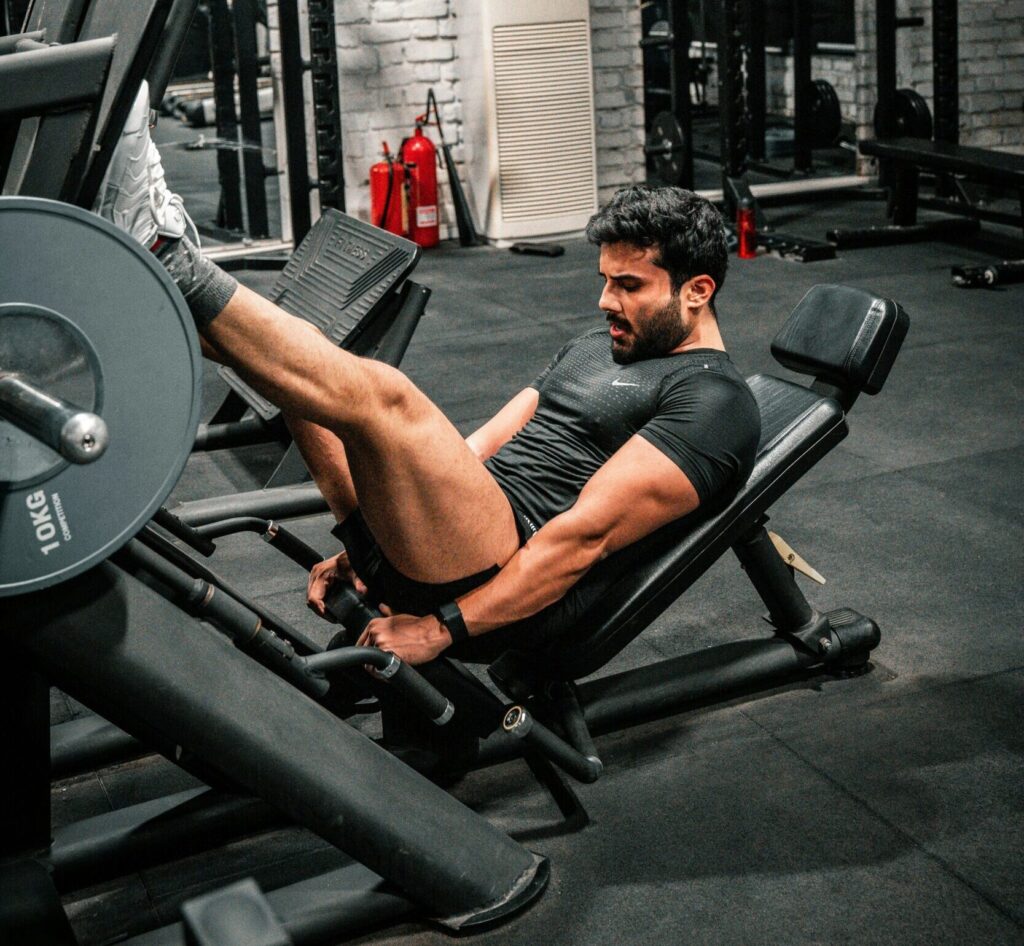
How to progress: add weight when you earn it
Use double progression. When you hit the top of the rep range on every set, add the smallest weight jump next session. Here is an example on the bench press, with a 6 to 8 rep range:
| Week | Weight | Reps over 4 sets | Next step |
|---|---|---|---|
| 1 | 50 kg | 8, 7, 6, 6 | Same weight |
| 2 | 50 kg | 8, 8, 7, 7 | Same weight |
| 3 | 50 kg | 8, 8, 8, 8 | Add 2.5 kg |
| 4 | 52.5 kg | 7, 6, 6, 5 | Same weight |
| 5 | 52.5 kg | 8, 7, 7, 6 | Same weight |
| 6 | 52.5 kg | 8, 8, 8, 7 | Same weight |
| 7 | 52.5 kg | 8, 8, 8, 8 | Add 2.5 kg |
| 8 | 55 kg | 7, 7, 6, 6 | Same weight |
This is an example, not a promise. Some weeks you will repeat a weight, and that is normal.
Write every set down so you know what to beat. Our progressive overload plan covers what to do when you stall.
Video: Why you’re not gaining muscle. A short video on the most common reasons muscle gain stalls.
What to expect over the first year
In the first two to three months, much of your strength gain comes from learning the lifts. Your weight climbs slowly and your shape changes only a little.
After a few months of eating enough and progressing your lifts, clothes often start to fit differently across your chest, shoulders and arms. Over a year, the changes add up. How much you gain depends on your starting point, consistency, sleep and genetics. Some of the weight you gain will be fat, which is normal when you eat in a surplus.
For research on how soon muscle shows, see how long it takes to build noticeable muscle.
Video: How long does it take to build muscle. A short guide to realistic timelines, so you know what to expect in your first months.
Common mistakes skinny guys make
- Eating less on rest days. Keep your food intake steady every day, not just on training days.
- Guessing instead of checking. Weigh yourself regularly and log your food for a couple of weeks.
- Lots of cardio without eating more. Cardio is good for your health, but it uses energy. If you do a lot, eat more to cover it. See cardio and weights on the same day.
- Program hopping. Changing your plan every couple of weeks makes it hard to progress. Stick with one plan for several months.
- Too much too soon. A six-day bodybuilding split is hard to recover from when you are new. Three good sessions you can repeat beat six you cannot.
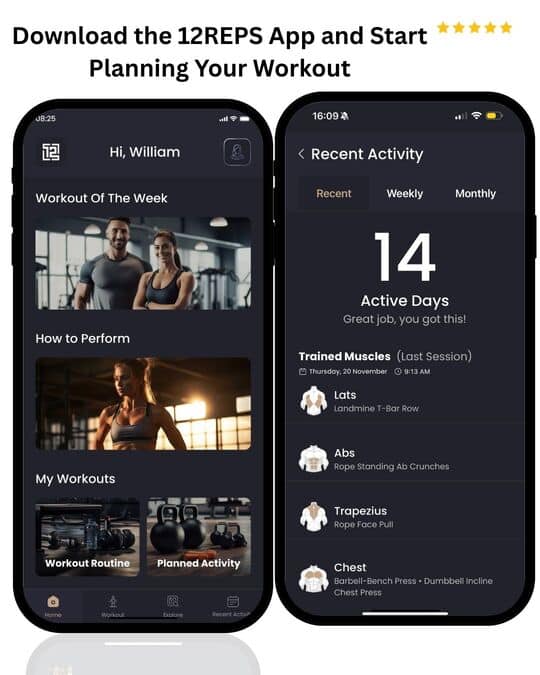
Track your training with 12REPS
If you want each session planned and every lift logged, 12REPS builds your workouts around your goal, your equipment and the time you have. A trainer demonstrates every exercise, and the app remembers what you lifted, so you always have a number to beat. You can also log your body weight and see the trend over time.
Skinny guy muscle building FAQs
How much weight should I gain each month?
There is no set number. The NHS advises gaining weight gradually. Check your trend every two to four weeks and adjust your food if it has stalled.
Do I need supplements to bulk?
No. Food can cover your calories and protein. A protein powder can be handy, but it is not required.
Should I do full body or push/pull/legs?
Both work. Full body suits two or three days a week, and push/pull/legs is simple to follow. See our split comparison.
Can I build muscle with a fast metabolism?
Yes. You may need to eat more than other people your size, but the same rules apply: eat enough, get enough protein and progress your lifts.
Sources
- Healthy ways to gain weight. NHS, accessed 2026. https://www.nhs.uk/live-well/healthy-weight/managing-your-weight/healthy-ways-to-gain-weight/
- International Society of Sports Nutrition position stand: diets and body composition. Aragon AA et al., Journal of the International Society of Sports Nutrition, 2017. https://doi.org/10.1186/s12970-017-0174-y
- International Society of Sports Nutrition position stand: protein and exercise. Jager R et al., Journal of the International Society of Sports Nutrition, 2017. https://doi.org/10.1186/s12970-017-0177-8
- Effects of resistance training frequency on measures of muscle hypertrophy: a systematic review and meta-analysis. Schoenfeld BJ, Ogborn D, Krieger JW, Sports Medicine, 2016. https://doi.org/10.1007/s40279-016-0543-8