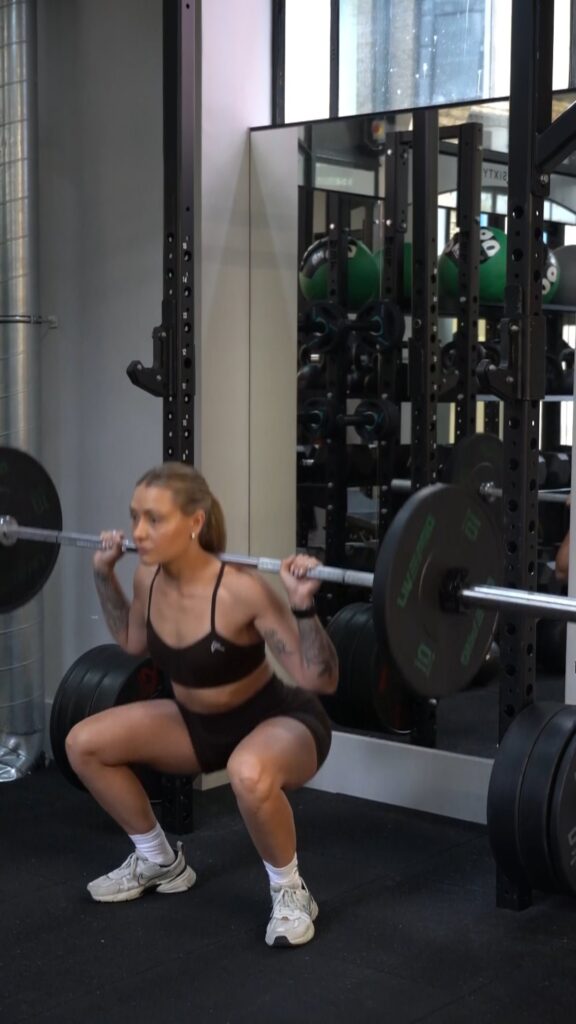
Short answer: Knee sleeves are snug neoprene tubes worn over the knee. A few small studies suggest they may help you lift a little more on a one-rep max squat and make your knees feel more stable. They don’t seem to change how your knee moves much, and they don’t improve other measures like jumping or leg endurance. There is no good evidence that they prevent injuries in healthy lifters. They are a comfort item, not a must-have.
This guide is for anyone deciding whether knee sleeves are worth buying. I cover what they do, what the research shows, who might benefit and how to choose a pair.
Knee sleeves vs knee wraps vs knee braces
| Type | What it is | Typical use |
|---|---|---|
| Knee sleeve | A snug neoprene tube, usually 3 to 7 mm thick | Warmth, comfort and a feeling of support during squats and other leg work |
| Knee wrap | A long elastic band wound tightly around the knee | Powerlifters on very heavy squats; it stores elastic energy and can add to the lift |
| Knee brace | A rigid or hinged support, often prescribed after an injury | Medical use to limit or guide knee movement |
This article focuses on sleeves, which are the most common option in regular gyms.
What the research says
- A small boost to max squat strength. In 15 trained men who had not used knee sleeves before, wearing neoprene sleeves increased back squat one-rep max by about 5 kg (11 pounds) compared with a minimally supportive control sleeve. A tighter sleeve did not help more than a normally sized one. Sleeves did not improve jump power, squat speed or leg extension strength and endurance (Machek et al., 2021).
- Little change in knee movement, but a feeling of stability. In 17 male CrossFit athletes, 7 mm sleeves made little difference to knee mechanics during front squats and box jumps, although front squat one-rep max was higher with sleeves. Almost all participants said their knees felt more stable, and all believed sleeves would help avoid knee pain (Maynart et al., 2024).
- Thicker sleeves made no clear difference. In 15 trained men, high-density and low-density sleeves produced no statistically significant differences in squat force, velocity or power, though the denser sleeves showed slightly higher average values (Leschot-Gatica et al., 2026).
I could not find studies showing that knee sleeves prevent injuries in healthy lifters. The feeling that they protect your knees is common, but it has not been proven.
My take: if you like how sleeves feel on heavy squat days, there is no reason not to wear them. But they are not a substitute for good technique, sensible loading and strengthening the muscles around your knees.
Who might benefit from knee sleeves?
These are my coaching suggestions, not research-based rules:
| Worth considering | Probably not needed |
|---|---|
| You squat heavy regularly and want a little extra support on top sets | You are a beginner still learning to squat |
| Your knees feel stiff or cold at the start of sessions | You mainly train upper body, machines or light leg work |
| You compete or test your max squat | You hope they will fix ongoing knee pain |
If you have knee pain, a sleeve may make your knee feel more comfortable, but it does not deal with the cause. See a doctor or physical therapist, and take a look at my guide on how to train around an injury.
How to choose knee sleeves
- Thickness: 5 mm is a common middle ground. 7 mm sleeves feel stiffer and warmer and are popular for heavy squats; 3 mm sleeves are lighter for general training.
- Fit: follow the manufacturer’s size chart. They should feel snug without cutting off circulation. In the 2021 study, going a size tighter did not add any benefit.
- Length: they should cover from a few inches above to a few inches below your kneecap.
- Putting them on: pull them up from your ankle while sitting, or roll them on. Many lifters find this easier with the sleeve turned inside out first.
Summary
- Knee sleeves are snug neoprene tubes that keep your knees warm and feel supportive.
- Small studies suggest they may add a little to your max squat, but they don’t improve other strength or power measures.
- They don’t change knee movement much, and there is no good evidence they prevent injuries.
- Wear them for comfort on heavy squat days if you like them; they are not essential.
- If you have knee pain, get it assessed rather than relying on a sleeve.
Build stronger knees with a plan
Strong, well-trained legs are the best support your knees can have. The hard part is progressing your squats and leg work sensibly week by week.
That is what I built 12REPS to help with. You set your goal, your available time and your equipment, and the app builds your workouts. Every exercise comes with a trainer demonstration, and you can log your sets and reps to see your progress over time.
Download 12REPS and see what you’ll get:
Sources
- Machek SB, Cardaci TD, Wilburn DT, et al. Neoprene knee sleeves of varying tightness augment barbell squat one repetition maximum performance without improving other indices of muscular strength, power, or endurance. J Strength Cond Res. 2021;35(Suppl 1):S6–S15.
- Maynart FR, Mazuquin B, Costa HS, et al. Are 7 mm neoprene knee sleeves capable of modifying the knee kinematics and kinetics during box jump and front squat exercises in healthy CrossFit practitioners? An exploratory cross-sectional study. J Bodyw Mov Ther. 2024;40:1027–1033.
- Leschot-Gatica J, Romero-Vera L, Ñancupil-Andrade A, et al. Effects of knee sleeve density on theoretical neuromuscular capacities derived from the force-velocity-power profile in the back squat. J Funct Morphol Kinesiol. 2026;11(1):47.
Related reading
- Lifting Straps: What They Do, When to Use Them and What the Research Says
- Do You Need Lifting Shoes? What They Do for Your Squat and Who They Help
- Do You Need a Lifting Belt? When to Wear One, and When Not To
- Knees Past Toes When Squatting: Is It Bad for Your Knees?
- Are Leg Extensions Bad for Your Knees? What the Research Says
- How Deep Should You Squat? What the Research Says
- How to Squat Properly: Stance, Depth and Fixes for Women
- How to Train Around an Injury: Safe Strategies for Staying Active
I’m Will Duru, a personal trainer and the founder of 12REPS. I hold a BSc (Hons) in Sport and Exercise Science and have more than a decade of experience coaching people in strength training.
This article is for general education and isn’t medical advice.