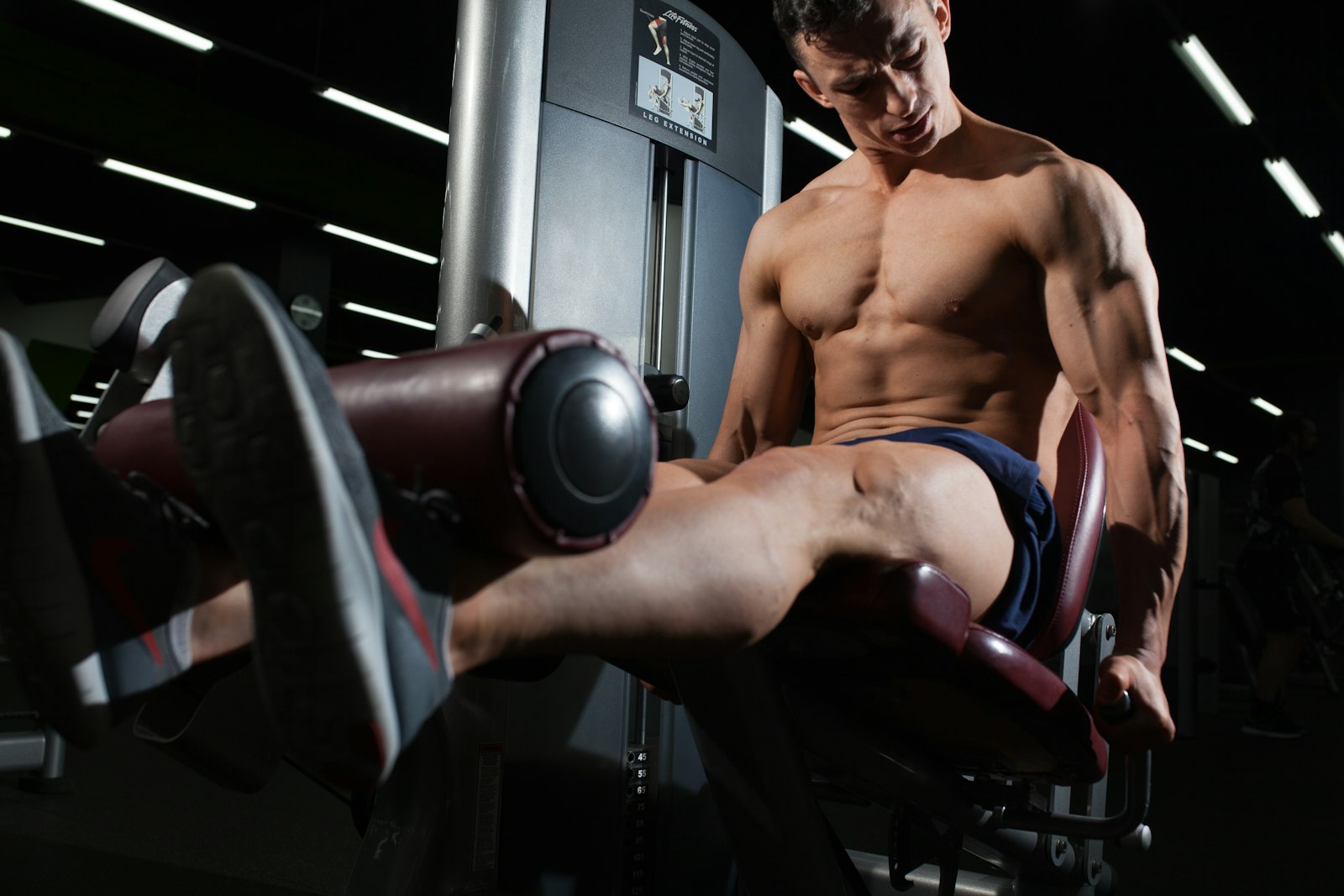


Quick answer: No, leg extensions aren’t bad for healthy knees. They load your knee differently from squats, not more dangerously. Leg extensions put the most stress on the kneecap joint when your leg is nearly straight, while squats put the most stress on it when your knee is deeply bent. In one study, the squat actually produced the highest peak stress. Leg extensions do load the ACL more near the top of the movement, which matters if you’ve had an ACL injury or surgery. If they bother your knees, you can usually fix it by changing the range, the load or the pad position.
Leg extensions have a bad reputation. You’ve probably heard that they “shear” the knee or wreck your ACL. This guide is for you if you want to know whether that’s true, whether they’re worth doing and how to do them in a way that feels good on your knees.
Where the worry comes from
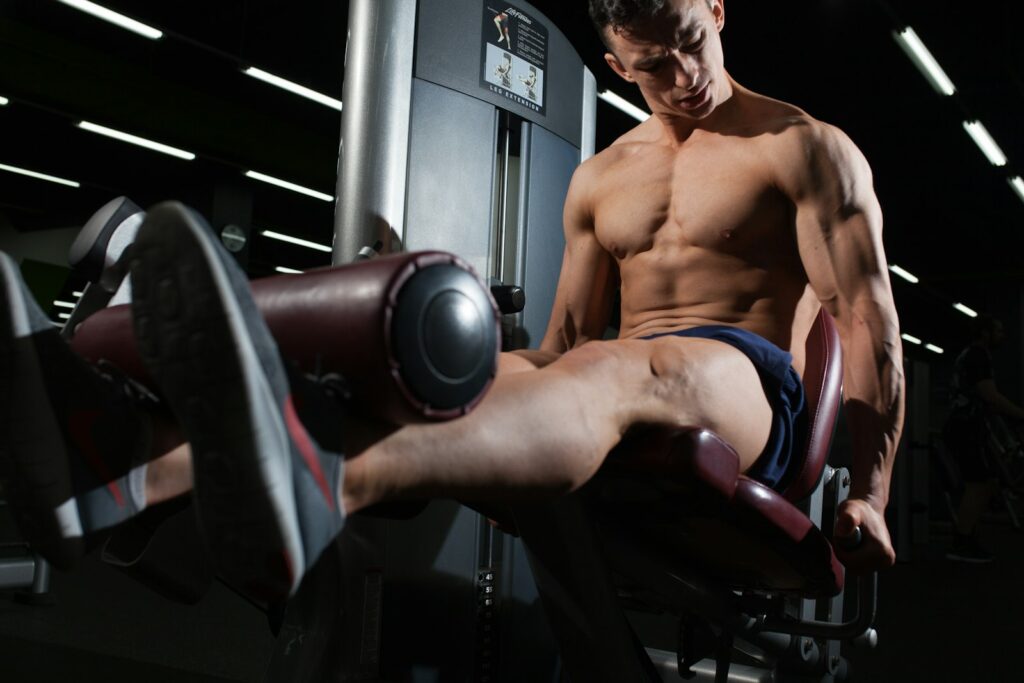
A leg extension is an “open chain” exercise: your foot moves freely instead of pushing against the floor. When you straighten your knee against a pad on your shin, your quads pull the shin bone forward. That forward pull is what stresses the ACL (the ligament that stops your shin sliding forward). It also presses your kneecap into the groove at the end of your thigh bone.
That sounds bad. But squats, lunges and leg presses also load the knee. They just load it at different angles.
What the research says
Kneecap stress: different, not worse
In a study of 10 healthy adults, researchers compared the squat with two kinds of leg extension (Powers et al., 2014):
- Leg extensions produced more kneecap stress near the top, from 30° of knee bend to a straight leg.
- The squat produced more kneecap stress deeper in the movement, from 60° to 90° of knee bend.
- The squat produced the highest peak stress overall.
The authors suggested doing leg extensions in the range from 90° to 45° of knee bend if you want to keep kneecap stress low. That’s the bottom half of the movement.
ACL load: higher near a straight leg
A review of ACL loading found the ACL works harder in seated leg extensions than in weight-bearing exercises like squats. The load was highest between about 10° and 30° of knee bend, close to a straight leg. Placing the pad higher on your shin, away from your ankle, reduced the force on the ACL (Escamilla et al., 2012).
For a healthy ACL, that load is normal. It’s the kind of stress the ligament handles every time you kick a ball or climb stairs. It matters more if you’re recovering from an ACL tear or surgery.
Even ACL rehab uses them
Physical therapists use leg extensions in ACL rehab. A 2025 review of 26 studies found open-chain exercises like leg extensions “appear to be safe” after ACL reconstruction, with precautions such as a limited range early on. Guidelines commonly suggest waiting about 4 weeks after surgery and starting with a partial range (Forelli et al., 2025). If you’re in rehab, follow your physical therapist’s plan.
Why leg extensions are worth doing
Your quads are four muscles. One of them, the rectus femoris, crosses both the hip and the knee. Squats don’t work it as hard, because your hip and knee bend at the same time.
In a 5-week trial with 27 trained men, the leg extension group grew their rectus femoris at all three spots measured. The squat group didn’t. The squat group did better on the outer quad and on jump height (Zabaleta-Korta et al., 2021, summarized by StrengthLog).
So leg extensions don’t replace squats. They fill a gap that squats leave.
| Leg extension | Squat | |
|---|---|---|
| Type | Open chain, foot moves freely | Closed chain, feet on the floor |
| Kneecap stress | Highest near a straight leg | Highest deep in the squat |
| ACL load | Higher, especially near the top | Lower |
| Rectus femoris growth | Strong | Weaker |
| Whole-leg strength and power | Limited | Strong |
| Skill needed | Very little | More |
How to do leg extensions
Setup
- Adjust the back pad so your knees line up with the machine’s pivot point (usually marked with a dot).
- Set the shin pad on the front of your lower shin, just above your ankle. If your knees are sensitive, move it slightly higher up the shin.
- Sit tall and hold the handles.
The movement
- Straighten your knees in a smooth motion until your legs are straight, or nearly straight.
- Squeeze your quads for a second at the top.
- Lower slowly, taking about 2 to 3 seconds.
- Stop just before the weight stack touches down, then start the next rep.
Coaching cues: “Kick the pad up, don’t throw it.” “Squeeze at the top.” “Slow on the way down.”
How to make leg extensions knee-friendly
If leg extensions bother your knees, try these before you drop them:
- Shorten the range. Work in the bottom half, from fully bent to about halfway up. That’s where kneecap stress was lowest (Powers et al., 2014).
- Move the pad up your shin. A higher pad reduced ACL force in research (Escamilla et al., 2012).
- Go lighter and do more reps. 15 to 20 controlled reps put less load on the joint than a heavy set of 6.
- Slow down. No kicking or dropping the weight.
- Train one leg at a time. Lets you use less weight and spot differences between your legs.
If your knee pain keeps getting worse, or you have swelling, clicking with pain or a recent injury, stop and see a doctor or physical therapist. For more on this, read how to train around an injury.
Sets and reps
| Goal | Sets and reps | Where in your workout |
|---|---|---|
| Build your quads | 2 to 4 sets of 10 to 15 | After squats, lunges or leg press |
| Sensitive knees | 2 to 3 sets of 15 to 20, partial range | Early, as part of your warm-up, or after main lifts |
| Beginners | 2 sets of 12 to 15 | After your main leg exercise |
Stop each set 1 to 2 reps before failure. When you can do the top of your rep range on every set, add a little weight. That’s progressive overload.
Summary
- Leg extensions aren’t bad for healthy knees. They load the knee at different angles than squats do.
- Kneecap stress is highest near a straight leg in leg extensions, and deep in the squat.
- The ACL works harder in leg extensions, especially near the top. That matters most after an ACL injury or surgery.
- Leg extensions build the rectus femoris, a part of your quads that squats work less.
- If they hurt, shorten the range, move the pad higher, go lighter and slow down.
Get a leg day that’s built for you
The right exercises in the right order make leg day work for your knees and your goals. 12REPS gives you trainer-built programs with two demo videos for every exercise. You can also swap exercises with Build Your Routine, and the gym log shows what you lifted last time. New users get a 7-day free trial.
Download 12REPS and see what you’ll get:
Sources
- Powers CM et al. Patellofemoral joint stress during weight-bearing and non-weight-bearing quadriceps exercises. J Orthop Sports Phys Ther, 2014
- Escamilla RF et al. Anterior cruciate ligament strain and tensile forces for weight-bearing and non-weight-bearing exercises: a guide to exercise selection. J Orthop Sports Phys Ther, 2012
- Forelli F et al. Criteria-based decision making for introducing open kinetic chain exercise after ACL reconstruction: a scoping review. Sports Med Open, 2025
- Zabaleta-Korta A et al. The role of exercise selection in regional muscle hypertrophy: a randomized controlled trial. J Sports Sci, 2021 (summarized by StrengthLog)
Related reading
- 5 leg exercises that actually grow your legs
- Get stronger legs with gym machines
- How to do a goblet squat
- How to do lunges: forward, reverse and walking
- Bulgarian split squats: how to do them correctly
- How to train around an injury
I’m Will Duru, a personal trainer and the founder of 12REPS. I hold a BSc (Hons) in Sport and Exercise Science and have more than a decade of experience coaching people in strength training. This article is for general education and isn’t medical advice.