
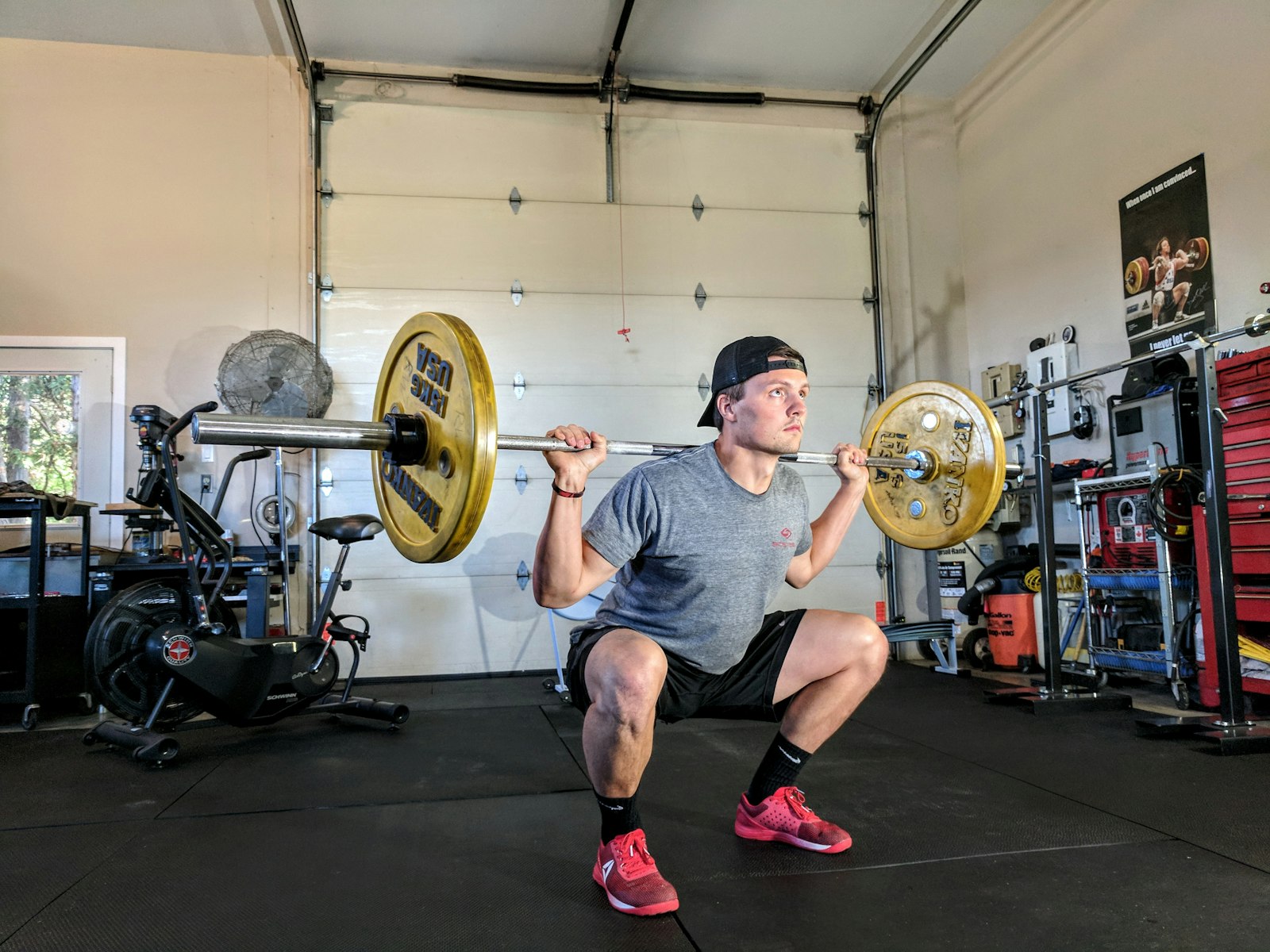



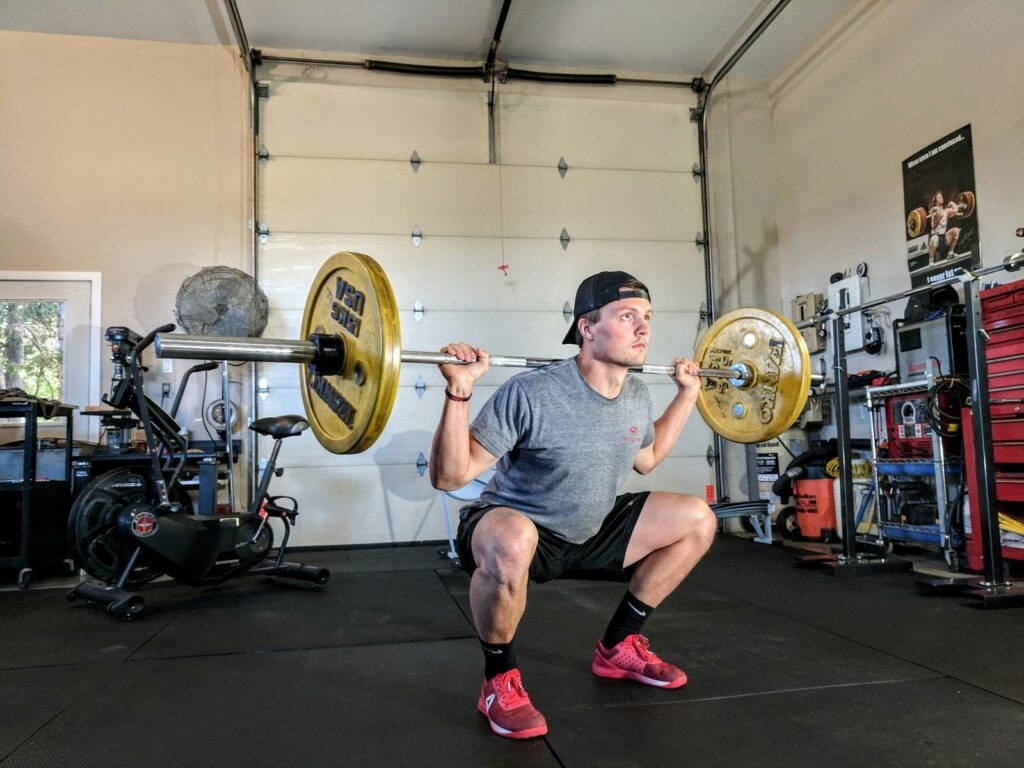
The short answer: for most people, squat as deep as you can while keeping your heels down and your back in a strong, neutral position. For many lifters, that means at least parallel, with the tops of your thighs level with your knees, or deeper. Research shows that deeper squats build the glutes and inner thighs more than half squats, build the front thighs at least as well, and make you stronger through a bigger range. A review of the research also found no good evidence that deep squats are bad for healthy knees when done with good technique and sensible loads.
This guide is for anyone who has wondered whether they’re squatting too deep, not deep enough or doing damage to their knees. I’ll cover the different squat depths, what the research shows, how to find your best depth and how to squat deeper if you struggle.
Squat depths explained
| Depth | What it looks like | Knee bend (approximate) |
|---|---|---|
| Quarter squat | A small dip, thighs well above parallel | About 45–60° |
| Half squat | Thighs about halfway to parallel | About 90° |
| Parallel squat | Tops of the thighs level with the knees | About 110–120° |
| Full (deep) squat | Hips below the knees, as low as you can control | About 120–140° |
What the research says
- Full squats built more glute and inner-thigh muscle. In a 2019 study of 17 young men, one group trained full squats and another trained half squats, twice a week for 10 weeks. The full squat group grew their glutes by about 6.7% compared with 2.2% for the half squat group, and their inner thighs (adductors) by 6.2% compared with 2.7%. Front thigh (quad) growth was almost identical, at about 4.9% and 4.6%. Neither group grew their hamstrings. The full squat group also improved their full squat 1RM by about 32%, compared with 11% for the half squat group.
- Deep squats built more front thigh muscle in another study. A 2013 study of 17 young men compared deep squats (bending the knees to about 120°) with shallow squats (about 60°) over 12 weeks. The deep squat group gained 4–7% more front thigh muscle and improved their squat jump more. Each group got strongest at the depth it trained.
- Deep squats don’t appear to be bad for healthy knees. A 2013 review looked at how squat depth affects the knee and spine. The authors concluded that deep squats, done with good technique and sensible loads, don’t appear to increase injury risk for the knee’s passive structures. They also argued that quarter squats, which let people lift much heavier weights, may put more stress on the spine and knees.
Both training studies were small and used young men, so treat the exact numbers with some caution. But together, they support squatting through a full range for most goals. The advice below comes from that research and my coaching experience.
How deep should you squat?
- Most people: squat as deep as you can while your heels stay down, your back stays neutral and you stay in control. For most lifters, that’s parallel or below.
- Want bigger glutes and inner thighs: go as deep as you can control. That’s where the research showed the biggest difference.
- Training for a sport that uses partial squats: keep full squats as your base, and add some partial or jump work that matches your sport.
- Knee pain or past injury: work in a range that feels comfortable and build it up gradually. A physical therapist can help you find the right depth.
How to squat with good depth
- Set your feet about shoulder width apart, toes turned out slightly.
- Take a breath and brace your stomach.
- Push your hips back and bend your knees at the same time, letting your knees travel forward over your toes.
- Keep your chest up and your heels down as you lower.
- Go as deep as you can while keeping your back neutral. Your lower back shouldn’t round at the bottom.
- Drive up through your whole foot to stand tall.
Coaching cues I use: “knees out over your toes,” “sit between your heels, not behind them” and “chest proud.” It’s normal for your knees to move past your toes in a deep squat. Trying to stop it usually makes you lean forward too much.

Can’t squat deep? Try this
- Start with a goblet squat. Holding a weight in front of you helps you sit upright and deeper. My goblet squat guide walks you through it.
- Raise your heels. Standing on small plates or a wedge helps if tight ankles stop you going deeper.
- Widen your stance a little. Turning your feet out slightly gives your hips more room.
- Squat to a box. A box or bench at your target depth builds consistency. Lower the box over time.
- Practice the bottom position. Hold a bodyweight deep squat for 20–30 seconds a few times a day.
Common mistakes and how to fix them
| Mistake | Why it matters | Fix |
|---|---|---|
| Lifting your heels | Shifts load onto your knees and toes | Raise your heels on plates or improve ankle mobility |
| Lower back rounding at the bottom | Puts stress on your spine | Stop just above the point where your back rounds and work on depth over time |
| Knees caving in | Reduces stability and glute work | Push your knees out in line with your toes |
| Cutting depth as the weight goes up | You lose the benefits of a full squat | Lower the weight and keep the same depth |
| Bouncing out of the bottom | Loses control at the hardest point | Lower under control and drive up smoothly |
Summary
- For most people, squat as deep as you can with your heels down and your back neutral, usually parallel or below.
- One study found full squats grew the glutes about three times more than half squats, and the inner thighs about twice as much.
- Deeper squats built front thigh muscle as well or better than shallow squats in two studies.
- A review found no good evidence that deep squats harm healthy knees when done with good technique.
- If you can’t squat deep, use goblet squats, raised heels and box squats to build depth gradually.
Squat with a plan
Good depth is one part of a strong squat. Adding weight at the right pace and balancing your leg training is the rest. That’s where 12REPS helps.
12REPS gives you trainer-built programs with two demo videos for every exercise, so you can check your squat depth and form. The gym log shows what you lifted last time, so you know when to add weight. Build Your Routine lets you set up your own leg days, and the built-in timer keeps your rest periods on track. Every new account starts with a 7-day free trial.
Download 12REPS and see what you’ll get:
Sources
- Kubo K, Ikebukuro T, Yata H. Effects of squat training with different depths on lower limb muscle volumes. European Journal of Applied Physiology. 2019;119:1933–1942.
- Bloomquist K, Langberg H, Karlsen S, Madsgaard S, Boesen M, Raastad T. Effect of range of motion in heavy load squatting on muscle and tendon adaptations. European Journal of Applied Physiology. 2013;113(8):2133–2142.
- Hartmann H, Wirth K, Klusemann M. Analysis of the load on the knee joint and vertebral column with changes in squatting depth and weight load. Sports Medicine. 2013;43:993–1008.
Related reading
- How to Do a Goblet Squat: A Step-by-Step Form Guide
- Why Women Should Do Barbell Squats and Deadlifts
- Are Leg Extensions Bad for Your Knees?
- Barbell Squat: exercise demo
I’m Will Duru, a personal trainer and the founder of 12REPS. I hold a BSc (Hons) in Sport and Exercise Science and have more than a decade of experience coaching people in strength training. This article is for general education and isn’t medical advice.
