



Short answer: Lifting straps wrap around your wrists and the bar so your grip is less likely to give out before the muscles you are training. Research shows they help you do more reps on heavy deadlifts, keep your grip fresher and make sets feel easier. There is no good evidence yet that they help you build more muscle over time, and they take some work away from your grip. Use them on your heaviest pulling sets, and train your grip separately.
This guide is for anyone whose hands give out before their back and legs on deadlifts, rows or shrugs. I cover what straps do, what the research says, when to use them and how to put them on.
What are lifting straps?
Lifting straps are strips of cotton, nylon or leather that loop around your wrists. You wrap the free end around the bar, which takes some of the load off your fingers and transfers it through your wrists.
- Loop straps: the most common type. A loop goes around your wrist and the tail wraps around the bar. They are easy to put on and take off.
- Figure-8 straps: loop around your wrist and under the bar, locking your hand in place. They are very secure but hard to let go of quickly, so they are usually kept for very heavy deadlifts and shrugs.
- Hook-style straps: have a metal or plastic hook that sits against the bar. They are quick to use but feel less secure for some people.
What the research says
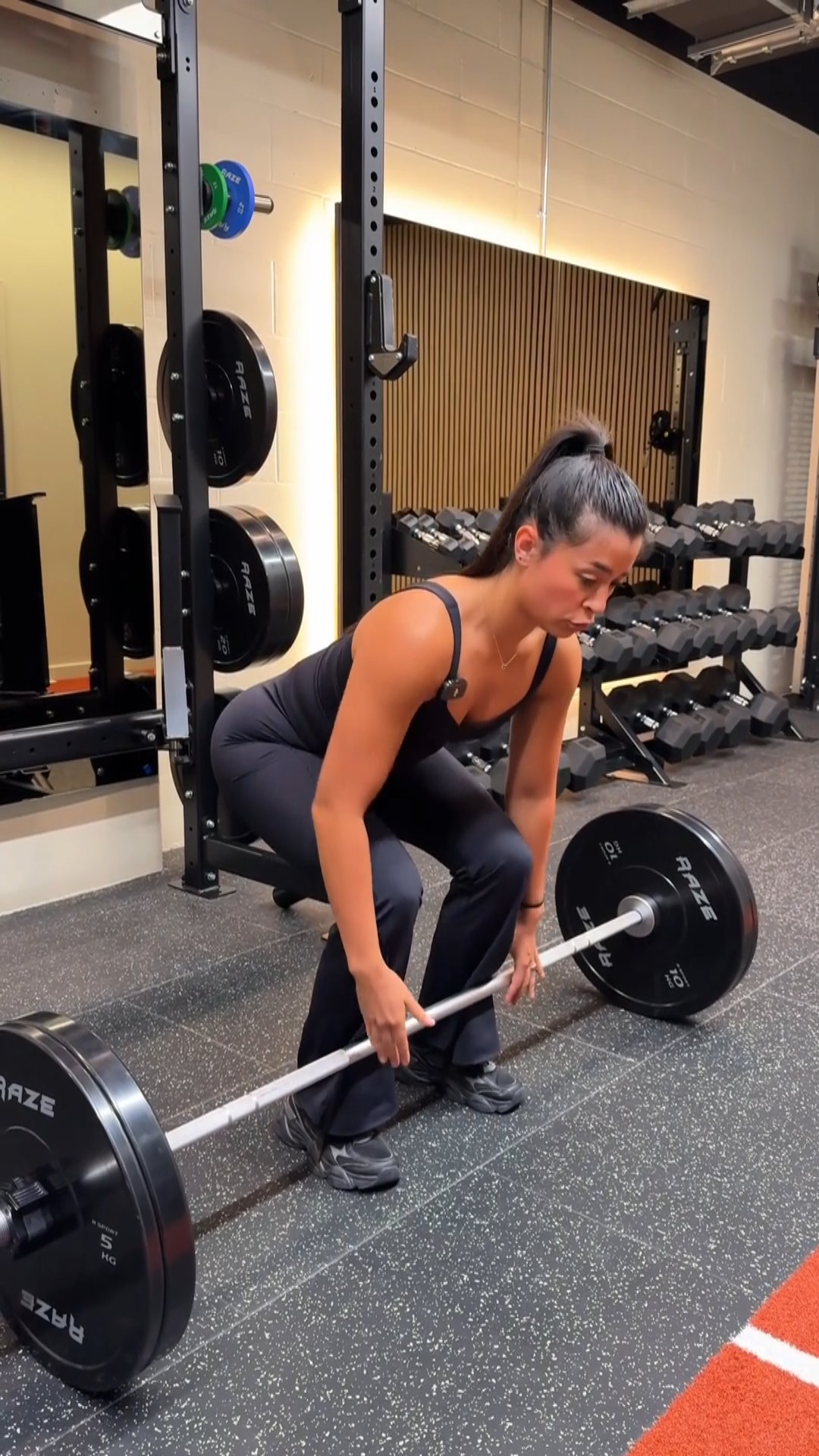
- More reps and less grip fatigue. In 10 trained women doing 3 sets of as many deadlift reps as possible at 80% of their maximum, straps allowed more reps and less loss of grip strength, without slowing the bar down (Trahey et al., 2023).
- Faster reps and lower effort. In 16 trained men doing 4 sets of 4 deadlifts, using straps with the same weight led to faster bar speed, less grip fatigue, lower perceived effort and a more secure-feeling grip (Jukic et al., 2021).
- More work in sets to failure. In 11 experienced lifters doing 3 sets to failure at 90% of their maximum, straps led to greater force output and longer lifting phases. The authors suggested this meant more work for the target muscles (Coswig et al., 2015).
- The long-term picture is unclear. A 2026 review concluded that straps can improve maximal strength in the deadlift and how secure your grip feels. But results for other pulling exercises were inconsistent, straps did not appear to increase muscle activation, and no studies have yet tested whether training with straps leads to better long-term results (Martins et al., 2026).
My take: straps are a useful tool when your grip is clearly what stops your set. They are not a shortcut to more muscle, and I would not use them on every set.
When to use lifting straps
These are my coaching suggestions:
| Use straps | Skip straps |
|---|---|
| Heavy deadlift, rack pull and Romanian deadlift sets where your grip fails first | Warm-up sets and lighter working sets |
| High-rep back work, such as rows or pulldowns, when your forearms are tiring before your back | When you are trying to build grip strength |
| Heavy shrugs | Exercises where you need to drop the weight quickly, such as cleans or snatches |
| Later sets in a session when your grip is already tired | If you have not yet learned the lift with a normal grip |
A simple approach is to do all your warm-up sets and your first working set without straps, then add them only when your grip starts to fail before your back and legs.
How to put on loop lifting straps
- Make the loop. Thread the tail of the strap through the stitched loop to form a circle.
- Put your hand through. Slide your hand into the loop so the tail runs across your palm toward your thumb.
- Tighten around your wrist. Pull the tail so the loop sits snugly around your wrist, not your hand.
- Wrap the bar. Place your hand on the bar, then wrap the tail under and around the bar toward you.
- Twist to tighten. Roll your hand toward you to wind the strap around the bar until it feels tight.
- Grip as normal. Wrap your fingers over the strap and bar. Your hand still grips; the strap just takes some of the load.
Practice with an empty bar first. It usually takes a few sessions before putting them on feels quick.

Will straps weaken your grip?
No studies have tested whether training with straps makes your grip weaker over time. But straps do reduce how hard your hands and forearms have to work, so relying on them for every set means less grip training.
The simple fix is to train your grip directly. Farmer’s carries, dead hangs and holding the last rep of a set for a few seconds all work well. My grip strength guide covers more options and why grip strength matters for your health.
Common mistakes
| Mistake | Why it matters | The fix |
|---|---|---|
| Using straps on every set | Your grip gets less training | Save them for heavy or late sets. |
| Strap around your hand, not your wrist | It feels loose and can slip | Tighten the loop around your wrist bones. |
| Wrapping the wrong way | The strap unwinds as you lift | Wrap under and around the bar toward you. |
| Letting go of your grip completely | The bar can roll and feel unstable | Keep gripping the bar firmly over the strap. |
| Using figure-8 straps on lifts you may need to drop | You can’t release the bar quickly | Use loop straps, or no straps, for those lifts. |
Summary
- Lifting straps help when your grip gives out before the muscles you are training.
- Studies show they allow more reps, less grip fatigue and lower effort on heavy deadlifts.
- There is no evidence yet that training with straps builds more muscle over time.
- Use them on heavy or late sets of deadlifts, rack pulls, rows and shrugs, not on warm-ups.
- Train your grip separately so it keeps up with the rest of your body.
Build a stronger back with a plan
Straps can help you get more out of your heavy pulling. The bigger factor is a plan that progresses your deadlifts, rows and grip work week by week.
That is what I built 12REPS to help with. You set your goal, your available time and your equipment, and the app builds your workouts. Every exercise comes with a trainer demonstration, and you can log your sets and reps to see your progress over time.
Download 12REPS and see what you’ll get:
Sources
- Trahey KM, Lapp EM, Talipan TN, et al. The effect of lifting straps on deadlift performance in females. J Strength Cond Res. 2023;37(10):1924–1928.
- Jukic I, García-Ramos A, Baláš J, et al. Ergogenic effects of lifting straps on movement velocity, grip strength, perceived exertion and grip security during the deadlift exercise. Physiol Behav. 2021;229:113283.
- Coswig VS, Freitas DFM, Gentil P, et al. Kinematics and kinetics of multiple sets using lifting straps during deadlift training. J Strength Cond Res. 2015;29(12):3399–3404.
- Martins R, Rosa M, Padovan R, et al. Are lifting straps a game changer for resistance training or an overrated tool? An exploratory review of current evidence and future research directions. Int J Sports Physiol Perform. 2026;21(3):342–349.
Related reading
- Grip Strength: Why It Matters for Your Health and How to Improve It
- Do You Need a Lifting Belt? When to Wear One, and When Not To
- How to Deadlift Properly: A Step-by-Step Guide for Women
- Rack Pulls: How to Do Them, Muscles Worked and Rack Pull vs Deadlift
- How to Do a Trap Bar Deadlift: Form, Benefits and Common Mistakes
- Farmer’s Carry: How to Do It and Why It Works
I’m Will Duru, a personal trainer and the founder of 12REPS. I hold a BSc (Hons) in Sport and Exercise Science and have more than a decade of experience coaching people in strength training.

