


To start lifting weights as a woman, learn six basic movements with light weights and train two to three times a week. Add a little weight or a few reps when the last reps of a set start to feel manageable. Write every session down so you always know what to beat next time. That’s the whole method. The rest of this guide shows you how to do it for your first four weeks and beyond.
Feeling out of your depth at the start is normal. Gym members often tell me they didn’t know what a set was, which weight to pick or whether they were doing it right. Every one of those questions has a simple answer, and you’ll find them below.
This guide is about learning to lift. If you want help with the gym itself, read our day-one gym plan and our guide to gym intimidation and weight room etiquette.
Why lifting weights is worth learning
The NHS advises all adults to do strengthening activities that work the major muscle groups on at least two days a week. Lifting weights is one of the most direct ways to do that, because you can measure the load and increase it over time.
Women respond well to it. A 2025 review of 29 studies found that relative gains in muscle size were similar in women and men when they followed the same training. Men gained slightly more in absolute terms, and the gap was bigger in the upper body.
Lifting also makes everyday tasks feel easier, like carrying shopping, lifting children or moving furniture. And no, it won’t make you bulky by accident. Our article on whether lifting weights makes women bulky explains why.
Gym terms to know before you start
A few words come up all the time. Here’s what they mean.
- Rep (repetition): one full movement. Lifting a dumbbell and lowering it once is one rep.
- Set: a group of reps done back to back. “3 sets of 10” means 10 reps, rest, 10 reps, rest, 10 reps.
- Rest: the break between sets. In the plan below, it’s 60 to 90 seconds.
- Form: how you do the movement. Good form means you control the weight through the full range you’re aiming for.
- Reps in reserve (RIR): the number of extra clean reps left in you when you stop a set. It’s a simple way to rate effort, set out in this paper on the RIR scale.
- Progressive overload: making your training slightly harder over time, with more weight, more reps or more sets. This is what makes you stronger.
- Compound exercise: a move that works several muscles at once, like a squat, row or press.
- Isolation exercise: a move that targets one main muscle, like a biceps curl.
- Free weights: dumbbells, barbells and kettlebells. Machines guide the movement along a fixed path.
The six movements to learn first
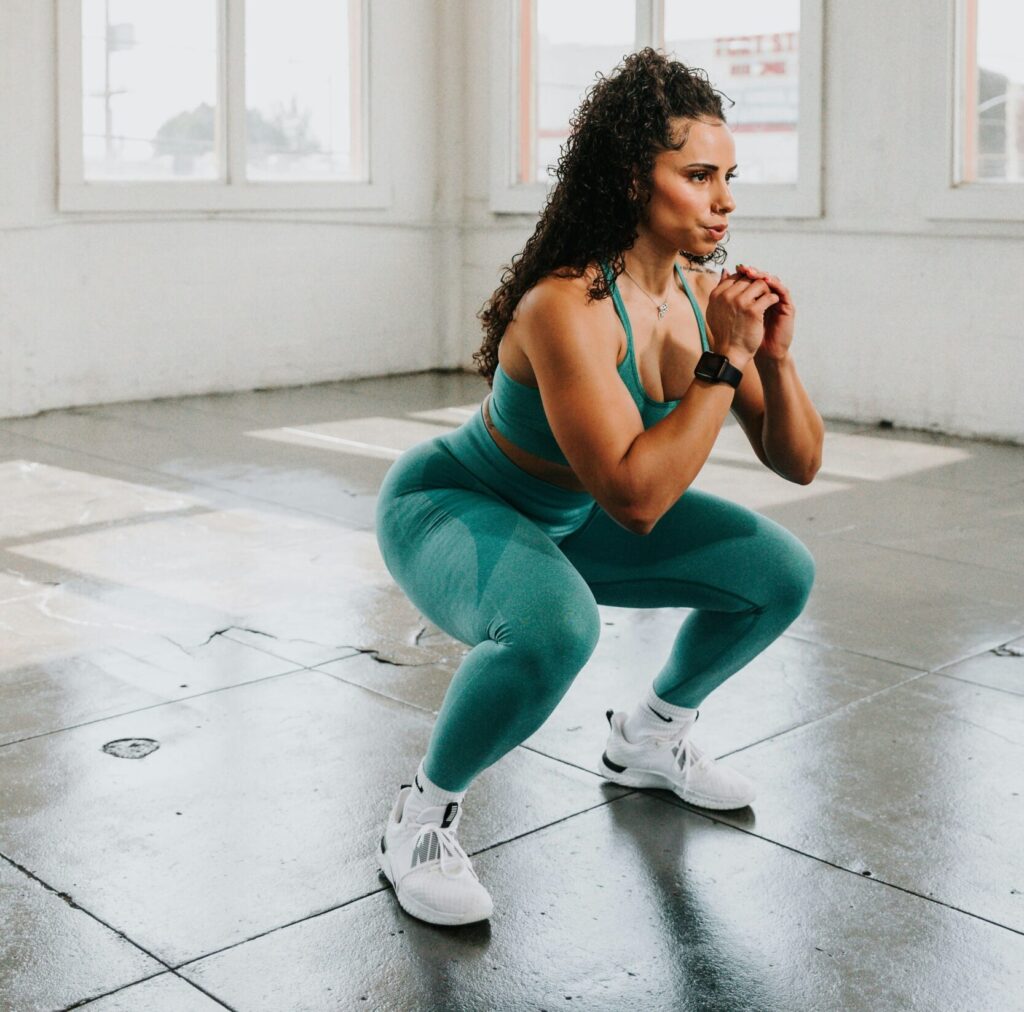
Almost every strength exercise is a version of six movement patterns. Learn one simple exercise for each, and you’ve trained your whole body.
| Movement | Beginner exercise | Main muscles |
|---|---|---|
| Squat | Goblet squat (one dumbbell held at your chest) | Thighs and glutes |
| Hinge | Dumbbell Romanian deadlift | Glutes and hamstrings |
| Horizontal push | Dumbbell chest press or elevated push-up | Chest, shoulders, triceps |
| Horizontal pull | Single-arm dumbbell row | Upper back and biceps |
| Vertical push | Dumbbell shoulder press | Shoulders and triceps |
| Vertical pull | Lat pulldown or assisted pull-up machine | Upper back and biceps |
For step-by-step technique on the big lifts, see our guides to squatting, deadlifting and the overhead press.
Video: How to do a lat pulldown. The lat pulldown is the vertical pull in the table above. Watch it before you try the machine so you know how the movement should look.
Machines or free weights?
Both work. Machines guide the path, so you only choose the weight. Dumbbells take a little more practice, but you can use them at home too. Our guide to free weights vs machines compares them.
How much weight to start with
Pick a weight that makes the last two or three reps of each set hard, while your form stays clean. In RIR terms, finish with about two or three reps left in the tank.
- If 15 reps would feel comfortable, the weight is too light.
- If you can’t reach 8 reps with good form, it’s too heavy.
- If reps 1 to 7 feel steady and reps 8 to 10 feel hard, you’ve found it.
Most women underestimate what they can lift at first. Our guide to how much weight a beginner woman should lift walks through finding your number step by step.
Film a set and write it down
Film one set of each exercise from the side. You’ll spot things you can’t feel yet, like your heels lifting or your back rounding.
Then log every session: exercise, weight, sets, reps and how it felt. Next time, try to beat it slightly.
Your first 4-week lifting plan
Do this full-body workout two or three times a week, with at least one rest day between sessions. That fits the American College of Sports Medicine position stand, which suggests novices train the whole body two to three days a week. It also suggests starting with one to three sets per exercise in the 8 to 12 rep range.
If you’ve done our day-one gym plan, you’ll know four of these moves already. This plan adds a shoulder press and builds on them over four weeks.
Weeks 1 and 2: learning phase
| Exercise | Sets x reps | Example starting weight |
|---|---|---|
| Goblet squat | 3 x 10 | 8 kg dumbbell |
| Single-arm dumbbell row | 3 x 10 per arm | 6 kg |
| Push-up (on knees or hands raised) | 3 x 8 | Body weight |
| Dumbbell shoulder press | 3 x 10 | 5 kg per hand |
| Plank | 3 x 20 to 30 seconds | Body weight |
Rest 60 to 90 seconds between sets. The weights are examples only; use the starting-weight test above. Focus on clean reps.
Video: Dumbbell goblet squats. Watch this before your first workout to see how to hold the dumbbell and how deep to sit.
Weeks 3 and 4: build your base
Keep the same exercises, but:
- do 3 to 4 sets of each.
- add weight once you can complete every rep with good form.
- cut rest to about 60 seconds.
A goblet squat might progress like this:
- Week 1: 8 kg x 10 reps.
- Week 2: 8 kg x 12 reps.
- Week 3: 10 kg x 8 reps.
- Week 4: 10 kg x 10 reps.
Adding reps before adding weight is a fair way to progress. A 2022 trial in trained adults found that adding reps from session to session built muscle about as well as adding weight, with similar strength gains.
Common beginner mistakes, and the fix
- Weights that are too light. If 15 reps feel easy, go up a step.
- Not writing anything down. Without a log, you’ll repeat the same weights for weeks.
- Skipping legs. Your legs and glutes are your biggest muscles. Train them in every full-body session.
- Only doing isolation moves. Start each session with compound lifts, then add curls or raises if you have time.
- Training every day. Muscles need time to recover. Keep at least one rest day between full-body sessions.
- Comparing yourself to others. The woman next to you may have years of training behind her. Compare yourself to last week.
- Quitting after two weeks. Visible changes usually take a few months. Commit to 12 weeks before you judge.
Video: 5 tips for ladies new to the gym. Quick advice for your first few weeks of lifting.
Weeks 5 to 12: how to keep progressing
After four to six weeks of steady training, you’re past the very start. Here’s how to keep moving forward.
- Train three days a week. For example: Monday lower body, Wednesday upper body, Friday full body.
- Add new exercises. Try Bulgarian split squats, hip thrusts, lat pulldowns and walking lunges.
- Add a set. Move from 3 to 4 sets on your main lifts.
- Add weight in small steps. The ACSM suggests a 2 to 10% increase once you can do one or two reps more than your target. In practice, that’s often 1 to 2 kg on lower body lifts and 0.5 to 1 kg on upper body lifts.
Not sure how to arrange your week? Compare a full-body or upper/lower split, and read when to increase your weights.
New to the weights area itself? Our gym intimidation guide covers the etiquette, from reracking to sharing equipment.
Should you hire a personal trainer?
If you can afford even four to six sessions with a good trainer, they’re worth it. A trainer can teach your first lifts, write a plan for your goal and spot mistakes you can’t see.
You don’t need one forever. A handful of sessions early on can save you months of repeating a habit you’d later have to unlearn. Our guide to finding the right personal trainer covers what to look for.
If a trainer isn’t in the budget:
- film your sets and compare them with trainer demonstrations.
- ask gym staff for a form check or induction (see how to ask for help at the gym).
- keep the weight conservative until your technique feels steady.
Can you start lifting at home?
Yes. A pair of adjustable dumbbells, a resistance band and a sturdy chair cover every pattern except heavy pulling. Our home strength training plan for women gives you a full 12-week program.

Eating to support your training
You don’t need a complicated diet to start. Focus on three things:
- Protein at each meal. To set a daily target, see how much protein women need for strength training.
- Enough food overall. Eating too little makes it harder to recover and progress. Carbs help fuel your sessions; see our guide to carbs for strength training.
- Whole foods first. Supplements are optional for beginners.
What to expect in your first three months
Everyone progresses at their own pace. This pattern is common:
- Weeks 1 and 2: the moves feel awkward and you may be sore for a day or two. Your lifts often go up from session to session as you learn the movements.
- Weeks 3 to 6: the moves feel more natural, soreness eases and your technique looks cleaner on video.
- Weeks 7 to 12: lifts that felt heavy at the start now feel manageable. Many people start to notice changes in how their clothes fit.
Progress slows after the first few months. That’s normal. Keep logging and keep adding small amounts.
How 12REPS helps you start lifting
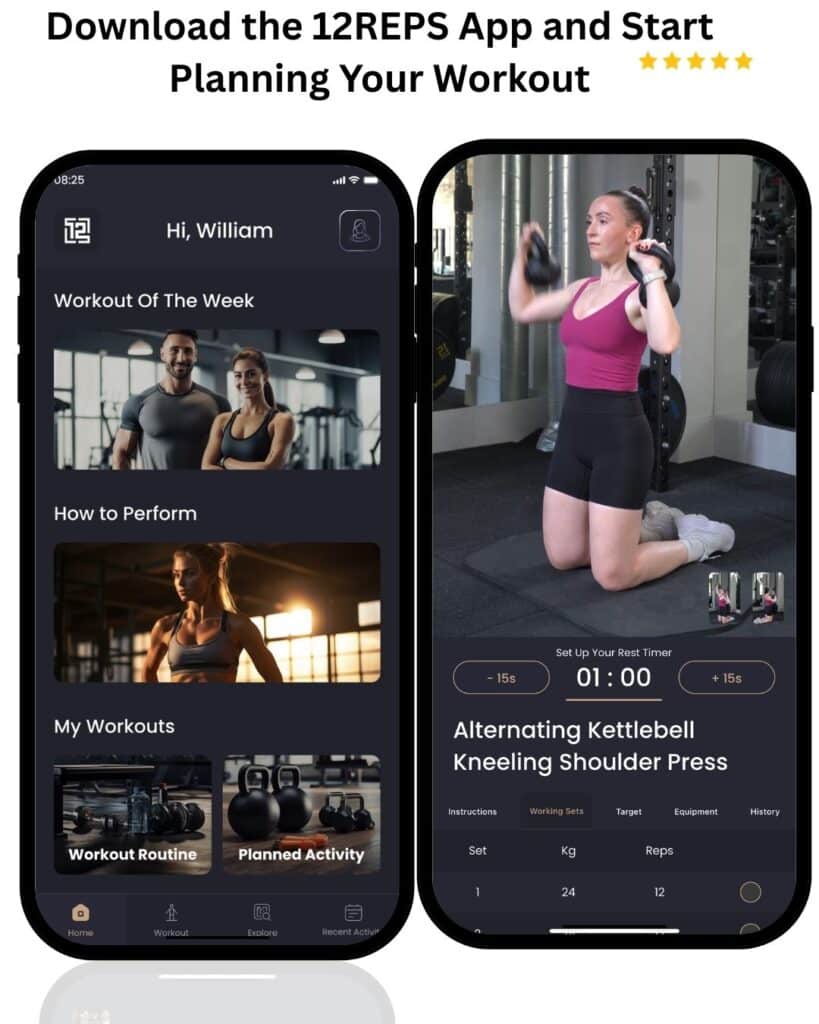
Starting out, you need a plan, a way to learn each movement and a record of what you lifted last time.
When you open 12REPS, your workout is ready, planned for your goal, the kit you can use and the time you have. You can watch a qualified trainer demonstrate each lift before your first set. Then enter the reps and weight you did, and next session you’ll see the number to beat.
The bottom line
Starting to lift weights feels strange for everyone at first. Keep it simple:
- start light and learn the six movements.
- train two to three times a week.
- build each session around compound lifts.
- add small amounts of weight or reps, and log everything.
- stay consistent for at least 12 weeks.
Pregnant, injured, or living with a health condition or regular medication? Talk to your doctor before you start lifting.
Sources
- Physical activity guidelines for adults aged 19 to 64. NHS, 2024. https://www.nhs.uk/live-well/exercise/physical-activity-guidelines-for-adults-aged-19-to-64/
- American College of Sports Medicine position stand: Progression models in resistance training for healthy adults. American College of Sports Medicine, Medicine and Science in Sports and Exercise, 2009. https://pubmed.ncbi.nlm.nih.gov/19204579/
- Sex differences in absolute and relative changes in muscle size following resistance training in healthy adults: a systematic review with Bayesian meta-analysis. Refalo MC et al. PeerJ, 2025. https://doi.org/10.7717/peerj.19042
- Application of the repetitions in reserve-based rating of perceived exertion scale for resistance training. Helms ER et al. Strength and Conditioning Journal, 2016. https://doi.org/10.1519/SSC.0000000000000218
- Progressive overload without progressing load? The effects of load or repetition progression on muscular adaptations. Plotkin D et al. PeerJ, 2022. https://doi.org/10.7717/peerj.14142