


How much protein do women need for strength training? Most women who lift do well on about 1.4 to 2.0 g of protein per kg of body weight a day. Up to about 2.2 g/kg gives a safety margin. For a 65 kg woman, that is roughly 90 to 140 g a day, split over 3 to 5 meals of about 20 to 40 g each.
I’m Will Duru, a personal trainer in London, and women at the gym ask me this all the time. They read one article saying 0.8 g per kg and another saying 2.2 g, and they stall.
This guide turns the research into a number you can use and a simple way to plan your meals around it. If you want the wider research on protein and muscle for all lifters, read how much protein you need to build muscle. If you eat little or no meat, see can female lifters build muscle without meat.
Daily protein targets for women who lift
Find your body weight in the left column. The middle columns cover the range most guidelines give for regular lifters.
| Body weight | 1.4 g/kg | 1.6 g/kg | 2.0 g/kg | 2.2 g/kg |
|---|---|---|---|---|
| 55 kg | 77 g | 88 g | 110 g | 121 g |
| 60 kg | 84 g | 96 g | 120 g | 132 g |
| 65 kg | 91 g | 104 g | 130 g | 143 g |
| 70 kg | 98 g | 112 g | 140 g | 154 g |
| 80 kg | 112 g | 128 g | 160 g | 176 g |
If you carry a lot of body fat, these numbers can come out high. In that case, a sensible option is to work from a goal weight that feels realistic to you.

Where these numbers come from
The baseline for adults who do not train is much lower. The European Food Safety Authority sets the population reference intake at 0.83 g per kg of body weight a day. That covers basic health, not building muscle.
Lifting raises your needs. The British Dietetic Association says strength athletes need about 1.4 to 2.0 g/kg a day, and about 1.6 to 1.7 g/kg for muscle gain. The International Society of Sports Nutrition (ISSN) gives the same 1.4 to 2.0 g/kg range for most people who exercise.
A large meta-analysis found that muscle gains from lifting leveled off at about 1.6 g/kg a day. Because the estimate was uncertain, the authors suggested about 2.2 g/kg for people who want to cover their bases.
The ISSN position stand on female athletes suggests aiming for the middle to upper part of 1.4 to 2.2 g/kg a day, spread every 3 to 4 hours.
Where should you aim in the range?
- Around 1.6 g/kg: a solid target for most women who lift two to four times a week and eat enough overall.
- Toward 2.0 to 2.2 g/kg: if you are in a calorie deficit, in the second half of your menstrual cycle, or in perimenopause or after menopause. The ISSN suggests the upper end for the luteal phase and for peri- and post-menopausal women (Sims et al., 2023).
- Higher still: for lean, trained women dieting hard, the ISSN says 2.3 to 3.1 g per kg of fat-free mass may be needed to keep muscle (Aragon et al., 2017). Fat-free mass is your weight minus your body fat, so this is not per kg of total weight.
You do not need to hit the exact gram. Landing in the range most days matters far more than perfect numbers.
How to split protein across your meals
Total daily protein matters most. How you spread it comes second, but it still helps.
The ISSN suggests about 0.25 g/kg or 20 to 40 g per meal, every 3 to 4 hours. For women who still have periods or take the pill, it suggests 0.32 to 0.38 g/kg in the meal or snack around training. The evidence for this is limited (Sims et al., 2023). For a 65 kg woman, that is about 21 to 25 g.
In practice, most women do well with three meals of 25 to 40 g each, plus one protein snack if they need it.
| Daily target | 3 meals | 4 eating times |
|---|---|---|
| 90 g | 30 g each | about 22 g each |
| 110 g | about 37 g each | about 28 g each |
| 130 g | about 43 g each | about 33 g each |
Protein in everyday foods
Build each meal around one main protein food, then add carbs, fruit or vegetables and some fat. These are typical amounts from an NHS dietetics guide. Brands vary, so check the label.
- Chicken or turkey breast, 80 g (2 slices): 20 g
- Tuna in brine or water, 100 g small tin: 24 g
- Salmon fillet, 140 g: 25 g
- White fish fillet, 150 g: 36 g
- Lean mince, 100 g: 22 g
- Two large eggs: 18 g
- 0% Greek-style yogurt, 170 g pot: 15 g
- Skyr, 150 g pot: about 14 g
- Cottage cheese, 100 g: 12 g
- Semi-skimmed milk, 200 ml: 7 g
- Quorn mince, 100 g: 14 g
- Baked beans, half a can (200 g): 10 g
- Tofu, 100 g: 8 g
Bread, oats, rice and pasta add a few more grams through the day.

A simple day of eating: about 100 g of protein
Here is one way a 65 kg woman could reach about 1.6 g/kg. The protein numbers come from the food list above. Grains and vegetables add a little extra.
| Meal | Example | Main protein |
|---|---|---|
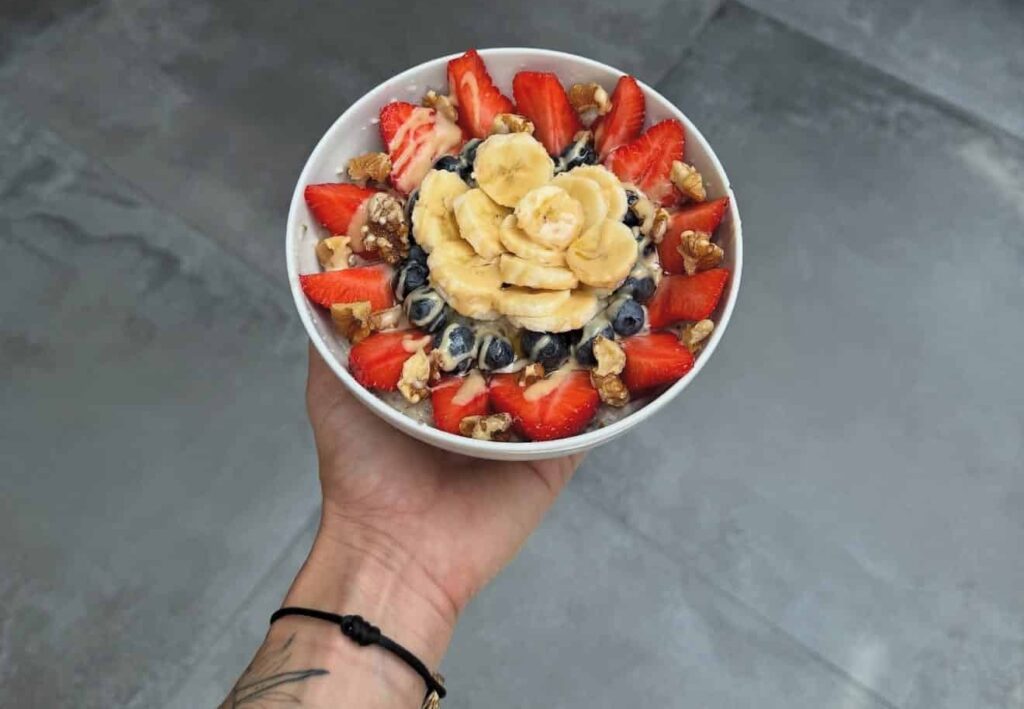
| Breakfast | Greek-style yogurt pot with oats and berries, glass of milk | about 22 g |
| Lunch | Tuna and salad wrap or jacket potato | about 24 g |
| Snack | Skyr pot or cottage cheese on crackers | about 12 to 14 g |
| Before or after the gym | Two eggs on toast | about 18 g |
| Dinner | Salmon fillet with potatoes and vegetables | about 25 g |
Total: about 100 g from the main protein foods. To aim higher, make two meals bigger rather than adding more snacks.
Easy swaps
- No fish? Swap the salmon for chicken breast or lean mince.
- Vegetarian? Use eggs, Greek yogurt, cottage cheese, Quorn and beans. You may need slightly bigger portions to reach the same total.
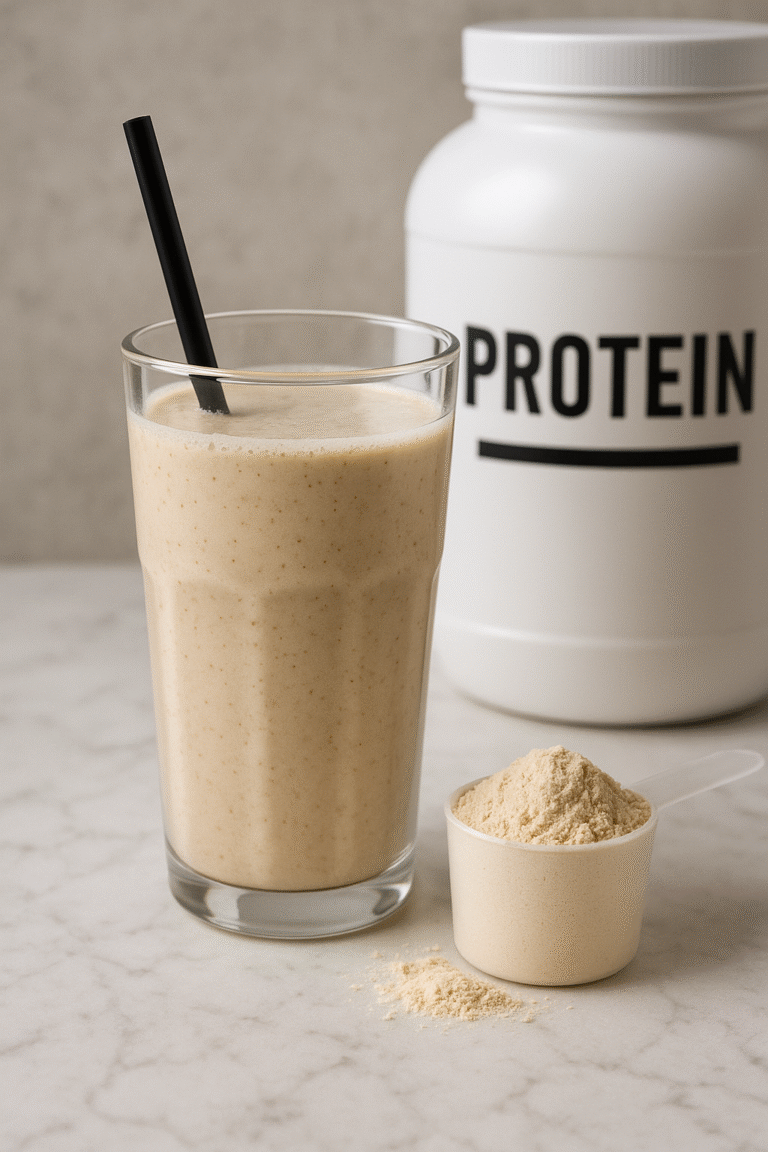
- Short on time? A protein shake can stand in for one snack.
For more breakfast ideas, see our high-protein breakfasts for building muscle.
Protein on training days and rest days
Eat about the same amount of protein every day. Your muscles keep repairing on rest days, and the ISSN advises spreading protein evenly across the day.
On training days, try to have a protein-rich meal or snack within a couple of hours either side of your session. The ISSN says high-quality protein eaten up to 2 hours after training strongly stimulates muscle building. It suggests doses of 20 to 40 g (Kerksick et al., 2017).
You do not need to rush a shake in the changing room. If your next meal is within a couple of hours, that meal does the job. For meal and snack ideas around your session, see what to eat before and after the gym.
Do you need protein shakes?
No. Whole foods can cover your needs. The ISSN calls supplements a practical way to get enough good-quality protein, but they are not required.
A shake helps when:
- You are not hungry for a meal after early training.
- Your next proper meal is more than a few hours away.
- You are a long way short of your target most days.
Treat a scoop of powder as one protein portion, like a pot of yogurt. Most women still get most of their protein from meals. The British Dietetic Association advises speaking to a registered practitioner before taking supplements. For dosing and safety, read how to take whey protein and creatine.
Common protein mistakes
- A light breakfast. Toast and coffee leaves a big gap. Add eggs, yogurt or milk.
- Guessing instead of checking. Many people think they eat more protein than they do. Write down a few normal days and add up the grams.
- Only eating protein on training days. Keep it steady every day.
- Going far above the range. Muscle gains level off around 1.6 g/kg in the research (Morton et al., 2018). Extra protein beyond that mostly replaces carbs or fat you could use to fuel training.
- Ignoring the rest of your plate. Protein works best alongside enough total food and carbs. See carbs for strength training.
Video: Why you’re not gaining muscle. Protein is only one piece. If you have fixed these mistakes and your progress has still stalled, this short video covers the training and recovery reasons.
Check your intake for a week
You do not need to track forever. Log what you eat for three to seven normal days using food labels or a tracking app. Then you will know what a 30 g portion looks like on your plate. Our beginner guide to tracking macros walks you through it.
FAQs
Do women need less protein than men?
Not per kg of body weight. The meta-analysis behind most targets found no clear difference between men and women, though it had far less data on women (Morton et al., 2018). Women often need fewer grams in total simply because they weigh less.
Is a high-protein diet safe?
The ranges in this guide come from sports nutrition guidelines for healthy adults. If you have kidney disease or another medical condition, or you are pregnant, check with your doctor or a registered dietitian before you raise your protein intake.
The bottom line
Aim for about 1.4 to 2.0 g of protein per kg of body weight a day. Move toward 2.2 g/kg if you are dieting or in perimenopause or after menopause. Split it into three or four meals of 20 to 40 g, and keep it steady on rest days.
Protein only builds muscle when your training gives it a reason to. 12REPS plans each session around your goal, your equipment and the time you have. It shows a trainer demonstration for every exercise and remembers what you lifted last time.
Sources
- EFSA sets population reference intakes for protein. European Food Safety Authority, 2012. https://www.efsa.europa.eu/en/press/news/120209
- Sport and exercise: Food Fact Sheet. British Dietetic Association, 2026. https://www.bda.uk.com/resource/sport-exercise-nutrition.html
- International Society of Sports Nutrition Position Stand: protein and exercise. Jäger R et al., Journal of the International Society of Sports Nutrition, 2017. https://doi.org/10.1186/s12970-017-0177-8
- International society of sports nutrition position stand: diets and body composition. Aragon AA et al., Journal of the International Society of Sports Nutrition, 2017. https://doi.org/10.1186/s12970-017-0174-y
- A systematic review, meta-analysis and meta-regression of the effect of protein supplementation on resistance training-induced gains in muscle mass and strength in healthy adults. Morton RW et al., British Journal of Sports Medicine, 2018. https://doi.org/10.1136/bjsports-2017-097608
- International society of sports nutrition position stand: nutritional concerns of the female athlete. Sims ST et al., Journal of the International Society of Sports Nutrition, 2023. https://doi.org/10.1080/15502783.2023.2204066
- International society of sports nutrition position stand: nutrient timing. Kerksick CM et al., Journal of the International Society of Sports Nutrition, 2017. https://doi.org/10.1186/s12970-017-0189-4
- Diet after weight loss surgery: eating enough protein (protein in common foods). Guy’s and St Thomas’ NHS Foundation Trust, 2026. https://guysandstthomas.nhs.uk/health-information/diet-after-weight-loss-surgery/eating-enough-protein