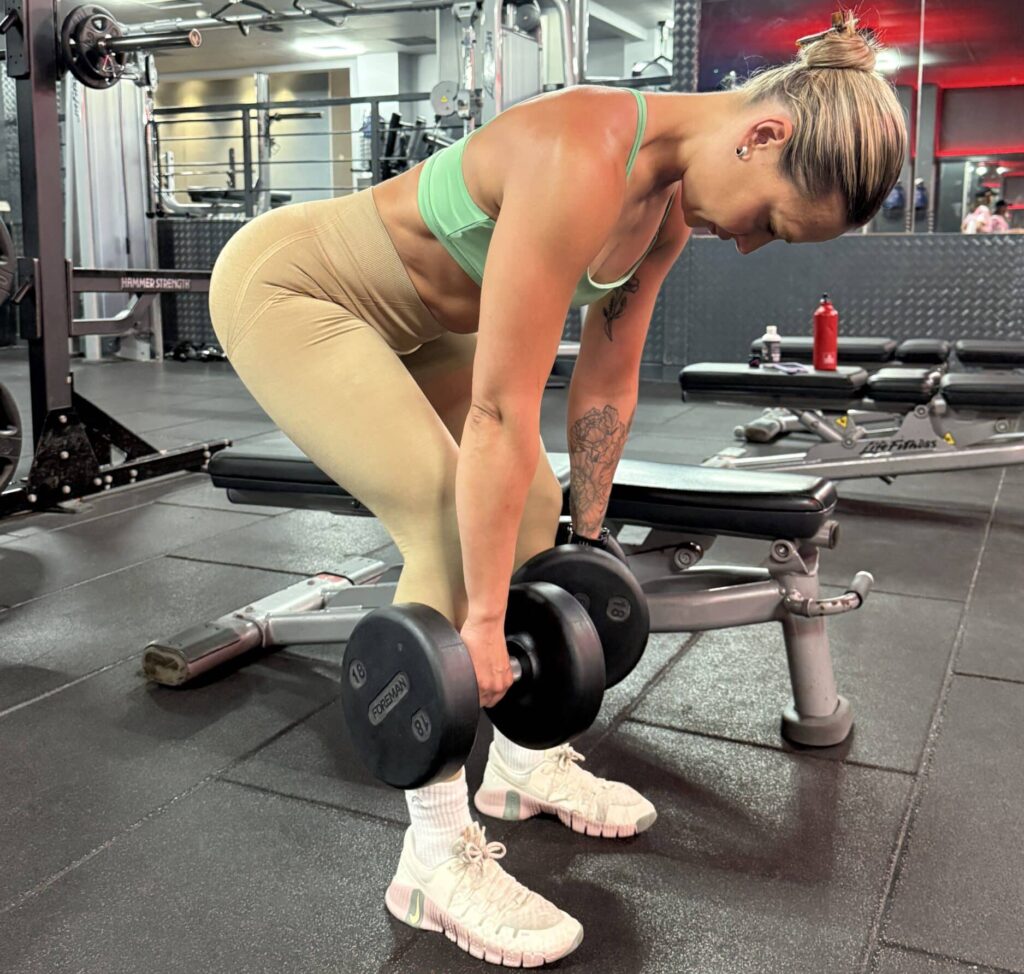
Good Romanian deadlift form is a hip hinge. Stand tall with the weight in front of your thighs and soften your knees. Push your hips back and slide the weight down close to your legs until you feel a strong stretch in your hamstrings, with your back flat. Then drive your hips forward to stand tall.
The Romanian deadlift, or RDL, is the exercise I spend the most time correcting. Most people who find it awkward are squatting it, not hinging it. Once the hinge clicks, the hamstrings take over and the lower back stops doing all the work.
This guide is the RDL on its own: setup, the rep, depth, common mistakes, barbell or dumbbells, and how to progress. For the deadlift from the floor, see how to deadlift properly.
Video: Barbell RDL. Watch the hips travel back while the shins stay almost still, and the bar stay close to the legs the whole way.
What is a Romanian deadlift?
An RDL is a hinge exercise. You start standing, not from the floor. Your knees stay softly bent and almost fixed while your hips move back and forward. The goal is to load your hamstrings in a long, stretched position, then use your hips to stand up.
| Romanian deadlift | Conventional deadlift | |
|---|---|---|
| Starting position | Standing, weight at your thighs | Bar on the floor |
| Knee bend | Soft and almost fixed | Bends more at the start |
| Depth | Until your hamstrings are stretched, usually around the knees to mid-shin | Bar returns to the floor |
| Main focus | Hamstrings and glutes | Legs, hips and back together |
| Typical load | Lighter | Heavier |
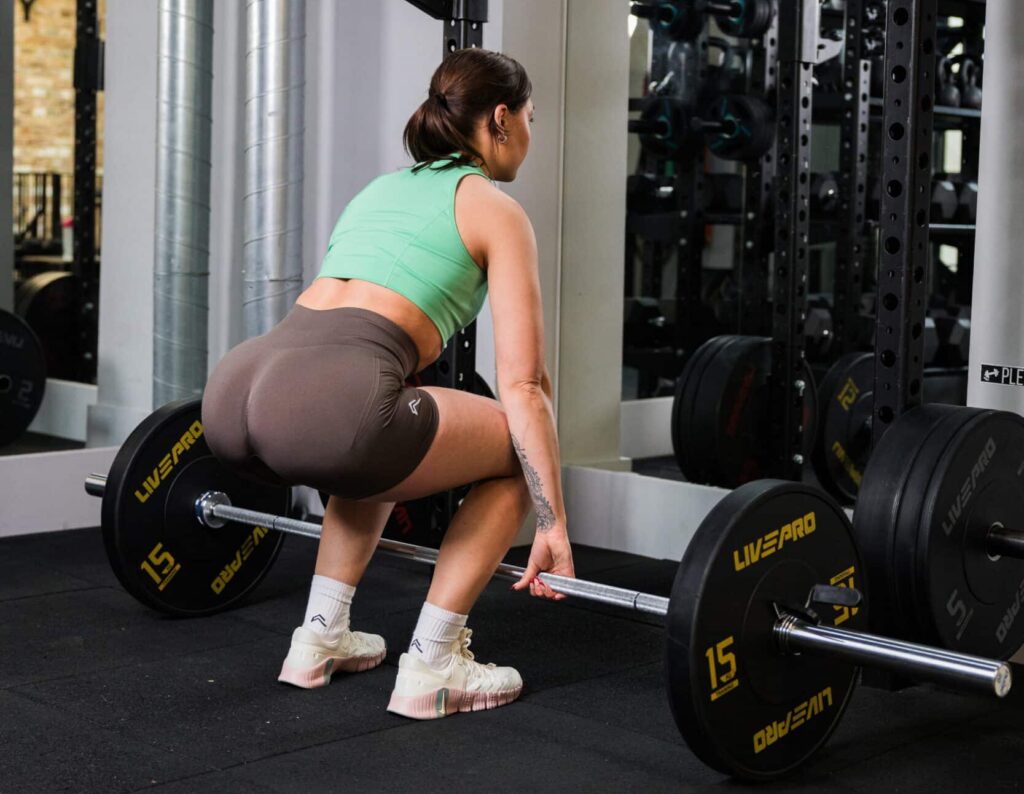
The deadlift setup below starts from the floor with more knee bend. The RDL starts at the top.

Muscles worked in the Romanian deadlift
- Hamstrings: in a study of 12 trained men, hamstring activity was highest in the RDL and the glute-ham raise. The other two exercises tested were the leg curl and good morning.
- Glutes: in eight trained men, the RDL was as effective as the barbell hip thrust at working the hip extensors. Glute activity did not differ significantly between the two.
- Lower back: the spinal muscles work to hold your back still. A systematic review of deadlift studies reported lower lower-back activity than hamstring activity in the RDL.
Most of these are muscle activity studies with small groups of men. They show which muscles do the work, not how much muscle you will build.
The RDL is usually done with a barbell, from a rack or after lifting the bar from the floor, as below. Dumbbells and kettlebells work too.
How to do a Romanian deadlift: step by step
Setup
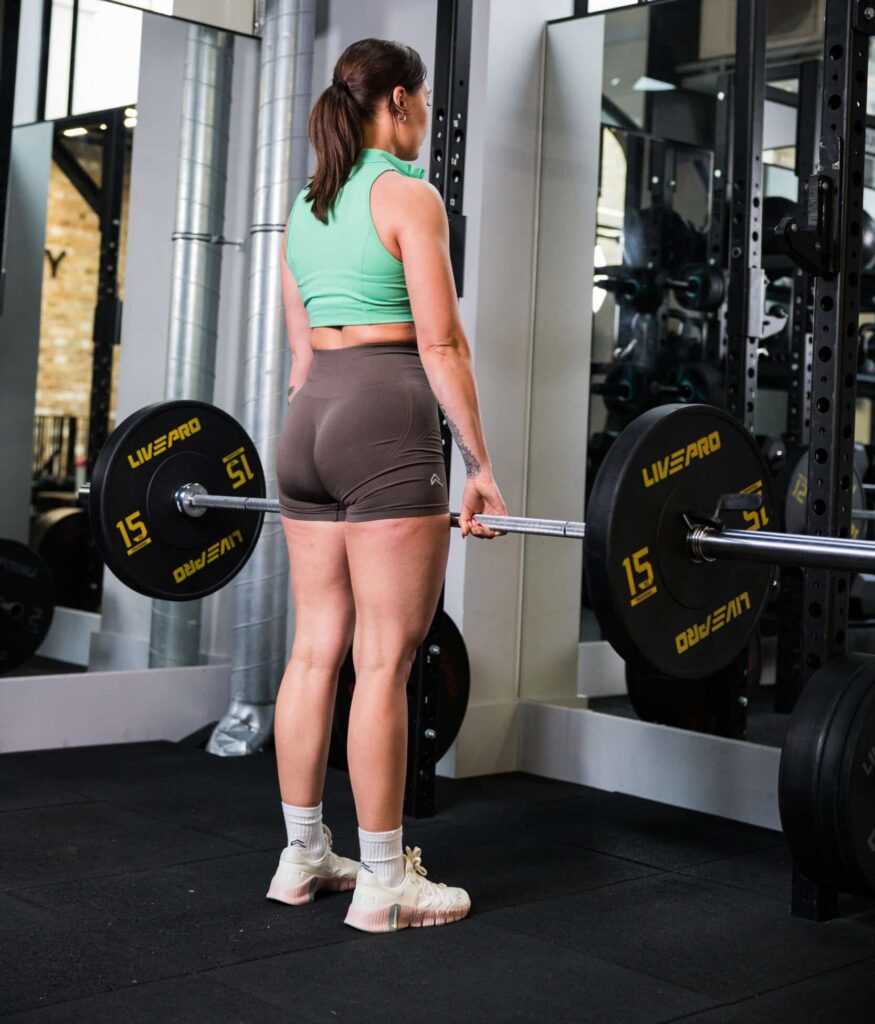
- Feet: hip-width apart, toes pointing forward.
- Grip: hands just outside your thighs, holding a barbell or a dumbbell in each hand.
- Posture: stand tall, shoulders back, ribs down. Take a breath and brace your trunk as if about to be nudged.
- Knees: unlock them slightly. Keep this bend for the whole rep.
The lowering
- Hips back first. Push your hips back as if closing a car door behind you with your bottom.
- Weight close. Let the bar or dumbbells slide down the front of your thighs, almost touching your legs.
- Back flat. Your spine stays long from head to hips. Look at the floor a little ahead of you.
- Stop at the stretch. Lower until you feel a strong stretch in your hamstrings, or until your back starts to round. That is your depth for now.
The lift
- Drive your hips forward. Push your feet into the floor and bring your hips through.
- Finish tall. Stand straight with your glutes squeezed. Do not lean back at the top.
Take about two to three seconds to lower and one to two to stand. The lowering is where most people lose position.
Video: How to do RDL (Romanian deadlifts). Use this as your checklist: soft knees, hips back, flat back, bar close, then hips forward.
How low should you go?
Your hamstring flexibility sets your depth, not a fixed point on your leg. Some people reach mid-shin with a flat back. Others reach just below the knee. Both are right if the back stays flat and you feel the stretch in your hamstrings.
Going lower by rounding your back does not add hamstring work. It moves the work into your lower back. The ACSM position stand found that lifting through a complete range of motion improved strength, so use the full range you can control with a flat back.
Common RDL mistakes and how to fix them
1. Squatting instead of hinging
The knees bend more and more as you go down, and the shins move forward. The quads take over and the hamstrings do less.
Fix: set your knee bend at the top and keep it. Practice with an empty bar or a broomstick, pushing your hips back to touch a wall behind you.
2. Rounding the back
The upper or lower back curves as the weight goes down, often at the bottom of the rep.
Fix: reduce the weight and the depth. Brace before every rep and keep your chest proud. A lighter RDL with a flat back is worth more than a heavy one with a rounded back.
3. Weight drifting away from your legs
The bar swings forward, away from your thighs and shins. This makes the load harder to hold and pulls on your lower back.
Fix: think about dragging the bar down your legs. Dumbbells should brush the front of your thighs.
4. Feeling it mostly in your lower back
Some lower-back effort is normal, because those muscles hold your spine still. If it is the main thing you feel, the hinge is usually off.
Fix: lower the weight, push your hips further back and stop at the hamstring stretch.
5. Leaning back at the top
Fix: finish by squeezing your glutes and standing straight, with your ribs stacked over your hips.
If your RDL looks like the deadlift setup below, with deep knee bend and your hips low, you are squatting it. An RDL keeps your hips high.
Getting the bar into position
An RDL starts at the top, so you need to get the weight there safely first.
- From a rack: set the bar at mid-thigh height, grip it, stand up and take one step back.
- From the floor: lift the bar with a normal deadlift, then start your RDL reps from standing.
- Dumbbells: pick them up with a hinge or a squat, not by rounding over.
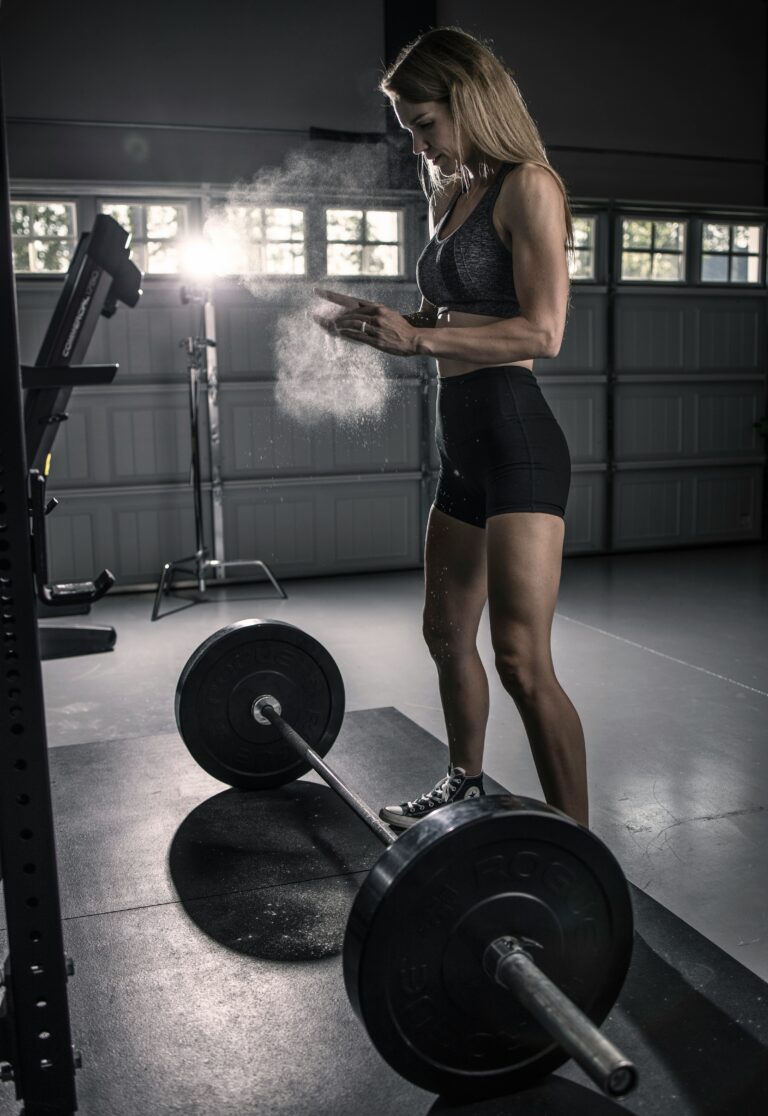
Grip often gives out before your hamstrings do. Chalk, a mixed grip or lifting straps can help on heavier sets, as long as your gym allows them.
Barbell vs dumbbell RDL
| Barbell RDL | Dumbbell RDL | |
|---|---|---|
| Load | Lets you lift more | Limited by the dumbbells you have and your grip |
| Path | Fixed: the bar stays in front of your legs | Freer: dumbbells can slide down the sides or front of your legs |
| Learning | Clear feedback on bar path | Easy to set up and good for learning the hinge |
| Where | Gym | Gym or home |
Start with dumbbells if you are new. They are easy to set up and let you feel the hinge with light weight. Move to a barbell when the dumbbells you have are no longer heavy enough.
For a cable version or a loop band version, see the cable straight bar RDL and the dumbbell RDL with loop band.
Video: Dumbbell RDL. Watch the dumbbells stay close to the legs and the hips move back while the knees stay softly bent.
RDL variations
Single-leg RDL
Hinge on one leg while the other leg reaches back. It trains each side on its own and challenges your balance. In 12 trained men, holding the dumbbell in the hand opposite the standing leg increased upper glute activity compared with holding it on the same side.
Video: Dumbbell single leg RDL. Watch how the hips stay square to the floor and the back leg moves in line with the trunk.
Kettlebell or band RDL at home
A kettlebell held in both hands works well at home. A resistance band under your feet is another option. See the resistance band Romanian deadlift and the kettlebell RDL with loop band.
Video: Kettlebell RDL. The same hinge with one kettlebell, a good option if you train at home.
How to progress your RDL
| Stage | Sets and reps | Focus |
|---|---|---|
| Weeks 1 to 2 | 3 x 10 | Learn the hinge with light dumbbells or an empty bar |
| Weeks 3 to 4 | 3 x 8 to 10 | Add a little weight while the form stays the same |
| Weeks 5 to 8 | 4 x 8 | Add weight when every rep looks the same |
| Month 3 onward | 4 x 6 to 8 | Heavier sets, often with a barbell |
Add weight only when your last set still has one or two good reps in reserve and your back stays flat. If form slips, go back to the last weight.
Where RDLs fit in your week
Do RDLs once or twice a week, after your main squat or deadlift and before smaller exercises. A simple lower-body day could look like this:
- Squat: 4 x 6 to 8
- Romanian deadlift: 4 x 8
- Hip thrust: 3 x 10
- Leg curl: 3 x 12
You can swap the hip thrust for reverse lunges for some single-leg work. Warm up first with a few light sets of the hinge. Our guide to warming up before lifting shows how. For more glute work alongside RDLs, see how to build your glutes and the bodyweight hip thrust.
Train RDLs with a plan
The RDL rewards patience: light weight first, then small jumps. 12REPS builds each session around your goal, your equipment and the time you have, with a trainer demonstration for every exercise. It remembers what you lifted last time, so you always know the number to beat.
Romanian deadlift FAQs
Should my knees be straight in an RDL?
No. Keep a soft bend and hold it. Straight, locked knees turn it into a stiff-leg deadlift, which needs more flexibility.
Where should I feel an RDL?
Mostly in your hamstrings, with your glutes working as you stand up. Your lower back works too, but it should not be the main thing you feel.
How heavy should my RDL be?
Start light. Use a weight you can lower slowly for 10 reps with a flat back. Most people use less on an RDL than on a deadlift from the floor.
Are RDLs safe if I have back pain?
That depends on the cause. If you have back pain or a back condition, check with a physiotherapist or doctor before you add RDLs.
Sources
- Muscle activation during various hamstring exercises. McAllister MJ, Hammond KG, Schilling BK, Ferreria LC, Reed JP, Weiss LW, Journal of Strength and Conditioning Research, 2014. https://doi.org/10.1519/JSC.0000000000000302
- Comparison between back squat, Romanian deadlift, and barbell hip thrust for leg and hip muscle activities during hip extension. Delgado J, Drinkwater EJ, Banyard HG, Haff GG, Nosaka K, Journal of Strength and Conditioning Research, 2019. https://pubmed.ncbi.nlm.nih.gov/31356511/
- Electromyographic activity in deadlift exercise and its variants. A systematic review. Martín-Fuentes I, Oliva-Lozano JM, Muyor JM, PLOS ONE, 2020. https://doi.org/10.1371/journal.pone.0229507
- Effects of loading positions on the activation of trunk and hip muscles during flywheel and dumbbell single-leg Romanian deadlift exercises. Mo RCY et al., Frontiers in Physiology, 2023. https://doi.org/10.3389/fphys.2023.1264604
- American College of Sports Medicine Position Stand. Resistance training prescription for muscle function, hypertrophy, and physical performance in healthy adults: an overview of reviews. Currier BS et al., Medicine and Science in Sports and Exercise, 2026. https://doi.org/10.1249/MSS.0000000000003897