


By Will Duru, BSc (Hons) Sport and Exercise Science, Award-winning Personal Trainer with over 10 years of experience in strength training and optimising recovery
An intermediate lower body workout for women should include a hip thrust, a deadlift, a single-leg exercise, a hip hinge, a squat and calf work, trained 2 to 3 times a week. Use reps between 6 and 20, depending on the exercise, and add weight when your form allows. This guide gives you that six-exercise gym session, with technique steps and a demo video for each lift.
It is written for women who already train and know their way around a gym. If you are just starting out, begin with our beginner’s guide to women’s lower body strength training. If you want a full plan that runs for several weeks, follow the 6-week lower body program for glutes, quads and hamstrings.
Why your lower body deserves heavy, focused training
Your glutes, quads, hamstrings and calves drive almost everything you do on your feet. Standing up, climbing stairs, carrying shopping, running and jumping all depend on them.
- Muscle you keep: An MRI study of 468 adults found that age-related muscle loss happens mainly in the lower body, mostly after about age 50 (Janssen and colleagues). Building leg strength now gives you more muscle to keep later.
- Bone loading: In premenopausal women, programs that combined impact exercise with heavy resistance training improved bone density at the hip and spine (Martyn-St James and Carroll).
- Health guidelines: The CDC advises muscle-strengthening activity for all major muscle groups, including the legs and hips, on at least 2 days a week (CDC).
Is this workout right for you?
This session suits you if:
- You have trained your legs regularly for at least a few months.
- You can squat, hinge and lunge with good control using light weights.
- Your gym has a barbell, a trap bar, dumbbells, a kettlebell and a step or calf raise platform.
A simple rule for heavier lifts: if your technique holds for every rep, you are ready to add weight. If it breaks down, stay at the same weight until it doesn’t.
The intermediate lower body workout for women
- How often: 2 to 3 times a week.
- How long: about 45 to 60 minutes.
- Equipment: barbell, trap bar, dumbbells, kettlebell and a calf raise platform or step.
- Goal: lower body strength, muscle and better movement.
| Exercise | Sets | Reps | Rest |
|---|---|---|---|
| Barbell hip thrust | 4 | 8-10 | 2-3 minutes |
| Trap bar deadlift | 4 | 6-8 | 3-4 minutes |
| Dumbbell reverse lunge | 3 | 10-12 each leg | 90 seconds |
| Dumbbell Romanian deadlift (RDL) | 3 | 10-12 | 2 minutes |
| Kettlebell goblet squat | 3 | 12-15 | 90 seconds |
| Calf raise | 4 | 15-20 | 60 seconds |
How heavy should you go?
Choose a weight that lets you reach the top of the rep range with clean form, where the last two reps feel hard. You do not need to push every set to failure. A meta-analysis found no clear extra muscle growth from training to complete failure compared with stopping a little short (Refalo and colleagues).
When you reach the top of the rep range on every set, add a little weight next session. This is progressive overload: making your training slightly harder over time. Our beginner’s guide to progressive overload explains other ways to do it.
In the 12REPS app, you enter the reps and weight for each set. The app remembers what you lifted, so you always have a number to beat next time.
How to do each exercise
1. Barbell hip thrust
The hip thrust trains your glutes through hip extension, which means driving your hips forward and up.
- Sit on the floor with your upper back against a bench and a padded barbell over your hip crease.
- Plant your feet about hip-width apart, so your shins are close to vertical at the top.
- Tuck your chin slightly and drive through your whole foot to lift your hips.
- At the top, your knees, hips and shoulders form a straight line. Squeeze your glutes without arching your lower back.
- Lower under control and repeat.
Hip thrusts are a strong glute exercise, but they are not the only one. In a 9-week trial in untrained young adults, hip thrusts and back squats built similar glute size. The squat group also gained more quad and inner-thigh muscle (Plotkin and colleagues). That is why this workout pairs the hip thrust with squat and lunge patterns.
Video: How to do a barbell hip thrust. Watch this before your first set to check your setup against the bench and your position at the top.
For a deeper breakdown, read how to do barbell hip thrusts correctly.
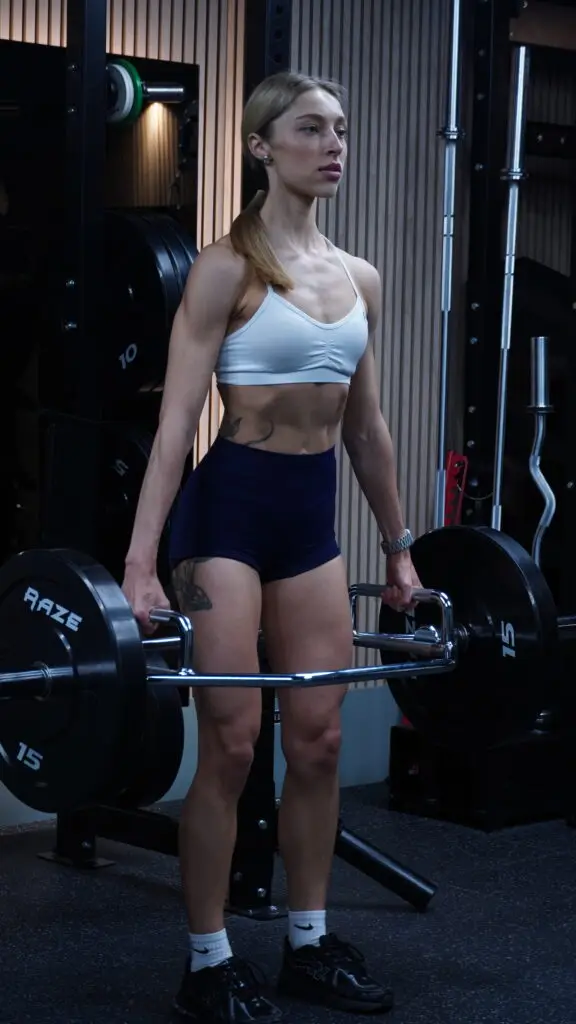
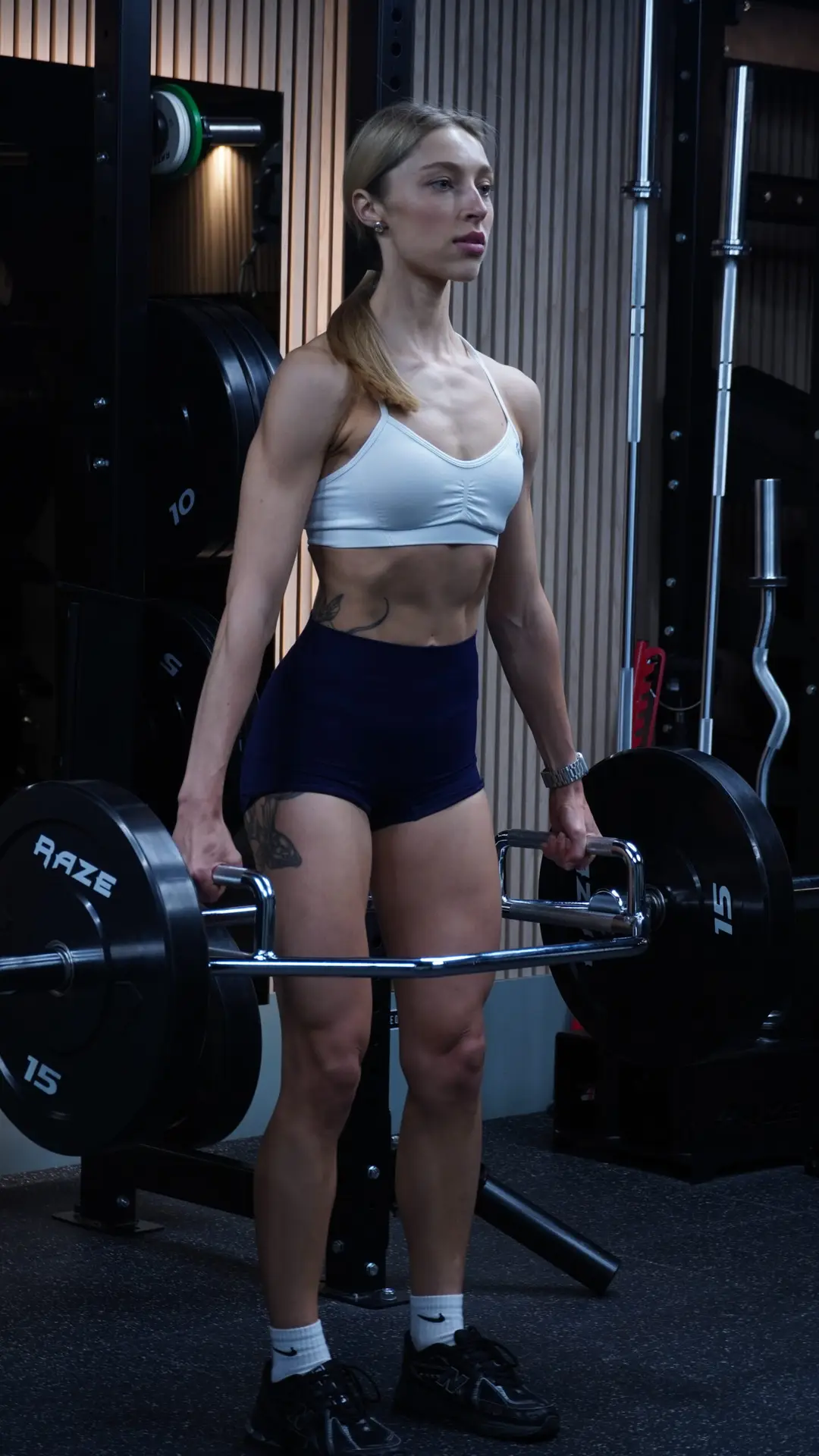
2. Trap bar deadlift
With a trap bar (also called a hex bar), you stand inside the bar and hold handles at your sides. In male powerlifters, the trap bar put less peak load on the lower back and hips than a straight bar. It put more on the knees (Swinton and colleagues). So the trap bar shares the work more evenly between your hips and knees.
- Step into the bar with your feet about hip-width apart, centered between the handles.
- Push your hips back, bend your knees and grip the handles with straight arms.
- Brace your trunk, lift your chest slightly and keep your back flat.
- Push the floor away, straightening your hips and knees together until you stand tall.
- Lower the bar the same way, under control.
Video: Trap bar deadlift. Watch the demo below to see the full movement before you load the bar.
3. Dumbbell reverse lunge
Reverse lunges train one leg at a time. That helps you notice and work on differences between your left and right side. Many people also find stepping back easier to balance than stepping forward.
- Stand tall with a dumbbell in each hand, arms by your sides.
- Take a long step backward with one leg.
- Lower your back knee toward the floor until both knees are bent to about 90 degrees.
- Keep your chest up and your front knee in line with your toes.
- Push through your front foot to return to standing. Finish all reps on one side, then switch.
Video: Dumbbell reverse lunges. Use this demo to check your step length and balance before you go heavier.
4. Dumbbell Romanian deadlift (RDL)
The RDL is a hip hinge. It trains your hamstrings and glutes as you bend at the hips with a long, flat back.
- Stand with your feet hip-width apart, holding dumbbells in front of your thighs.
- Soften your knees slightly and keep them in that position.
- Push your hips back and let the dumbbells slide down the front of your legs.
- Stop when you feel a strong stretch in your hamstrings, or when your back starts to round.
- Drive your hips forward to stand tall again.
See our RDL form guide for women for common faults and variations.
Video: Dumbbell RDL. Watch how the hips move back first, then copy that pattern with light dumbbells.
5. Kettlebell goblet squat
Holding the weight at your chest helps you stay upright, which makes the goblet squat a good squat pattern to load after heavier work.
- Hold a kettlebell by the horns at chest height, elbows pointing down.
- Stand with your feet slightly wider than hip-width and toes turned out a little.
- Sit down between your heels, keeping your chest up and your whole foot on the floor.
- Go as low as you can while your back stays flat and your heels stay down.
- Push the floor away to stand up.
Video: Kettlebell goblet squats. Watch the demo to see the depth and upright posture to aim for.
6. Calf raise
Calf raises train the muscles that point your foot and push you off the ground when you walk, run or jump.
- Stand with the balls of your feet on a step or calf raise platform.
- Lower your heels below the step until you feel a stretch in your calves.
- Rise as high as you can onto your toes.
- Pause for a moment at the top, then lower slowly.
Video: Standing calf raises. Watch the full range of motion in the demo, from a deep stretch to a high finish.
Common mistakes and how to fix them
- Arching at the top of the hip thrust. Finish with your ribs down and glutes squeezed. If your lower back takes over, lighten the bar.
- Rounding your back on deadlifts and RDLs. Brace before each rep and stop the lowering phase where your back stays flat.
- Rushing the lowering phase. Control each rep on the way down. Bouncing out of the bottom shifts work away from the target muscles.
- Short calf raises. Use the full range, from a deep stretch to a high rise.
- Cutting rest short on heavy lifts. The hip thrust and trap bar deadlift need the full rest listed, so you can keep your form on every set.
- Adding weight too soon. Increase the load only when you hit the top of the rep range on every set with clean form.
Where this workout fits in your week
Repeat this session 2 to 3 times a week and log every set. Training your upper body too? See the legs and core day in our push/pull/legs plan for women over 30. It shows how a lower body session fits into a three-day week.
If you want a plan built around your goal, your equipment and the time you have, the 12REPS app sets out each session for you. Every exercise comes with a trainer demonstration, and your lifts are saved so you can see your progress week by week.
Sources
- Skeletal muscle mass and distribution in 468 men and women aged 18-88 yr. Janssen I, Heymsfield SB, Wang Z, Ross R. Journal of Applied Physiology, 2000. https://pubmed.ncbi.nlm.nih.gov/10904038/
- Effects of different impact exercise modalities on bone mineral density in premenopausal women: a meta-analysis. Martyn-St James M, Carroll S. Journal of Bone and Mineral Metabolism, 2010. https://doi.org/10.1007/s00774-009-0139-6
- Adult Activity: An Overview. Centers for Disease Control and Prevention (CDC), 2023. https://www.cdc.gov/physical-activity-basics/guidelines/adults.html
- Influence of Resistance Training Proximity-to-Failure on Skeletal Muscle Hypertrophy: A Systematic Review with Meta-analysis. Refalo MC and colleagues. Sports Medicine, 2023. https://pubmed.ncbi.nlm.nih.gov/36334240/
- Hip thrust and back squat training elicit similar gluteus muscle hypertrophy and transfer similarly to the deadlift. Plotkin DL and colleagues. Frontiers in Physiology, 2023. https://doi.org/10.3389/fphys.2023.1279170
- A biomechanical analysis of straight and hexagonal barbell deadlifts using submaximal loads. Swinton PA and colleagues. Journal of Strength and Conditioning Research, 2011. https://pubmed.ncbi.nlm.nih.gov/21659894/