


By Will Duru, BSc (Hons) Sport and Exercise Science Award-winning Personal Trainer with over 10 years of experience in strength training and optimising recovery.
How much weight should a woman lift as a beginner? Choose a weight you can lift for your target reps, usually 8 to 12, with good technique and 2 to 3 reps still left in the tank. For most women that is heavier than the small dumbbells they first reach for. The right number differs by exercise, so find it with a short test set rather than a guess.
Standing in front of the dumbbell rack is one of the most common sticking points for women who are new to lifting. As a personal trainer, I see two mistakes again and again. Some women start so light that nothing changes for weeks. Others grab something so heavy that their technique falls apart by rep four.
This guide is only about your starting weight: the number you use in your first sessions on a new exercise. When you are ready to go heavier, read how heavy is too heavy and when to increase your weights. For a general version of this topic, see how much weight should I lift.
What the right starting weight feels like
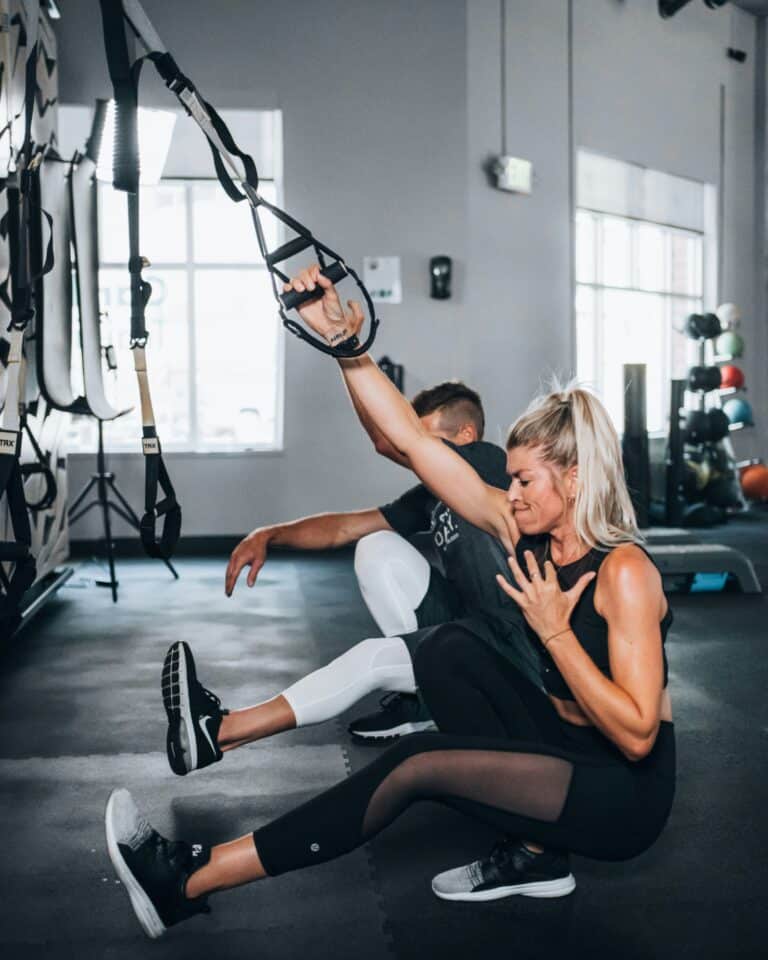
The right weight is defined by effort, not by a number on the dumbbell. Trainers measure that effort with reps in reserve (RIR): how many more good reps you could have done when you stopped the set.
Some people use RPE (rating of perceived exertion) instead. On the lifting version of the scale, RPE 10 means no reps left and RPE 8 means about 2 left (Zourdos et al., 2016). Read RPE vs RIR for more on both scales.
| Reps left at the end of the set | RPE | What it means for a beginner |
|---|---|---|
| 5 or more | 5 or lower | Too light to count as a working set |
| 3 to 4 | 6 to 7 | A little light, fine for your first session |
| 2 to 3 | 7 to 8 | Your target zone |
| 0 to 1 | 9 to 10 | Too heavy for now |
You do not need to train to failure. The American College of Sports Medicine (ACSM) 2026 position stand found that taking sets to failure did not add strength or muscle gains. It mentions stopping about 2 to 3 reps short as one way to work hard enough, though the exact target is not settled (ACSM, 2026).
Expect to misjudge this at first. Across studies, people underestimated how many reps they had left by about one rep on average (Halperin et al., 2022). If you think you have 2 left, you may well have 3. That is one reason many beginners can lift more than they expect.
Do women need different starting weights from men?
The method is the same for women and men. The ACSM 2026 position stand gives no separate recommendations for women (ACSM, 2026). A large analysis also found that sex made little difference to how many reps people can do at a given percentage of their maximum (Nuzzo et al., 2024).
What often differs is the gap between your upper and lower body. In one classic study, women’s upper-body strength averaged about 52% of men’s, while lower-body strength averaged about 66% (Miller et al., 1993). In practice, many women can lift much more with their legs than their arms.
So do not pick one dumbbell for the whole session. A weight that suits a shoulder press is often far too light for a goblet squat. Read why women’s upper and lower body strength differ for more on this gap.
How to find your starting weight in 4 steps
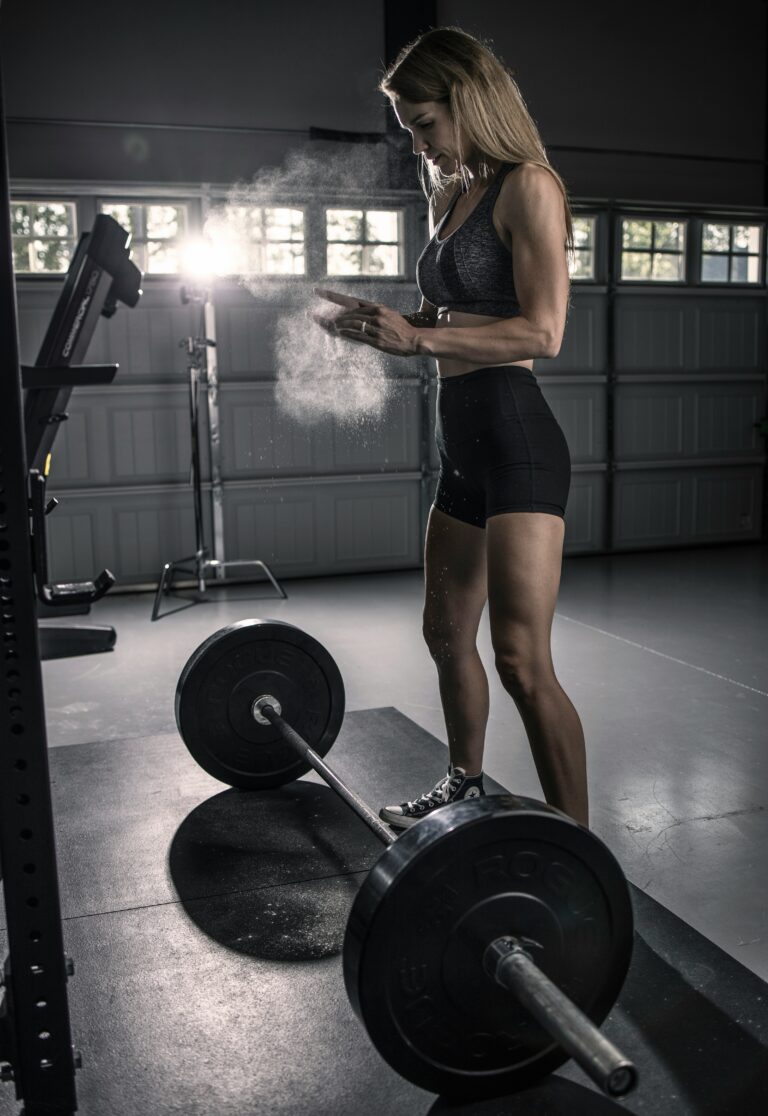
Use this test the first time you try any exercise. It takes two or three sets.
- Warm up. Do one or two easy sets with a light weight to rehearse the movement.
- Pick a conservative weight. Choose one you are confident you can lift 10 to 12 times. If you are torn between two, take the lighter one.
- Do one set of 10 reps. Move with control through your full range. Then rate how many good reps you had left.
- Adjust and repeat. Rest for a minute or two, change the weight using the table below, and test again.
| After 10 reps you had | Next set |
|---|---|
| 5 or more reps left | Go up one or two dumbbell sizes |
| 3 to 4 reps left | Go up one size, or keep it for your first week |
| 2 to 3 reps left | This is your starting weight. Use it for your remaining sets |
| 0 to 1 reps left, or your technique slipped | Go down one size |
This matches a common starting point for new lifters. ACSM’s 2009 position stand suggests novices begin with a weight they can lift for about 8 to 12 reps (ACSM, 2009).
Worked example: the goblet squat
Say you pick an 8 kg dumbbell for goblet squats. After 10 reps you feel you could do 6 more. Next set, try 10 or 12 kg. If you finish 10 reps at 12 kg with 2 or 3 left, 12 kg is your starting weight.
Video: Dumbbell goblet squats. Watch this before your test sets to see the position and depth you should keep on every rep. For a full breakdown, read how to do a goblet squat.
Typical first weights for women new to lifting
These are rough coaching starting points, not rules. Your history, body size and sport background all change them.
| Exercise type | Common starting range (dumbbells) |
|---|---|
| Shoulder exercises, such as a dumbbell shoulder press | 3 to 5 kg each hand |
| Upper-back exercises, such as a single-arm row | 5 to 8 kg |
| Lower-body exercises, such as a goblet squat | 8 to 12 kg |
Use the ranges to choose your first test weight. Let the test set decide the final number.
Machines, dumbbells or a barbell?
Any of them works for your first sessions. Machines let you change the weight in small steps and guide the path of the movement. Dumbbells train each side on its own. A standard Olympic barbell weighs 20 kg before you add plates, so start with dumbbells or a lighter fixed bar if that is too much.
Video: What beginners should use, free weights or machines. Watch this if you are unsure which equipment to start with in the gym.
Common starting-weight mistakes
- Using one weight for everything. Your legs and back can usually handle far more than your shoulders and arms.
- Staying with the lightest dumbbells. If you could do 15 more reps, the set is too easy to drive change. Lifting a challenging weight will not make you bulky either; see will lifting weights make me bulky.
- Going to failure on day one. Stop with 2 to 3 reps left. You will learn the movement better and recover sooner.
- Letting technique slide to finish the set. If your range shortens or you start swinging, the weight is too heavy for now.
- Retesting every session. Once you find a starting weight, write it down and build from it.
Write your starting weights down
Log the exercise, weight, reps and how many reps you had left. Next session you can start from that number instead of testing again. Our guide to tracking your workouts explains what to record.
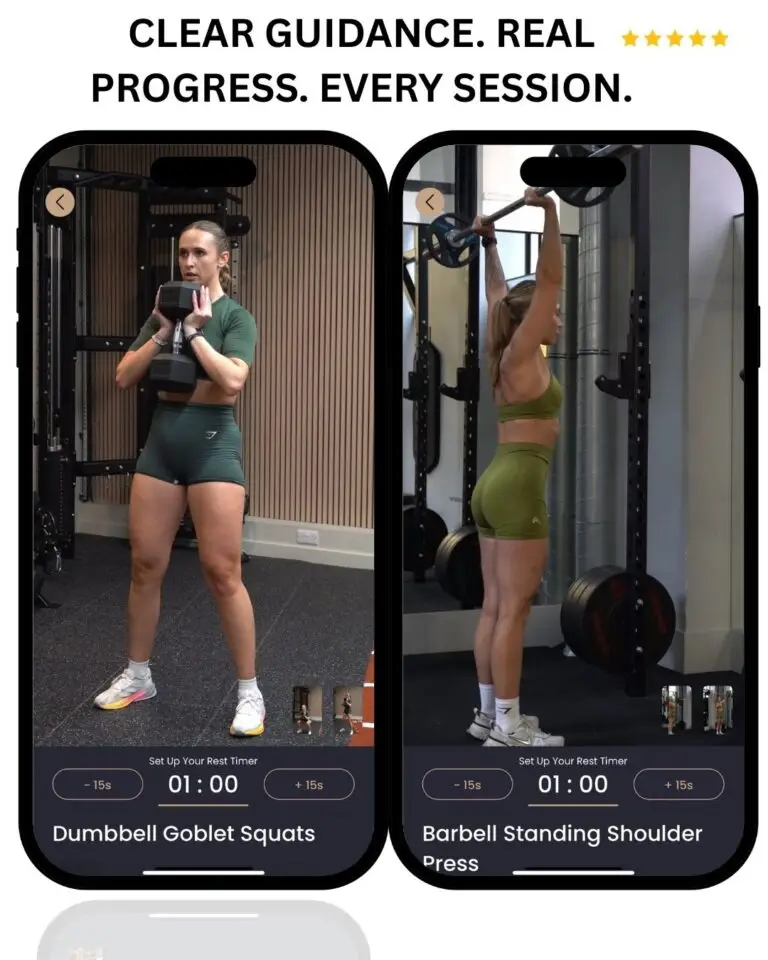
If you would rather not guess at all, 12REPS builds each session around your goal, your equipment and the time you have. Every exercise comes with a trainer demonstration, and the app remembers what you lifted, so you always have a number to beat.
What comes next
Your starting weight is only the first step. Expect to outgrow it as you get stronger. When a weight starts to feel easy, our guide to increasing your weights explains when to go up and by how much.
Starting weight FAQs
Is a 2 kg dumbbell too light to start with?
For some shoulder exercises, 2 kg is a sensible first test. For most other exercises it will be too light. Run the 4-step test and let your reps in reserve decide.
Should a beginner woman lift heavy?
Lift a weight that is challenging for your target reps. That will feel heavy by the end of each set. Very heavy, low-rep sets can wait until you have learned the movement.
What if I cannot tell how many reps I have left?
That is normal at first. Watch your rep speed. When the last reps slow down clearly but still look the same, you are usually close to 2 to 3 reps left.
Sources
- Resistance training prescription for muscle function, hypertrophy, and physical performance in healthy adults: an overview of reviews (ACSM position stand). Currier BS et al., American College of Sports Medicine, Medicine & Science in Sports & Exercise, 2026. https://doi.org/10.1249/MSS.0000000000003897
- Novel resistance training-specific rating of perceived exertion scale measuring repetitions in reserve. Zourdos MC et al., Journal of Strength and Conditioning Research, 2016. https://doi.org/10.1519/JSC.0000000000001049
- Accuracy in predicting repetitions to task failure in resistance exercise: a scoping review and exploratory meta-analysis. Halperin I et al., Sports Medicine, 2022. https://doi.org/10.1007/s40279-021-01559-x
- Maximal number of repetitions at percentages of the one repetition maximum: a meta-regression and moderator analysis of sex, age, training status, and exercise. Nuzzo JL, Pinto MD, Nosaka K, Steele J, Sports Medicine, 2024. https://doi.org/10.1007/s40279-023-01937-7
- Gender differences in strength and muscle fiber characteristics. Miller AEJ, MacDougall JD, Tarnopolsky MA et al., European Journal of Applied Physiology, 1993. https://doi.org/10.1007/BF00235103
- American College of Sports Medicine position stand. Progression models in resistance training for healthy adults. American College of Sports Medicine, Medicine & Science in Sports & Exercise, 2009. https://pubmed.ncbi.nlm.nih.gov/19204579/