


By Will Duru, BSc (Hons) Sport and Exercise Science, Award-winning Personal Trainer with over 10 years of experience in strength training and optimising recovery
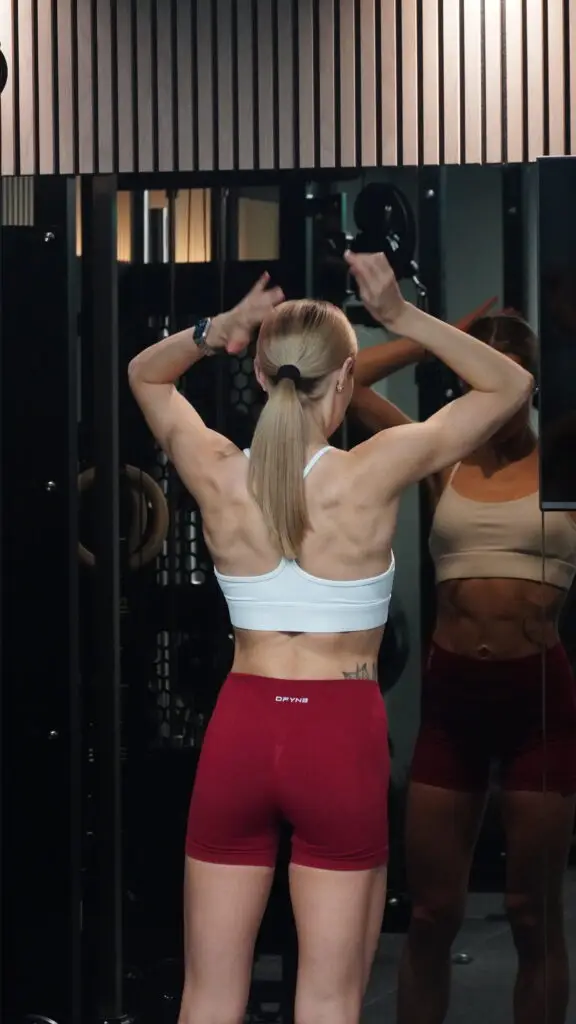
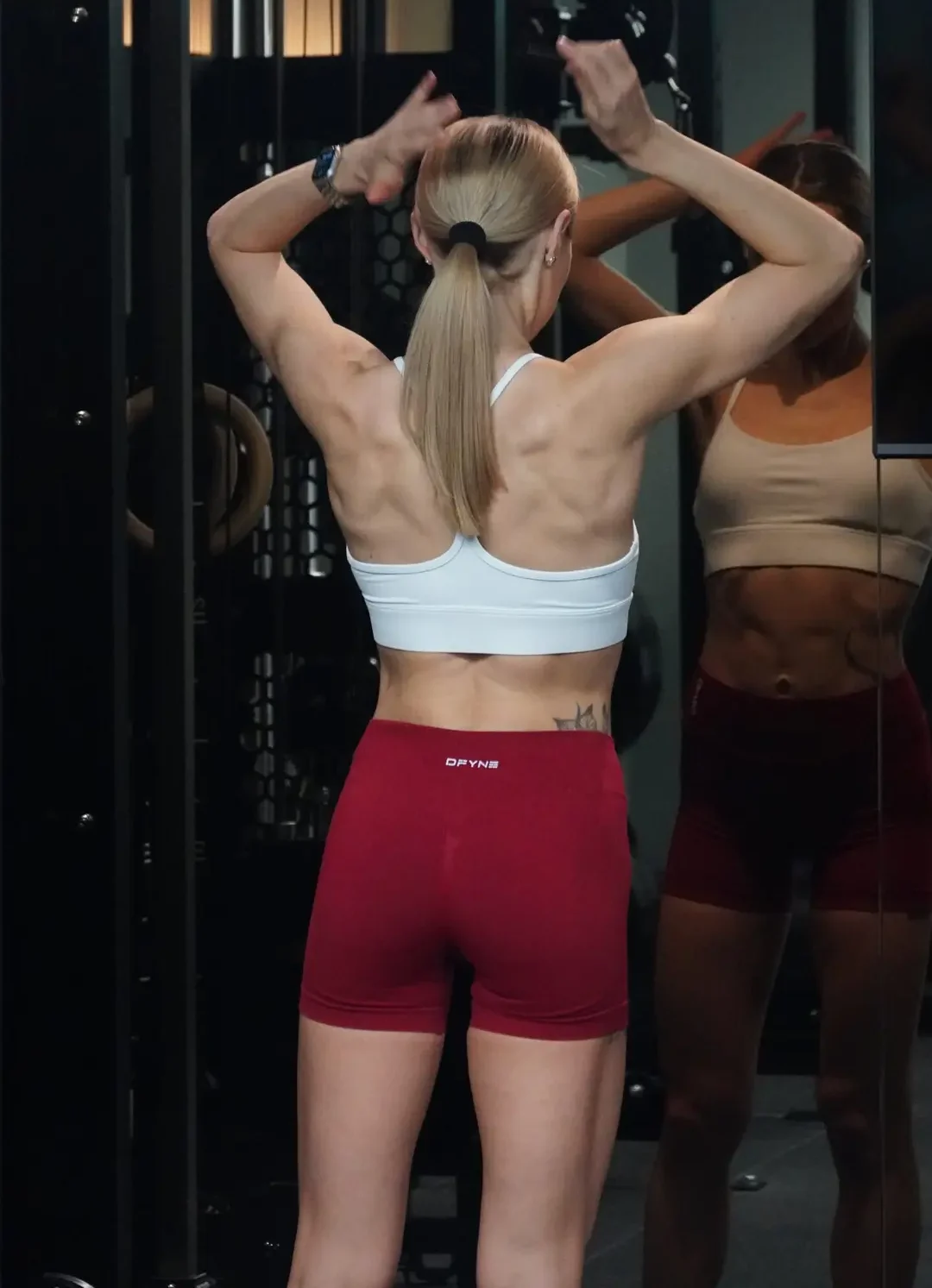
Upper body strength training for women means training your back, shoulders and arms with exercises such as pull-ups, rows, face pulls, lateral raises and curls. Train these muscles at least twice a week, use weights that feel hard by the last few reps, and add a little more over time.
If your upper body feels like your weak link, the good news is that it responds well to training. This guide covers the muscles involved, six gym exercises, a sample workout and how to progress it.
Why upper body strength matters for women
You use your upper body every day to lift, carry, push and pull. Bags, children, luggage and a heavy door all ask for it. The NHS physical activity guidelines recommend strengthening activities on at least 2 days a week, covering all major muscle groups, including your back, chest, shoulders and arms.
Women also gain upper body strength well. A 2020 meta-analysis on sex differences in resistance training found no significant difference between women and men in muscle growth. Women made larger relative gains in upper body strength.
The upper body muscles you are training
- Latissimus dorsi (lats): the large, fan-shaped muscles on each side of your back. They pull your arms down and back, as in a pull-up.
- Rhomboids and middle trapezius: they sit between your shoulder blades and pull them together when you row.
- Upper trapezius: runs from the base of your skull to your shoulders and lifts your shoulder blades, as in a shrug.
- Deltoids: your shoulder muscles have front, side and rear parts. The front raises your arm forward, the side raises it out to the side, and the rear pulls it back.
- Rotator cuff: four small muscles that help control and turn your shoulder joint.
- Biceps and brachialis: on the front of your upper arm. They bend your elbow.
- Triceps: on the back of your upper arm. They straighten your elbow.
Will lifting make your arms bulky?
This is a common worry, and a common misconception. Muscle builds slowly, over months and years of hard training and enough food. For most women, building muscle makes the arms and back look more defined, not bulky. Read more in will lifting weights make me bulky?
Progressive overload for your upper body
Progressive overload means making your training a little harder over time, so your muscles keep adapting. The 2026 ACSM position stand recommends progressive resistance training for healthy adults. It found that strength improved with 2 or more sessions a week and with heavier loads.
You can progress by:
- adding weight,
- doing more reps or sets,
- resting a little less between sets,
- or improving your technique and range of motion.
Upper body lifts often move in smaller steps than leg lifts. Going from a 6 kg to an 8 kg dumbbell is a big jump on a lateral raise, so add reps first. Our complete guide to progressive overload explains more ways to progress.

The 6 best upper body exercises for women at the gym
These six exercises cover the main pulling muscles of your back, your shoulders and your arms. Here is what each one mainly trains.
| Exercise | Main muscles |
|---|---|
| Pull-up (or assisted pull-up) | Lats, biceps, upper back |
| Barbell bent-over row | Lats, rhomboids, trapezius, rear shoulders, biceps |
| Rope face pull | Rear shoulders, upper back, rotator cuff |
| Cable seated row | Lats, rhomboids, middle back |
| Dumbbell lateral raise | Side shoulders |
| Dumbbell hammer curl | Biceps, brachialis, forearms |
1. Pull-up
The pull-up trains your lats, biceps and upper back. Many women cannot do one at first, and that is normal. Start with a band-assisted pull-up, an assisted pull-up machine or a lat pulldown, and build up.
- Hang from the bar with your hands just wider than your shoulders, palms facing away.
- Pull your shoulder blades down, then pull your chest toward the bar.
- Lower yourself with control until your arms are straight.
Video: Pull-ups. Watch this 12REPS demo to see the full hang, the pull and the controlled lowering.
For a step-by-step path, read how to do your first pull-up and our lat pulldown and pull-up technique guide for women.
2. Barbell bent-over row
The barbell bent-over row builds your lats, rhomboids, trapezius and rear shoulders, with help from your biceps.
- Stand with your feet about hip-width apart and hold the bar with an overhand grip.
- Hinge at your hips until your torso is well forward, with a flat back and soft knees.
- Pull the bar toward your lower ribs, squeezing your shoulder blades together.
- Lower the bar with control and repeat.
Video: How to do a barbell bent-over row. Watch this before your first set to see the hip hinge and where the bar should travel.
Our barbell row technique guide for women covers grip and back position in more detail.
3. Rope face pull
The rope face pull trains your rear shoulders and upper back, and works the rotator cuff as you turn your arms out.
- Attach a rope to a cable set at about head height.
- Hold the rope with both hands and step back until your arms are straight.
- Pull the rope toward your face, keeping your elbows high and spreading the rope ends apart.
- Pause, then return with control.
4. Cable seated row
The cable seated row lets you train your lats and middle back through a full range of motion with steady tension. A neutral handle, as in the cable V-bar row, is a good place to start.
- Sit with your feet on the platform and your knees slightly bent.
- Hold the handle with your arms straight and your chest up.
- Pull the handle to your lower ribs and squeeze your shoulder blades together.
- Let your arms straighten with control, without rounding your back.
5. Dumbbell lateral raise
The lateral raise targets the side of your shoulders, which gives your shoulders a broader, rounder look.
- Stand with a light dumbbell in each hand at your sides.
- Keep a slight bend in your elbows and raise the dumbbells out to the sides.
- Stop at about shoulder height. Keep your shoulders down, away from your ears.
- Lower slowly.
6. Dumbbell hammer curl
The hammer curl uses a palms-facing-in grip. It trains your biceps, the brachialis underneath them and the forearm muscles.
- Stand with a dumbbell in each hand, palms facing each other.
- Keep your elbows at your sides and curl the dumbbells toward your shoulders.
- Lower with control. Avoid swinging your body.
Sample upper body workout
Here is a gym session that puts the six exercises together. Warm up for 5 to 10 minutes first:
- light cardio, such as cycling or a brisk walk,
- moving stretches, such as arm circles and torso turns,
- activation drills, such as band pull-aparts and wall slides.
| Exercise | Sets | Reps | Rest | Focus |
|---|---|---|---|---|
| Pull-up or assisted pull-up | 4 | 8-12 | 60-90 seconds | As many good reps as you can, within the range |
| Barbell bent-over row | 4 | 8-12 | 60-90 seconds | Challenging weight, squeeze your back |
| Rope face pull | 4 | 12-15 | 45-60 seconds | Controlled, squeeze your shoulder blades |
| Cable seated row | 4 | 10-12 | 60-90 seconds | Full range of motion |
| Dumbbell lateral raise | 4 | 12-15 | 45-60 seconds | Light to moderate weight, clean form |
| Dumbbell hammer curl | 4 | 10-12 | 45-60 seconds | Squeeze at the top |
Pick a weight that leaves you about 1 to 3 reps short of failure on most sets. This is called reps in reserve (RIR). When you can hit the top of the rep range on every set, add a little weight next time.
Nutrition for upper body strength
Training builds the stimulus. Food helps you recover and build muscle from it.
- Protein: a 2018 meta-analysis found muscle gains from strength training leveled off at about 1.6 g of protein per kg of body weight per day. The authors suggested up to 2.2 g/kg for the full benefit. Spread it across meals, for example about 0.4 g/kg per meal over four meals.
- Carbohydrates: they fuel hard sessions. Oats, rice, potatoes, fruit and whole grains are easy choices.
- Fats: choose mostly unsaturated fats, such as olive oil, nuts, seeds, avocado and oily fish.
For practical amounts and meal ideas, read how much protein women need for strength training and what to eat before and after the gym.
Common upper body training mistakes
- Only training what you can see in the mirror. Rows and pull-ups matter as much as curls and raises.
- Staying with weights that feel easy. If you could do many more reps, the weight is too light to drive progress.
- Shrugging on lateral raises. Keep your shoulders down and use a lighter weight if needed.
- Swinging on curls and rows. Control the weight both ways.
- Skipping legs. A balanced week trains your whole body. Our glute workout for women at the gym pairs well with this session.
- Too little rest and sleep. Your muscles recover between sessions, so give each muscle group a day or two before training it hard again.
How to fit this into your week
Do this upper body session once or twice a week, and a lower body session on separate days. That gives you at least two strength days, in line with the NHS guidelines. If you are unsure how to split your week, read upper/lower vs full body for women.
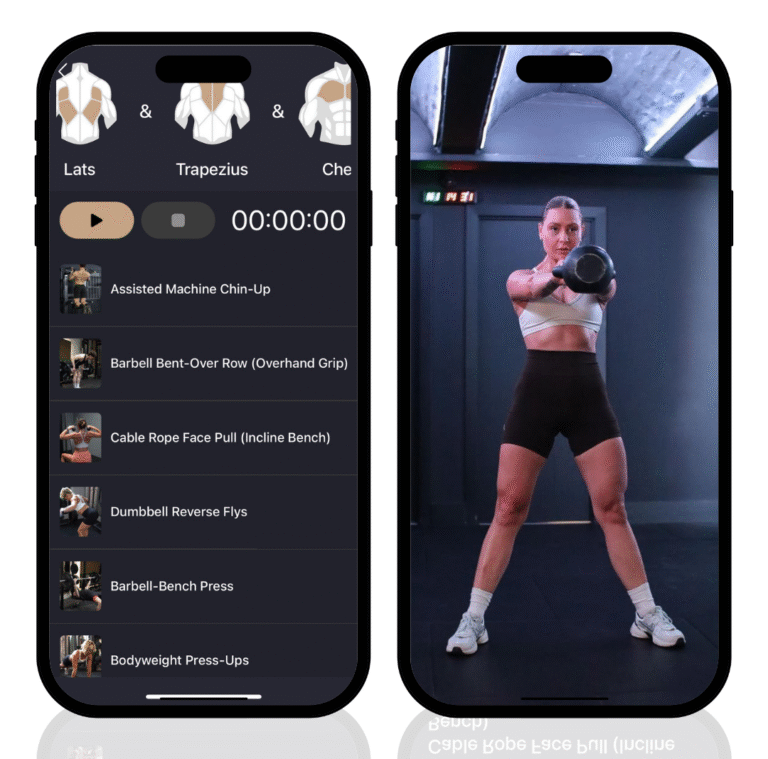
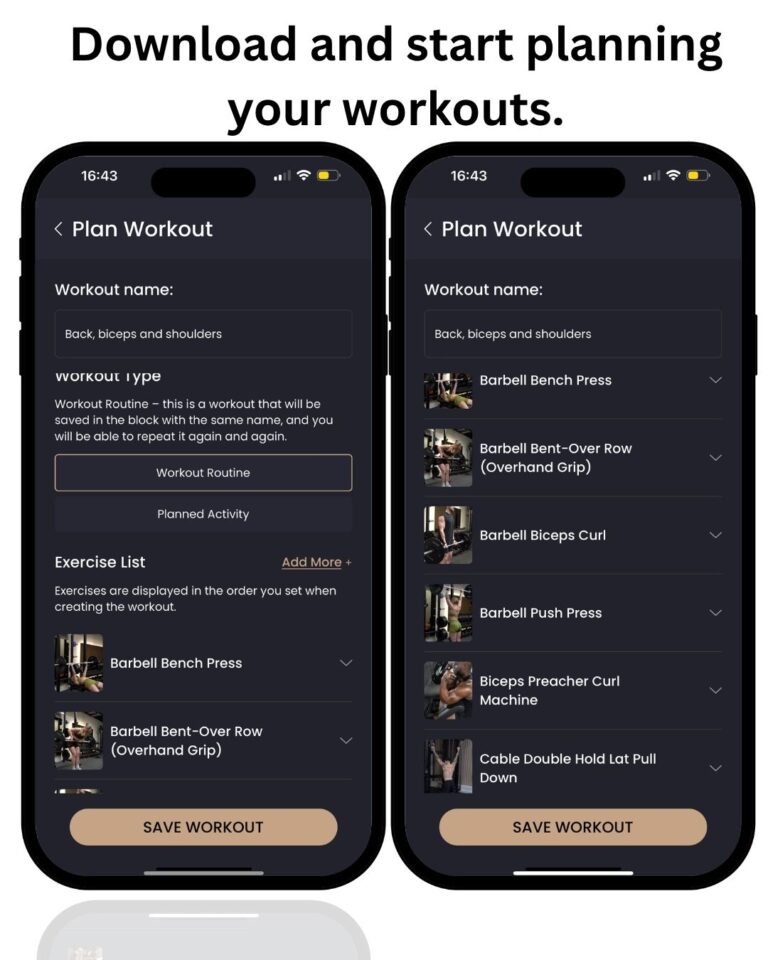
Want each session planned for you? 12REPS builds your training around your goal, your equipment and your time. Every exercise has a trainer demonstration, and you log reps and weight for each set, so you always know what to beat next time.
Key takeaways
- Train your back, shoulders and arms at least twice a week.
- Women build upper body strength well relative to their starting point.
- Rows and pull-ups are the base of the session. Raises and curls add detail.
- Add reps first, then weight, and track every set.
Sources
- Physical activity guidelines for adults aged 19 to 64. NHS, 2024. https://www.nhs.uk/live-well/exercise/physical-activity-guidelines-for-adults-aged-19-to-64/
- Sex Differences in Resistance Training: A Systematic Review and Meta-Analysis. Roberts BM, Nuckols G, Krieger JW. Journal of Strength and Conditioning Research, 2020. https://pubmed.ncbi.nlm.nih.gov/32218059/
- American College of Sports Medicine Position Stand. Resistance Training Prescription for Muscle Function, Hypertrophy, and Physical Performance in Healthy Adults: An Overview of Reviews. Currier BS, D’Souza AC, Singh MAF, et al. Medicine & Science in Sports & Exercise, 2026. https://doi.org/10.1249/MSS.0000000000003897
- A systematic review, meta-analysis and meta-regression of the effect of protein supplementation on resistance training-induced gains in muscle mass and strength in healthy adults. Morton RW, Murphy KT, McKellar SR, et al. British Journal of Sports Medicine, 2018. https://bjsm.bmj.com/content/52/6/376
- How much protein can the body use in a single meal for muscle-building? Implications for daily protein distribution. Schoenfeld BJ, Aragon AA. Journal of the International Society of Sports Nutrition, 2018. https://doi.org/10.1186/s12970-018-0215-1