




Good lat pulldown form means sitting tall with your thighs locked under the pad and your hands just outside shoulder-width. Pull the bar to your upper chest by driving your elbows down toward your hips. Control the bar back up until your arms are straight. If you feel it mostly in your arms, the weight is usually too heavy.
The lat pulldown is also the most common starting point for a first pull-up. This guide covers pulldown technique, which grip to use, the mistakes I see most at the machine, and how pulldowns fit into a pull-up plan.
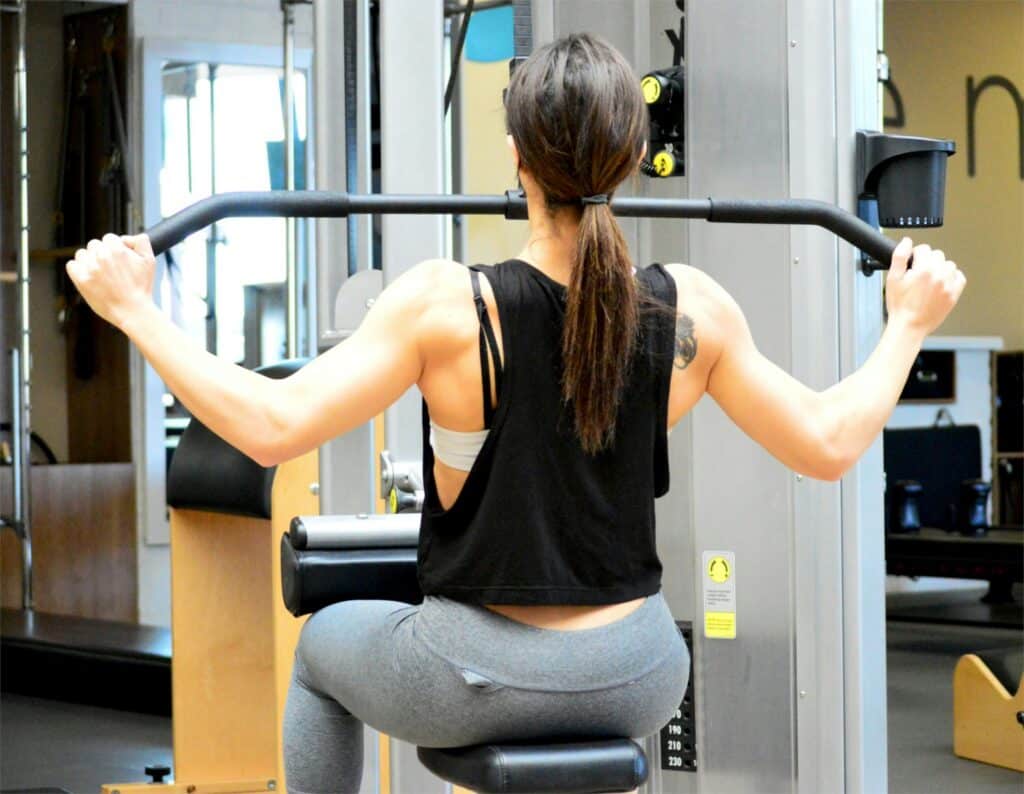
Lat pulldown form: step by step
Setup
- Adjust the thigh pad so it sits snug on your thighs. It stops you lifting off the seat.
- Take your grip slightly wider than your shoulders, palms facing away.
- Choose a weight you can pull for 8 to 12 controlled reps. Machines differ, so judge by how the reps feel, not the number on the stack.
- Sit tall with your feet flat on the floor.
The pull
- Start with long arms. Let the bar gently stretch your arms and shoulders up.
- Lean back slightly, about 10 to 15 degrees, so the bar can pass your face. You are not rowing, so keep the lean small.
- Drive your elbows down and back toward your hips. Think of your hands as hooks.
- Pull to your upper chest, somewhere between your collarbone and the top of your chest.
- Pause briefly, with your shoulders down and away from your ears.
- Return over two to three seconds until your arms are straight again. Do not let the stack yank you up.
Video: How to do lat pulldown. Watch this before your first set to see the start position, the small lean back and where the bar stops.
Which lat pulldown grip is best?
For most people, a medium overhand grip is a good default. Research on grip shows small differences, and the evidence is mixed. The studies below tested only men, so results may differ for women.
- Grip width. A 2014 study of narrow, medium and wide grips in 15 trained men found similar lat activation across all three, with only small differences. They lifted less with the wide grip. A very wide grip is not needed for your lats.
- Overhand vs underhand. A study of 12 men found more lat activity with an overhand grip than an underhand grip, whatever the width. An earlier study of 12 men found no significant difference in lat activity between a wide grip and a reverse grip.
- Neutral grip. Parallel handles, palms facing each other, feel more comfortable for some shoulders. It is a fair choice if a straight bar bothers you.
Pick the grip that lets you feel your back working and keeps your shoulders comfortable. Changing grip every few weeks is fine too.

Common lat pulldown mistakes
- Pulling the bar too low. Bringing the bar to your stomach turns the movement into a row. Stop at your upper chest.
- Swinging. Rocking back and forth to move the weight. Lower the weight until your torso stays still.
- Pulling with your arms. Your elbows bend first and your biceps tire before your back. Start each rep by pulling your shoulders down, then drive your elbows.
- Cutting the top short. Not letting your arms straighten. Let the bar go all the way up each rep.
- Shrugging. Shoulders up near your ears. Pull them down and back before every rep.
"I can't feel my back working"
This is the question I hear most about this exercise. Try these in order:
- Drop the weight by about a third.
- Use the cue “elbows to your back pockets”.
- Pause for two seconds with the bar at your chest.
- Try a different grip from the list above.
- Use lifting straps if your grip gives out first.
Video: Back workout with the 12reps app. This full back session shows where the lat pulldown fits alongside rows and other pulling exercises.
How to program lat pulldowns
- Frequency: once or twice a week.
- Sets: 3 to 4.
- Reps: 8 to 12.
- Tempo: about two seconds down, a short pause, then two to three seconds up.
A simple way to progress
- Start with 3 sets of 8 at a weight you can control.
- Add reps each session until you reach 3 sets of 12.
- Then increase the weight by the smallest step on the stack and drop back to 3 sets of 8.
This is called double progression: you add reps first, then weight.
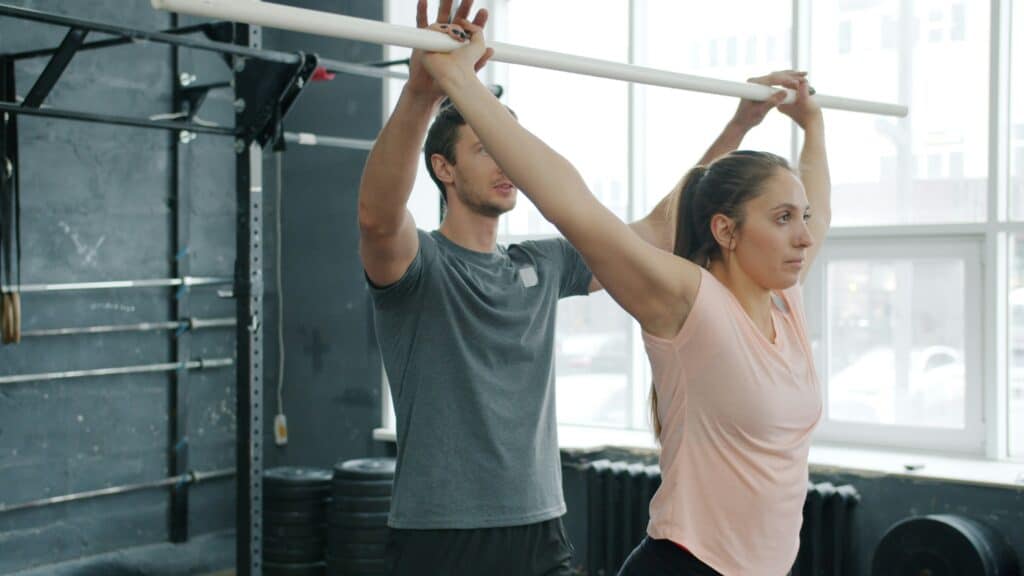
Lat pulldown vs pull-up: what is the difference?
Both are vertical pulls that train your lats. In a pulldown, you pull a bar down to you and choose the load. In a pull-up, you pull your whole body up to a fixed bar.
A study comparing chin-ups and lat pulldowns found the lats were among the most active muscles in both. Chin-ups produced more biceps and lower-back muscle activity on the way up. The movement of the shoulders and upper spine also differed. So the two exercises are related but not the same.
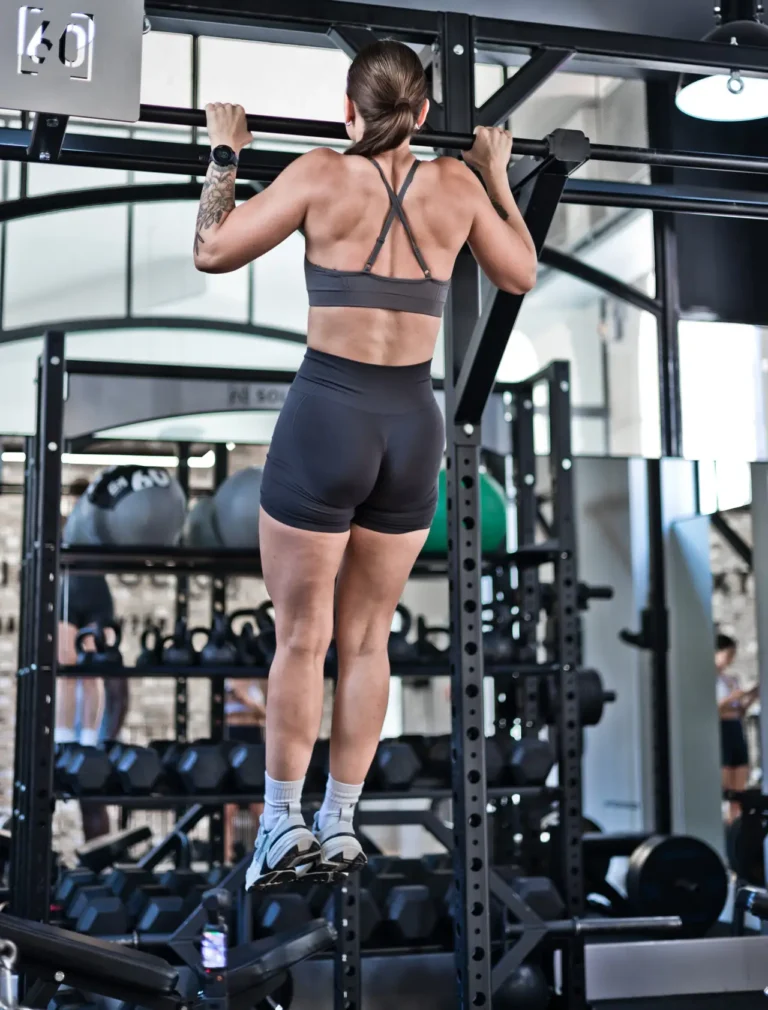
- Pull-up: overhand grip, palms facing away. Usually harder.
- Chin-up: underhand grip, palms facing you. Many people find it a little easier because the biceps help more.
Video: Pull ups. Watch this to see a full pull-up from a dead hang to chin over the bar, so you know the target you are working toward.
From lat pulldown to your first pull-up
Pulldowns build the base, but you also need to practice moving your body on a bar. Our full guide to doing your first pull-up has a week-by-week plan. Here is the short version.
| Exercise | What it builds | Starting point |
|---|---|---|
| Lat pulldown | Pulling strength with a load you choose | 3 sets of 10 to 12, twice a week |
| Dead hang | Grip and comfort hanging from a bar | 3 hangs of 20 to 30 seconds |
| Ring row or inverted row | Pulling your body weight at an angle | 3 sets of 8 to 12 |
| Band-assisted pull-up | The full pull-up path with help | 3 sets of 5 to 8 |
| Negative pull-up | Strength in the lowering phase | 3 sets of 3 to 5, lowering over 5 seconds or more |
For the inverted row, the ring row exercise page shows the setup. Raise the rings to make it easier, and lower them to make it harder.
How long does it take? It varies a lot with your starting strength, body weight and how often you train. Measure progress by longer hangs, slower negatives and lighter bands, not by a deadline.
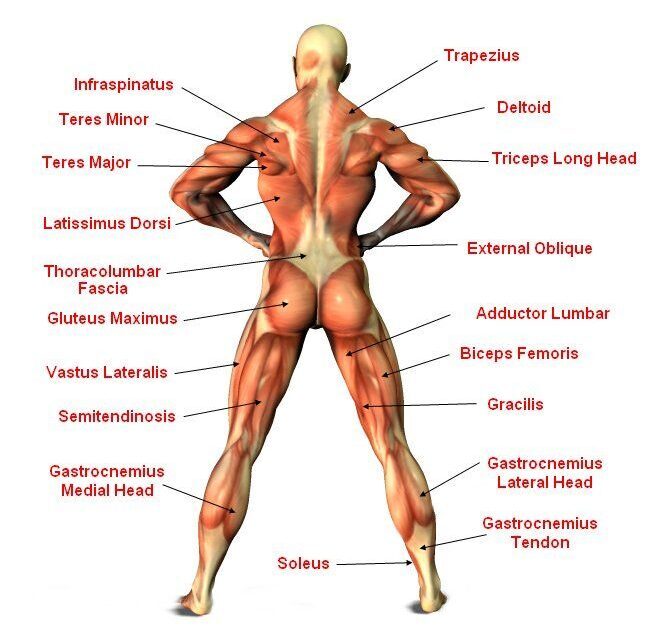
Muscles worked by lat pulldowns and pull-ups
- Main muscle: latissimus dorsi (lats), the broad muscles that run from your upper arms to your lower back.
- Helping muscles: lower and middle trapezius, rhomboids, rear shoulders, biceps and forearms.
- Trunk muscles: keep your body steady, more so in pull-ups.
Vertical pulls work well alongside horizontal pulls, such as rows. Rows bring in more of the muscles between your shoulder blades. Our guide on how to barbell row covers that side.
Where to put pulldowns in your workout
- Pull-up practice: first in the session, while you are fresh.
- Lat pulldowns: early or in the middle of the session.
- Smaller exercises such as face pulls: at the end.
Sample back session
- Pull-up practice (bands or negatives): 4 to 5 sets
- Barbell row: 3 to 4 sets of 8 to 10
- Lat pulldown: 3 sets of 10 to 12
- Face pulls: 3 sets of 15
Balance this with pressing work, such as the overhead press, on another day or in the same upper body session. For more pull exercises, see these pull day exercises.

Track your progress
- Lat pulldown: weight and reps for each set.
- Dead hang: seconds held.
- Negatives: seconds to lower.
- Band-assisted pull-ups: which band you used.
Look at the trend over four to eight weeks. Single sessions go up and down.
If you want this tracked for you, 12REPS lets you enter reps and weight for every set. It remembers what you lifted last time, so you always have a number to beat, and each exercise comes with a trainer demonstration. See how the 12REPS app works.

Lat pulldown and pull-up FAQs
Should I pull the bar behind my neck?
Pull to the front. It lets you lean back slightly and keep your shoulders in a comfortable position.
Is the assisted pull-up machine worth using?
Yes, if it is what your gym has. Bands and negatives add practice at holding your body steady on a free bar, so use them too when you can.
Am I too old to work toward a pull-up?
Age is not a reason to skip vertical pulls. Progress may be slower, so give yourself more time and keep training consistently.
Sources
- Effects of grip width on muscle strength and activation in the lat pull-down. Andersen V, Fimland MS, Wiik E, Skoglund A, Saeterbakken AH. Journal of Strength and Conditioning Research, 2014. https://pubmed.ncbi.nlm.nih.gov/24662157/
- Grip width and forearm orientation effects on muscle activity during the lat pull-down. Lusk SJ, Hale BD, Russell DM. Journal of Strength and Conditioning Research, 2010. https://pubmed.ncbi.nlm.nih.gov/20543740/
- Variations in muscle activation levels during traditional latissimus dorsi weight training exercises: An experimental study. Lehman GJ, et al. Dynamic Medicine, 2004. https://doi.org/10.1186/1476-5918-3-4
- Kinematic and electromyographic comparisons between chin-ups and lat-pull down exercises. Doma K, Deakin GB, Ness KF. Sports Biomechanics, 2013. https://pubmed.ncbi.nlm.nih.gov/24245055/

