


By Will Duru, BSc (Hons) Sport and Exercise Science, Award-winning Personal Trainer with over 10 years of experience in strength training and optimising recovery.
A good strength training schedule for women is two to four sessions a week that train every major muscle group at least twice. Beginners do well with two or three full-body sessions. As you progress, an upper/lower split lets you add more work while keeping rest days.
“I don’t want to get bulky.” Many women say this before they first pick up a weight. The truth is that strength training is one of the most useful things you can do for your health, strength and confidence.
This isn’t about matching anyone else’s idea of how you should look. It’s about finding out what your body can do. Whether you are a beginner or an experienced lifter, this guide gives you evidence-based weekly schedules and the principles behind them.
Why Women Need Strength Training
The Benefits for Women's Health
Bone health is a big reason. The NHS explains that resistance exercise, where muscles pull on bones, helps strengthen them. It advises muscle-strengthening activity on 2 or more days a week.
Muscle also uses a little more energy at rest. A review found that resistance training raised resting metabolic rate by about 96 calories a day on average. The studies had a high risk of bias, so see this as a modest bonus. Diet and overall activity still matter most for weight management.
Strength training can help how you feel, too. A meta-analysis of 33 trials linked resistance training with fewer depressive symptoms.
If you have osteoporosis, a heart condition, are pregnant or take regular medication, check with your doctor before starting a new program.
Debunking the ‘Bulking Up’ Myth
Women build muscle, but large gains take years of focused work. One reason is testosterone. After puberty, men’s levels are more than 15 times higher than women’s.
That does not mean women can’t grow. A meta-analysis found no significant difference in relative muscle growth between men and women on the same training. Women also gained more relative upper-body strength. So training builds real muscle and strength, at a steady pace.
Women who look very muscular have usually trained hard for many years with that specific goal. For most women on a sensible program, the result is a stronger, more capable body. Read the truth about women and muscle growth for more.

Understanding Women's Training Needs
Should You Train Around Your Menstrual Cycle?
Hormone levels change across the menstrual cycle. Estrogen rises in the follicular phase (the first half), and progesterone rises in the luteal phase (the second half).
You may read that you should plan your training around these phases. Current research does not support that. A 2023 review found no clear effect of cycle phase on strength performance or on long-term gains from resistance training.
So consistency matters more than timing. Some days will still feel harder than others. Logging your sets, reps and weights helps you spot your own patterns and adjust on low-energy days.
Do Women Recover Differently From Men?
Research shows women are often less fatigable than men during some types of muscle contraction, at similar intensities. The size of this difference depends on the task and the muscle tested. Evidence on whether women recover faster between sessions is limited.
In practice, many women handle training each muscle group two or three times a week well. That doesn’t mean training hard every day. Your body adapts during rest, so rest days are part of the plan.
Common Training Goals for Women
Many women want to feel strong, improve their health, build confidence and gain some muscle. Strength training supports all of these.
Lower body work, especially for the glutes, is often a priority. The schedules below include lower body training twice a week, alongside balanced upper body work.
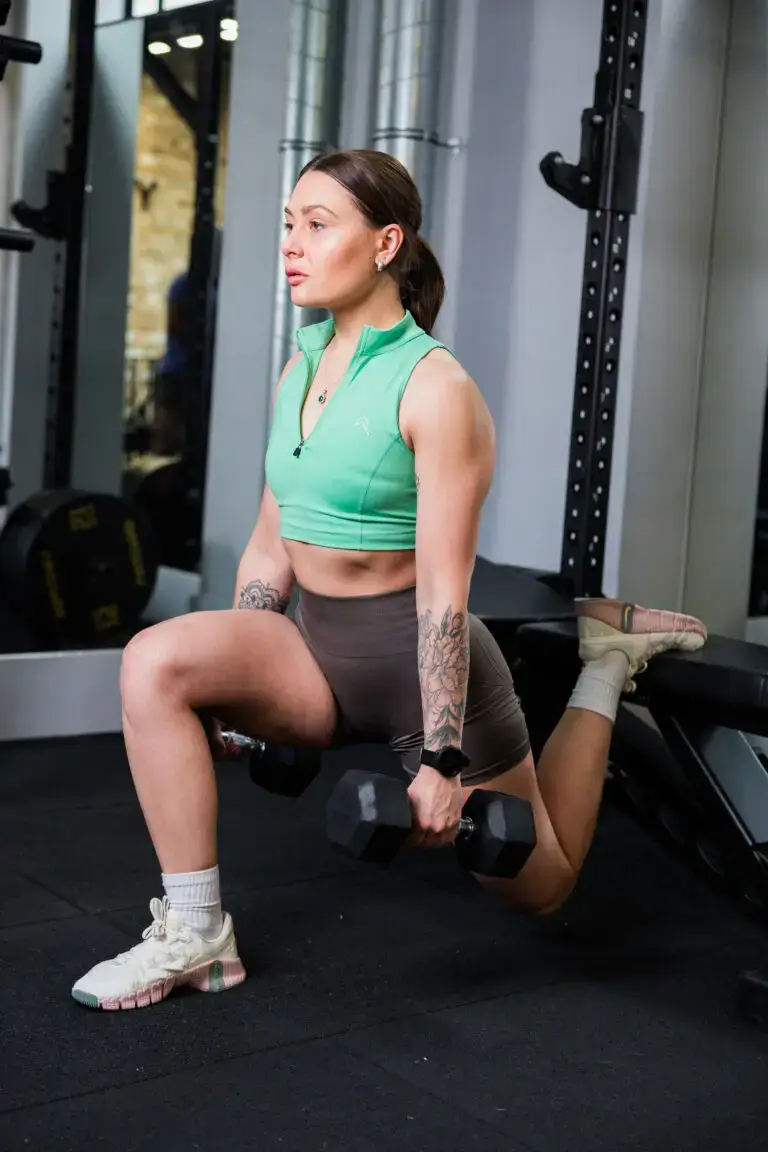
How to Build a Strength Training Schedule for Women
Frequency: How Often Should Women Strength Train?
The CDC and the NHS advise adults to work all major muscle groups on at least two days a week. For building muscle, a meta-analysis found that training each muscle group twice a week beat once a week when total work was equal.
The American College of Sports Medicine suggests 2 to 3 full-body days a week for beginners. Intermediate lifters can use 3 to 4 days, for example an upper/lower split. Advanced lifters often train 4 to 6 days.
Consistency beats intensity. Two quality sessions a week, kept up for months, will do more than a burst of hard training followed by weeks off. For a deeper look, read how many days per week women should strength train.
Sample Weekly Strength Training Schedules for Women
Pick the schedule that fits your experience and your week. Each one trains every major muscle group at least twice.
| Schedule | Best for | Example week |
|---|---|---|
| 2 days: full body | Beginners or very busy weeks | Mon: full body. Thu: full body. |
| 3 days: full body | Beginners ready for more | Mon, Wed, Fri: full body. |
| 4 days: upper/lower | Intermediate lifters | Mon: lower. Tue: upper. Thu: lower. Fri: upper. |
On lower body days, you can use the glute-focused lower body gym plan or this dumbbell leg day workout. Training at home? Try these no-equipment lower body exercises. New to leg training? Start with our beginner’s guide to women’s lower body strength training.
Comparing split styles? See upper/lower vs full body for women.
Progressive Overload for Women
Progressive overload means gradually increasing the demands on your muscles. It is essential for continued progress. You don’t always have to add weight. The ACSM lists more reps, more sets, changes in rest and better technique as other ways to progress.
For muscle growth, a review found similar results across light and heavy loads, while heavier loads gave the biggest strength gains. So moderate reps (about 8 to 12) suit muscle building, and lower reps (about 3 to 6) are useful for maximal strength. 12REPS remembers what you lifted last time, so you always have a number to beat.
Balancing Intensity and Recovery
Not every session needs to be all-out. A well-designed program mixes harder sessions with moderate ones.
Listen to your body. If you are always tired, stressed or sleeping badly, ease off the intensity until you recover. Our guide to rest days for women who strength train explains why recovery builds muscle.
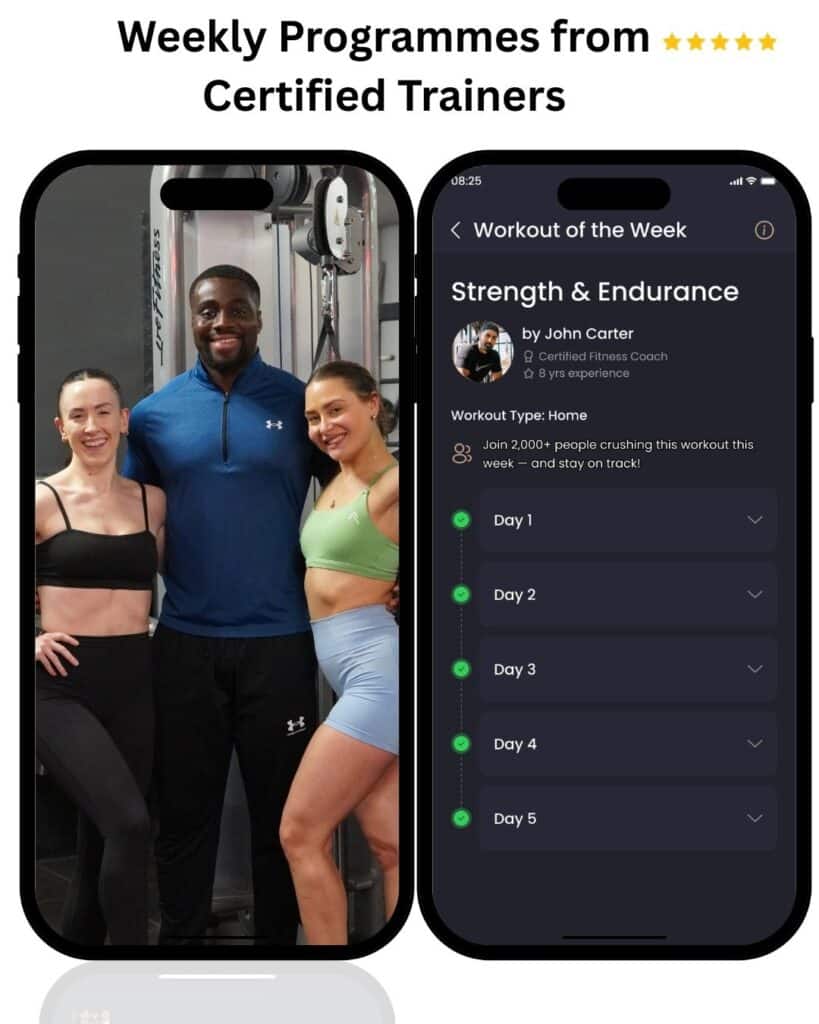
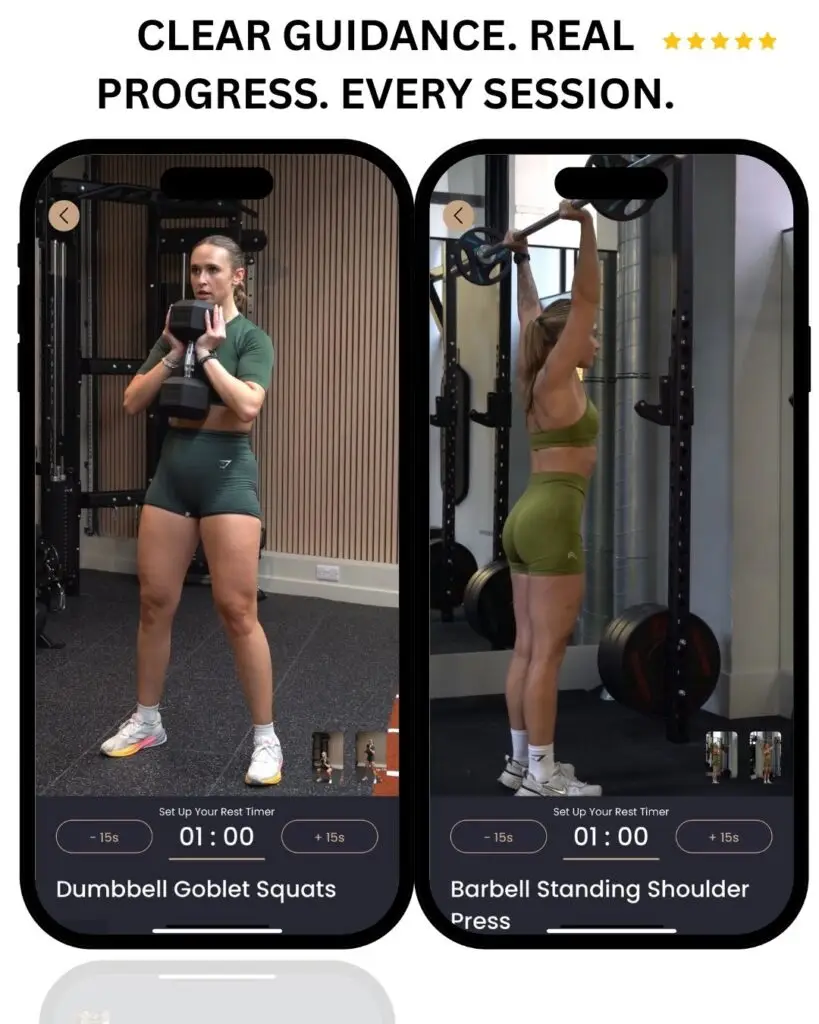
These are stills from 12REPS exercise demo videos.
Exercise Selection for Women
Compound Movements: The Foundation
Compound exercises work several muscle groups at once, which saves time for busy women. They also build strength that carries over to daily tasks.
Key compound exercises:
- Squats: build leg and glute strength.
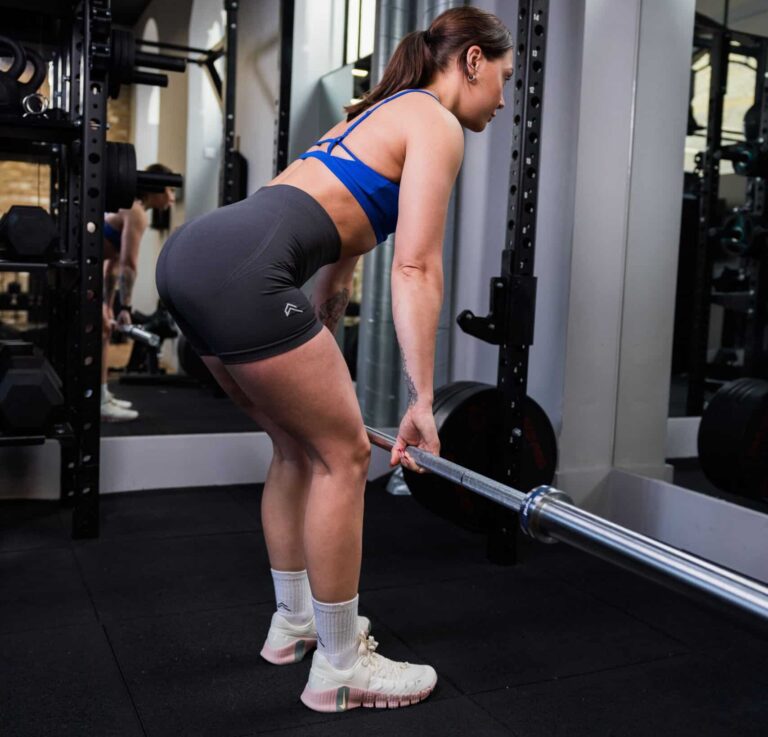
- Deadlifts: strengthen your glutes, hamstrings and back.
- Push-ups: develop chest, shoulder, arm and core strength.
- Rows: build upper back strength.
- Overhead press: build shoulder and core strength.
Isolation Exercises: Targeting Specific Muscles
Compound lifts form the foundation. Isolation exercises then add extra work for specific muscles.
- Hip thrusts: direct, heavy work for your glutes.
- Lateral raises: build the side of your shoulders.
- Triceps extensions: build the back of your upper arms.
- Calf raises: build lower leg strength.
- Face pulls: train your rear shoulders and upper back.
Functional Patterns for Daily Life
Strength training should help you do daily tasks with confidence. So include exercises that mirror real-life movements:
- Farmer’s walks: like carrying groceries or luggage.
- Step-ups: like climbing stairs.
- Single-leg deadlifts: balance and control on one leg.
- Turkish get-ups: getting up from the floor with control.
The 12REPS exercise library shows trainer demonstrations, so you can check your technique.
Nutrition and Recovery Considerations
Training is only half of the picture. What you eat and how you recover decide how well your body adapts.
Fueling Your Strength Training
Good nutrition supports your training and recovery. I’m not a dietitian, but these basic principles help most women who strength train.
Protein: a large review found that gains in muscle leveled off at around 1.6 g of protein per kg of body weight per day. Protein supports muscle repair and helps you keep muscle while losing fat. See how much protein women need for strength training.
Carbohydrates: don’t fear carbs. They fuel your workouts and support recovery. Whole grains, potatoes, fruit and beans are good choices around training.
Fats: include sources such as nuts, avocado and olive oil as part of a balanced diet.
Hydration: drink regularly through the day, and more on training days or when you sweat a lot.
Recovery Strategies for Busy Women
Recovery is when your body adapts and gets stronger. Without enough of it, progress stalls.
Sleep: the CDC, citing sleep experts, says adults aged 18 to 60 need at least 7 hours a night.
Stress: long-term stress can make training and recovery harder. Find ways to manage stress that work for you.
Active recovery: light movement on rest days, such as walking, keeps you moving without adding much fatigue.
Common Challenges and Solutions
Time Constraints and Busy Schedules
“I don’t have time” is the most common barrier. But strength training doesn’t need hours in the gym. A focused 30 to 45 minute session, done consistently, works well.
- Prioritize compound movements.
- Use supersets (two exercises back to back) to save time.
- Train at home with minimal equipment when needed.
- Book workouts in your calendar like appointments.
12REPS builds each session around the time you have, so a short session still has a plan.
Gym Intimidation and Confidence
Many women feel intimidated by the gym, especially the weights area. This is normal.
- Start with bodyweight exercises at home to build confidence.
- Try off-peak hours when the gym is quieter.
- Bring a friend for support.
- Remember that most people are focused on their own workouts.
Our guide to gym intimidation for women has more tips.
Plateaus and Motivation
Progress isn’t always steady. Plateaus are normal and usually pass with patience and small changes.
- Track more than one measure, not just your weight.
- Change your exercises or rep ranges every few weeks.
- Check that you are sleeping and eating enough.
- Set process goals, such as three sessions a week, not only outcome goals.
- Celebrate small wins along the way.
Tracking Progress and Staying Motivated
Beyond the Scale: Meaningful Progress Measures
The scale is only one measure of progress, and often not the most useful one. As you build muscle and lose fat, your weight may stay the same while your body changes.
Better progress measures:
- Strength: can you lift more weight or do more reps?
- Body measurements: waist, hips, arms and thighs.
- Progress photos: changes the scale can’t show.
- Energy: do you feel more energetic through the day?
- Confidence: how do you feel about your body and what it can do?
- Everyday performance: can you climb stairs without getting out of breath?
12REPS tracks your workouts, sets, reps and weights. You can also log your body weight to see the trend, and store private progress photos to compare over time.
Building Consistency and Habits
Consistency matters more than perfection. Missing one workout won’t undo your progress, but missing weeks will.
- Start small and build gradually.
- Train at the same times each week.
- Pack your gym bag the night before.
- Find an accountability partner or community.
- Focus on how training makes you feel, not only how you look.
A weekly goal and a workout streak in 12REPS give you a simple target to keep showing up for.
Conclusion
Strength training isn’t just about building muscle or changing how you look. It’s about finding out what you are capable of. Every woman deserves to feel strong and capable in her own body.
Start with a schedule you can keep: two or three sessions a week, every major muscle group trained at least twice. Add sessions as your experience grows, and make your training a little harder over time.
You don’t need to be young, naturally athletic or free for hours each day. You just need to start where you are, with what you have.
If you’d like your week planned for you, 12REPS builds training around your goal, your equipment and your time. Each exercise has a trainer demonstration, and the app tracks your sets, reps and streaks so you can see your progress.
Sources
- Osteoporosis: Prevention. NHS, accessed 2026. https://www.nhs.uk/conditions/osteoporosis/prevention/
- The effect of exercise interventions on resting metabolic rate: a systematic review and meta-analysis (MacKenzie-Shalders et al.). Journal of Sports Sciences, 2020. https://research.bond.edu.au/en/publications/the-effect-of-exercise-interventions-on-resting-metabolic-rate-a-/
- Association of efficacy of resistance exercise training with depressive symptoms: meta-analysis and meta-regression analysis of randomized clinical trials (Gordon et al.). JAMA Psychiatry, 2018. https://search.pedro.org.au/search-results/record-detail/53565
- Circulating testosterone as the hormonal basis of sex differences in athletic performance (Handelsman, Hirschberg and Bermon). Endocrine Reviews, 2018. https://lida.sport-iat.de/twm/Record/4049631?lng=en
- Sex differences in resistance training: a systematic review and meta-analysis (Roberts, Nuckols and Krieger). Journal of Strength and Conditioning Research, 2020. https://ouci.dntb.gov.ua/works/4NeaBQv7
- Current evidence shows no influence of women’s menstrual cycle phase on acute strength performance or adaptations to resistance exercise training (Colenso-Semple et al.). Frontiers in Sports and Active Living, 2023. https://doaj.org/article/6b0c0ed2b14045e29d01c055be956349
- Sex differences in human fatigability: mechanisms and insight to physiological responses (Hunter). Acta Physiologica, 2014. https://epublications.marquette.edu/exsci_fac/64
- Adult Activity: An Overview. Centers for Disease Control and Prevention (CDC), accessed 2026. https://www.cdc.gov/physical-activity-basics/guidelines/adults.html
- Physical activity guidelines for adults aged 19 to 64. NHS, accessed 2026. https://www.nhs.uk/live-well/exercise/physical-activity-guidelines-for-adults-aged-19-to-64/
- Effects of resistance training frequency on measures of muscle hypertrophy: a systematic review and meta-analysis (Schoenfeld, Ogborn and Krieger). Sports Medicine, 2016. https://pubmed.ncbi.nlm.nih.gov/27102172/
- American College of Sports Medicine position stand: Progression models in resistance training for healthy adults. Medicine & Science in Sports & Exercise, 2009. https://sfu.ca/~ryand/kin343/ACSMresistance.pdf
- Strength and hypertrophy adaptations between low- vs. high-load resistance training: a systematic review and meta-analysis (Schoenfeld, Grgic, Ogborn and Krieger). Journal of Strength and Conditioning Research, 2017. https://vuir.vu.edu.au/42281/
- A systematic review, meta-analysis and meta-regression of the effect of protein supplementation on resistance training-induced gains in muscle mass and strength in healthy adults (Morton et al.). British Journal of Sports Medicine, 2018. https://bjsm.bmj.com/content/52/6/376.abstract
- 1 in 3 adults don’t get enough sleep. Centers for Disease Control and Prevention (CDC), 2016. https://archive.cdc.gov/www_cdc_gov/media/releases/2016/p0215-enough-sleep.html