




Most women who strength train do well with at least two rest days a week. Plan them so each muscle group gets about 48 hours before you train it hard again. Use rest days for sleep, normal meals and light movement, not extra workouts.
I’m Will Duru, a personal trainer with over 10 years’ experience in London. The most common recovery mistake I see in the gym is not training too little. It is training too often without enough rest. This guide shows how many rest days you need, where to put them in your week and what to do on them.
If you are still deciding how many days to train, start with how many days a week women should strength train, then come back here to plan your rest.

Why rest days matter when you lift
A strength session is the signal to change. The repair and adaptation happen afterwards. The Better Health Channel, run by the Victorian Department of Health, puts it simply. Muscle needs time to repair and adapt after a workout. Without enough recovery time, muscles will not get bigger or stronger.
Rest days do not mean you are lazy or losing progress. They are part of the plan. Hard training plus enough recovery is what moves your lifts up over months.
The opposite also holds. A joint consensus statement on overtraining warns against excessive overload combined with too little recovery. That pattern can leave you tired, moody and lifting less, sometimes for weeks.
How many rest days do women who strength train need?
There is no single number. It depends on how many days you lift and how you split your sessions. Two guidelines help:
- The American College of Sports Medicine advises training each major muscle group on 2 to 3 days a week.
- The Better Health Channel advises resting each muscle group for at least 48 hours before you work it hard again.
Here is how that plays out across a normal week.
| Strength days a week | Rest days | What to watch |
|---|---|---|
| 2 | 5 | Full-body sessions with at least two days between them. |
| 3 | 4 | Full-body or push/pull/legs on non-consecutive days, such as Monday, Wednesday and Friday. |
| 4 | 3 | Use a split, such as upper/lower, so you do not train the same muscles two days running. |
| 5 | 2 | Only with a split and good sleep. Keep at least one full day off. |
| 6 | 1 | For experienced lifters who recover well. Most women do not need this many days. |
As a coach, I suggest at least one full day off strength training each week. Most people do better with two or more.
Rest days are about muscle groups, not just the calendar
You can train upper body on Monday and lower body on Tuesday because they use different muscles. But heavy squats on Monday and heavy deadlifts on Tuesday both load your legs and lower back. Leave a day or two between them.
How to place rest days in your week
Put rest days where they protect your hardest sessions. Here are three simple layouts.
Three strength days
- Monday: Full body
- Tuesday: Rest or a walk
- Wednesday: Full body
- Thursday: Rest or a walk
- Friday: Full body
- Weekend: Rest
Four strength days (upper/lower)
- Monday: Lower body (squats, hip thrusts)
- Tuesday: Upper body (bench press, rows)
- Wednesday: Rest
- Thursday: Lower body (deadlifts, lunges)
- Friday: Upper body (overhead press, pull-ups)
- Saturday: Active recovery, such as a 60-minute easy walk
- Sunday: Rest
This gives each muscle group 48 to 72 hours between sessions. If you like six days of training, see the rest day built into our push/pull/legs schedules for women.
Not sure which split to use?
Your split decides where rest days fall. Read full body vs split training for women to choose one that fits your week.
Rest day or active recovery day?
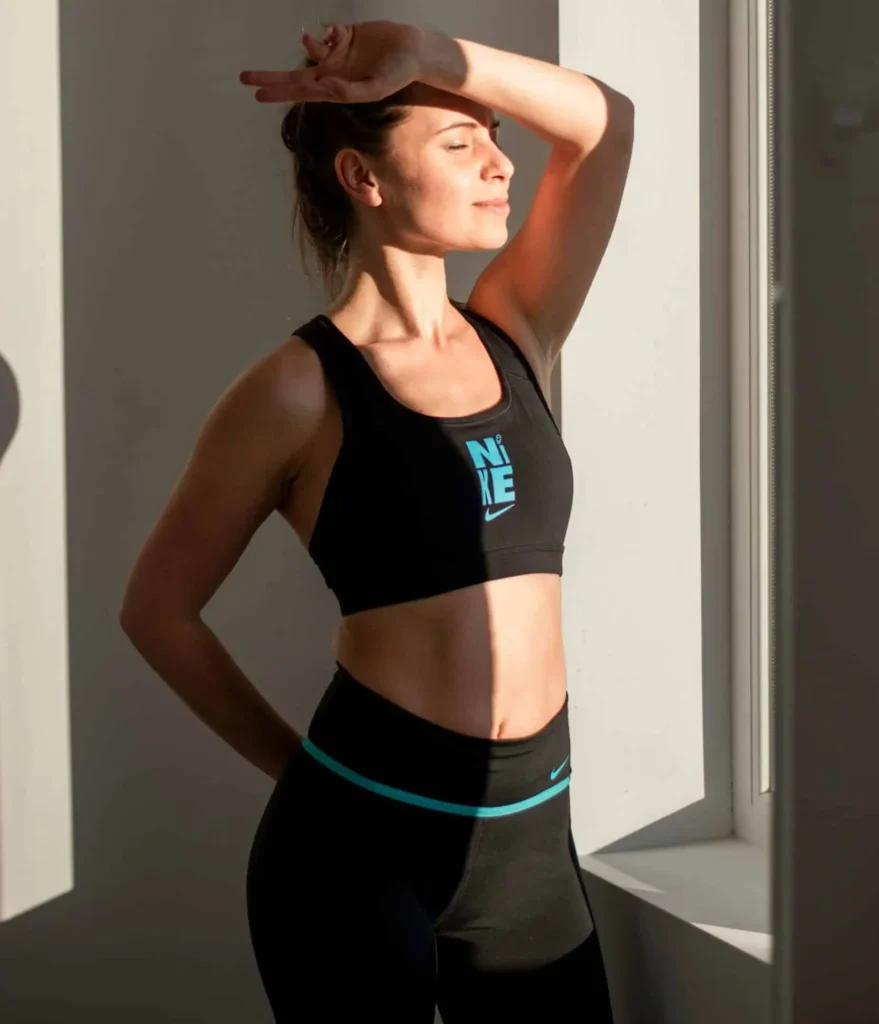
A rest day means no structured training. You still move as normal: walk to the shops, take the stairs, play with the kids.
An active recovery day adds light movement that does not leave you tired. Good options include:
- An easy walk of 30 to 60 minutes
- Gentle swimming or cycling
- Yoga, stretching or light mobility work
- Foam rolling
HIIT classes, hard runs and intense group classes are training, not recovery. If you are breathing hard and sweating heavily, count it as a workout.
Does active recovery help? A 2018 meta-analysis found that active recovery was one of six methods that reduced muscle soreness, with effects ranging from small to large across those methods. Massage came out as the most effective method for soreness and perceived fatigue. Stretching did not show a clear effect on soreness, but it can still feel good and keep you moving.
For a simple routine, try these post-workout stretches for strength training recovery.
Signs you need an extra rest day
Sometimes the plan says train, but your body says otherwise. Watch for these signs, especially when several show up together:
- You feel tired before your workout even starts, day after day.
- Your lifts are going backwards for a week or more.
- You are sore all the time and never feel fresh.
- You sleep badly even though you feel exhausted.
- You feel irritable, flat or unmotivated about training.
- Small aches keep appearing and do not settle.
The ECSS and ACSM consensus on overtraining lists fatigue, performance decline and mood disturbances among its symptoms. These signs can also come from illness, low iron or other health problems, so see your doctor if they last.
One unplanned rest day is often enough to feel better. For a fuller checklist, read signs you need more rest vs when to push through. If soreness is your main worry, see feeling sore after every workout.
Do you need more rest days around your period?
Many women ask whether to plan rest days around their menstrual cycle. The research does not support one rule for everyone.
A 2020 meta-analysis found that exercise performance might be reduced by a trivial amount in the early follicular phase, which starts with your period. The authors rated the quality of evidence as low. They recommended a personalized approach based on each woman’s response.
A 2023 review went further. Its authors concluded it is premature to say short-term hormone changes meaningfully affect strength performance or long-term gains.
In practice:
- You do not need to schedule extra rest days for your cycle by default.
- If cramps, heavy bleeding or fatigue make a session feel bad, swap it for a lighter day or rest. That is a sensible choice, not a failure.
- Track how you feel for a few months. Patterns help you plan.
If you have very painful or heavy periods, speak to your doctor.

What to eat on rest days
Rest days are not a reason to eat as little as possible. Your body is still repairing and adapting, so eat normal, balanced meals.
- Protein: Keep it about the same as on training days. See how much protein women need for strength training.
- Carbohydrates: You may need a little less than on training days, but you do not need to cut them out. Read carbs for strength training for more.
- Calories: Avoid big cuts on rest days to make up for not training. If you want to lose fat, keep a small, steady deficit across the whole week.
Sleep: the recovery habit that matters most
No rest day plan works well on short sleep. The American Academy of Sleep Medicine and Sleep Research Society advise that adults sleep 7 or more hours per night on a regular basis.
Sleep loss also affects muscle. In one small study of young men and women, a single night without sleep reduced muscle protein synthesis by 18% compared with a normal night. Muscle protein synthesis is the process your body uses to build new muscle protein.
Simple habits help:
- Go to bed and get up at similar times, even at weekends.
- Keep your bedroom dark and cool.
- Cut back on caffeine later in the day.
- Do not train so early that you lose sleep to fit it in.
For what the research says about lifting and sleep, read strength training and sleep.

Life stress, age and planned lighter weeks
Stressful weeks
Work deadlines, family stress and poor sleep all draw on the same recovery. During a hard week, try this:
- Train one day fewer than usual.
- Use lighter weights or fewer hard sets.
- Add a rest day or swap a session for a walk.
- Protect your sleep.
Do not stop training altogether unless you need to. Exercise can be a good way to manage stress. Just adjust the dose.
Age and perimenopause
Train for the recovery you have now, not the recovery you had ten years ago. Many women in their 40s and 50s find three well-planned strength days work better than five rushed ones. If sleep or energy changes during perimenopause, see strength training in perimenopause. If you have a health condition or take medication, check with your doctor before changing your training.
Deload weeks
A deload week is a planned lighter week, with fewer sets or lighter weights, every few weeks of hard training. It works alongside rest days. Read deload week: when and how to take one for the details.
Plan your training days so rest days take care of themselves
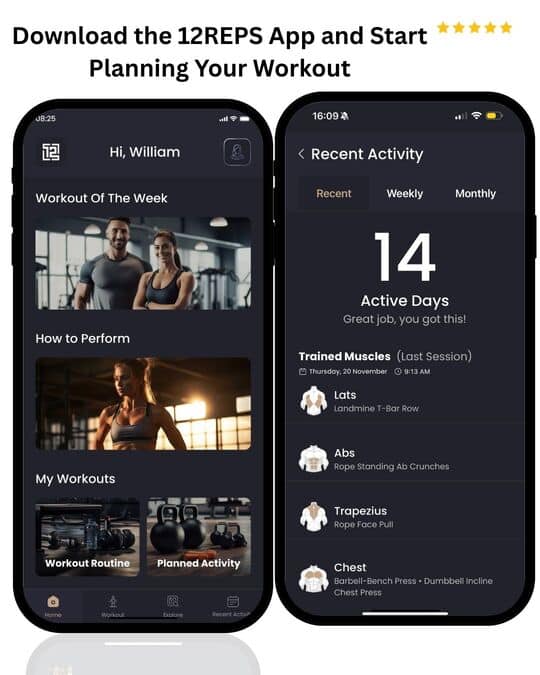
Rest days are easier to keep when your training days are planned. 12REPS builds each session around your goal, your equipment and the time you have. You set a weekly goal, log your sets, reps and weights, and see your workout streaks. That makes it clear when you have trained enough for the week. See how the 12REPS app works.
Common rest day mistakes
- Training through constant fatigue. Sometimes an unplanned rest day is the most useful session of your week.
- Treating rest days as cheat days or starvation days. Eat normally.
- Doing nothing at all for days. Gentle movement usually feels better than lying on the sofa.
- Turning rest days into HIIT days. That is extra training, not recovery.
- Training hard through a niggle. Rest it, train around it, or get it checked.
- Copying someone else’s schedule. Your sleep, stress and recovery are your own.

The bottom line
- Most women who strength train do well with at least two rest days a week.
- Leave about 48 hours before training the same muscles hard again.
- Take at least one full day off strength training each week.
- Use light activity on some rest days if you enjoy it.
- Sleep 7 or more hours and eat normally on rest days.
- You do not need to plan rest around your cycle, but adjust when symptoms make training feel bad.
Train hard on your training days. Rest well on your rest days. That balance is what keeps you progressing.
Sources
- Resistance training: health benefits. Better Health Channel, Victorian Department of Health, 2022. https://www.betterhealth.vic.gov.au/health/healthyliving/resistance-training-health-benefits
- Quantity and quality of exercise for developing and maintaining cardiorespiratory, musculoskeletal, and neuromotor fitness in apparently healthy adults: guidance for prescribing exercise. Garber CE, et al. (American College of Sports Medicine position stand). Medicine and Science in Sports and Exercise, 2011. https://doi.org/10.1249/MSS.0b013e318213fefb
- Prevention, diagnosis and treatment of the overtraining syndrome: joint consensus statement of the ECSS and the ACSM. Meeusen R, et al. European Journal of Sport Science, 2013. https://doi.org/10.1080/17461391.2012.730061
- An evidence-based approach for choosing post-exercise recovery techniques to reduce markers of muscle damage, soreness, fatigue, and inflammation: a systematic review with meta-analysis. Dupuy O, et al. Frontiers in Physiology, 2018. https://doi.org/10.3389/fphys.2018.00403
- The effects of menstrual cycle phase on exercise performance in eumenorrheic women: a systematic review and meta-analysis. McNulty KL, Elliott-Sale KJ, et al. Sports Medicine, 2020. https://doi.org/10.1007/s40279-020-01319-3
- Current evidence shows no influence of women’s menstrual cycle phase on acute strength performance or adaptations to resistance exercise training. Colenso-Semple LM, et al. Frontiers in Sports and Active Living, 2023. https://doi.org/10.3389/fspor.2023.1054542
- Recommended amount of sleep for a healthy adult: a joint consensus statement of the American Academy of Sleep Medicine and Sleep Research Society. Watson NF, et al. Journal of Clinical Sleep Medicine, 2015. https://doi.org/10.5664/jcsm.4758
- The effect of acute sleep deprivation on skeletal muscle protein synthesis and the hormonal environment. Lamon S, et al. Physiological Reports, 2021. https://doi.org/10.14814/phy2.14660
