By Will Duru, BSc (Hons) Sport and Exercise Science – Award-Winning Personal Trainer (10+ year’s experience)
This lean muscle workout plan for women is a 5-day week built for women around 40 and over. It has three strength days (chest and back, shoulders and arms, legs and core), one cardio day and one short mobility session, with two recovery days. You build lean muscle by lifting weights that feel challenging for you, adding a little more over time, and eating enough protein.
I often meet women, especially over 40, who hesitate to lift heavier because they worry it will make them bulky. That worry is understandable, but it is not how muscle works. This guide explains the plan, how to progress, what to eat, and gives you a full day-by-day breakdown with alternatives for dumbbells, machines, kettlebells, TRX or bodyweight.
If you have a health condition, take medication or have symptoms you are unsure about, check with your doctor before starting a new program.

How this lean muscle workout plan for women is set up
A 5-day split means you are active on five days, with a different focus each day. Only three of those days are strength sessions, which leaves time to recover.
| Day | Focus |
|---|---|
| Monday | Chest and back (strength) |
| Tuesday | Shoulders, biceps and triceps (strength) |
| Wednesday | Legs, abs and calves (strength) |
| Thursday | Rest and recovery |
| Friday | Cardio: running, cycling, incline walking or hiking |
| Saturday | 10 to 15 minutes of yoga, Pilates or stretching at home |
| Sunday | Morning meditation (up to 20 minutes) and 5 minutes of stretching |
By the end of the week, you have trained every major muscle group and done some cardio and mobility work. The CDC guidance for adults is muscle-strengthening on at least 2 days a week, plus 150 minutes of moderate aerobic activity. The three strength days cover the first part. Friday’s cardio gives you 30 to 45 minutes, so add brisk walks on other days to reach 150.
The plan is flexible. If you need to swap days, that is fine. Just keep a rest day after your leg session. If you prefer fewer gym days, see how many days per week women should strength train.

Progressive overload: how you keep building lean muscle
Progressive overload means gradually increasing the demands on your muscles over time. If you repeat the exact same workout with the same weights every week, your body adapts and progress slows.
You can progress in a few ways:
- Add a rep or two before you add weight.
- Move up to the next dumbbell once you reach the top of the rep range with good form.
- Add a set, or control the lowering phase more carefully.
For example, if you did 3 sets of 10 goblet squats with a 5 kg (11 lb) dumbbell last week, try 3 sets of 12 this week. Or move to a 6 kg (13 lb) dumbbell for 8 to 10 reps. The ACSM position stand suggests increasing the load by 2 to 10% once you can do 1 to 2 reps over your target on two sessions in a row.
How hard should each set feel?
Aim to finish most sets feeling like you could do only 1 to 2 more good reps. That is about 8 out of 10 effort. On the reps-in-reserve effort scale, 2 reps left in the tank equals an RPE of 8. RPE stands for rate of perceived exertion.
Write down your weights and reps each session. That way you always know what to beat next time.

Lifting heavy is for women over 40 too
The idea that heavy strength training makes women bulky is a myth. Building a large amount of muscle takes years of focused training and eating. What does happen when you lift is that you build lean muscle and get stronger.
Women respond well to training. A 2020 meta-analysis found women gained muscle and lower body strength at similar relative rates to men on the same programs. For more on this myth, read will lifting weights make me bulky.
Heavy is relative
When I say lift heavy, I mean challenge yourself. For one woman, heavy is a 5 kg dumbbell. For another, it is 15 kg. Work in the 8 to 12 rep range so the last few reps feel hard but your form stays good.
Heavier lifting may also help your bones. In the LIFTMOR trial, postmenopausal women with low bone mass did supervised heavy lifting and impact training twice a week for 8 months. Their spine bone density rose and their hip bone density held steady, while the home-based, low-intensity group lost bone at both sites. That was a closely supervised study, so work up to heavy loads gradually and get coaching if you have low bone density.
Everyday tasks such as carrying groceries or lifting grandchildren often feel easier as you get stronger.
Coach’s tip: Focus on form first, then add weight. If you are new, start lighter and learn the technique. Once you feel comfortable, move up to heavier dumbbells or a heavier machine setting.
Video: 5 tips for ladies new to the gym. If the weights area feels unfamiliar, watch these tips before your first session.
Nutrition for lean muscle and fat loss
Training builds the stimulus. Food gives your body what it needs to recover and build muscle. Focus on enough protein, enough total energy for your goal, and mostly whole foods.
Protein
Protein repairs and builds muscle tissue. The International Society of Sports Nutrition suggests 1.4 to 2.0 g per kilogram of body weight per day for people who exercise. A 2018 meta-analysis found extra protein stopped adding muscle gains above about 1.6 g/kg per day on average.
For a 70 kg (154 lb) woman, 1.6 g/kg is about 112 g of protein a day. Spread it across 3 or 4 meals. Good sources include chicken, turkey, lean beef, fish, eggs, Greek yogurt, cottage cheese, beans, lentils and tofu. Our guide on how much protein women need for strength training goes deeper.
Carbohydrates and fats
Carbs fuel your training. Include oats, whole grain bread or pasta, rice, potatoes, fruit and plenty of vegetables. Healthy fats from olive oil, nuts, seeds, avocado and oily fish support overall health. For practical amounts, see how many carbs women need for strength training.
Eating for fat loss
To lose fat while building muscle, eat slightly less than you burn and keep your protein high. Avoid crash diets. The CDC notes that people who lose about 1 to 2 pounds a week are more likely to keep the weight off.
Drink water regularly through the day, and a little more on training days.
Video: How strength training helps with fat loss. Watch this to see where lifting fits into a fat loss plan alongside your diet.

Workout plan: day-by-day breakdown
Below is each day of the 5-day split. Strength days (Monday to Wednesday) list the exercise, sets and reps, rest and target effort. Effort uses RPE on a 1 to 10 scale. Aim for about 7 to 8 out of 10 on most sets.
Start each exercise with one light warm-up set. Then do 4 working sets of 8 to 12 reps. Choose a weight that makes the last reps hard to finish with good form. Rest about 60 to 90 seconds between sets.
Each day also lists alternative exercises. Use them if you have limited equipment or want variety.
Monday: chest and back
Focus: upper body push (chest) and pull (back). Warm up with arm circles and light band or dumbbell work first.
| Exercise | Sets x reps | Rest | Effort (RPE) |
|---|---|---|---|
| Dumbbell bench press (chest) | 4 x 8-12 | 90 s | 8/10 |
| Lat pulldown, machine or band (back) | 4 x 8-12 | 90 s | 7-8/10 |
| Machine chest press or push-up (chest) | 4 x 10-12 | 60 s | 7/10 |
| Seated cable row or dumbbell row (back) | 4 x 10-12 | 60 s | 8/10 |
| Dumbbell chest fly | 4 x 12 | 60 s | 7/10 |
| TRX inverted row (upper back) | 4 x 8-10 | 60 s | 8/10 (adjust your angle) |
Alternatives: incline dumbbell press, bent-over dumbbell row, band pulldown, chest press machine or assisted pull-up. Control the lowering phase of every rep.
Tuesday: shoulders, biceps and triceps
Focus: shoulders (deltoids), biceps and triceps. Warm up with shoulder rolls and light arm swings.
| Exercise | Sets x reps | Rest | Effort (RPE) |
|---|---|---|---|
| Seated dumbbell shoulder press | 4 x 8-12 | 90 s | 8/10 |
| Dumbbell lateral raise | 4 x 10-12 | 60 s | 7/10 |
| TRX Y-T fly (rear shoulders, upper back) | 4 x 10 | 60 s | 7/10 |
| Dumbbell biceps curl | 4 x 10-12 | 60 s | 8/10 |
| Cable triceps pushdown | 4 x 12 | 60 s | 7-8/10 |
| Dumbbell triceps kickback | 4 x 12 | 60 s | 7/10 |
Alternatives: Arnold press or a shoulder press machine, hammer curl or cable curl, overhead dumbbell triceps extension or bench dip. Choose moves that work the muscle without joint pain.
Wednesday: legs, abs and calves
Focus: quads, hamstrings, glutes, calves and core. Warm up with 5 minutes of brisk walking or light cycling, then some gentle leg swings.
| Exercise | Sets x reps | Rest | Effort (RPE) |
|---|---|---|---|
| Goblet squat, dumbbell or kettlebell | 4 x 8-12 | 90 s | 8/10 |
| Leg press | 4 x 10 | 90 s | 8/10 |
| Dumbbell Romanian deadlift | 4 x 10 | 90 s | 7-8/10 |
| Glute bridge, bodyweight or dumbbell | 4 x 12 | 60 s | 7/10 (pause at the top) |
| Calf raise, machine or dumbbell | 4 x 15 | 60 s | 8/10 |
| Plank (30-second hold = 1 set) | 4 x 30 s | 60 s | 7/10 |
Alternatives: box squat to a chair, wall sit instead of leg press, Swiss ball hamstring curl instead of Romanian deadlift, dead bug or bird dog for core, calf raises on a step or seated calf raises.
If you train at home, our dumbbell lower body workout for women works as a swap for this day.
Some soreness in your thighs or glutes after leg day is normal. Sharp pain in your knees or back is not. Adjust the range of motion or weight if needed.
Thursday: rest day
No formal workout today. Go for an easy walk, do a few gentle stretches, prepare some meals for the next few days, and aim for a good night’s sleep. Rest is part of the program. Our guide to rest days for women who strength train explains why.
Friday: cardio and conditioning
Aim for 30 to 45 minutes of moderate cardio. You should breathe harder but still be able to speak in short sentences. Pick one or two options you enjoy:
- Running or jogging: outdoors or on a treadmill. Mix jogging and brisk walking if needed, for example 1 minute each.
- Cycling: steady pace, or switch between easy and hard every few minutes.
- Incline treadmill walk: a steep incline at a brisk pace works your calves and glutes too.
- Hiking: uneven paths also challenge your balance.
- Elliptical or rowing machine: low-impact options that use your arms and legs.
- Dance or a home cardio circuit: marching, jumping jacks or gentle skipping.
For example, walk briskly for 10 minutes, jog for 20 minutes, then walk for 10 minutes to cool down.

Saturday: 10-minute home mobility session
Today is active recovery. A short yoga, Pilates or stretching session keeps you moving and eases stiffness from the week. Try this 10-minute routine with no equipment:
- Child’s pose, 1 minute. Kneel, sit your hips back toward your heels and reach your arms forward.
- Cat-cow, 1 minute. On hands and knees, round your back up, then let your belly drop and lift your head. Move with your breath.
- Downward dog, 1 minute. Lift your hips into an upside-down V. Press your heels toward the floor.
- Kneeling hip flexor stretch, 1 minute per side. Lower your back knee to the floor and press your hips gently forward.
- Cobra, 30 seconds. Lie face down, hands under your shoulders, and press your chest up gently.
- Seated hamstring stretch, 1 minute. Sit with your legs straight and reach toward your shins or toes with a long back.
- Neck and shoulder rolls, 1 minute. Slow half-circles with your neck, then roll your shoulders.
If you prefer Pilates, use pelvic tilts, glute bridges or bird dogs. Keep it light. This is about quality of movement, not sets and reps.
Sunday: meditation and stretching
Start the day with up to 20 minutes of quiet meditation. Sit or lie comfortably and focus on your breathing. If 20 minutes feels long, start with 5 to 10. Then do 5 minutes of light stretching:
- Gentle neck stretches, ear toward each shoulder.
- Big arm circles or a self-hug to stretch your upper back.
- Calf and hamstring stretches from Saturday.
- A lying spinal twist on each side.
A short walk later in the day is a good optional extra.
Track your progress
Real progress comes from consistent training, enough protein and regular rest, week after week. Within a few weeks, you may notice you are stronger, your clothes fit differently or you have more energy.
The scale is only one measure. Take progress photos and note your lifts. If the 5 kg dumbbells that felt heavy in week 1 now feel light, that is progress.
Video: How women should track progress, scale or photos. This video explains why the scale alone can mislead you and what to track alongside it.
Next steps
Commit to this 5-day split for at least 8 to 12 weeks. Progress your weights slowly, eat enough protein and protect your rest days. For more on training through this stage of life, read our guides to strength training for women over 40 and strength training in perimenopause.
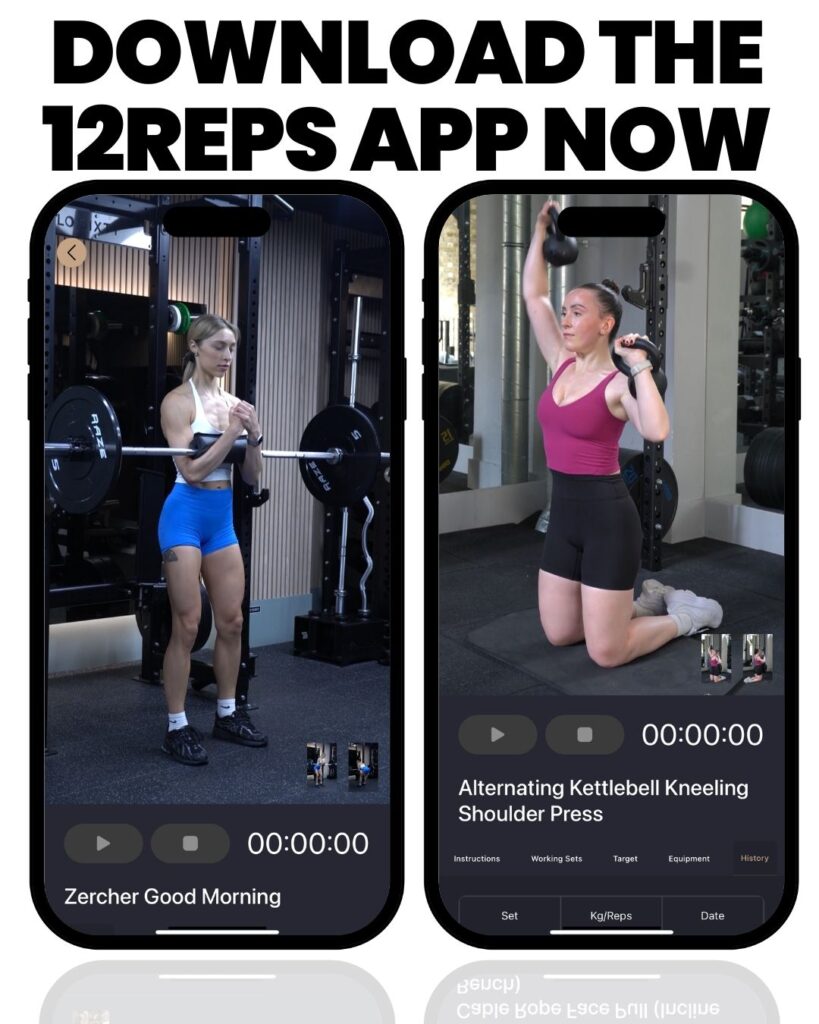
If you want a plan built around your goal, your equipment and your time, the 12REPS app sets out each session with a trainer demonstration for every exercise. It also logs your lifts, tracks your body weight trend and keeps private progress photos so you can compare stages.
Sources
- Adult Activity: An Overview. Centers for Disease Control and Prevention (CDC), 2023. https://www.cdc.gov/physical-activity-basics/guidelines/adults.html
- American College of Sports Medicine position stand: Progression models in resistance training for healthy adults. American College of Sports Medicine, 2009. https://pubmed.ncbi.nlm.nih.gov/19204579/
- Application of the Repetitions in Reserve-Based Rating of Perceived Exertion Scale for Resistance Training. Helms ER, Cronin J, Storey A, Zourdos MC. Strength and Conditioning Journal, 2016. https://doi.org/10.1519/SSC.0000000000000218
- Sex Differences in Resistance Training: A Systematic Review and Meta-Analysis. Roberts BM, Nuckols G, Krieger JW. Journal of Strength and Conditioning Research, 2020. https://pubmed.ncbi.nlm.nih.gov/32218059/
- High-Intensity Resistance and Impact Training Improves Bone Mineral Density and Physical Function in Postmenopausal Women With Osteopenia and Osteoporosis: The LIFTMOR Randomized Controlled Trial. Watson SL, Weeks BK, Weis LJ, Harding AT, Horan SA, Beck BR. Journal of Bone and Mineral Research, 2018. https://doi.org/10.1002/jbmr.3284
- International Society of Sports Nutrition Position Stand: protein and exercise. Jäger R and colleagues. Journal of the International Society of Sports Nutrition, 2017. https://doi.org/10.1186/s12970-017-0177-8
- A systematic review, meta-analysis and meta-regression of the effect of protein supplementation on resistance training-induced gains in muscle mass and strength in healthy adults. Morton RW and colleagues. British Journal of Sports Medicine, 2018. https://doi.org/10.1136/bjsports-2017-097608
- Steps for Losing Weight. Centers for Disease Control and Prevention (CDC), 2023. https://www.cdc.gov/healthy-weight-growth/losing-weight