



By Will Duru, BSc (Hons) Sport and Exercise Science, Award-winning Personal Trainer with over 10 years of experience in strength training and optimising recovery
A strength training workout planner sets out what you will do in each session: the exercises, sets, reps and weights. A good planner also records what you lifted, so next week you know what to beat. That link between plan and log is what turns regular workouts into steady progress.
Many lifters train hard but stop getting stronger because they have no clear plan. They repeat the same weights, skip the hard exercises and guess what to do next. This guide shows you how to plan a strength training week, what a good planner should do, and how the 12REPS app handles planning and tracking.

Why plan your strength training?
Progressive overload needs a plan
Progressive overload means gradually asking more of your muscles over time. You might add a rep, add a little weight or add a set. The American College of Sports Medicine (ACSM) has a position stand on progression. It recommends raising the load by about 2 to 10% once you can do one or two reps more than your target.
You can only apply that rule if you know what you did last time. A plan sets the target, and a log shows whether you hit it. For a deeper look, read our complete guide to progressive overload.
Writing it down helps you stay consistent
Self-monitoring means keeping a record of your own behavior. A meta-regression of healthy eating and physical activity programs found that self-monitoring explained more of the differences between programs than any other technique. Programs that paired it with related techniques, such as setting goals and reviewing progress, worked better.
Habits also take time. In a real-world study of habit formation, a new daily behavior took a median of 66 days to feel automatic, among people whose data could be modeled. The range was wide, from 18 to 254 days, and missing one day did not derail the process. A plan you can follow for months matters more than a perfect first week.
It takes the guesswork out of each session
Without a plan, it is easy to stall on the same weights or jump up too far. A plan spreads your training across the week and builds in rest days. When your log shows a lift has stalled or your technique is slipping, you can adjust before you push on.
Video: Why you’re not gaining muscle. This short 12REPS video covers common reasons lifters stop making progress. Use it as a checklist before you change your plan.
What to look for in a strength training workout planner
Not every workout app is built for strength training. Before you choose one, check that it does these things well:
- Builds around your goal, equipment and time. Your plan should fit the gym you use, or the dumbbells you have at home, and the minutes you really have.
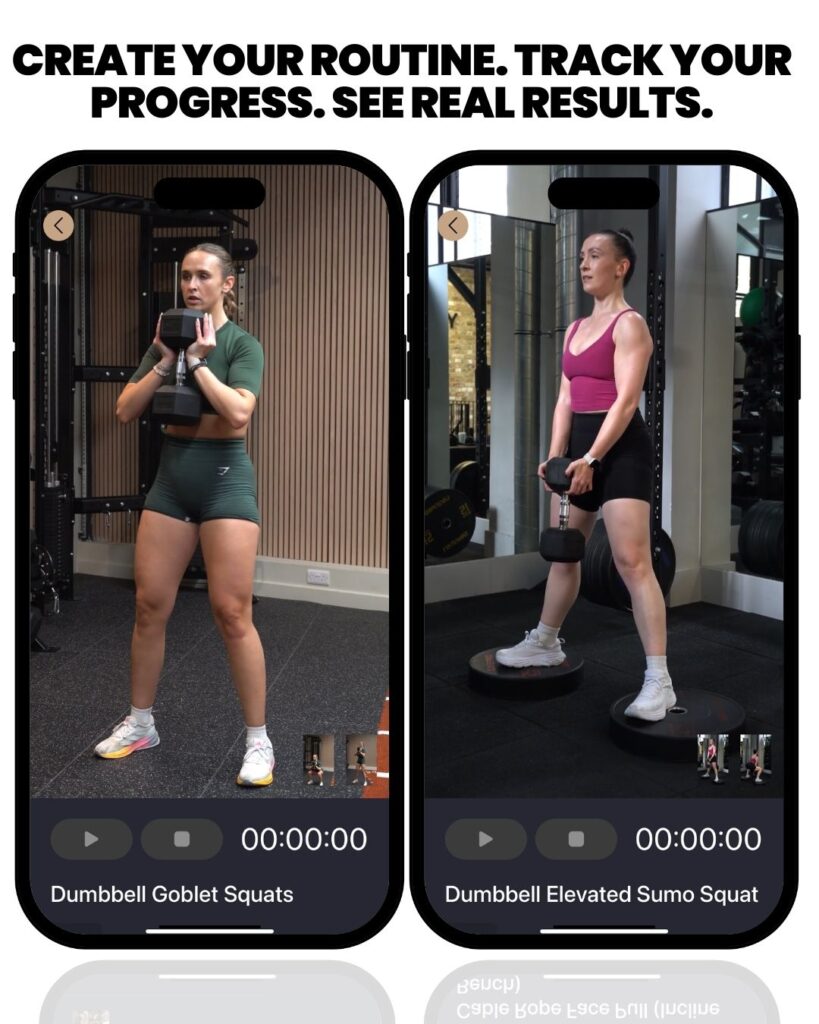
- Shows clear exercise demonstrations. Video demos and technique cues help you learn each movement and repeat it the same way.
- Makes logging simple. You should be able to enter reps and weight for each set in a few taps, mid-workout.
- Shows what you did last time. Last session’s numbers give you a clear target to beat.
- Lets you change the plan. You may need a different session when a machine is busy or you train somewhere new.
- Supports consistency. Streaks, weekly goals and a visible history help you keep showing up.
If you are comparing apps, our guide to choosing the right workout app goes into more detail.
How to plan your strength training week in 4 steps
Step 1: Set a clear goal
Decide what you want most right now: more strength, more muscle or better general fitness. Then make it specific and measurable. “Squat my body weight for 5 reps within 12 weeks” is easier to plan for than “get stronger”.
A useful check is SMART: specific, measurable, achievable, relevant and time-bound. Write the goal down where you will see it.
Step 2: Choose your training days and split
A training split is how you divide muscle groups across the week. For health, the CDC recommends muscle-strengthening activity on at least 2 days a week, working all major muscle groups.
- Full body (2 to 3 days a week): every session trains the whole body. A good fit for beginners and busy weeks.
- Upper/lower (4 days a week): two upper-body days and two lower-body days.
- Push/pull/legs (3 to 6 days a week): sessions split by movement type.
The split matters less than many people think. A 2024 meta-analysis of 14 studies found similar strength and muscle gains from split and full-body routines when weekly volume was matched. Pick the one that fits your schedule. Our workout split guide compares the options in detail.
Step 3: Pick your exercises
Start each session with compound exercises. These work several muscle groups at once, such as squats, deadlifts, presses and rows. Then add isolation exercises, which focus on one muscle, such as biceps curls or calf raises.
Across the week, cover your legs, hips, back, chest, shoulders, arms and core. Our guide to the best exercises for each muscle group can help you fill the gaps. Keep most exercises the same for several weeks, so you can see progress on them.
Step 4: Set your sets, reps and load
Your rep range depends on your goal. The ACSM position stand gives these general starting points:
- Beginners: loads you can lift for 8 to 12 reps, 2 to 3 days a week.
- Muscle growth: mostly 6 to 12 reps, with 1 to 2 minutes of rest and multiple sets.
- Strength, after about 6 months of training: a wider range that moves toward heavier sets of 1 to 6 reps, with 3 to 5 minutes of rest.
- Muscular endurance: lighter loads for more than 15 reps, with less than 90 seconds of rest.
Training volume is the amount of work you do, often counted as hard sets per muscle per week. A meta-analysis on weekly training volume linked more weekly sets with more muscle growth. One influential study had a large effect on the size of that link. Start with a volume you can recover from, then build up. Our guide to rep ranges explains more.
Finally, set your progression rule. When you reach the top of your rep range with good form, add a small amount of weight next session.

How 12REPS works as a workout planner and tracker
12REPS is a strength training app built to give you direction in the gym. It fills the gap between a gym membership and ongoing personal coaching. Here is what it does, based on the 12REPS app page:
- A plan built for you. Training is built around your goal, your equipment and the time you have. Open the app and your workout is ready, for example Chest & Back, 60 minutes, 6 exercises.
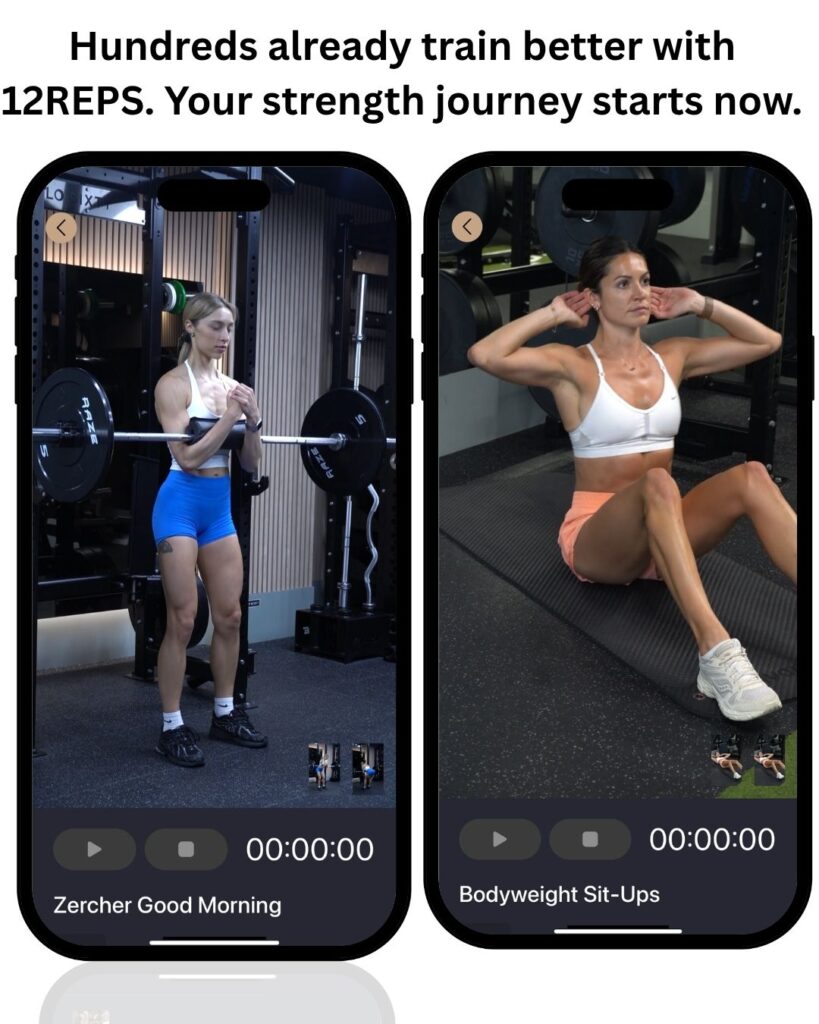
- Trainer demonstrations. Exercise demos and technique breakdowns come from real, qualified personal trainers.
- Set-by-set logging. Tap Start Workout, watch the demo, then enter reps and weight for each set. The app remembers what you lifted, so you have a number to beat.
- Build your own session. Use the body map to choose the muscle, equipment and time. 12REPS builds the session, and you can save it and train.
- Accountability. The app tracks workouts, sets, reps, weights and streaks. It also has challenges, awards, a weekly goal and a community.
- Body progress. Log your body weight to see the trend, and keep before, mid and final progress photos in private storage.
12REPS is available on the App Store and Google Play.
Video: Most fitness apps are useless for strength training. This short 12REPS video explains why a strength app needs more than a blank log. Watch it before you pick a planner.
Common planning mistakes to avoid
- Changing the plan every week. If your exercises change all the time, you cannot tell whether you are progressing.
- Adding weight too soon. Earn each jump by hitting your rep target with good form first.
- Planning more days than you can train. Three sessions you complete beat five you skip.
- Not logging. A plan without a record is a guess. Our guide on why a workout tracker helps you progress explains what to record.
Want a plan built around your goal, your equipment and the time you’ve got? The 12REPS app sets out each session and shows trainer demonstrations as you go. You log each set, so every workout gives you a number to beat next time.
Related reading
Sources
- American College of Sports Medicine position stand: Progression models in resistance training for healthy adults. American College of Sports Medicine. Medicine and Science in Sports and Exercise, 2009. https://pubmed.ncbi.nlm.nih.gov/19204579/
- Effective techniques in healthy eating and physical activity interventions: a meta-regression. Michie S, Abraham C, Whittington C, McAteer J, Gupta S. Health Psychology, 2009. https://pubmed.ncbi.nlm.nih.gov/19916637/
- How are habits formed: Modelling habit formation in the real world. Lally P, van Jaarsveld CHM, Potts HWW, Wardle J. European Journal of Social Psychology, 2010. https://doi.org/10.1002/ejsp.674
- Adult Activity: An Overview. Centers for Disease Control and Prevention, 2023. https://www.cdc.gov/physical-activity-basics/guidelines/adults.html
- Efficacy of Split Versus Full-Body Resistance Training on Strength and Muscle Growth: A Systematic Review With Meta-Analysis. Ramos-Campo DJ, Benito-Peinado PJ, Andreu-Caravaca L, Rojo-Tirado MA, Rubio-Arias JA. Journal of Strength and Conditioning Research, 2024. https://pubmed.ncbi.nlm.nih.gov/38595233/
- Dose-response relationship between weekly resistance training volume and increases in muscle mass: A systematic review and meta-analysis. Schoenfeld BJ, Ogborn D, Krieger JW. Journal of Sports Sciences, 2017. https://doi.org/10.1080/02640414.2016.1210197
