




Written by Will Duru, BSc (Hons) Sport and Exercise Science, award-winning Level 3 Personal Trainer.
To lose 5kg safely, aim for about 0.5 to 1kg a week, use a moderate calorie deficit, and strength train to keep your muscle. At the lower end of that range, 5kg takes about 10 weeks, and many people find 10 to 12 weeks easier to sustain. Very aggressive diets may move the scale faster, but more of what you lose can be muscle and water.
This guide explains how to lose 5kg safely and the evidence behind each step: the calorie deficit, safe weekly rates, keeping muscle, tracking and common mistakes. If you want a ready-made weekly routine, see our 10-week plan for working toward 5kg.
No gimmicks and no extreme measures. Just steady habits based on current guidance and research.

The Science Behind 5kg Weight Loss
Understanding the calorie deficit
To lose weight, you need to use more energy than you eat over time. This is called a calorie deficit. It sounds simple, but there is more to it than most people think.
A common estimate is that 1kg of body fat holds about 7,700 calories. On that basis, 5kg of fat is about 38,500 calories. Spread over 12 weeks (84 days), that is about 460 calories a day.
Treat that as a rough guide. Researchers point out that a fixed-calorie rule like this leads to overestimation of weight loss, because your energy use changes as you lose weight. Expect progress to slow over time, and adjust.
Your body does not only lose fat in a deficit. Without strength training, part of the weight you lose can be muscle. The CDC notes that people who lose weight at a gradual, steady pace are more likely to keep it off.
Why 5kg is a good starting goal
For many people, 5kg is enough to notice a change in how clothes fit and how you feel. It is also a goal that does not feel overwhelming.
For someone who weighs 62 to 83kg, 5kg is about 6 to 8% of body weight. The CDC says that even modest weight loss can help improve blood pressure, cholesterol and blood sugar levels. Its example is losing 5% of body weight.
The timeline: why 10 to 12 weeks makes sense
Many people want to lose 5kg in 4 weeks. That would mean losing more than 1kg a week, which is faster than the NHS suggests. The NHS advises aiming to lose 0.5 to 1kg a week, and the CDC suggests about 1 to 2 pounds a week.
At 0.5kg a week, 5kg takes about 10 weeks. A 10 to 12 week timeline also leaves room for slower weeks.
When you lose weight, your body uses less energy, partly because you weigh less. Some studies also find an extra drop, called adaptive thermogenesis. A 2022 systematic review found it in 27 of 33 studies, but it was often small, and smaller still in higher-quality studies.
A steady pace gives you time to build habits that last. Those habits are what help you keep the weight off.

The Foundation: Setting Yourself Up for Success
Tracking your starting point
Before you start, record where you are. This is not just about the number on the scale.
Weigh yourself first thing in the morning, after using the bathroom, in minimal clothing. Then measure your waist, hips, chest, arms and thighs. Take progress photos from the front, side and back. They can feel awkward, but they often show changes the scale misses.
Your weight will move from day to day with water, food in your system and hormonal changes. Many women notice bigger swings around their menstrual cycle. This is normal. Focus on the weekly average, not daily changes.
Setting expectations you can meet
Set process goals, not just outcome goals. Instead of “I want to lose 5kg,” set goals for what you will do. For example, strength train 2 to 3 times a week and eat protein with every meal. Put a calendar on your fridge and mark each training day. You’ll see it every time you open the fridge, which helps keep you accountable.
Your body composition can change before the scale does. You might lose 2cm from your waist while your weight stays the same. That can mean you are losing fat and keeping or building muscle. The scale does not tell the whole story.
Expect plateaus. Weight loss often slows as your body adapts to your new routine. This does not mean you are failing. It means it may be time to adjust your approach.
The importance of consistency over perfection
People who make lasting progress are rarely perfect. They are consistent. They miss workouts and have off days, then get back on track at the next meal or session. Believing one bad day ruins everything is what makes many people give up.
Aim for about 80% consistency. For example, eat well at 8 out of 10 meals, and train 2 to 3 times a week in most weeks. You do not need to be perfect to make progress.

The Training Component: Why Strength Training Is Essential
Preserving muscle during weight loss
In a calorie deficit, your body can break down both fat and muscle for energy. Without strength training, a larger share of the weight you lose can be muscle. That can leave you lighter but weaker.
Strength training gives your body a reason to keep muscle. A meta-analysis pooled six trials in older adults with obesity. Adding strength training to calorie restriction prevented about 93.5% of the lean mass loss seen with calorie restriction alone. Fat loss was similar in both groups. The analysis was small, so treat the exact figure with care.
Strength training also stimulates muscle protein synthesis. This is your body’s process of building and repairing muscle tissue. Eating enough protein supports it too.
The metabolic benefits of resistance training
Muscle uses more energy at rest than fat. Researchers estimate about 13 calories per kg of muscle per day, compared with about 4.5 for fat tissue. Keeping muscle while you diet helps keep your energy needs a little higher.
There is also the afterburn effect, known as EPOC (excess post-exercise oxygen consumption). After a hard session, your body uses extra energy to recover. In one small study, oxygen use stayed raised for up to 38 hours after a 31-minute resistance circuit. The total number of extra calories is modest, so see EPOC as a small bonus, not the main driver of fat loss.
For the full numbers, read strength training and metabolism: what muscle really burns.
Your 5kg loss training framework
To lose 5kg while keeping muscle, strength train three times a week. This gives your muscles regular work and leaves time to recover. The NHS recommends strengthening activities on at least 2 days a week.
Focus on compound movements. These are exercises that use several muscle groups at once. Squats, deadlifts, bench press, rows and overhead press make a strong foundation for your routine.
Here’s a simple weekly structure:
Day 1: Lower body focus – barbell squats or goblet squats, Romanian deadlifts, lunges, leg press, sled push, calf raises, core work.
Day 2: Upper body push – bench press or push-ups, overhead press, dips, triceps extensions, core work.
Day 3: Upper body pull – rows, pull-ups or lat pulldowns, face pulls, biceps curls, core work.
Start with 4 sets of 8 to 12 reps for each exercise. Focus on good form first, then add a little weight or a few reps over time. This is called progressive overload, and it helps you keep muscle while you lose weight.
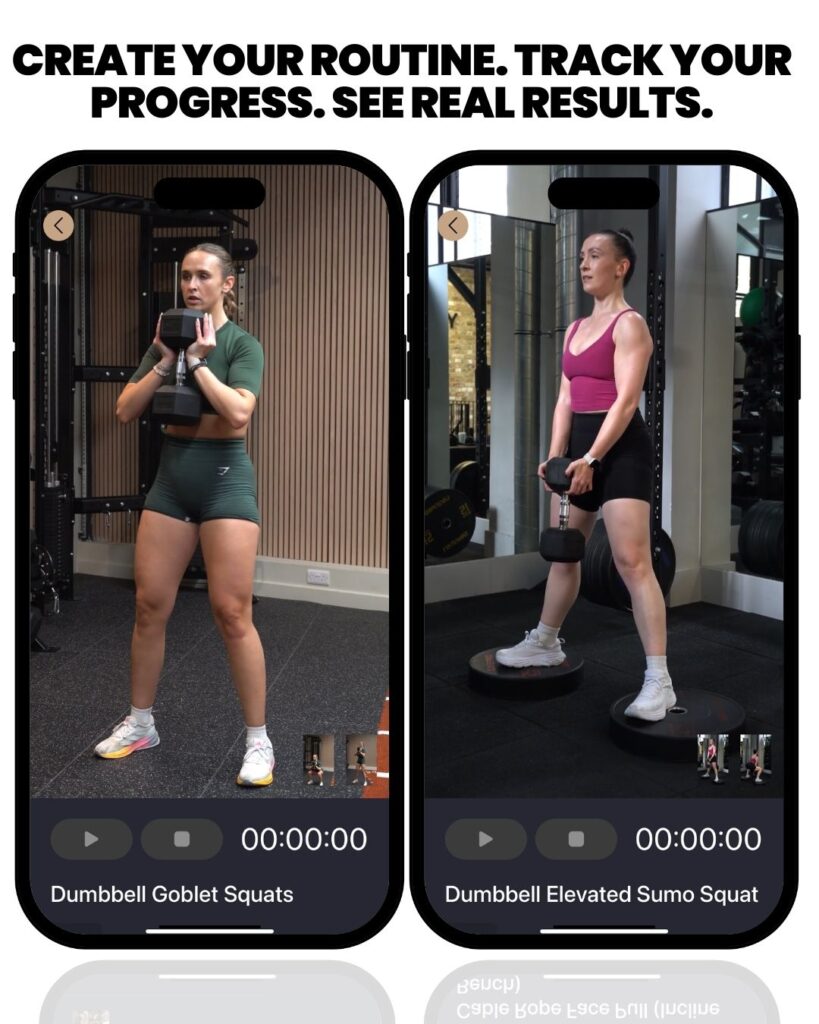
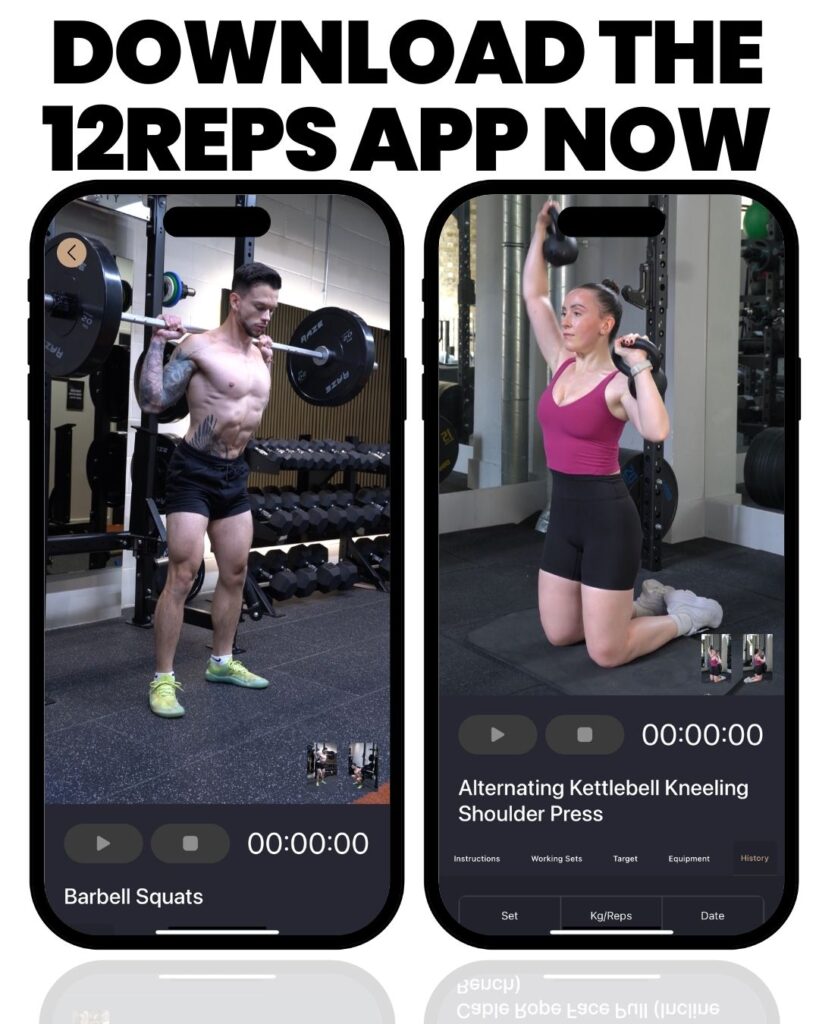
The 12REPS app shows a trainer demonstration for each exercise and logs the weight and reps for every set. It remembers what you lifted last time, so you always have a number to beat. Download the app.
Nutrition Fundamentals for 5kg Loss
Creating your calorie deficit
Using the estimate above, losing 5kg in 12 weeks needs a deficit of about 460 calories a day. One way to get there is to eat about 300 to 350 fewer calories and burn an extra 100 to 150 through activity. Many people find this easier to sustain than cutting food hard.
To estimate your needs, start with your basal metabolic rate (BMR). This is the energy you burn just staying alive at rest. Then multiply it by an activity factor. Online calculators can do this for you, but as a rough guide:
- Sedentary (desk job, little exercise): BMR × 1.2.
- Lightly active (light exercise 1 to 3 days a week): BMR × 1.375.
- Moderately active (moderate exercise 3 to 5 days a week): BMR × 1.55.
From this total, subtract 300 to 500 calories to create your deficit. Start at the smaller end. You can adjust if your weekly average stops moving. For a worked example with numbers, see the nutrition steps in our 10-week 5kg plan.
Macronutrient priorities for fat loss
Macronutrients are protein, carbohydrates and fat. Protein is the most important one during weight loss, because it helps you keep muscle.
Aim for about 1.6 to 2.2 grams of protein per kilogram of body weight. For a 70kg person, that’s 112 to 154 grams a day. Include protein with every meal.
A large meta-analysis found that, in people who lift, protein above about 1.62g per kg a day gave no further muscle gains. The ISSN notes that higher intakes may help keep lean mass during periods of eating less. For more, read how much protein you really need.
Carbohydrates fuel your workouts and help with recovery. You don’t need to cut them out. Focus on oats, rice, potatoes, fruit and vegetables. Many people like to eat some of their carbs before and after training.
Fat supports hormone production and helps your body absorb some vitamins. Include sources like nuts, olive oil, avocado and oily fish. About 0.8 to 1.2 grams per kilogram of body weight is a practical starting point.
Meal timing and practical tips
Total calories and protein matter most. Timing can still help you stick to your plan and train well.
Spread your protein across the day rather than eating it all in one meal. The ISSN suggests about 0.25g per kg of body weight, or 20 to 40g, per meal, spread every 3 to 4 hours.
A protein-rich meal in the hours after training is a simple habit that fits this pattern.
Drink water regularly through the day, and more when you’re active or it’s hot.
Don’t forget sleep. The CDC says adults should get at least 7 hours of sleep each night. Poor sleep can make it harder to recover and stay consistent with your training.

Common Mistakes and How to Avoid Them
These are the mistakes that most often slow people down, and how to avoid them.
Extreme calorie restriction: Eating too little is hard to sustain and makes it harder to keep muscle. Stick to a moderate deficit of 300 to 500 calories a day.
Neglecting strength training: Cardio helps you use more energy, but it does not build muscle the way lifting does. In one trial, strength training was needed to increase lean body mass.
All-or-nothing mentality: One bad meal doesn’t ruin your progress. Get back on track with your next meal, not next Monday.
Comparing yourself to others: A colleague might lose weight faster than you, but everyone’s body is different. Focus on your own progress.
Timelines that are too short: 5kg in 4 weeks is faster than the NHS range. Give yourself 10 to 12 weeks.
Ignoring recovery: Sleep, stress and rest days all affect how well you train and recover.
Your 12-Week Action Plan
Weeks 1–4: Foundation phase
Focus on building habits and setting your routine. Start with 3 strength training sessions a week and a moderate calorie deficit. Don’t expect dramatic changes yet. Your body is adapting.
Track your food, workouts, measurements and how you feel. This record will help later when you need to make changes.
Weeks 5–8: Momentum phase
By now, your habits should feel more settled. You might hit your first plateau during this phase. That’s normal. Stay consistent.
This is when you might need a small change to your calories or training. Your logged lifts and body-weight trend in the 12REPS app show whether your weight is still moving and whether your lifts are going up.
Weeks 9–12: Refinement phase
This phase is about fine-tuning and planning for maintenance. Some people will be near their 5kg goal by now. Others will need longer, and that’s fine. Start thinking about how you’ll keep your new habits.
Don’t go straight back to your old eating habits once you reach your goal. Raise your calories back to maintenance gradually over 2 to 3 weeks.
Conclusion
Losing 5kg safely isn’t about finding the perfect diet or workout plan. It comes down to setting expectations you can meet, a moderate calorie deficit, strength training and patience.
Focusing on the process, not just the outcome, makes it easier to keep going. Real change takes time.
This is about more than the scale. You’re building strength, supporting your health and creating habits that can last.
Start today. Take your measurements, plan your first workout and commit to the process. For a week-by-week training and nutrition plan, see our 10-week plan for working toward 5kg. For the wider research, read strength training and weight loss: what the research shows.
If you have a medical condition, take medication, are pregnant or have a history of disordered eating, check with your doctor before you start a calorie deficit.
If you’d like a plan built around your goal, equipment and time, 12REPS sets out each session with trainer demonstrations. It logs every set and lets you track your body-weight trend and progress photos.
Sources
- Tips to help you lose weight. NHS, accessed 2026. https://www.nhs.uk/live-well/healthy-weight/managing-your-weight/12-tips-to-help-you-lose-weight/
- Steps for Losing Weight. Centers for Disease Control and Prevention (CDC), 2023. https://www.cdc.gov/healthy-weight-growth/losing-weight/index.html
- Why is the 3500 kcal per pound weight loss rule wrong?. International Journal of Obesity, 2013. https://www.nature.com/articles/ijo2013112.pdf
- Does adaptive thermogenesis occur after weight loss in adults? A systematic review. British Journal of Nutrition, 2022. https://eprints.whiterose.ac.uk/172561/1/does-adaptive-thermogenesis-occur-after-weight-loss-in-adults-a-systematic-review%281%29.pdf
- Resistance Training Prevents Muscle Loss Induced by Caloric Restriction in Obese Elderly Individuals: A Systematic Review and Meta-Analysis. Nutrients, 2018. https://www.mdpi.com/2072-6643/10/4/423
- Specific metabolic rates of major organs and tissues across adulthood: evaluation by mechanistic model of resting energy expenditure. The American Journal of Clinical Nutrition, 2010. https://pmc.ncbi.nlm.nih.gov/articles/PMC2980962
- Effect of an acute period of resistance exercise on excess post-exercise oxygen consumption: implications for body mass management. European Journal of Applied Physiology, 2002. https://link.springer.com/doi/10.1007/s00421-001-0568-y
- Physical activity guidelines for adults aged 19 to 64. NHS, accessed 2026. https://www.nhs.uk/live-well/exercise/physical-activity-guidelines-for-adults-aged-19-to-64/
- A systematic review, meta-analysis and meta-regression of the effect of protein supplementation on resistance training-induced gains in muscle mass and strength in healthy adults. British Journal of Sports Medicine, 2018. https://openrepository.aut.ac.nz/items/8dea98a4-4e37-4c60-be43-4b6ece0bd9a5
- International Society of Sports Nutrition Position Stand: Protein and Exercise. Journal of the International Society of Sports Nutrition, 2017. https://cdr.lib.unc.edu/concern/articles/gh93h184p
- 1 in 3 adults don’t get enough sleep. Centers for Disease Control and Prevention (CDC), 2016. https://archive.cdc.gov/www_cdc_gov/media/releases/2016/p0215-enough-sleep.html
- Effects of aerobic and/or resistance training on body mass and fat mass in overweight or obese adults. Journal of Applied Physiology (PEDro record), 2012. https://search.pedro.org.au/search-results/record-detail/34655
