

Strength training and metabolism are linked, but the effect is smaller than many headlines suggest. Each kilogram of muscle burns about 13 calories a day at rest. Strength training still supports lasting fat loss, mainly by protecting muscle while you diet and making you stronger.
Here is what the numbers look like, where they come from, and what they mean for how you train.
What is metabolism?
Your metabolism is all the energy your body uses in a day. It has a few parts:
- Resting metabolic rate (RMR): the energy you use at rest to keep your body running. It makes up a large share of your daily energy use.
- Exercise: the energy you use during workouts.
- Everyday movement: walking, standing, chores and fidgeting.
- Digesting food: the energy used to break down and absorb what you eat.
Strength training can nudge some of these up. None of them changes by a huge amount.
How many calories does muscle burn?
Researchers estimate that skeletal muscle uses about 13 kcal per kg per day at rest. Fat tissue uses about 4.5 kcal per kg per day. So muscle does burn more than fat, but each extra kilogram adds only a little.
| Extra muscle | Estimated extra calories at rest |
|---|---|
| 1 kg | About 13 kcal a day. |
| 2 kg | About 26 kcal a day. |
| 3 kg | About 39 kcal a day. |
Over months and years, this adds up. On its own, though, it is not enough to drive large fat loss. Claims that each kilogram of muscle burns 50 or more extra calories a day are not supported by this research.
Does strength training raise resting metabolism?
Some studies measure RMR directly before and after a strength program:
- In 15 adults aged 61 to 77, 26 weeks of strength training raised resting energy expenditure by 6.8%. Total daily energy expenditure rose by 12%.
- In a 9-month study, resting metabolic rate rose by about 5% on average, from 1,653 to 1,726 kcal a day. The change varied widely between people.
The studies were small, though, and results differ from person to person. A fair summary is that strength training raised resting metabolism by about 5 to 7% in these studies.
The afterburn effect (EPOC)
EPOC stands for excess post-exercise oxygen consumption. After a workout, your body uses extra energy to recover, refuel and repair.
In a study of seven young men, oxygen use stayed above baseline for up to 38 hours after a hard 31-minute resistance circuit. That sounds large, but the total number of extra calories is modest.
A University of New Mexico review reported that EPOC after resistance exercise accounted for roughly 51 to 127 kcal in the studies it covered. It described EPOC as a supplemental part of weight management. So the afterburn is a small bonus, not the main reason strength training helps.
Does dieting slow your metabolism?
When you lose weight, you burn less energy, partly because there is less of you to move and maintain. Some research also finds an extra drop beyond what the weight change predicts. This is called adaptive thermogenesis.
A 2022 systematic review found adaptive thermogenesis in 27 of 33 studies. Its size varied a lot. It was often small or not significant in higher-quality studies, and it tended to fade once weight was stable.
This is where strength training earns its place. A meta-analysis of six trials in older adults with obesity found that strength training during calorie restriction prevented most of the lean mass loss seen with dieting alone. Keeping that muscle helps you stay strong and keeps your energy needs a little higher.
What really drives lasting fat loss
Muscle and metabolism matter, but they are only part of the picture. The research points to a few key factors:
- A calorie deficit. You lose fat when you use more energy than you eat over time. See how many calories to eat to build muscle and lose fat.
- Strength training to keep muscle. The ACSM position stand notes that resistance training does not add much weight loss on its own but may increase fat-free mass and fat loss.
- Sensible expectations from lifting alone. In a large meta-analysis, strength training alone reduced fat mass by about 0.55 kg compared with not training.
- Enough protein. The ISSN suggests 1.4 to 2.0 g of protein per kg of body weight a day for most people who exercise. Read more in how much protein you really need.
- Habits you can keep. Cardio and daily movement add to your energy use, and consistency matters more than any single workout.
For a wider look at the research on lifting and weight loss, read strength training and weight loss: what the research shows.
How to train with this in mind
- Strength train all major muscle groups at least two days a week, as the NHS guidelines recommend.
- Build sessions around compound lifts such as the barbell squat, barbell bench press and barbell bent-over row.
- Add weight or reps over time. This is called progressive overload, and it keeps giving your muscles a reason to adapt. Our beginner’s guide to progressive overload explains how.
- Log what you lift, so you can see progress over weeks, not just days.
Want a full week laid out? Our 10-week plan for working toward 5kg includes a three-day strength split, cardio sessions and nutrition steps. For safe weekly targets, see how to lose 5kg safely.
If you have a medical condition or take medication, check with your doctor before you make big changes to your diet or exercise.
Key takeaways
- Each kilogram of muscle burns about 13 calories a day at rest.
- In small studies, strength training raised resting metabolism by about 5 to 7%.
- The afterburn effect is real, but it adds only a modest number of calories.
- During weight loss, the main benefit of lifting is keeping your muscle.
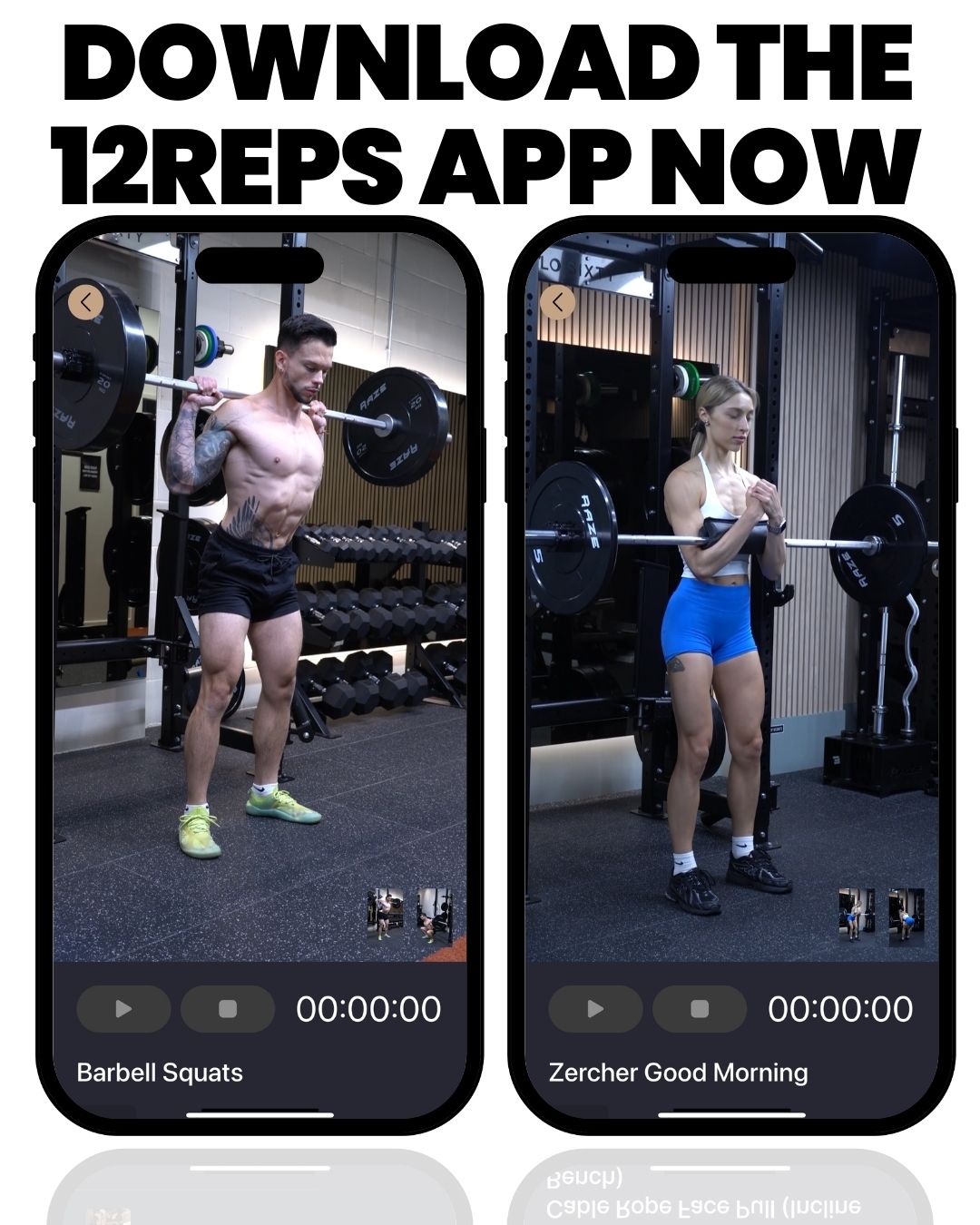
If you’re not sure what to do in the gym, 12REPS gives you a plan built around your goal, equipment and time. Every exercise has a trainer demonstration, and the app logs each set so you know what to beat next time.
Sources
- Specific metabolic rates of major organs and tissues across adulthood: evaluation by mechanistic model of resting energy expenditure. The American Journal of Clinical Nutrition, 2010. https://pmc.ncbi.nlm.nih.gov/articles/PMC2980962
- Resistance training increases total energy expenditure and free-living physical activity in older adults. Journal of Applied Physiology, 2000. https://www.bisp-surf.de/Record/PU199912408417
- Effect of resistance training on resting metabolic rate and its estimation by a dual-energy X-ray absorptiometry metabolic map. European Journal of Clinical Nutrition, 2015. https://www.researchwithrowan.com/en/publications/effect-of-resistance-training-on-resting-metabolic-rate-and-its-e/
- Effect of an acute period of resistance exercise on excess post-exercise oxygen consumption: implications for body mass management. European Journal of Applied Physiology, 2002. https://link.springer.com/doi/10.1007/s00421-001-0568-y
- Resistance Training and EPOC. Reynolds and Kravitz, University of New Mexico, n.d.. https://www.unm.edu/~lkravitz/Article%20folder/epoc.html
- Does adaptive thermogenesis occur after weight loss in adults? A systematic review. British Journal of Nutrition, 2022. https://eprints.whiterose.ac.uk/172561/1/does-adaptive-thermogenesis-occur-after-weight-loss-in-adults-a-systematic-review%281%29.pdf
- Resistance Training Prevents Muscle Loss Induced by Caloric Restriction in Obese Elderly Individuals: A Systematic Review and Meta-Analysis. Nutrients, 2018. https://www.mdpi.com/2072-6643/10/4/423
- ACSM Position Stand: Appropriate Physical Activity Intervention Strategies for Weight Loss and Prevention of Weight Regain for Adults. American College of Sports Medicine, Medicine & Science in Sports & Exercise, 2009. https://www.sportgeneeskunde.com/files/bestanden/VSG/VSG6671.pdf
- The effect of resistance training in healthy adults on body fat percentage, fat mass and visceral fat: a systematic review and meta-analysis. Sports Medicine, 2022. https://www.pubmed.gov/34536199/
- International Society of Sports Nutrition Position Stand: Protein and Exercise. Journal of the International Society of Sports Nutrition, 2017. https://cdr.lib.unc.edu/concern/articles/gh93h184p
- Physical activity guidelines for adults aged 19 to 64. NHS, accessed 2026. https://www.nhs.uk/live-well/exercise/physical-activity-guidelines-for-adults-aged-19-to-64/