


Arm training for women works the same way as for anyone: train your biceps and triceps directly once or twice a week, on top of your main presses and rows. Use weights heavy enough that each set ends one to three reps short of failure, and add weight or reps over time. Give your triceps at least as much work as your biceps, because they are the bigger muscle.
The usual mistake is a few light curls at the end of a session, at the same weight for months. That is not enough to change how your arms look or how strong they feel.
This guide covers the programming side: how much arm training you need, how heavy to go, which exercises to choose and how to fit arm work into your week. For a ready-made session, see our arm workout for biceps and triceps. If you are worried about size, read will lifting weights make me bulky?

Your arm muscles: what you are training
Front of the upper arm
- Biceps brachii: two heads, long and short. It bends your elbow and turns your palm up.
- Brachialis: sits under the biceps and bends the elbow whatever your grip.
Back of the upper arm
- Triceps brachii: three heads (long, lateral and medial). It straightens your elbow. The long head also crosses the shoulder, so the position of your arm changes how it works.
Why triceps matter
In an MRI study of 10 adults, five women and five men, the triceps had more than twice the volume of the biceps brachii. It was the largest muscle crossing the elbow. So if you want more shape in your upper arms, the back of the arm deserves at least as much attention as the front.
Light weights and high reps: do they work?
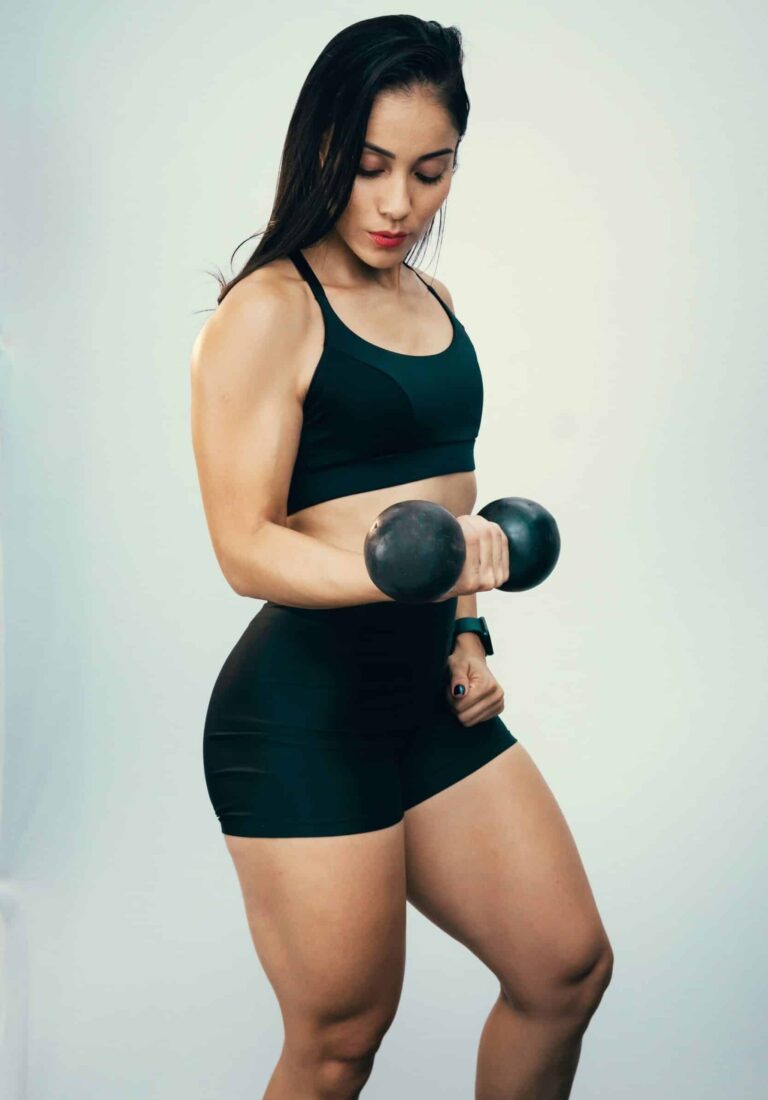
Light weights can build muscle, but only if the sets are hard. A meta-analysis comparing low-load and high-load training found similar muscle growth across a wide range of loads. Heavier loads gave bigger gains in maximum strength.
The problem with “light weights for toning” is not the weight. It is stopping a set of 20 when you could have done 40. Muscle responds to effort. Whatever weight you use, the last few reps should feel hard.
A simple way to judge effort is reps in reserve (RIR): how many more good reps you could have done at the end of a set. Aim for one to three in reserve on most sets.
A practical range for arm exercises is 8 to 15 reps. It is heavy enough to make progress and light enough to keep your elbows and form comfortable.
Will arm training make you bulky?
Women build muscle at a similar rate to men in percentage terms. A 2025 meta-analysis found similar relative gains in muscle size between the sexes. Men gained slightly more in absolute terms, and that gap showed up in upper-body muscles, not the legs.
In practice, arm muscle grows slowly for most women. Visible change takes months of steady training, and you control how far you take it.
How much arm training do you need?
The 2026 ACSM position stand on resistance training found that higher weekly volume, about 10 or more sets per muscle group a week, was linked to more muscle growth. An earlier dose-response meta-analysis found the same pattern: more weekly sets, more growth, up to a point.
Your arms already get some of this from compound lifts. In one study, push-ups and bench press both increased triceps thickness in 18 young men. So a few direct sets are often enough, especially early on.
| Training experience | Direct arm work | Weekly hard sets |
|---|---|---|
| First 3 to 6 months | Optional; focus on presses, rows and pulldowns | 0 to 4 each for biceps and triceps |
| 6 to 24 months | 1 arm block a week | 6 to 8 each |
| 2 years or more, or arms are a priority | 2 arm blocks a week, 2 to 3 days apart | 8 to 12 each |
A “hard set” is a working set taken close to failure, not a warm-up. Start at the low end and add sets only if you are recovering well and progress has stalled.
Your arms do not need a separate day. Two or three arm exercises at the end of an upper-body or full-body session work well. For how to arrange your week, see our upper body strength guide for women.

The best biceps exercises
Pick one or two of these and stick with them long enough to add weight.
- Dumbbell or barbell curl. The basic curl. Keep your elbows by your sides and lower the weight all the way. A Z-bar biceps curl is easier on some people’s wrists.
- Hammer curl. Palms face each other the whole way. A good second curl that lets most people use a little more weight.
- Cable curl. The cable keeps tension on the arm at the bottom of the rep. Try the cable rope biceps curl.
- Incline dumbbell curl. Sit back on a bench set at about 45 to 60 degrees and let your arms hang behind your body. Go lighter than your standing curl.
- Preacher or spider curl. Your upper arm rests on a pad, so you cannot swing. See the spider biceps curl.
Cues for every curl: stand tall, keep your elbows still, squeeze at the top and take two seconds to lower. If you have to lean back to lift it, the weight is too heavy.
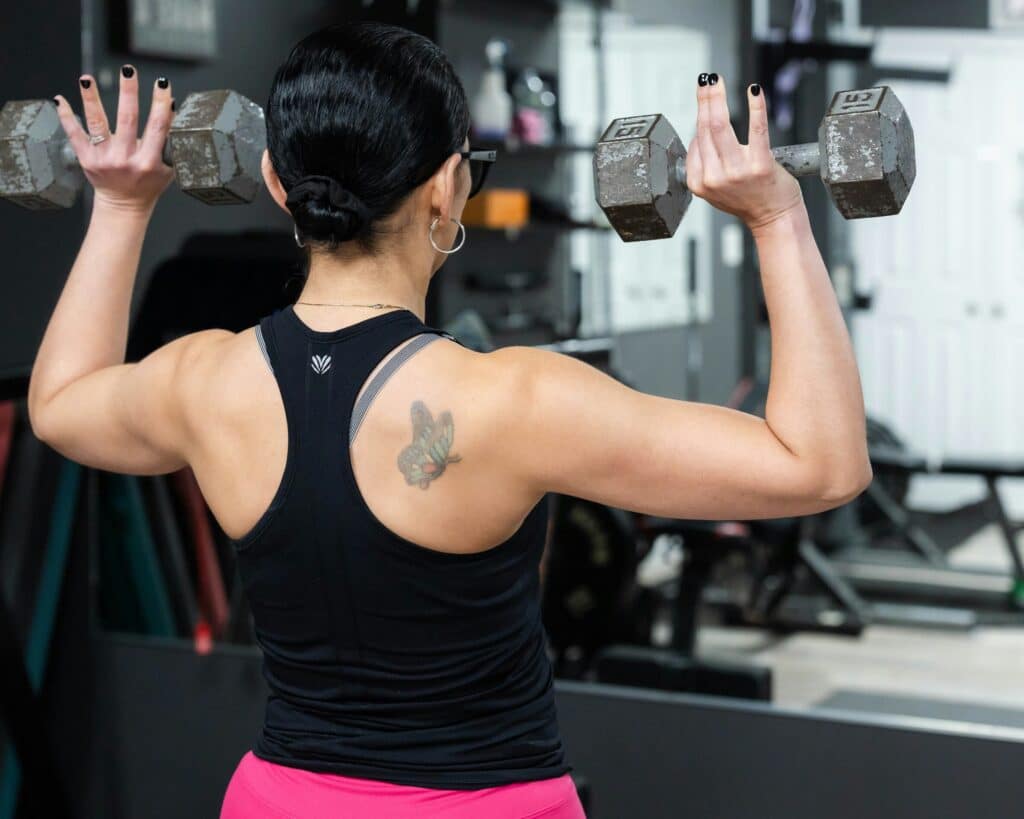
Video: Dumbbell hammer curl. Watch how the palms stay facing each other and the elbows stay pinned to the sides through the whole rep.
The best triceps exercises
- Overhead triceps extension. With a dumbbell, cable or rope, lower the weight behind your head and straighten your arms. In a 12-week study of 21 untrained adults, overhead cable extensions grew the triceps about 1.4 times more than pushdowns with the arm by the side. The overhead arm did this while lifting lighter weights. See the rope overhead triceps extension.
- Rope or bar pushdown. Elbows stay tucked at your sides while you push the handle down. Try the straight bar triceps pushdown.
- Close-grip press or push-up. A press with your hands closer together. It lets you use more load. See the dumbbell close grip chest press.
- Skull crusher. Lying on a bench, lower an EZ bar or dumbbells toward your forehead, then straighten your arms. See the EZ bar skull crusher.
- Dips. Bench dips or parallel bar triceps dips. Only go as deep as your shoulders feel comfortable.
A good pairing is one overhead exercise and one pushdown or press each week.
Video: Rope triceps extension. Watch the elbows stay still while the rope moves, and how the hands spread apart at the bottom.
Sample arm sessions
Do these at the end of an upper-body or full-body workout. Rest 60 to 90 seconds between sets.
Session A: one arm block a week (about 20 minutes)
- Dumbbell or barbell curl: 3 sets of 10 to 12
- Rope or bar pushdown: 3 sets of 10 to 12
- Hammer curl: 2 sets of 10 to 12
- Overhead triceps extension: 2 sets of 10 to 12
That is 5 sets for biceps and 5 for triceps. Add Session B on a second day if arms are a priority.
Session B: second arm block (about 20 minutes)
- Close-grip press: 3 sets of 8 to 10
- Incline dumbbell curl: 3 sets of 10 to 12
- Overhead triceps extension: 2 sets of 10 to 15
- Cable curl: 2 sets of 12 to 15
How to progress your arm training
Progressive overload means doing a little more over time. For arms, the simplest method is double progression:
- Pick a rep range, for example 10 to 12.
- Use the same weight until you can do 12 good reps on every set.
- Then move up to the next dumbbell or the next cable plate, and build back up from 10.
Arm exercises use small weights, so jumps of 1 to 2 kg can feel big. If a jump is too much, add a rep or a set first. Log every session so you know what to beat next time.
Training arms at home
Bands work well for curls, pushdowns and overhead extensions. A meta-analysis found elastic resistance gave similar strength gains to free weights and machines. Try the resistance band standing biceps curl. For a full plan with limited kit, see our home workout plan to build muscle.

Common arm training mistakes
- Only training biceps. The triceps is the bigger muscle. Match your biceps sets at least.
- Same weight for months. If nothing changes on paper, little changes in the mirror. Track your weights and reps.
- Stopping sets too early. Light weights only work if the set gets hard. Check your reps in reserve.
- Swinging. Leaning back or bouncing moves the work away from your arms. Lower the weight and slow down.
- Arms every day. More is not always better. One or two arm blocks a week, with a couple of days between, is enough for most people.
For more on shape rather than size, see our guides to defined arms without bulk and building bigger arms.
Arm training with 12REPS
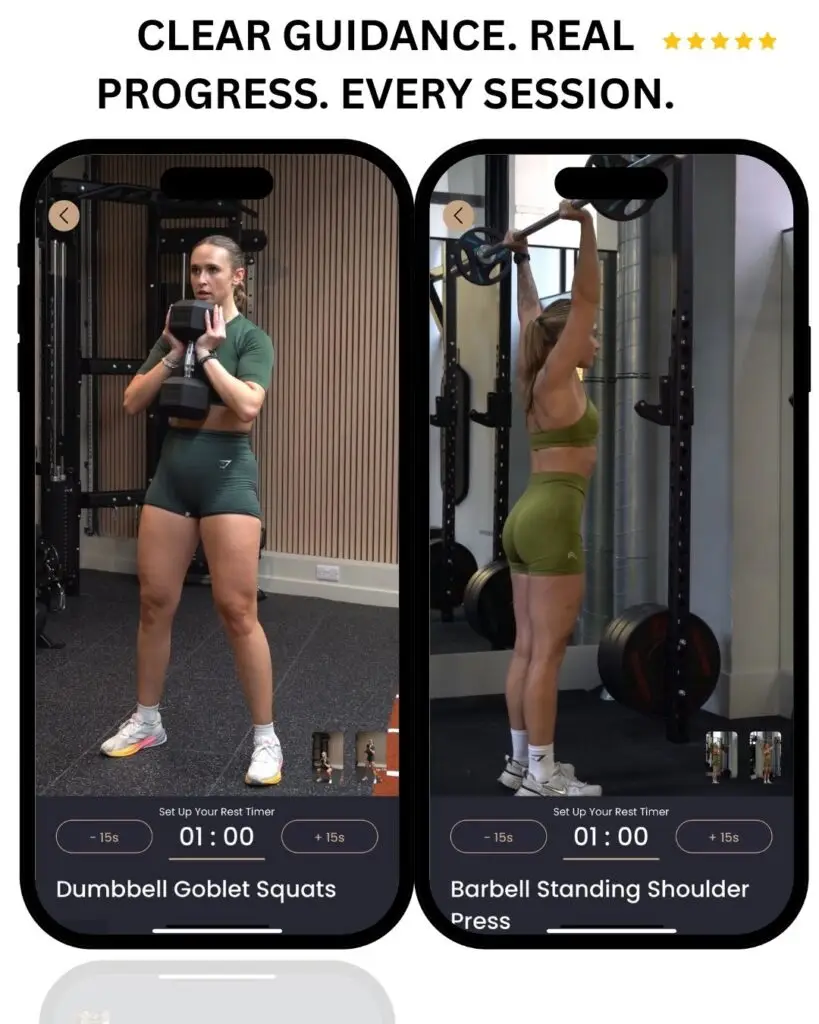
If you want arm work placed in a full plan, 12REPS builds each session around your goal, your equipment and the time you have. You can also choose arms on the body map, pick your equipment and time, and the app builds an arm session for you. Every exercise has a trainer demonstration, and the app remembers what you lifted so you have a number to beat next time.
Arm training FAQs
How often should women train arms?
Once or twice a week of direct arm work, on top of your presses and rows, suits most people. Beginners can start with presses, rows and pulldowns alone for the first few months.
What rep range is best for arms?
Muscle grows across a wide range of loads when sets are hard. Around 8 to 15 reps, ending one to three reps short of failure, is a practical choice for most arm exercises.
Can I build arm muscle without weights?
Yes, if the exercises get harder over time. Push-up variations, bench dips and resistance bands can all train your arms at home.
Can I lose fat just from my arms?
No. Arm training builds the muscle underneath, but where you lose fat depends on your overall eating, activity and genetics, not on which muscle you train.
Sources
- Upper limb muscle volumes in adult subjects. Holzbaur KRS, Murray WM, Gold GE, Delp SL, Journal of Biomechanics, 2007. https://doi.org/10.1016/j.jbiomech.2006.11.011
- Triceps brachii hypertrophy is substantially greater after elbow extension training performed in the overhead versus neutral arm position. Maeo S et al., European Journal of Sport Science, 2023. https://doi.org/10.1080/17461391.2022.2100279
- Strength and hypertrophy adaptations between low- vs. high-load resistance training: a systematic review and meta-analysis. Schoenfeld BJ, Grgic J, Ogborn D, Krieger JW, Journal of Strength and Conditioning Research, 2017. https://pubmed.ncbi.nlm.nih.gov/28834797/
- Dose-response relationship between weekly resistance training volume and increases in muscle mass: a systematic review and meta-analysis. Schoenfeld BJ, Ogborn D, Krieger JW, Journal of Sports Sciences, 2017. https://doi.org/10.1080/02640414.2016.1210197
- American College of Sports Medicine Position Stand. Resistance training prescription for muscle function, hypertrophy, and physical performance in healthy adults: an overview of reviews. Currier BS et al., Medicine and Science in Sports and Exercise, 2026. https://doi.org/10.1249/MSS.0000000000003897
- Sex differences in absolute and relative changes in muscle size following resistance training in healthy adults: a systematic review with Bayesian meta-analysis. Refalo MC et al., PeerJ, 2025. https://doi.org/10.7717/peerj.19042
- Low-load bench press and push-up induce similar muscle hypertrophy and strength gain. Kikuchi N, Nakazato K, Journal of Exercise Science and Fitness, 2017. https://doi.org/10.1016/j.jesf.2017.06.003
- Effects of training with elastic resistance versus conventional resistance on muscular strength: a systematic review and meta-analysis. Lopes JSS et al., SAGE Open Medicine, 2019. https://doi.org/10.1177/2050312119831116