


By Will Duru, BSc (Hons) Sport and Exercise Science, Award-winning Personal Trainer with over 10 years of experience in strength training and optimising recovery
Yes, building muscle mass after 40 is possible. In a review of 49 studies, older adults gained an average of about 1.1 kg of lean mass from resistance training. The essentials are progressive strength training at least twice a week, enough protein and good sleep.
I often hear people say it is too late to build muscle once you pass 40. The research does not support that. This article covers what changes with age, how to train and eat for muscle growth, and a 12-week program you can follow.
If you have a health condition, take medication or are new to exercise, check with your doctor before you start. Ask a pharmacist before adding supplements.

What changes with age, and what does not
You lose muscle slowly if you do nothing
Harvard Health notes that after age 30, men can lose as much as 3% to 5% of their muscle mass per decade. The same article names progressive resistance training as one of the best ways to build muscle.
Sarcopenia is the medical term for age-related loss of muscle mass, strength and function. Strength training is one of the main tools used to slow that loss.
Your muscles still respond to training
A meta-analysis of 49 studies and 1,328 older adults found an average lean mass gain of 1.1 kg after resistance training. Programs with more sets per session produced bigger gains. Older participants gained a little less, and the authors suggest that starting earlier may help.
The National Strength and Conditioning Association calls resistance training a powerful intervention to combat the loss of muscle strength and muscle mass in older adults. It links training to better physical function, mobility and independence.
Video: How long does it take to build muscle? Watch this to set realistic expectations before you start the 12-week plan below.
Protein needs rise a little
As you age, your muscles respond less to the same amount of protein. This is often called anabolic resistance. In one large review, the benefit of protein supplements on muscle gains became smaller with age. That is one reason older adults are advised to eat more protein, covered below.

How to train for muscle growth after 40
Frequency: at least twice a week
A review found that training each muscle group twice a week led to more growth than once a week. The NHS also advises strengthening activities on at least 2 days a week for adults over 65.
Volume: build up your weekly sets
Volume is the total work you do, often counted as hard sets per muscle group per week. A meta-analysis found that more weekly sets led to more muscle growth, with at least 10 weekly sets per muscle group suggested to maximize gains.
Start lower, for example 2 to 4 sets per exercise, and add sets as your recovery allows.
Effort and load: hard sets matter most
In one study of young men, light and heavy loads built similar muscle when sets were taken to failure, while heavy loads gave more maximal strength. For most people over 40, sets of about 6 to 15 reps work well. Pick a weight where the last few reps are hard but your form stays clean.
Exercise choice: compound moves first
Compound exercises work several muscles at once. Build each session around squats, hip hinges such as Romanian deadlifts, lunges, rows and presses. Balance pushing with pulling and upper body with lower body.
Progressive overload
Progressive overload means doing a little more over time: one more rep, a small jump in weight or an extra set. Our beginner guide to progressive overload shows simple ways to do it.

Nutrition for building muscle mass after 40
How much protein
- Daily total: one large review found that extra protein stopped adding muscle beyond about 1.6 g per kg of body weight per day. The International Society of Sports Nutrition suggests 1.4 to 2.0 g per kg per day for most people who exercise.
- Over 65: the PROT-AGE group advises at least 1.2 g per kg per day for older adults who exercise or are otherwise active.
- Per meal: the ISSN suggests doses of about 0.25 g per kg, or 20 to 40 g, spread every 3 to 4 hours across the day.
For example, a person who weighs 80 kg and aims for 1.6 g per kg needs about 128 g of protein a day. That could be four meals of about 30 to 35 g.
Leucine
Leucine is an amino acid that helps switch on muscle building after a meal. The ISSN suggests each protein dose contains 700 to 3,000 mg of leucine. Choosing high-quality protein at each meal is the simplest way to get there.
Calories
A calorie surplus means eating slightly more energy than you burn. Building muscle is harder if you under-eat, but a large surplus mostly adds fat. Aim for a small surplus, and adjust based on your body weight trend.
Whole foods first
Build your meals around protein, vegetables, fruit and whole grains. A balanced diet comes before supplements.
Read more in our guide to how much protein you need to build muscle.
Recovery and lifestyle
Muscle is built between sessions, so recovery matters as much as the workout.
Sleep
Sleep experts advise that adults should sleep 7 or more hours per night on a regular basis. If you are training hard but sleeping 5 or 6 hours, improving sleep is a sensible place to start.
Stress and rest days
Training is a stress on your body, and so are work and family life. On busy, stressful weeks, keep the session but trim a set or two. Plan at least one rest day between hard sessions for the same muscles.
Supplements
Creatine monohydrate: a meta-analysis in older adults found that creatine plus resistance training added about 1.4 kg more lean tissue than training with a placebo. The ISSN position stand describes creatine as safe and well tolerated in healthy people at the doses studied. Read our guide to creatine for older adults for more.
Protein powder: a convenient way to reach your daily protein target, not a requirement.
Supplements are not a substitute for training and food. Check with your doctor or pharmacist before taking any supplement, especially if you have a kidney condition or take medication.

12-week strength training program for adults over 40
This 12-week program builds strength, confidence and muscle step by step. Each phase uses supersets. A superset means doing two exercises back to back, then resting. Here, a loaded exercise is paired with a bodyweight exercise to save time.
Train 3 times a week in weeks 1 to 6, and 3 to 4 times a week from week 7, with at least one rest day between sessions. Warm up before each session.
Weeks 1 to 3: bodyweight foundation
Focus: learn the basic movements, build stability and get into a routine.
| Pair | Exercise 1 (sets x reps) | Exercise 2 (sets x reps) | Rest (seconds) |
|---|---|---|---|
| Superset 1 | Bodyweight squats (3 x 10 to 15) | Plank (3 x 30 to 60 second hold) | 60 to 90 |
| Superset 2 | Push-ups, on knees or incline (3 x 8 to 12) | Bird dog (3 x 10 to 12 per side) | 60 to 90 |
| Superset 3 | Glute bridges (3 x 12 to 15) | Wall sit (3 x 30 to 60 second hold) | 60 to 90 |
| Accessory | Reverse lunges (3 x 8 to 12 per leg) | Calf raises (3 x 15 to 20) | 45 |

Move on when you can complete the top of each rep range with good form. If a phase still feels hard after three weeks, repeat it before moving up.
Weeks 4 to 6: free weights and bodyweight
Focus: add light free weights and keep progressing the bodyweight moves.
| Pair | Exercise 1 (sets x reps) | Exercise 2 (sets x reps) | Rest (seconds) |
|---|---|---|---|
| Superset 1 | Goblet squats (3 x 10 to 12) | Push-ups, standard or incline (3 x max reps) | 60 to 90 |
| Superset 2 | Dumbbell rows (3 x 8 to 12 per arm) | Plank (3 x 45 to 75 second hold) | 60 to 90 |
| Superset 3 | Dumbbell Romanian deadlifts (3 x 10 to 12) | Glute bridges (3 x 15 to 20) | 60 to 90 |
| Accessory | Dumbbell overhead press (3 x 8 to 12) | Bodyweight lunges (3 x 10 to 15 per leg) | 45 |
Video: How to do a dumbbell RDL. The dumbbell Romanian deadlift first appears in weeks 4 to 6. Watch this to see the hip hinge, a flat back and where the dumbbells travel.
Weeks 7 to 9: more sets with dumbbells and kettlebells
Focus: more volume and heavier weights, keeping the superset structure.
| Pair | Exercise 1 (sets x reps) | Exercise 2 (sets x reps) | Rest (seconds) |
|---|---|---|---|
| Superset 1 | Kettlebell goblet squats (4 x 8 to 10) | Jump squats (4 x 10 to 12) | 90 to 120 |
| Superset 2 | Dumbbell bench press (4 x 8 to 10) | Inverted rows (4 x max reps) | 90 to 120 |
| Superset 3 | Kettlebell swings (4 x 15 to 20) | Mountain climbers (4 x 30 to 45 seconds) | 90 to 120 |
| Accessory | Dumbbell biceps curls (3 x 10 to 12) | Triceps dips (3 x max reps) | 60 |
If jumping bothers your knees or hips, swap jump squats for slow bodyweight squats. Our low-impact strength training guide has more joint-friendly swaps.

Weeks 10 to 12: advanced progressive overload
Focus: heavier loads, more volume and harder pairings.
| Pair | Exercise 1 (sets x reps) | Exercise 2 (sets x reps) | Rest (seconds) |
|---|---|---|---|
| Superset 1 | Dumbbell deadlifts (4 to 5 x 6 to 8) | Box jumps (4 to 5 x 6 to 8) | 120 to 180 |
| Superset 2 | Dumbbell floor press (4 to 5 x 8 to 10) | Pull-ups, assisted or banded (4 to 5 x max reps) | 120 to 180 |
| Superset 3 | Kettlebell front squats (4 to 5 x 8 to 10) | Pistol squat progression (4 to 5 x 5 to 8 per leg) | 120 to 180 |
| Accessory | Dumbbell lateral raises (3 x 12 to 15) | Plank with shoulder taps (3 x 10 to 12 per side) | 60 |
Box jumps can be swapped for step-ups if you prefer to avoid landings. Always put good form before heavier weight.
Keep going after week 12
Building muscle after 40 is a long game. Keep the habits that worked: train each muscle at least twice a week, add a little over time, eat enough protein and protect your sleep.
For more on this topic, read our complete training guide to building muscle after 40, is it too late to build muscle after 40?, and our guides for men over 40 and women over 40. New to training? Start with bodyweight strength training at home.
Track the plan with 12REPS
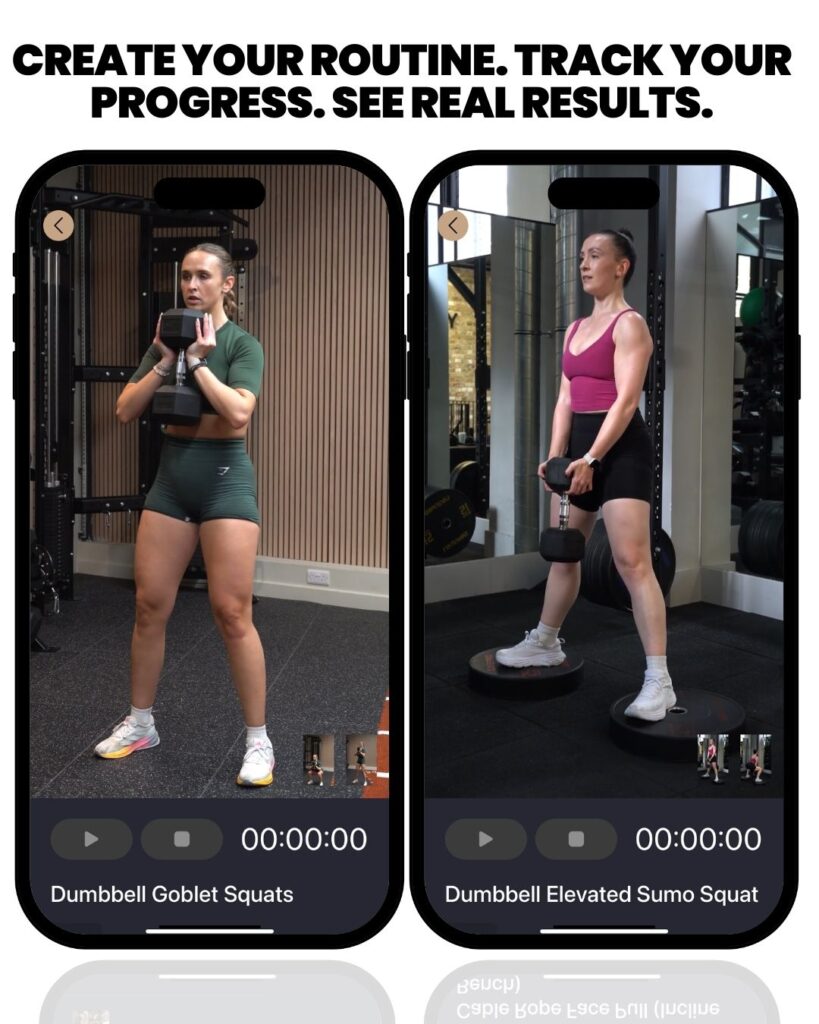
If you want each session built around your goal, your equipment and your time, see how 12REPS works. Every exercise has a trainer demonstration, and the app remembers what you lifted, so you always have a number to beat.

Sources
- Declining muscle mass is part of aging, but not inevitable. Harvard Health Publishing, 2016. https://www.health.harvard.edu/press_releases/declining-muscle-mass-is-part-of-aging-but-not-inevitable-from-the-march-2016-harvard-mens-health-watch
- Influence of Resistance Exercise on Lean Body Mass in Aging Adults: A Meta-Analysis. Peterson MD, Sen A, Gordon PM. Medicine & Science in Sports & Exercise, 2011. https://pubmed.ncbi.nlm.nih.gov/20543750/
- Resistance Training for Older Adults: Position Statement From the National Strength and Conditioning Association. Fragala MS et al. Journal of Strength and Conditioning Research, 2019. https://pubmed.ncbi.nlm.nih.gov/31343601/
- A systematic review, meta-analysis and meta-regression of the effect of protein supplementation on resistance training-induced gains in muscle mass and strength in healthy adults. Morton RW et al. British Journal of Sports Medicine, 2018. https://doi.org/10.1136/bjsports-2017-097608
- Effects of Resistance Training Frequency on Measures of Muscle Hypertrophy: A Systematic Review and Meta-Analysis. Schoenfeld BJ, Ogborn D, Krieger JW. Sports Medicine, 2016. https://pubmed.ncbi.nlm.nih.gov/27102172/
- Dose-response relationship between weekly resistance training volume and increases in muscle mass: A systematic review and meta-analysis. Schoenfeld BJ, Ogborn D, Krieger JW. Journal of Sports Sciences, 2017. https://pubmed.ncbi.nlm.nih.gov/27433992/
- Resistance exercise load does not determine training-mediated hypertrophic gains in young men. Mitchell CJ et al. Journal of Applied Physiology, 2012. https://pmc.ncbi.nlm.nih.gov/articles/PMC3404827
- Physical activity guidelines for older adults. NHS, 2024. https://www.nhs.uk/live-well/exercise/physical-activity-guidelines-older-adults/
- International Society of Sports Nutrition Position Stand: Protein and Exercise. Jäger R et al. Journal of the International Society of Sports Nutrition, 2017. https://pubmed.ncbi.nlm.nih.gov/28642676/
- Evidence-based recommendations for optimal dietary protein intake in older people: A position paper from the PROT-AGE study group. Bauer J et al. Journal of the American Medical Directors Association, 2013. https://pubmed.ncbi.nlm.nih.gov/23867520/
- Recommended Amount of Sleep for a Healthy Adult: A Joint Consensus Statement of the American Academy of Sleep Medicine and Sleep Research Society. Watson NF et al. Journal of Clinical Sleep Medicine, 2015. https://www.aasm.org/resources/pdf/adultsleepdurationconsensus.pdf
- Effect of creatine supplementation during resistance training on lean tissue mass and muscular strength in older adults: a meta-analysis. Chilibeck PD et al. Open Access Journal of Sports Medicine, 2017. https://www.dovepress.com/effect-of-creatine-supplementation-during-resistance-training-on-lean–peer-reviewed-article-OAJSM
- International Society of Sports Nutrition position stand: safety and efficacy of creatine supplementation in exercise, sport, and medicine. Kreider RB et al. Journal of the International Society of Sports Nutrition, 2017. https://pubmed.ncbi.nlm.nih.gov/28615996/