


By Will Duru, BSc (Hons) Sport and Exercise Science, Award-winning Personal Trainer with over 10 years of experience in strength training and optimising recovery
Strength training for men over 50 helps you hold on to muscle, stay strong for daily life and keep doing the things you enjoy. A good way to start is two or three sessions a week with light weights, adding a little at a time. The 8-week plan below rotates three workouts: lower body, upper body and full body.
I have worked as a personal trainer in the City of London for over ten years. In that time, I have seen more and more men train to feel strong, move better and stay healthy as they age. This guide is built around those goals.
Health check: if you have a heart condition, high blood pressure, joint problems or another medical condition, or you take regular medication, check with your doctor before you start.
What changes in your 50s
Muscle and strength
Muscle mass and strength tend to decline with age. When the loss becomes severe it is called sarcopenia. A 2019 European consensus on sarcopenia describes it as a muscle disease that builds up over a lifetime. It is most common in older age but can begin earlier.
Testosterone
Testosterone does fall with age, but slowly. Ireland’s health service, the HSE, says levels drop by less than 2% a year from around age 30 to 40. It also says this gradual fall is unlikely to cause problems on its own. If you have symptoms such as low mood, low sex drive or tiredness, speak to your GP rather than guessing.
Your muscles still respond
The key point is that muscle still grows when you train. A meta-analysis of 49 studies in adults aged 50 and over found resistance training added about 1.1 kg of lean mass on average. Programs with more sets gave bigger gains. You do not need to be young, or to fix your hormones, to get stronger.
Why lift in your 50s: the main benefits
- Daily strength. Carrying shopping, lifting luggage, climbing stairs and playing with children or grandchildren all get easier when you are stronger.
- Muscle you keep. Regular training helps you build and hold muscle as you age.
- Better movement. Squats, hinges, pushes, pulls and carries train the same patterns you use every day.
- Confidence. Many men find that setting and beating small targets in the gym carries over into the rest of life.

Is strength training safe for men over 50?
For most healthy men, yes, when you build up gradually. These habits help:
- Learn good form first. Clean technique with a light weight beats poor technique with a heavy one.
- Start light and add weight slowly. Add more only when every rep feels steady and pain-free.
- Warm up every time. Spend 5 to 8 minutes moving the joints you will train and raising your heart rate.
- Stop before your form breaks down. End the set when you can no longer do a clean rep.
- Know effort from pain. Tired, burning muscles are normal. Sharp or joint pain means stop and get advice.
How to set up your training
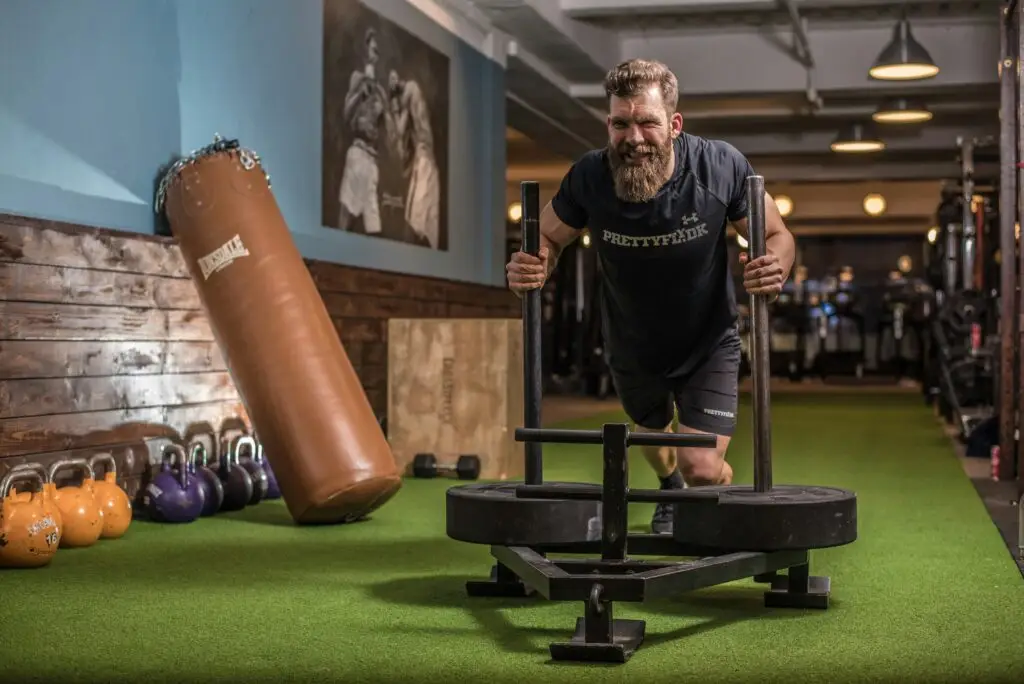
For beginners, I like a mix of equipment: bodyweight moves, resistance bands, dumbbells, machines, TRX and kettlebells. Each one teaches you how your body moves and what working a muscle feels like. That is the base for everything you do later.
Train 2 or 3 times a week, with at least one rest day between sessions. Each session takes about 45 minutes to an hour. This meets the NHS guideline of strengthening activities on at least 2 days a week, covering all major muscle groups. The 2026 ACSM position stand also found strength improved with 2 or more sessions a week.
Your 8-week, 3-day program
This program uses three workouts, A, B and C, that you rotate through. Do 2 or 3 workouts a week, with at least one rest day between sessions. If you train twice a week, simply carry on where you left off.
Day A: Lower body and core
| Exercise | Sets | Reps | Rest |
|---|---|---|---|
| Dumbbell goblet squat | 4 | 8-12 | 60 seconds |
| Dumbbell reverse lunge | 4 | 10 per side | 60 seconds |
| Dumbbell Romanian deadlift | 4 | 10 | 60 seconds |
| Dumbbell farmer carry | 4 | 20-30 meters | 60 seconds |
| Plank | 3 | 30 seconds | 45 seconds |
| Crab crawl | 2 | 30 meters | 60 seconds |
Day B: Upper body
| Exercise | Sets | Reps | Rest |
|---|---|---|---|
| Lat pulldown (machine or resistance band) | 5 | 8-12 | 60 seconds |
| Dumbbell incline bench press | 4 | 10 | 60 seconds |
| Dumbbell single-arm row | 4 | 10 per side | 60 seconds |
| Push-up (or knee push-up) | 3 | 8-10 | 60 seconds |
| Dumbbell seated shoulder press | 4 | 12 | 60 seconds |
| Dumbbell lateral raise | 3 | 12 | 45 seconds |
Day C: Full body
| Exercise | Sets | Reps | Rest |
|---|---|---|---|
| Bodyweight box squat | 4 | 10 | 60 seconds |
| Bodyweight reverse lunge | 4 | 10 per leg | 60 seconds |
| Push-up (or knee push-up) | 4 | 12 | 60 seconds |
| Bench dip | 4 | 12 | 60 seconds |
| Dead bug | 3 | 8-10 per side | 45 seconds |

Every exercise in this plan has a trainer demonstration in the 12REPS app, and you can log your reps and weight for each set as you train.
Two lifts to learn first
Video: Box squats. The box squat opens Day C. Sitting back to a box teaches you a consistent depth and a controlled lowering. Watch this 12REPS demo before your first session.
Video: How to do a lat pulldown. The lat pulldown opens Day B. This demo shows where to grip the bar and how to pull it to your upper chest.
For more technique help, see the exercise pages for the cable machine lat pulldown, the dumbbell single-arm row and the bodyweight press-up.
How to progress through the program
- Weeks 1-2, learning phase: focus only on doing each exercise well. If something feels too hard, use a lighter weight or an easier version. The goal is to learn the movements and feel confident.
- Weeks 3-4, building phase: once you can do all the reps with good form, add 2 to 5 pounds (about 1 to 2 kg). You can also add 2 or 3 reps to each set.
- Weeks 5-6, strength phase: move to harder versions, such as knee push-ups to full push-ups, or add weight to your lifts. Progress at a pace that feels challenging but doable.
- Weeks 7-8, power phase: lift each rep with more intent on the way up, while keeping the lowering slow and controlled.
Nutrition basics for men over 50
This article focuses on training, but food and recovery decide how much you get from it.
Eat enough protein
A 2018 meta-analysis found that muscle gains from strength training leveled off at about 1.6 g of protein per kg of body weight per day. A practical target is about 0.4 g/kg per meal across four meals. For an 85 kg man, that is roughly 34 grams per meal. Eggs, chicken, fish, lean meat, Greek yogurt and beans all help.
Consider creatine
A 2017 meta-analysis looked at older adults with average ages of 57 to 70. Creatine plus resistance training added about 1.4 kg more lean mass than training alone, with small extra strength gains. The International Society of Sports Nutrition states that creatine is safe and well tolerated in healthy people. Check with your doctor or pharmacist first if you have a kidney condition or take regular medication.
Drink and eat regularly
Drink water through the day, and more when you sweat. Eat regular meals so you have energy to train. Skipping meals to lose weight usually makes sessions harder.
Recovery basics
- Sleep: make it a priority. Keep your bedroom cool and dark, and put screens away before bed.
- Stress: walking, reading or a hobby you enjoy can help you switch off.
- Rest days: take at least one day off between workouts. Light walking or stretching is fine.
- Listen to your body: some muscle soreness is normal, but sharp pain is not. If something hurts, rest and see a professional.
After 8 weeks: what next?
When this plan feels steady, you can add sets, move to heavier free weights or follow a longer program. These guides can help:
- Lifting weights at 50: building strength after 50
- Strength training for men over 40
- Strength training after 60: a safe guide for beginners
- Strength training for women over 50
If you want your sessions planned for you, 12REPS builds training around your goal, your equipment and the time you have. Every exercise has a trainer demonstration, and the app remembers what you lifted, so you always have a number to beat.
Sources
- Sarcopenia: revised European consensus on definition and diagnosis. Cruz-Jentoft AJ, Bahat G, Bauer J, et al. Age and Ageing, 2019. https://pubmed.ncbi.nlm.nih.gov/30312372/
- Male menopause: symptoms, causes, diagnosis and treatments. HSE (Health Service Executive, Ireland), 2022. https://www2.hse.ie/conditions/male-menopause
- Influence of resistance exercise on lean body mass in aging adults: a meta-analysis. Peterson MD, Sen A, Gordon PM. Medicine & Science in Sports & Exercise, 2011. https://pubmed.ncbi.nlm.nih.gov/20543750/
- Physical activity guidelines for adults aged 19 to 64. NHS, 2024. https://www.nhs.uk/live-well/exercise/physical-activity-guidelines-for-adults-aged-19-to-64/
- American College of Sports Medicine Position Stand. Resistance Training Prescription for Muscle Function, Hypertrophy, and Physical Performance in Healthy Adults: An Overview of Reviews. Currier BS, D’Souza AC, Singh MAF, et al. Medicine & Science in Sports & Exercise, 2026. https://doi.org/10.1249/MSS.0000000000003897
- A systematic review, meta-analysis and meta-regression of the effect of protein supplementation on resistance training-induced gains in muscle mass and strength in healthy adults. Morton RW, Murphy KT, McKellar SR, et al. British Journal of Sports Medicine, 2018. https://bjsm.bmj.com/content/52/6/376
- How much protein can the body use in a single meal for muscle-building? Implications for daily protein distribution. Schoenfeld BJ, Aragon AA. Journal of the International Society of Sports Nutrition, 2018. https://doi.org/10.1186/s12970-018-0215-1
- Effect of creatine supplementation during resistance training on lean tissue mass and muscular strength in older adults: a meta-analysis. Chilibeck PD, Kaviani M, Candow DG, Zello GA. Open Access Journal of Sports Medicine, 2017. https://doi.org/10.2147/OAJSM.S123529
- International Society of Sports Nutrition position stand: safety and efficacy of creatine supplementation in exercise, sport, and medicine. Kreider RB, Kalman DS, Antonio J, et al. Journal of the International Society of Sports Nutrition, 2017. https://doi.org/10.1186/s12970-017-0173-z