

By Will Duru, BSc (Hons) Sport and Exercise Science, Award-winning Personal Trainer with over 10 years of experience in strength training and optimising recovery
A dumbbell only leg workout can train your whole lower body with four moves: goblet squats, reverse lunges, Romanian deadlifts and glute bridges. Each move gets 4 sets, with a minute’s rest after every set. Beginners can repeat it twice a week. Your core works the whole time to keep your trunk steady under the weights.
In my decade-plus career as a personal trainer, I’ve learned that complexity is the enemy of consistency. This is the session for a small space at home, a crowded gym or a busy week when all you have is a pair of dumbbells.
Have more equipment? These versions use what you have:
- Dumbbells plus TRX straps for home or travel: the dumbbell and TRX leg workout.
- A gym with leg extension and abductor machines: the machines-first leg workout for beginners.
- A full gym with machines and a TRX: the legs and abs workout with machines and TRX.
- A full gym and a whole session for legs: the barbell and kettlebell leg day.
For a dumbbell session with jump squats and hip thrusts, see this dumbbell lower body workout for women.

Why a dumbbell only leg workout works for beginners
If you are new to strength training, a busy gym floor can feel like a lot. A pair of dumbbells is simpler. You can start light, learn each movement and train in your living room.
Progressive overload is the key principle. It means slowly raising the demand on your muscles over time. With dumbbells that is easy to track: when every set feels controlled, you pick up the next weight.
All four exercises here are compound movements. That means each one works several muscle groups across more than one joint. A goblet squat trains your quads and glutes, while your upper back and trunk hold the weight in place.
Do you need machines to build muscle? Pooled research says no. Across 13 studies, free-weight and machine training gave similar overall gains in strength and muscle size. People did improve most on the kind of equipment they practiced with (Haugen and colleagues, 2023). So dumbbells can be your main tool, not a backup.

Keep your strength when life gets busy
This workout is not only for beginners. It is also a go-to session for keeping your hard-earned strength through travel, holidays or a packed few weeks.
A review on maintaining fitness looked at this question. Younger adults kept their strength and muscle size for up to 32 weeks with one strength session a week and one set per exercise. The catch: the weights had to stay heavy. Older adults may need two sessions a week and two to three sets per exercise to keep muscle size (Spiering and colleagues, 2021).
So in a busy week, keep your dumbbells heavy and cut the number of sets rather than the effort.
The dumbbell only leg and core workout
Four movements cover your quads, hamstrings, glutes and core. If you are a beginner, do this session twice a week and leave at least a day between sessions, for example Tuesday and Friday.
| Exercise | Sets | Reps | Rest |
|---|---|---|---|
| Dumbbell goblet squat | 4 | 12 | 60 seconds |
| Dumbbell reverse lunge | 4 | 16 (8 per leg) | 60 seconds |
| Dumbbell Romanian deadlift (RDL) | 4 | 12 | 60 seconds |
| Dumbbell glute bridge | 4 | 15 | 60 seconds |
Not sure which dumbbells to start with? This guide on how much weight to lift helps you choose.
Where does the core come in?
Holding weights while you squat, lunge and hinge makes your trunk muscles work to keep you upright. One study found heavy squats and deadlifts activated the lower-back muscles more than a superman or side bridge did. Activity in the abdominal muscles was similar across the exercises (Hamlyn and colleagues, 2007).
In that study the squats and deadlifts used 80% of each person’s one-rep max, which is heavier than most home dumbbells. For direct ab work on the floor at home, see how to do a plank or a dead bug.
How to do each dumbbell exercise
1. Dumbbell goblet squat
- Cup the top of one dumbbell in both hands and hold it against your chest, elbows pointing down.
- Set your feet a little wider than your hips, toes turned out slightly.
- Lower your hips between your heels while your chest stays tall.
- Stand up by pressing the floor away with your whole foot.
The goblet squat form guide covers depth and foot position in more detail.
2. Dumbbell reverse lunge
- Stand with your feet hip-width apart and a dumbbell in each hand.
- Reach one foot behind you and sink straight down until your back knee hovers just above the floor, with both knees near 90 degrees.
- Keep your torso tall and your front knee in line with your toes.
- Push the floor away with your front foot to come back up. Alternate legs until you reach 8 on each side.
Stepping back is often easier to control than stepping forward. This lunge technique guide compares the main versions.
3. Dumbbell Romanian deadlift (RDL)
- Hold a dumbbell in each hand in front of your thighs, palms facing you.
- Unlock your knees slightly, then fold forward from the hips, not the waist.
- Keep the dumbbells close as they move down your thighs and shins, with your back flat.
- When the backs of your thighs feel a strong stretch, push your hips forward to return to standing.
Your hips move back and forward. Your knees stay softly bent and barely move. The Romanian deadlift form guide explains the hip hinge step by step.
4. Dumbbell glute bridge
- Lie on your back with your knees bent and your feet flat on the floor.
- Rest one dumbbell across your hips and hold it in place with both hands.
- Push through your heels and squeeze your glutes to lift your hips.
- Stop when your body forms a straight line from shoulders to knees, then lower with control.
Keep your ribs down at the top so your glutes, not your lower back, finish the movement.
When your dumbbells start to feel light
Home dumbbells have a limit. The ACSM’s rule of thumb: once you can do one or two reps more than you planned, add 2 to 10% to the weight (ACSM, 2009). If you have no heavier pair, make each rep harder instead:
- Lower each rep more slowly.
- Pause for a moment at the bottom of squats and lunges.
- Train one leg at a time with split squats or single-leg RDLs.
Video: Dumbbell split squats. A harder lunge option with both feet staying planted. It loads your front leg more without needing heavier dumbbells.
Video: Dumbbell single-leg RDL. A harder RDL option. Watch how the hips stay level as one leg reaches back.
For more ways to keep progressing, read this beginner’s guide to progressive overload. When you have access to a gym, the leg workout for strength and size and the intermediate lower body workout for women are good next steps.
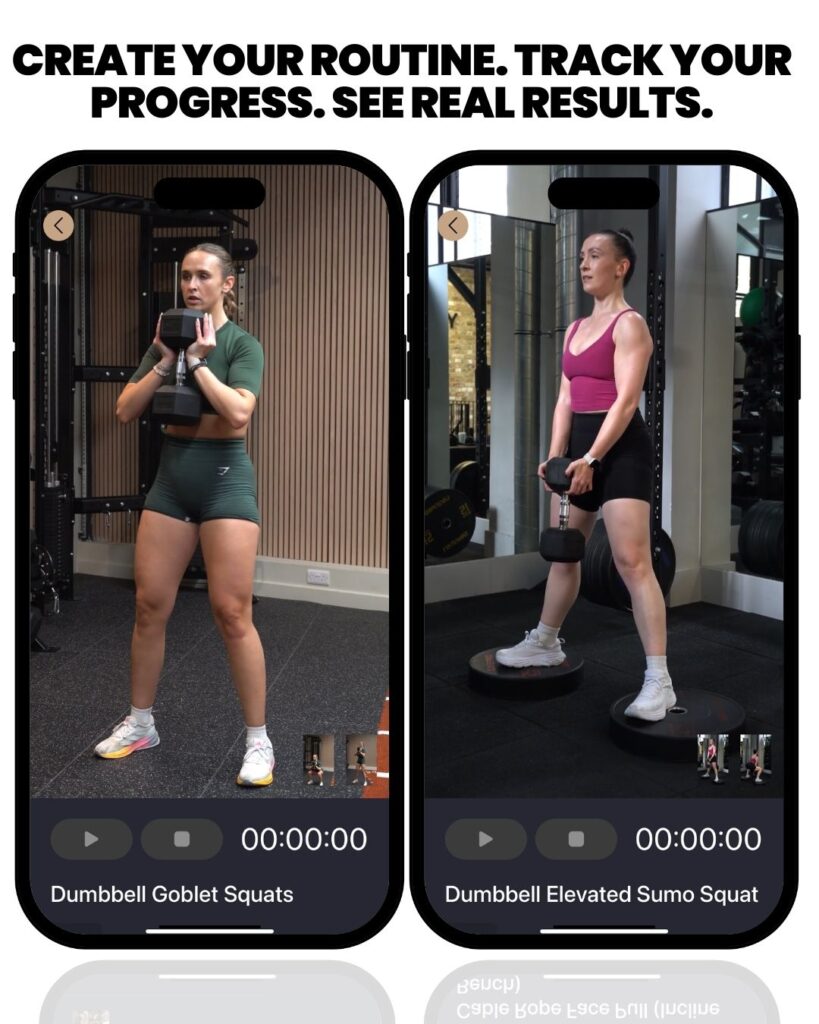
If you want a plan that fits your goal, the dumbbells you own and the time you have, 12REPS builds the session for you. Each exercise comes with a trainer demonstration, and the app logs your reps and weights so you know what to beat next time.
Sources
- Effect of free-weight vs. machine-based strength training on maximal strength, hypertrophy and jump performance: a systematic review and meta-analysis. Haugen ME, Vårvik FT, Larsen S, Haugen AS, van den Tillaar R, Bjørnsen T. BMC Sports Science, Medicine and Rehabilitation, 2023. https://doi.org/10.1186/s13102-023-00713-4
- Maintaining physical performance: the minimal dose of exercise needed to preserve endurance and strength over time. Spiering BA, Mujika I, Sharp MA, Foulis SA. Journal of Strength and Conditioning Research, 2021. https://pubmed.ncbi.nlm.nih.gov/33629972/
- Trunk muscle activation during dynamic weight-training exercises and isometric instability activities. Hamlyn N, Behm DG, Young WB. Journal of Strength and Conditioning Research, 2007. https://pubmed.ncbi.nlm.nih.gov/18076231/
- American College of Sports Medicine position stand. Progression models in resistance training for healthy adults. American College of Sports Medicine. Medicine and Science in Sports and Exercise, 2009. https://pubmed.ncbi.nlm.nih.gov/19204579/