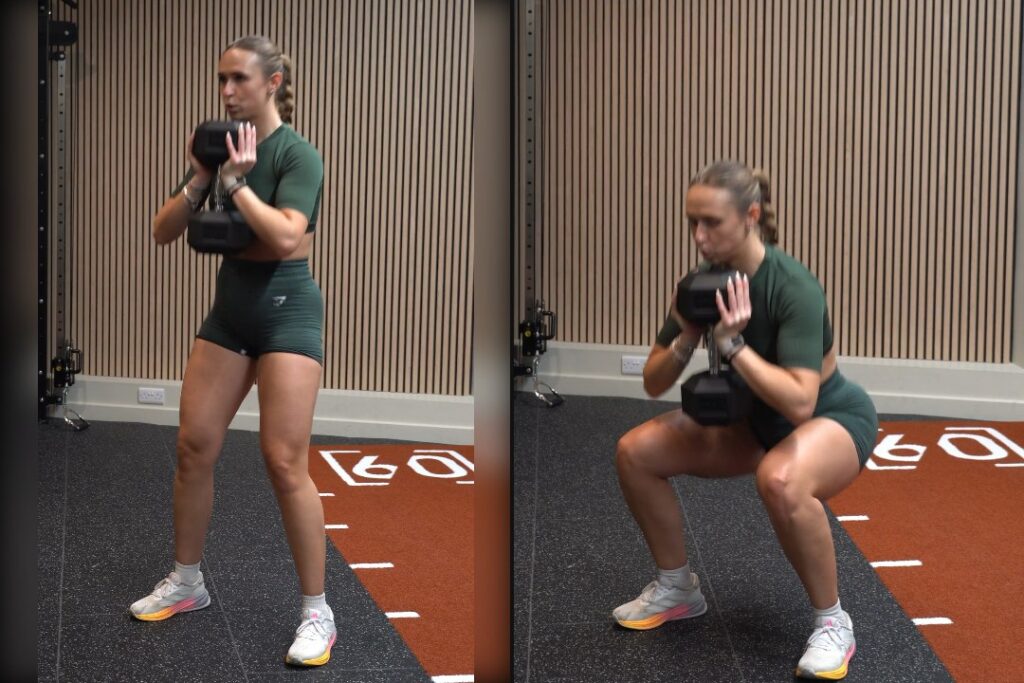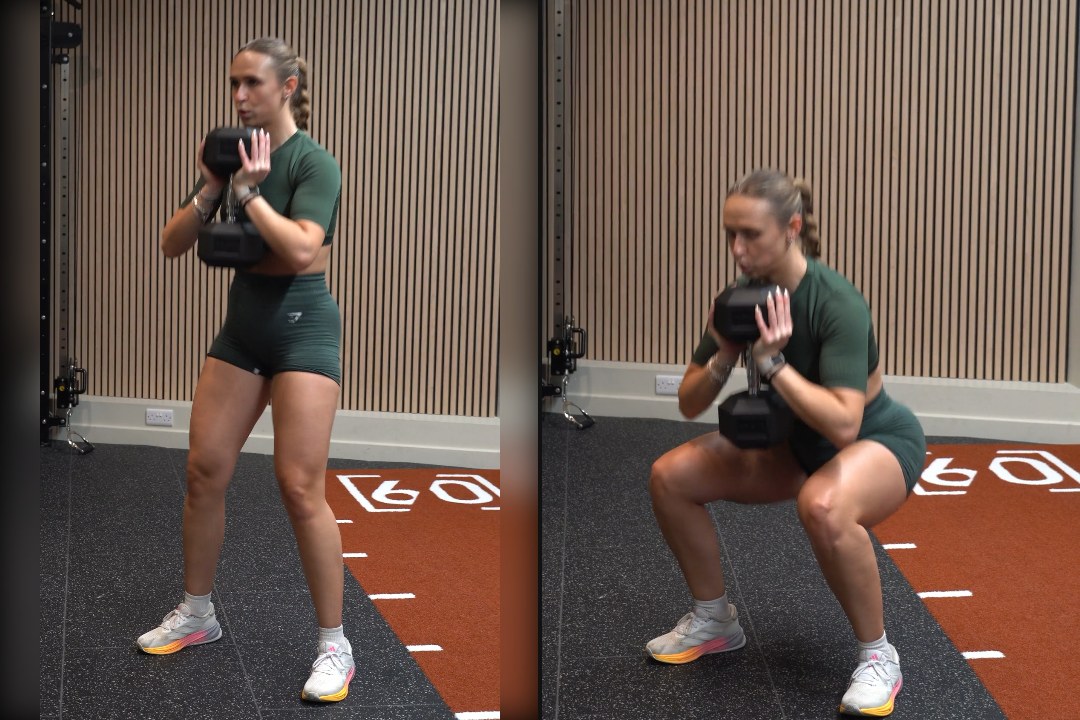


To do a goblet squat, hold one dumbbell or kettlebell close to your chest with both hands. Stand with your feet just past shoulder-width, then sit down between your legs, keeping your chest tall. Push through your feet to stand back up.
That’s the short version.
The goblet squat is the squat I teach most beginners first. The weight sits in front of you, which keeps you balanced and pushes you into good form. It trains your quads, glutes and core, and you only need one weight.
This guide is for you if:
- You’re new to squatting and want to learn it safely.
- Back squats feel awkward or uncomfortable, and you want another option.
- You train at home or in a busy gym with just a dumbbell or kettlebell.
I’m Will Duru, a personal trainer and the founder of 12REPS. Below, I’ll cover what the research shows, how to set up and move, the dumbbell and kettlebell versions, the mistakes I see most and how to choose your weight.
Why do goblet squats?
The squat is one of the most useful movements you can train. It’s how you get up from a chair, lift a box off the floor and climb stairs. The goblet squat makes it easy to learn.
What the research says
- It’s a strong quad builder. A 2021 study of 16 men and 16 women compared the goblet squat with the landmine squat, using a weight of 30% of body weight. The goblet squat produced more activity in the quadriceps (the muscles on the front of your thigh) and more vertical force. (Collins et al., 2021)
- Holding the weight in front may be easier on your knees. There’s little research on the goblet squat itself. The closest is on the barbell front squat, which also loads the weight in front of your body. In 15 trained lifters, the front squat worked the muscles as well as the back squat, with less compressive force on the knee. (Gullett et al., 2009)
- It helps you meet the strength guidelines. U.S. guidelines recommend muscle-strengthening exercise for all major muscle groups on two or more days a week. A squat covers the biggest muscles in your lower body in one move. (Physical Activity Guidelines for Americans)
What the research doesn’t say
- These were short lab studies with small groups. None followed people training goblet squats for months.
- The knee findings come from the barbell front squat. The goblet squat is similar, but not identical.
If you have knee, hip or back pain, check with a doctor or physical therapist before you start.
Why I use them
The front-loaded position forces your core to work hard to keep you upright. That’s what makes the goblet squat such a good teacher. If you lean too far forward, the weight pulls you off balance, so you learn to stay tall.
It also teaches good squat form you can carry into every other squat. And when back squats hurt, a goblet squat is often one of the first swaps I make.
How to do a goblet squat
If you’ve never squatted before, practice a few bodyweight squats first. Get the movement right before you add weight.
Setup
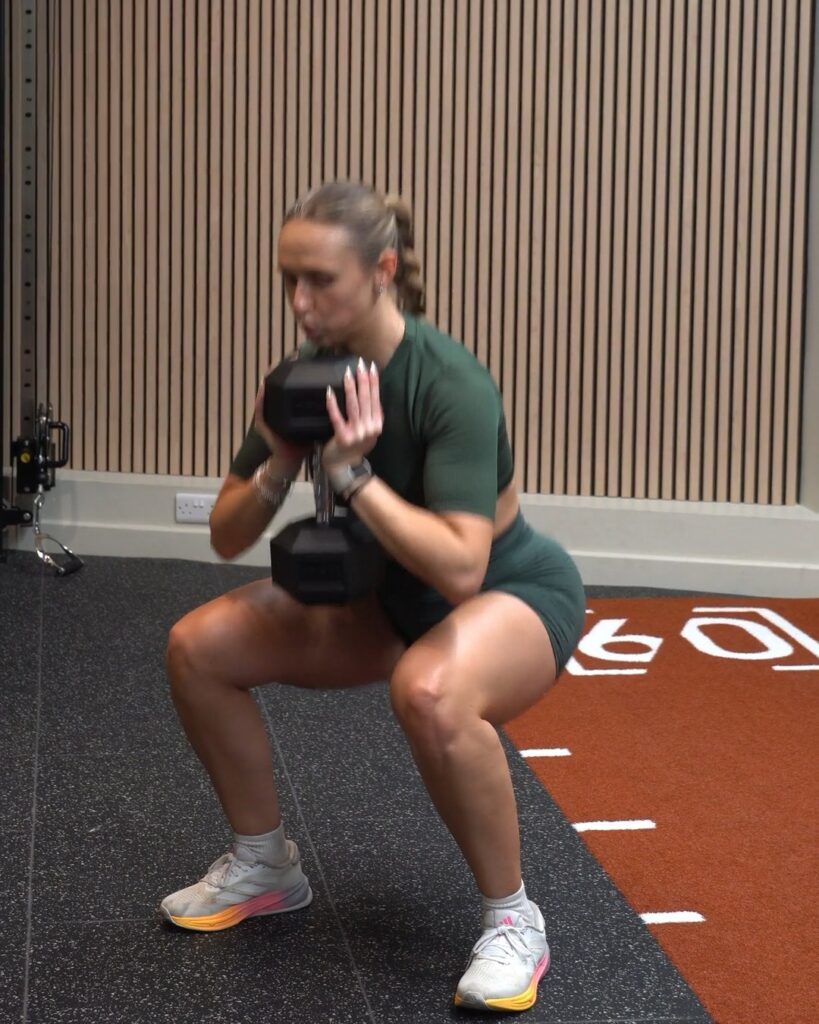
- Hold the weight at your chest. With a dumbbell, stand it on its end and cup the top with both hands. With a kettlebell, hold it by the handle sides (the “horns”). Keep it touching your chest, elbows pointing down.
- Set your feet. Stand with your feet just past shoulder-width. Point your toes slightly out, like 11 and 1 on a clock face.
- Stand tall. Chest up, shoulders back. Feel your weight spread evenly across your whole foot.
- Brace. Take a breath in and tighten your stomach as if you’re about to be poked.
The movement
- Sit down between your legs. Push your hips back slightly and bend your knees. Let your hips drop between your heels, not behind you.
- Keep your knees in line with your toes. As you go down, your knees move forward and slightly out. Don’t let them cave in.
- Go as low as you can with good form. Aim for your thighs to be at least parallel to the floor. Go lower only if your heels stay down and your back stays flat.
- Stand up. Push through your whole foot and drive back up. Squeeze your glutes at the top.
- Control the next rep. Lower yourself slowly. Don’t drop into the bottom.
Breathing
Breathe in at the top and hold that brace on the way down. Breathe out as you stand up.
How low should you go?
- Minimum: thighs parallel to the floor, with your hip crease level with your knee.
- Ideal: slightly below parallel, if your mobility allows.
- Maximum: as low as you can go while your back stays flat and your heels stay down.
Don’t force depth your hips and ankles aren’t ready for. Depth usually improves with practice.
My coaching cues
- “Sit down between your legs.” Your hips drop down between your heels instead of reaching far back.
- “Show the logo on your shirt.” Keep your chest proud, so someone in front of you could read it.
- “Knees follow your toes.” Your knees track the same way your toes point.
- “Whole foot down.” Big toe, little toe and heel all stay on the floor.
Dumbbell vs kettlebell goblet squat
Both work the same muscles. Pick the one you have, or the one that feels better to hold.
| Dumbbell | Kettlebell | |
|---|---|---|
| How to hold it | Stand it on its end and cup the top with both hands | Hold the horns, with the bell under your chin |
| Best for | Gyms with a full rack, so it’s easy to go up in small jumps | Home training and kettlebell workouts |
| Watch out for | The dumbbell sliding down your body as your arms tire | The bell drifting away from your chest |
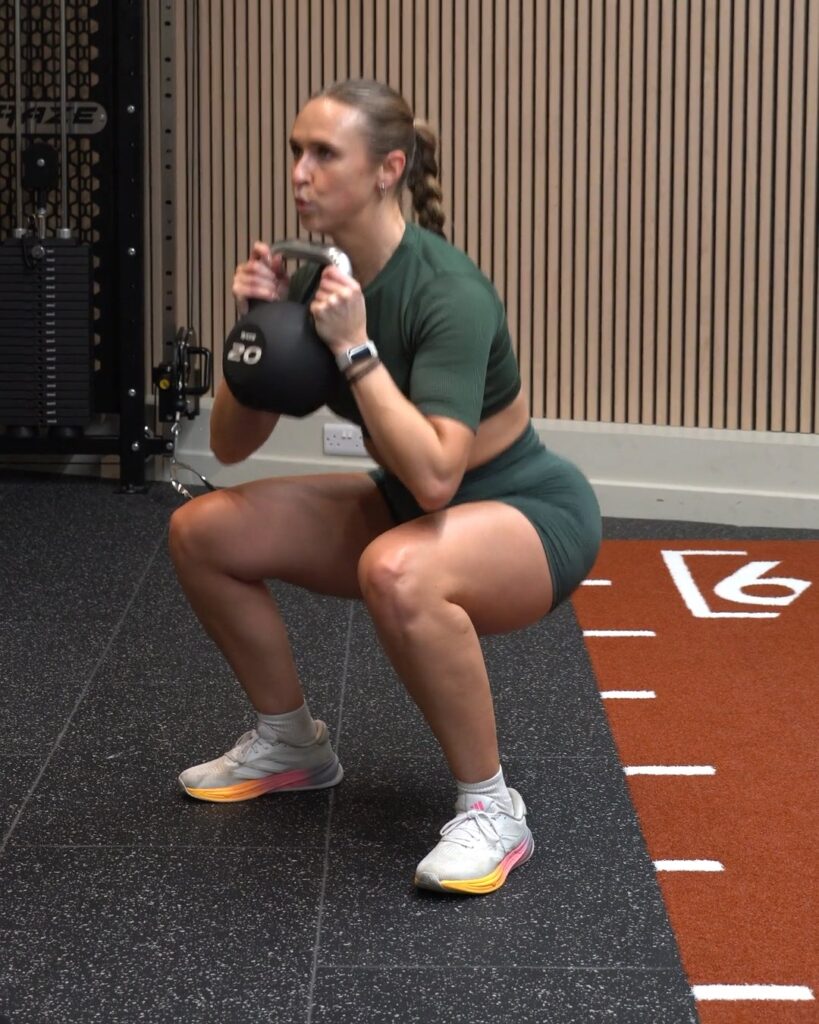
Kettlebell goblet squat
Hold the kettlebell by the horns at chest height, elbows pointing down. Everything else is the same as the dumbbell version.
Goblet squat variations
Once you’ve got the basic squat, these versions can help you learn it or make it harder.
Goblet squat with a loop band
Place a loop band just above your knees. As you squat, gently push your knees out against it. The band is a reminder to stop your knees caving in, and it adds work for your glutes.
See the Dumbbell Goblet Squat with Loop Band demo for more.
Swiss ball goblet squat
Place a Swiss ball between your lower back and a wall, then squat with the ball rolling down the wall behind you. The ball supports you, which helps if you’re still finding your balance or depth.
See the Swiss Ball Dumbbell Goblet Squat demo for more.
Heels-elevated goblet squat
Stand with your heels on a squat wedge or a small weight plate. This lets you stay more upright, keeps the weight closer to your body and reduces arm fatigue. It’s a good option if your heels lift or the dumbbell keeps pulling you forward.
Common goblet squat mistakes
The three I see most are leaning forward, heels lifting and knees caving inward. Here’s how to spot and fix each one, plus a few more.
| Mistake | What it looks like | The fix |
|---|---|---|
| Leaning forward | Chest drops toward your knees, weight pulls you forward | Keep the weight touching your chest and show the logo on your shirt |
| Heels lifting | Weight shifts onto your toes at the bottom | Spread your weight across your whole foot. Try a heel wedge if your ankles are tight |
| Knees caving in | Knees move toward each other as you stand up | Push your knees out in line with your toes. Use a loop band as a reminder |
| Weight drifting away | Dumbbell slides away from your chest, arms tire first | Squeeze your elbows in and pull the weight tight to your body |
| Dropping into the bottom | Fast, bouncy lowering with no control | Take 2 to 3 seconds on the way down |
| Squatting too shallow | Thighs stay well above parallel | Practice to a box or bench, then lower it as your depth improves |
If your legs feel fine but your arms give out first, that’s normal. It means your legs are ready for more weight than you can hold. Try the heels-elevated version, slow the lowering down, or move on to a leg press or barbell squat.
What weight should you use for goblet squats?
In your first week, the goal isn’t to find your maximum. It’s to learn the movement with a weight you can control.
For most beginners, I start goblet squats with an 8 to 10 kg (about 18 to 22 lb) dumbbell or kettlebell. If that feels too heavy, start with bodyweight squats. If it feels easy after a couple of sessions, go up.
A good working weight is one where:
- You can finish every rep with your chest tall and heels down.
- The last 2 or 3 reps of each set feel hard, but your form doesn’t change.
Sets and reps
For beginners, 3 sets of 10 to 12 reps works well. Rest 60 to 90 seconds between sets. Train goblet squats two or three times a week, with a day off in between.
A simple lower-body workout
This is the leg session I use in my desk workers program. The goblet squat goes first, while you’re fresh.
| Exercise | Sets | Reps | Rest |
|---|---|---|---|
| Goblet squat | 3 | 12 | 90 sec |
| Romanian deadlift | 3 | 10 | 90 sec |
| Hip thrust | 3 | 12 | 90 sec |
| Walking lunge | 3 | 10 each leg | 60 sec |
| Dead bug | 3 | 10 each side | 60 sec |
How to progress
Keep a log of every set. When you hit all your reps with good form, add weight the next session. That’s usually 2.5 to 5 kg, or one dumbbell size (5 lb in most U.S. gyms).
If you can’t add weight yet, add a rep to each set, or slow the lowering to 3 seconds. Small jumps, every week or two, add up fast.
Summary
- Hold one dumbbell or kettlebell tight to your chest, elbows pointing down.
- Feet just past shoulder-width, toes slightly out.
- Sit down between your legs, keeping your chest tall and your whole foot on the floor.
- Aim for thighs at least parallel, only as deep as your form allows.
- Start with 8 to 10 kg (about 18 to 22 lb) and 3 sets of 10 to 12 reps.
- Log every set and add weight in small jumps.
Build your squat with a plan
The goblet squat is simple. Getting stronger at it week after week is where most people stall. They forget what they lifted last time, or they never add weight at all.
That’s why I built 12REPS. Every program is written by a real personal trainer. Before every lift, you get a demo video and a coach’s guide, so you can check your form. Tap the muscles you want to train, hit generate, and you get a workout built around them. Every set you log is saved, so you always know when it’s time to pick up a heavier dumbbell.
Download 12REPS and see what you’ll get:
Sources
- Collins KS, Klawitter LA, Waldera RW, Mahoney SJ, Christensen BK. Differences in muscle activity and kinetics between the goblet squat and landmine squat in men and women. Journal of Strength and Conditioning Research. 2021;35(10):2661–2668.
- Gullett JC, Tillman MD, Gutierrez GM, Chow JW. A biomechanical comparison of back and front squats in healthy trained individuals. Journal of Strength and Conditioning Research. 2009;23(1):284–292.
- U.S. Department of Health and Human Services. Physical Activity Guidelines for Americans, 2nd edition: Executive Summary. 2018.
Related reading
- How to Squat Properly: The Complete Guide for Women
- Dumbbell Leg Day: 4 Simple Moves to Build Strong, Lean Legs
- Strength Training for Desk Workers: Fix Your Posture and Build Real Strength
- How Much Weight Should I Lift? Choosing the Right Weight
- Full Body Kettlebell Workout: 5 Moves for a Quick, Effective Gym Session
About the author: I’m Will Duru, a personal trainer and the founder of 12REPS. I hold a BSc (Hons) in Sport and Exercise Science, and my training advice has been featured in Men’s Health, The Times and The Telegraph.