


By Will Duru, BSc (Hons) Sport and Exercise Science, Award-winning Personal Trainer with over 10 years of experience in strength training and optimising recovery.
A 2-day workout split for busy dads trains your upper body on one day and your legs and core on the other. You do each session once a week, on non-consecutive days, and each one is built to take about 45 minutes, warm-up included. Over 12 weeks you move from straight sets to supersets, so the plan gets harder as you get stronger.
Gym members who are fathers often tell me the same thing. They want to lose the “dad bod”, build some muscle and have more energy, but they cannot give up hours every week. This plan is for that situation. It uses a small set of proven exercises and asks you to show up twice a week, every week.

Who this 2-day plan is for
- Dads who can reliably get to a gym twice a week, but not more.
- Beginners and returners who want a clear, written plan instead of guessing.
- Anyone with access to dumbbells, a cable machine, a leg press and a leg extension machine.
If you can train three times a week, the 3-day strength training split for busy dads spreads the work out more. If you can train most weekdays, the 5-day workout split for busy dads adds more volume. If you want two full-body sessions instead of an upper/lower split, see this 12-week 2-day full-body gym split.
Strength training and fat loss: what it can and cannot do
Strength training helps with fat loss, but it is not a shortcut. A 2022 meta-analysis of 58 studies found that resistance training alone reduced body fat percentage by about 1.5 percentage points on average, compared with no exercise. That is a real but modest change.
Cardio still has a place. In an 8-month trial in adults with overweight or obesity, aerobic training cut more fat mass than resistance training, while resistance training added more lean mass. Doing both lowered body fat percentage the most.
So treat this plan as one part of the picture. Lift twice a week to build and keep muscle. Walk or do cardio on other days if you can. Manage your food intake, because that drives most of the change on the scale.
What about testosterone?
You will often read that lifting “boosts testosterone”. The evidence is more modest. Testosterone and growth hormone do rise for a short time after a hard session. But a review of hormonal responses to resistance training notes that many studies show no significant change in resting levels with training.
A large study of young men who trained with weights found these short post-workout rises were not linked to strength gains. Their links to muscle growth were weak or absent. In plain terms, you build muscle by training hard and progressively, eating enough protein and recovering well. You do not need to chase a hormone spike.
If you have symptoms that worry you, such as low energy or low sex drive, speak to your doctor rather than relying on training to fix them.

How to fit two sessions into a busy week
“I don’t have time” is the most common thing I hear from busy dads. Two 45-minute sessions are easier to protect than five. These habits help:
- Book it. Put both sessions in your calendar like a work meeting, on non-consecutive days such as Monday and Thursday.
- Pick a realistic slot. For many dads that is a lunch break, before work or on the way home.
- Cut travel time. Train at a gym near your home or office.
- Have a backup day. If a session is missed, move it to the next free day rather than skipping the week.
Two sessions that work every major muscle group also meet the NHS guideline of strengthening activities on at least 2 days a week. For more ideas on keeping going, read how to stay motivated to exercise as a busy dad.

Nutrition and supplements for this plan
Eat in a moderate calorie deficit
A calorie deficit means eating fewer calories than your body uses. You need one to lose fat. Keep it moderate so you can still train well. The NHS suggests aiming to lose 0.5 to 1kg a week, and your own rate will depend on your starting point and consistency.
Logging your food in a calorie-tracking app for a few weeks can show you where the calories come from. Build most meals around lean protein, vegetables, whole grains and some healthy fats.
Get enough protein
A large meta-analysis found that gains in muscle from resistance training leveled off at about 1.6g of protein per kilogram of body weight a day. The authors suggested up to 2.2g per kilogram for people who want to make the most of their training. For more detail, see how much protein you need to build muscle.
Supplements are optional
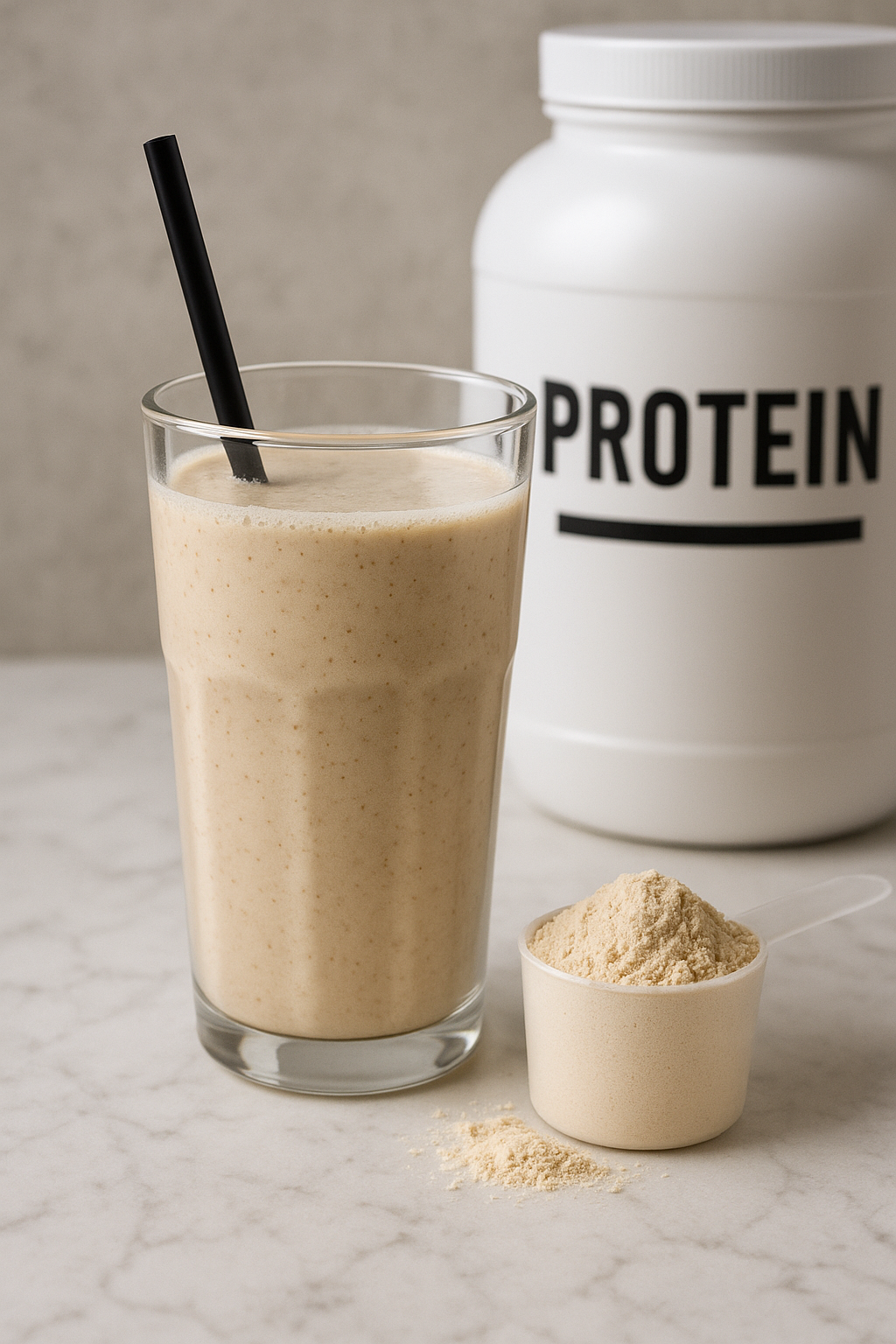
- Whey protein: a practical way to reach your protein target if food alone falls short, according to the ISSN position stand on protein. Clear whey is a lighter option if you dislike milky shakes.
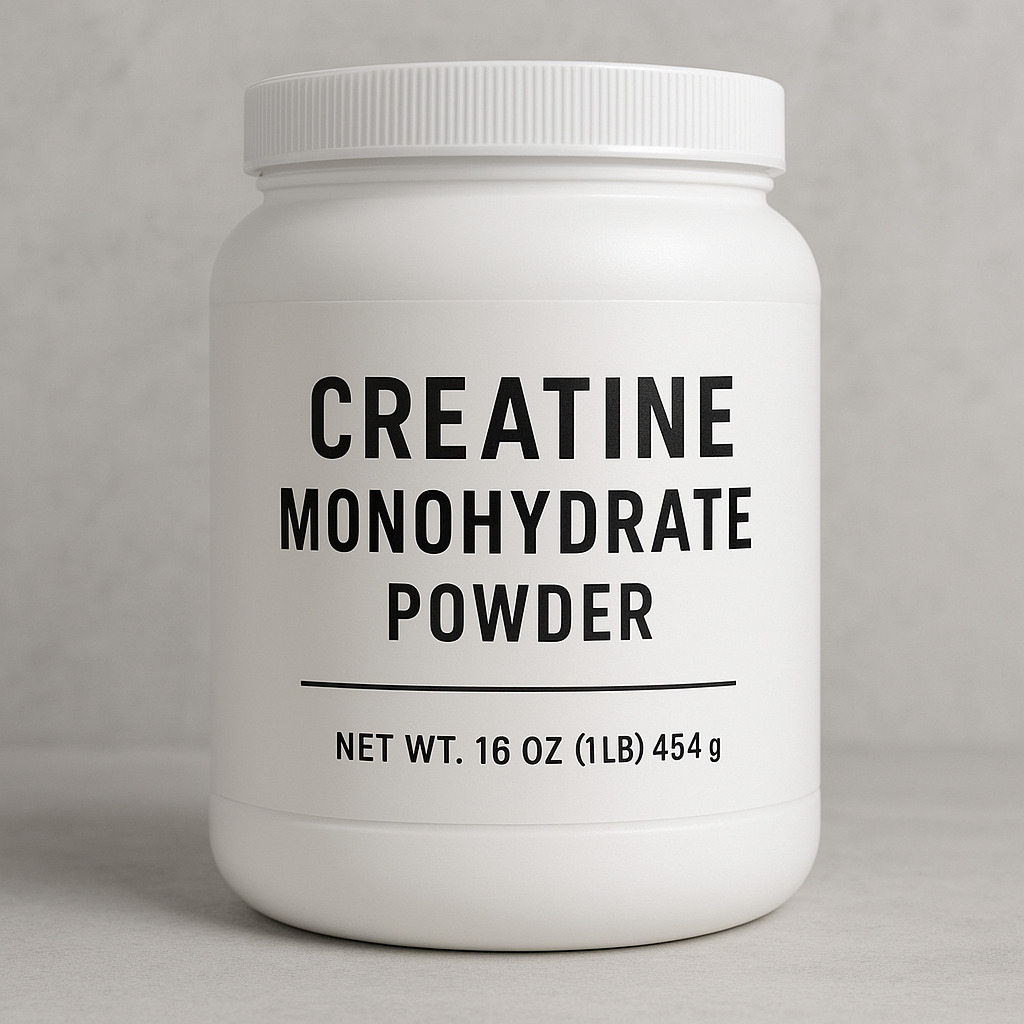
- Creatine monohydrate: the NSCA describes it as an effective way to support gains in strength and muscle during resistance training. It gives a maintenance dose of 2 to 5g a day.
If you have a medical condition or take medication, check with your doctor or pharmacist before taking supplements.
The warm-up
Start every session with a short warm-up. It raises your heart rate and takes your joints through the ranges you are about to load.
- 5 to 10 minutes of light cardio: a brisk incline walk, the cross-trainer or an easy cycle.
- 5 minutes of mobility: cat-cow for your spine, the world’s greatest stretch for your hips and upper back, and arm circles for your shoulders.
The 12-week, 2-day split workout plan
The plan has two 6-week phases. Phase 1 builds your technique and a base of strength. Phase 2 adds supersets to raise the intensity without making the session longer.
Pick weights that make the last few reps of each set hard while your form stays good. When you reach the top of a rep range on every set with good form, add a little weight next time. This is progressive overload: doing slightly more over time. Read the beginner’s guide to progressive overload for more ways to apply it.
Phase 1: Build the foundation (weeks 1-6)
Do these two workouts on non-consecutive days, for example Monday and Thursday.
Day 1: Upper body push and pull
| Exercise | Sets | Reps | Rest (seconds) |
|---|---|---|---|
| Dumbbell bench press | 3 | 8-12 | 60-90 |
| Lat pulldown | 3 | 8-12 | 60-90 |
| Seated dumbbell shoulder press | 3 | 10-15 | 60 |
| Seated cable row | 3 | 10-15 | 60 |
| Triceps pushdown | 2 | 12-15 | 45 |
| Dumbbell biceps curl | 2 | 12-15 | 45 |
Video: How to do a dumbbell chest press. Watch this before your first set of dumbbell bench press to see how to set your shoulders and lower the weights under control.
Day 2: Legs and core
| Exercise | Sets | Reps | Rest (seconds) |
|---|---|---|---|
| Goblet squat | 3 | 8-12 | 60-90 |
| Leg press | 3 | 10-15 | 60-90 |
| Dumbbell Romanian deadlift | 3 | 10-15 | 60 |
| Leg extension | 2 | 12-15 | 45 |
| Plank | 3 | Hold 30-60 seconds | 45 |
| Medicine ball Russian twist | 3 | 15-20 | 45 |
Video: Dumbbell goblet squats. The goblet squat opens Day 2. This demo shows where to hold the dumbbell and how deep to squat.
Phase 2: Add supersets (weeks 7-12)
A superset means doing two exercises back to back with no rest between them. Rest only after the second exercise (the A2, B2 or C2 move). “To failure” means stop when you cannot do another rep with good form, not when your form breaks down.
Day 1: Upper body push and pull (supersets)
| Exercise | Sets | Reps | Rest (seconds) |
|---|---|---|---|
| A1: Dumbbell bench press | 4 | 8-12 | 0 |
| A2: Bodyweight push-ups | 4 | To failure | 90 |
| B1: Lat pulldown | 4 | 8-12 | 0 |
| B2: TRX rows or dumbbell reverse flys | 4 | To failure | 90 |
| C1: Seated dumbbell shoulder press | 3 | 10-15 | 0 |
| C2: Dumbbell biceps curl | 3 | 12-15 | 60 |
Day 2: Legs and core (supersets)
| Exercise | Sets | Reps | Rest (seconds) |
|---|---|---|---|
| A1: Dumbbell or kettlebell goblet squat | 4 | 8-12 | 0 |
| A2: Bodyweight squats or jump squats | 4 | To failure | 90 |
| B1: Leg press | 5 | 10-15 | 0 |
| B2: Sled push or dumbbell walking lunges | 4 | 20 yards | 90 |
| C1: Plank | 3 | Hold 60 seconds | 0 |
| C2: Medicine ball slams | 3 | 15 | 60 |
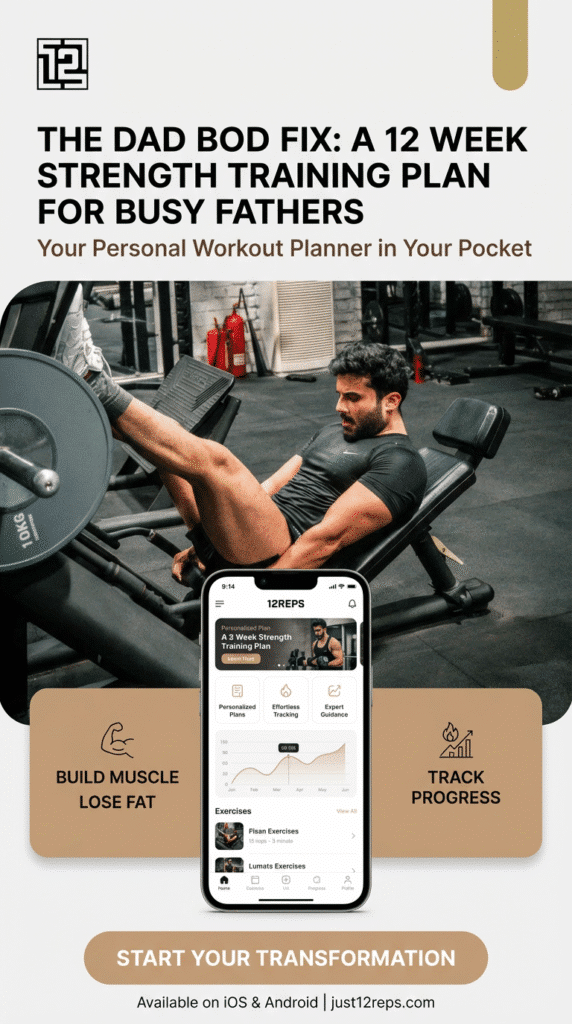
Track the plan in 12REPS
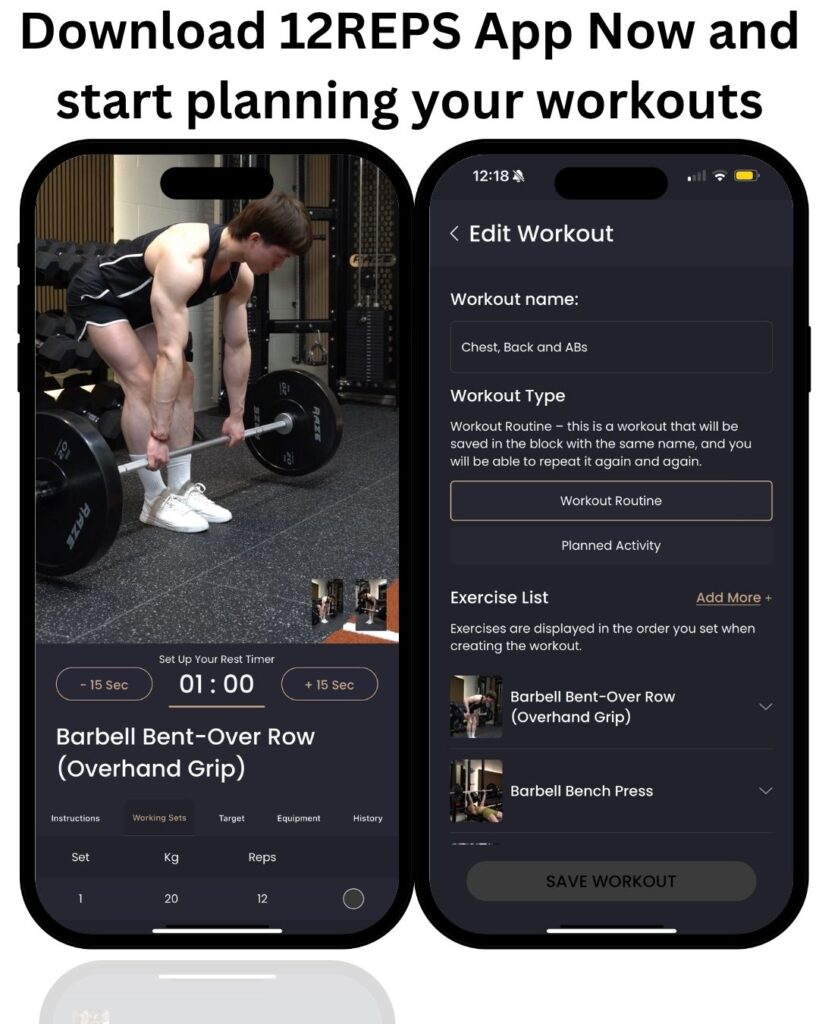
Progressive overload only works if you know what you lifted last time. A training log gives you that number.
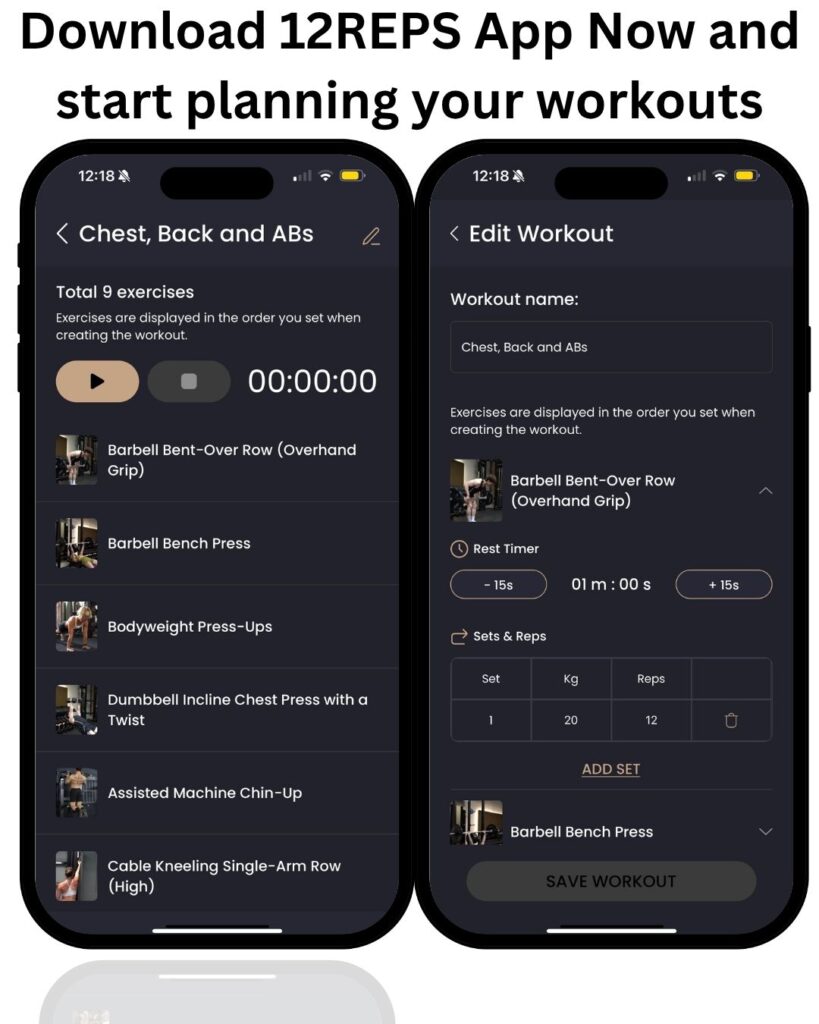
- Build your own session: choose the muscle, the equipment and the time you have, then save the workout.
- Follow the demos: each exercise has a demonstration from a qualified personal trainer.
- Log every set: enter your reps and weight, and the app remembers them so you have a number to beat next week.
- Stay accountable: track your streaks and set a weekly goal of two sessions.
Common questions
Is training twice a week enough?
Two sessions that work all your major muscles meet the NHS strength guideline and are enough to get stronger as a beginner. More sessions can help later, once two a week is a fixed habit.
What if I miss a session?
Do the missed workout at your next chance, then carry on with the plan. One missed day does not undo your progress.
Can I do cardio as well?
Yes. Walking, cycling or easy runs on other days support your fitness and fat loss. Keep them easy enough that your two gym sessions still feel strong.
If you want both workouts set out for you, with a trainer demo for every exercise and your last weights ready to beat, see how the 12REPS app works.
Sources
- The effect of resistance training in healthy adults on body fat percentage, fat mass and visceral fat: a systematic review and meta-analysis. Wewege MA, Desai I, Honey C, et al. Sports Medicine, 2022. https://pubmed.ncbi.nlm.nih.gov/34536199/
- Effects of aerobic and/or resistance training on body mass and fat mass in overweight or obese adults. Willis LH, Slentz CA, Bateman LA, et al. Journal of Applied Physiology, 2012. https://pubmed.ncbi.nlm.nih.gov/23019316/
- Hormonal responses and adaptations to resistance exercise and training. Kraemer WJ, Ratamess NA. Sports Medicine, 2005. https://pubmed.ncbi.nlm.nih.gov/15831061/
- Associations of exercise-induced hormone profiles and gains in strength and hypertrophy in a large cohort after weight training. West DWD, Phillips SM. European Journal of Applied Physiology, 2012. https://pubmed.ncbi.nlm.nih.gov/22105707/
- Physical activity guidelines for adults aged 19 to 64. NHS, 2024. https://www.nhs.uk/live-well/exercise/physical-activity-guidelines-for-adults-aged-19-to-64/
- Tips to help you lose weight. NHS, 2023. https://www.nhs.uk/live-well/healthy-weight/managing-your-weight/12-tips-to-help-you-lose-weight/
- A systematic review, meta-analysis and meta-regression of the effect of protein supplementation on resistance training-induced gains in muscle mass and strength in healthy adults. Morton RW, Murphy KT, McKellar SR, et al. British Journal of Sports Medicine, 2018. https://pubmed.ncbi.nlm.nih.gov/28698222/
- International Society of Sports Nutrition Position Stand: protein and exercise. Jäger R, Kerksick CM, Campbell BI, et al. Journal of the International Society of Sports Nutrition, 2017. https://pubmed.ncbi.nlm.nih.gov/28642676/
- Creatine (excerpt from NSCA’s Guide to Sport and Exercise Nutrition). National Strength and Conditioning Association (NSCA), Kinetic Select, 2019. https://www.nsca.com/education/articles/kinetic-select/creatine/