




By Will Duru, BSc (Hons) Sport and Exercise Science, Award-winning Personal Trainer with over 10 years of experience in strength training and optimising recovery.
A superset is two exercises done back to back with little or no rest between them. The main types of supersets pair opposing muscles, different body parts or the same muscle, and each type suits a different goal. Research shows superset training saves time and builds strength and muscle about as well as regular sets.
This guide explains how supersets work, the main types, and what the evidence says about each. If you want ready-made pairings and a sample session, read our practical superset workout guide.

What is a superset?
In a superset, you do one set of exercise A, then go straight into one set of exercise B. You rest only after you finish both. Then you repeat the pair for as many sets as your program says.
Programs often label a pair A1 and A2. Three exercises in a row is a tri-set. Four or more is a giant set.
Two terms help here. A rest interval is the break between sets. Training volume is the total work you do, often counted as hard sets, or as sets x reps x weight (volume load).
What the research says about superset training
A 2025 systematic review and meta-analysis compared supersets with traditional sets (Zhang et al., 2025). It found:
- Shorter sessions. Supersets got the same work done in less time.
- Similar total volume. On average, people lifted about the same total load.
- Similar long-term results. Gains in strength and muscle size were similar. Only three long-term studies were available, so this finding is still limited.
- Harder sessions. Supersets felt more effortful and raised blood lactate more.
A 2021 review of time-saving training methods reached a similar view. It reported that supersets can roughly halve training time while keeping volume, but cause more fatigue (Iversen et al., 2021).
You may read that supersets build muscle because they “build up lactic acid”. Higher lactate shows that a session was demanding. It does not prove extra muscle growth. The best-supported reason to use supersets is simple: they save time.
The main types of supersets
Supersets fall into two families. Some pair exercises for different muscles, so one muscle rests while the other works. Others pair exercises for the same muscle. That makes the muscle work harder, but it lowers how much you can lift.
1. Antagonist supersets (opposing muscles)
These pair muscles that do opposite jobs, such as a push and a pull. Examples are a Z-bar biceps curl with a rope triceps extension, or a seated cable chest press with a seated low row.
In the 2025 meta-analysis, this type let people do more reps than traditional sets (Zhang et al., 2025). One idea is that working the opposing muscle first may raise muscle activation in the next exercise. The reason is not settled yet.
2. Upper-lower supersets (different body parts)
These pair an upper-body and a lower-body exercise, such as a Bulgarian split squat with a lat pulldown. The muscles barely overlap, so each one gets a break. Leg exercises raise your breathing and heart rate, so the pair can still feel tiring.
3. Compound sets (same muscle, two big lifts)
A compound set pairs two multi-joint exercises for the same muscles, such as a barbell squat followed by a forward lunge. Multi-joint (compound) exercises move more than one joint, so they train several muscle groups at once.
This type is very demanding. The meta-analysis found that pairing exercises with similar movement patterns lowered total volume load compared with traditional sets (Zhang et al., 2025). Expect to use lighter loads than you would for straight sets.
4. Isolation supersets (same muscle, two small lifts)
These pair two single-joint exercises for one muscle, such as a biceps curl followed by a hammer curl. Single-joint (isolation) exercises move one joint and focus on one muscle group. They add extra work for a muscle without tiring your whole body.
5. Pre-exhaust supersets
Pre-exhaust means doing an isolation exercise first, then a compound exercise for the same muscle. A classic example is a dumbbell chest fly or pec deck fly, followed by a bench press. The aim is to tire the chest so it does more of the work in the press.
Research does not support that aim well. In one study, flyes before the bench press did not raise chest muscle activity. They raised triceps activity and cut bench press reps (Brennecke et al., 2009). Another study found that a triceps exercise done first cut bench press reps by about 20% (Soares et al., 2016). In practice, pre-exhaust mostly means you lift less in the big exercise.
6. Post-exhaust supersets
Post-exhaust flips the order. You do the compound exercise first, such as the bench press, then an isolation exercise for the same muscle, such as a chest fly. This keeps your heaviest lift at the start of the pair, when you are fresh. The second exercise then adds extra work for the target muscle.
Tri-sets and giant sets
You can extend any of these into three or more exercises in a row. This saves even more time, but fatigue builds up faster. They work best with lighter exercises and a clear plan.
Types of supersets at a glance
Here is how the six types compare.
| Type | Example | Good for | Trade-off |
|---|---|---|---|
| Antagonist | Biceps curl + triceps extension | Saving time with little loss of performance | Needs two exercises set up at once. |
| Upper-lower | Split squat + lat pulldown | Full-body sessions in less time | Leg work raises breathing and effort. |
| Compound set | Squat + lunge | Hard work for one area | Lower loads and high fatigue. |
| Isolation | Biceps curl + hammer curl | Extra work for one muscle | Best for smaller muscles. |
| Pre-exhaust | Chest fly + bench press | Rarely the best choice | Fewer reps on the big lift. |
| Post-exhaust | Bench press + chest fly | Extra work after your main lift | High fatigue for one muscle. |
How to choose the right type of superset
- New to lifting? Start with antagonist or upper-lower supersets. Each muscle gets a break, so good form is easier to keep.
- Short on time? Antagonist pairs save time with the smallest drop in performance (Zhang et al., 2025). See our guide to building strength and muscle with limited time.
- Training for maximal strength? Keep your heaviest lifts as straight sets with full rest. Iversen et al. (2021) note that time-saving methods are probably better for muscle growth than for maximal strength.
- Focused on muscle size? Same-muscle supersets can add extra work, but expect to use lighter loads.
How to use supersets safely
Keep your form
Fatigue builds faster in supersets, and form often slips first. Move the weight in a controlled way and use your full range of motion (Mayo Clinic, 2026). If your form breaks down, lower the weight, do fewer reps or rest longer.
Manage fatigue
Rest after each pair before you start the next round. Our guide on how long to rest between sets explains how rest affects your results. Supersets already feel harder, so think carefully before you push every set to the limit. Read more about training to failure.
Stop if something hurts
Hard effort and burning muscles are normal. Sharp or joint pain is not. If an exercise causes pain, stop (Mayo Clinic, 2026).
Progress over time
Progressive overload means gradually making your training harder so your body keeps adapting. With supersets, you can add weight, add reps, add a set, or shorten your rest a little. Our beginner’s guide to progressive overload explains how.

How to track supersets
Log each exercise in the pair on its own, with the weight and reps for every set. That way you can see which exercise is improving and which one fatigue is holding back.
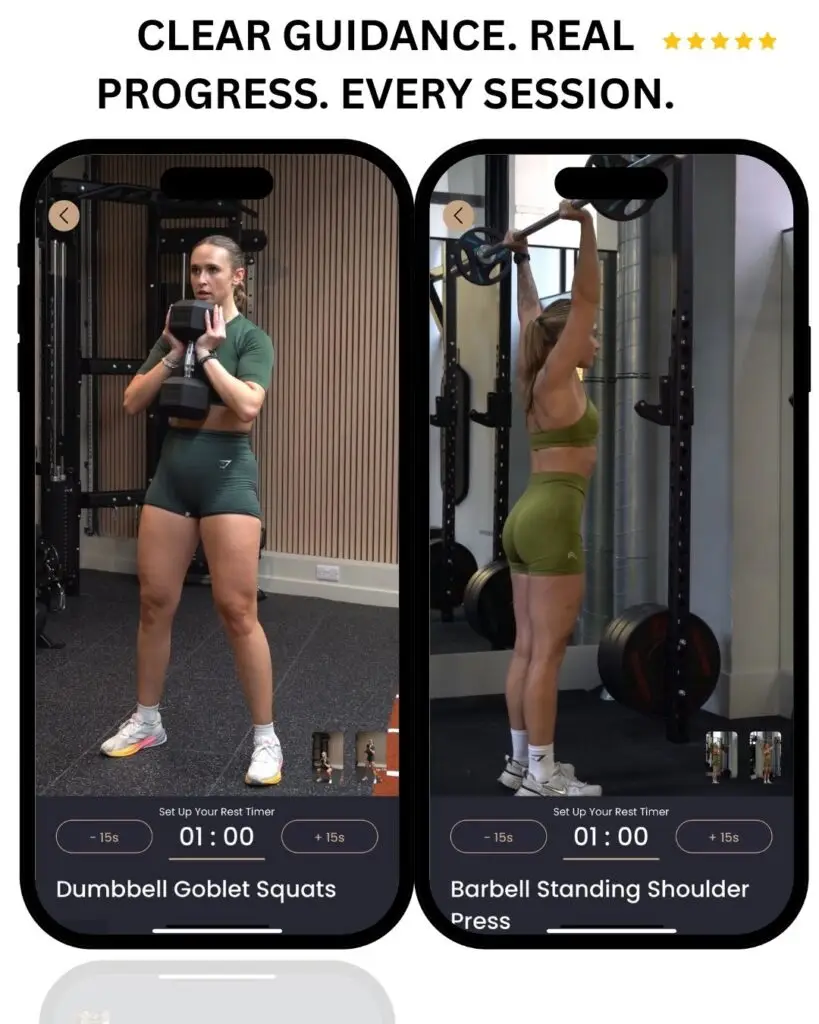
A plan helps too. If you want each session built around your goal, your equipment and the time you have, 12REPS sets it out for you and shows a trainer demonstration for every exercise. It remembers what you lifted, so you always have a number to beat. See how the 12REPS app works.
Key points
- A superset is two exercises back to back, with rest only after both.
- Supersets mainly save time. Long-term strength and muscle gains look similar to regular sets.
- Opposing-muscle and upper-lower pairs are the easiest place to start.
- Same-muscle pairs, including pre-exhaust, are harder and lower how much you can lift.
Ready to try it? Our superset workout guide shows how to build a session step by step. Our kettlebell and bodyweight superset workouts give you two complete sessions.
Sources
- Superset Versus Traditional Resistance Training Prescriptions: A Systematic Review and Meta-analysis Exploring Acute and Chronic Effects on Mechanical, Metabolic, and Perceptual Variables. Sports Medicine (Zhang X, Weakley J, Li H, Li Z, Garcia-Ramos A), 2025. https://pmc.ncbi.nlm.nih.gov/articles/PMC12011898
- No Time to Lift? Designing Time-Efficient Training Programs for Strength and Hypertrophy: A Narrative Review. Sports Medicine (Iversen VM, Norum M, Schoenfeld BJ, Fimland MS), 2021. https://pmc.ncbi.nlm.nih.gov/articles/PMC8449772
- Neuromuscular Activity During Bench Press Exercise Performed With and Without the Preexhaustion Method. Journal of Strength and Conditioning Research (Brennecke A, et al.), 2009. https://paulogentil.com/pdf/Neuromuscular%20Activity%20During%20Bench%20Press%20Exercise%20Performed%20With%20and%20Without%20the%20Preexhaustion%20Method.pdf
- Comparison Between Pre-Exhaustion and Traditional Exercise Order on Muscle Activation and Performance in Trained Men. Journal of Sports Science and Medicine (Soares EG, et al.), 2016. https://jssm.org/jssm-15-111.xml-Fulltext
- Weight training: Do’s and don’ts of proper technique. Mayo Clinic, 2026. https://www.mayoclinic.org/healthy-lifestyle/fitness/in-depth/art-20045842
