



By Will Duru, BSc (Hons) Sport and Exercise Science, Award-winning Personal Trainer with over 10 years of experience in strength training and optimising recovery.
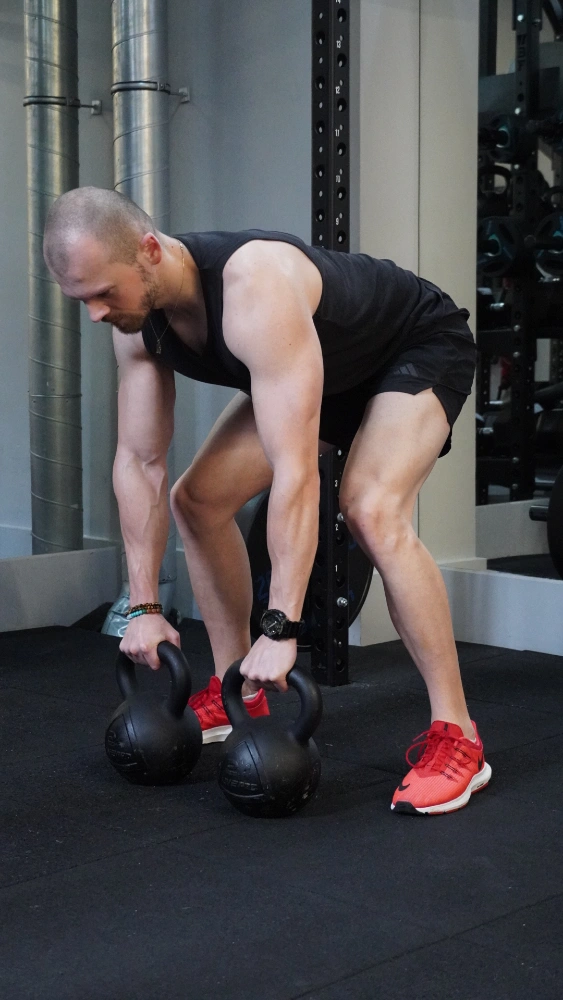
This 20-minute kettlebell leg workout uses one kettlebell and five moves: swings, sumo squats, Romanian deadlifts, reverse lunges and goblet squats. You do 3 sets of each move with 30 seconds of rest between sets. It trains your glutes, quads and hamstrings when you don’t have time for a long leg day.
It works at home or in the gym. All you need is one kettlebell and about 20 minutes after your warm-up.

How the 20-minute kettlebell leg workout works
Do the moves in order. Finish all 3 sets of one exercise, resting 30 seconds between sets, then move to the next one.
Five moves at 3 sets each gives you 15 working sets. With short rests, that fits into about 20 minutes.
Pick a kettlebell you can control for every rep. If you log each set in the 12REPS app, it remembers the weight and reps, so you know what to beat next time.
| Exercise | Sets and reps | Rest |
|---|---|---|
| 1. Kettlebell swing | 3 x 12 | 30 seconds |
| 2. Kettlebell sumo squat | 3 x 12 | 30 seconds |
| 3. Kettlebell Romanian deadlift | 3 x 12 | 30 seconds |
| 4. Kettlebell reverse lunge | 3 x 8 per leg | 30 seconds |
| 5. Kettlebell goblet squat | 3 x 12 | 30 seconds |
Exercise 1: Kettlebell swing
3 sets of 12 reps, 30 seconds rest
Why: The swing is a hip hinge, which means you bend from the hips with a flat back. It works your glutes, hamstrings and core, and it raises your heart rate.
In one study described by exercise scientist Len Kravitz, 10 minutes of swing intervals pushed heart rate above 85% of age-predicted maximum.
Key cue: Drive the bell with your hips, not your arms. For a full breakdown, read how to do a kettlebell swing.
Exercise 2: Kettlebell sumo squat
3 sets of 12 reps, 30 seconds rest
Why: The wide stance works your quads and glutes, with your inner-thigh muscles (adductors) helping as you stand up.
Key cue: Turn your toes out a little and push your knees out in the same direction as you squat.
Exercise 3: Kettlebell Romanian deadlift (RDL)
3 sets of 12 reps, 30 seconds rest
Why: The RDL targets your hamstrings, glutes and lower back. In a study of trained men, it was one of the two exercises with the highest hamstring activity.
Key cue: Keep a soft bend in your knees and push your hips back until you feel a stretch in your hamstrings.
Exercise 4: Kettlebell reverse lunge
3 sets of 8 reps per leg, 30 seconds rest
Why: Lunges train one leg at a time. That builds single-leg strength and balance, and it shows you if one side is weaker.
Key cue: Step back with control and keep your front knee roughly over your ankle. Our lunge guide covers more variations.
Exercise 5: Kettlebell goblet squat
3 sets of 12 reps, 30 seconds rest
Why: Holding the bell at your chest makes your upper back and core work to keep you upright while your legs do the squat.
Key cue: Elbows down, chest tall. See our goblet squat form guide for depth and foot position.
Why only 30 seconds of rest?
Short rests keep the session to about 20 minutes and keep your heart rate up. The trade-off is that you may need a lighter kettlebell to finish every rep.
For muscle growth, the ACSM suggests 1 to 2 minutes of rest in beginner and intermediate programs. A 2024 meta-analysis found a small growth benefit from resting longer than 60 seconds.
So on days when you have more time, rest longer and use a heavier bell. The kettlebell lower body workout with form cues and a progression plan is built for that.
How often to do this workout
The NHS advises strengthening activities on at least 2 days a week, working all the major muscle groups. This session covers your legs and hips, so add upper-body work on another day.
What the research on kettlebells says
Kettlebell research is still limited. A 2019 scoping review found that reported effects were mostly trivial to small, and confidence in them was low.
That doesn’t mean kettlebells don’t work. It means they are one useful tool, and the basics still matter most: good form, steady effort and gradual progress.
More kettlebell workouts
- 4-move kettlebell workout for strong legs: fewer moves, more sets.
- 20-minute full-body kettlebell workout: legs plus a row for your upper back.
If you want your sessions set out for you, 12REPS builds your training around your goal, your equipment and the time you have. Each exercise has a trainer demonstration, and the app tracks your sets, reps and weights.
Sources
- Kettlebell Research Update (Len Kravitz, PhD). University of New Mexico, n.d.. https://www.unm.edu/~lkravitz/Article%20folder/kettlebellresearch.html
- Muscle activation during various hamstring exercises (McAllister et al.). Journal of Strength and Conditioning Research, 2014. https://digitalcommons.memphis.edu/facpubs/9934
- American College of Sports Medicine position stand: Progression models in resistance training for healthy adults. Medicine & Science in Sports & Exercise, 2009. https://sfu.ca/~ryand/kin343/ACSMresistance.pdf
- Give it a rest: a systematic review with Bayesian meta-analysis on the effect of inter-set rest interval duration on muscle hypertrophy (Singer et al.). Frontiers in Sports and Active Living, 2024. https://www.frontiersin.org/articles/10.3389/fspor.2024.1429789/full
- Physical activity guidelines for adults aged 19 to 64. NHS, 2024. https://www.nhs.uk/live-well/exercise/physical-activity-guidelines-for-adults-aged-19-to-64/
- Kettlebell training in clinical practice: a scoping review (Meigh et al.). BMC Sports Science, Medicine and Rehabilitation, 2019. https://doaj.org/article/034dc129d99845a09c115bf925f577e1
