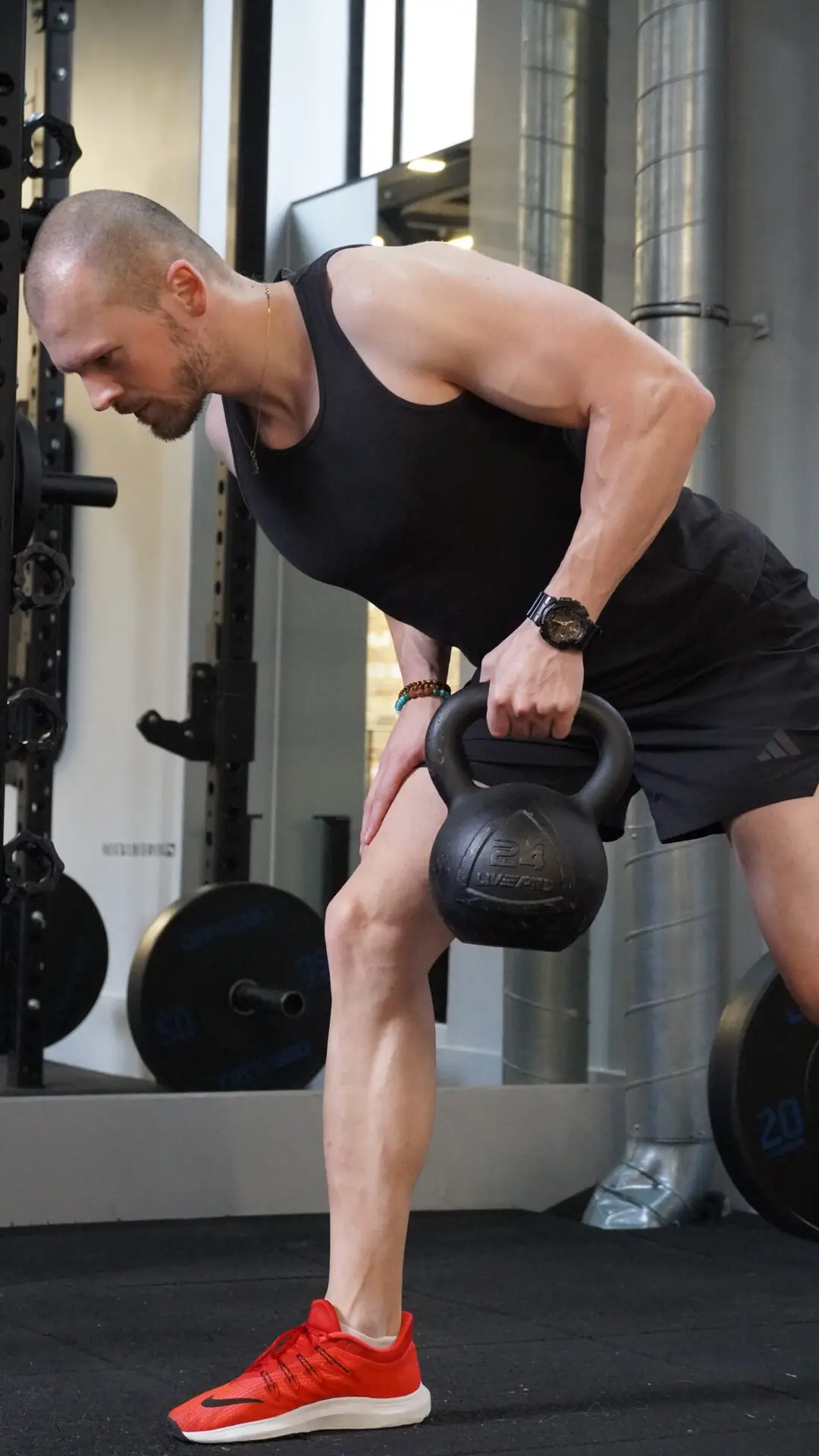


This 4-move kettlebell workout trains your quads, glutes and hamstrings with one kettlebell. You do 4 sets each of front squats, swings, static split lunges and goblet squats, with 60 seconds of rest between sets. It suits anyone who wants a simple, hard leg session at home or in the gym.
Why a short kettlebell leg workout works
If you do the same leg exercises every week, your sessions can start to feel stale. A short list of moves helps you put real effort into every set and keep track of your numbers.
These four moves cover the main lower-body patterns: two squats, a hip hinge and a split lunge. A hip hinge means you bend forward from the hips with a flat back, as you do in a swing.
The American College of Sports Medicine (ACSM) recommends including both two-leg and single-leg exercises in a strength program. This workout gives you both.
The 4-move kettlebell workout at a glance
| Exercise | Sets and reps | Main muscles |
|---|---|---|
| Kettlebell front squat | 4 x 12 | Quads, glutes, core |
| Kettlebell swing | 4 x 15 | Glutes, hamstrings, lower back |
| Static split lunge | 4 x 12 per leg | Quads, glutes |
| Goblet squat | 4 x 12 | Quads, glutes, core |
Rest for 60 seconds between sets. Spend a few minutes warming up first with light squats, lunges and hip hinges. Our 3-phase warm-up guide shows you how.
Choose a kettlebell you can control for every rep. If the last set feels too easy, use a heavier bell next time.
1. Kettlebell front squat
4 sets of 12 reps
- Hold the kettlebell in the rack position. The handle sits in one hand and the bell rests on the back of your forearm, against your chest.
- Stand with your feet about shoulder-width apart.
- Sit down into a deep squat while you keep your chest up.
- Drive through your whole foot to stand back up.
This move works your quads, glutes and core. With one bell, switch hands between sets so both sides do the same work.
2. Kettlebell swing
4 sets of 15 reps
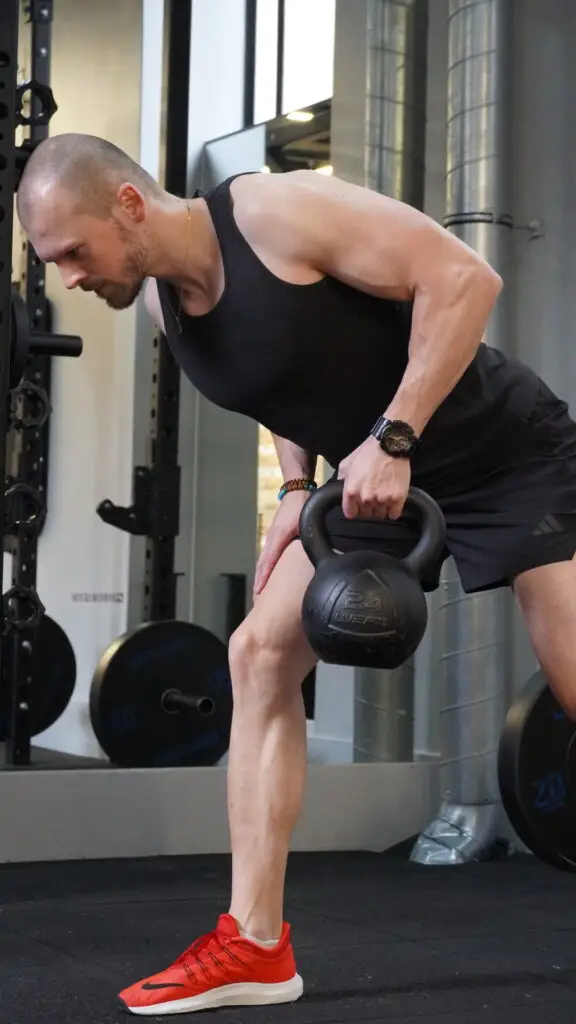
- Stand with the bell on the floor a little in front of you. Set your feet just wider than hip-width.
- Hinge at the hips, grab the handle and hike the bell back between your legs.
- Drive your hips forward and squeeze your glutes to swing the bell to about chest height.
- Let the bell fall back, hinge again and flow into the next rep.
The power comes from your hips, not your arms. In a lab study, the swing produced high glute activity. The same study found the swing loads the lower back in an unusual direction, so stop if it bothers your back.
A 2012 study found that six weeks of swing training improved maximal and explosive strength. New to swings? Read how to do a kettlebell swing for cues and common mistakes.
3. Static split lunge
4 sets of 12 reps per leg
- Hold the kettlebell at your chest.
- Take a long step back with one foot and stay in that split stance.
- Keep your back leg steady and lower your back knee toward the floor.
- Push through your front foot to rise. Finish all your reps, then switch legs.
Your feet stay in place, so balance is simpler than in a walking lunge. This move builds single-leg strength in your quads and glutes.
4. Goblet squat
4 sets of 12 reps
- Hold the kettlebell by the horns (the sides of the handle), close to your chest.
- Point your elbows down and keep your chest tall.
- Squat as low as you can with good form.
- Brace your core and stand back up.
Holding the bell in front of you helps you stay upright. Our goblet squat form guide covers depth, foot position and common mistakes.
How long to rest and how to progress
This workout uses 60 seconds of rest between sets. A 2024 meta-analysis found a small muscle-growth benefit from resting longer than 60 seconds. It found no clear extra benefit beyond 90 seconds.
So if your reps drop off a lot from set to set, rest a little longer.
To keep getting stronger, use progressive overload. That means you make the work a little harder over time. The ACSM lists heavier loads, more reps, a different tempo (lifting speed) and changes to rest as ways to progress.
How often to do this workout
The CDC advises adults to do muscle-strengthening activity on at least 2 days a week, working all major muscle groups. This workout covers your legs and hips, so pair it with upper-body work during the week.
More kettlebell leg workouts
- 20-minute kettlebell leg workout: five moves with short rests for days when time is tight.
- Kettlebell lower body workout with form cues: a warm-up, five moves and a weekly progression plan.
Want leg sessions planned around your goal, your equipment and your time? 12REPS sets out each workout and shows a trainer demonstration for every exercise. It also remembers what you lifted, so you always have a number to beat.
Sources
- American College of Sports Medicine position stand: Progression models in resistance training for healthy adults. Medicine & Science in Sports & Exercise, 2009. https://sfu.ca/~ryand/kin343/ACSMresistance.pdf
- Kettlebell swing, snatch, and bottoms-up carry: back and hip muscle activation, motion, and low back loads (McGill and Marshall). Journal of Strength and Conditioning Research, 2012. https://www.backfitpro.com/medical-scientific-articles/2012/%5B63%5DMcGill,S.(2012)Kettlebell-swing-snatch-and-bottoms-up-carry%5BJ.Strength-Condit.Res.%5D.pdf
- Kettlebell swing training improves maximal and explosive strength (Lake and Lauder). Journal of Strength and Conditioning Research, 2012. https://eprints.chi.ac.uk/id/eprint/266/
- Give it a rest: a systematic review with Bayesian meta-analysis on the effect of inter-set rest interval duration on muscle hypertrophy (Singer et al.). Frontiers in Sports and Active Living, 2024. https://www.frontiersin.org/articles/10.3389/fspor.2024.1429789/full
- Adult Activity: An Overview. Centers for Disease Control and Prevention (CDC), 2023. https://www.cdc.gov/physical-activity-basics/guidelines/adults.html