
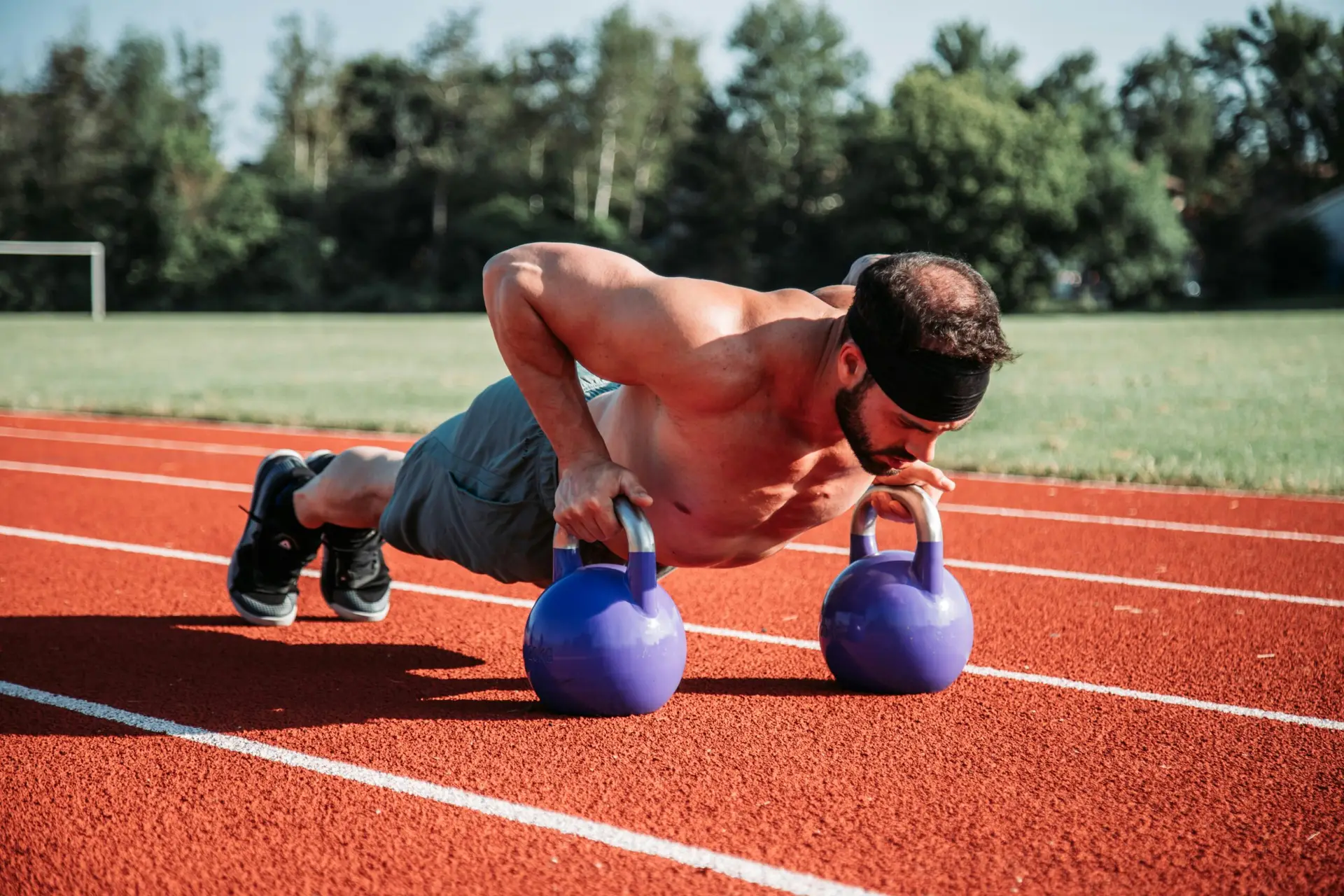



This 20-minute kettlebell workout trains your legs, hips, back and core with four moves: goblet squats, reverse lunges, kettlebell swings and single-arm alternating rows. You do 4 sets of 12 reps of each move, with 30 to 40 seconds of rest between sets. It’s simple, but it’s hard work.
The kettlebell is one of our favorite tools for 12REPS group workouts. As a personal trainer, I recommend adding kettlebells to your training. One bell lets you squat, lunge, hinge and row in a small space.
How the 20-minute kettlebell workout is structured
Do all 4 sets of one exercise before you move to the next. Use this pattern for every move:
| Set | Reps | Rest after |
|---|---|---|
| 1 | 12 | 30 seconds |
| 2 | 12 | 30 seconds |
| 3 | 12 | 40 seconds |
| 4 | 12 | Move on to the next exercise |
That’s 16 working sets in about 20 minutes. Warm up for a few minutes first with light squats, lunges and hip hinges.
The CDC advises adults to do muscle-strengthening activity on at least 2 days a week, working all major muscle groups. This session has no pressing move, so train your chest and shoulders on another day.

1. Goblet squats
Goblet squats build leg strength for everyday tasks like standing up, climbing stairs and lifting. Holding the kettlebell at chest height helps you keep your torso upright, which makes it a good way to practice squat form.
- Hold the bell by the horns, close to your chest, elbows pointing down.
- Squat as deep as you can with a tall chest, then drive back up.
| Set | Reps | Rest after |
|---|---|---|
| 1 | 12 | 30 seconds |
| 2 | 12 | 30 seconds |
| 3 | 12 | 40 seconds |
| 4 | 12 | Move on to the next exercise |
For depth, stance and common mistakes, see our goblet squat form guide.
2. Reverse lunges
Reverse lunges build single-leg strength and challenge your balance. Stepping back also changes how your knee is loaded.
A 2021 study of 20 women found that the reverse lunge put less load on the kneecap joint than the forward lunge. That may make reverse lunges a useful option if forward lunges feel uncomfortable on your knees.
- Hold the bell at your chest and step back with control.
- Lower your back knee toward the floor, then push through your front foot to stand.
Follow the same set pattern as above: 4 sets of 12 reps, resting 30, 30 and 40 seconds.
Our lunge guide covers forward, reverse and walking lunges.
3. Kettlebell swings
Swings are the most explosive move in this workout. They train the hip hinge, where you bend forward from the hips with a flat back and then drive your hips forward. Each rep produces force through your hips, glutes and hamstrings.
Your core and upper back then control the arc of the bell. In a lab study, the swing produced high glute activity. The authors also noted that swings load the lower back in an unusual way, so they may not suit everyone.
What swings can and can't do
- A 2012 study found that six weeks of swing training improved maximal and explosive strength.
- Swings also raise your heart rate. In one study described by Len Kravitz, 10 minutes of swing intervals pushed heart rate above 85% of age-predicted maximum.
- They don’t automatically make you faster. In an 8-week study, swing training didn’t improve 30-meter sprint times in recreationally active women, though vertical jump improved.
Follow the same set pattern as above: 4 sets of 12 reps, resting 30, 30 and 40 seconds.
Learn the details in how to do a kettlebell swing.
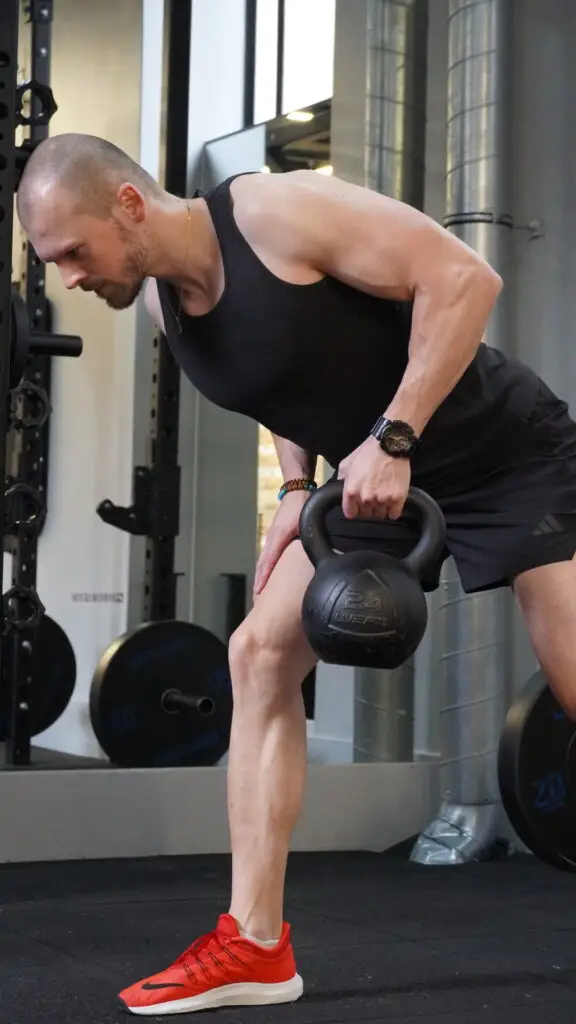
4. Single-arm alternating rows
This row works your upper back, arms and grip. Switching arms each rep adds control and rhythm, so you stay focused on every pull.
Your trunk also has to stay still while the bell moves on one side. That trains your core to resist twisting, which matters in sports where your upper and lower body move in different directions.
- Hinge forward with a flat back and let the bell hang from one hand.
- Pull it toward your hip, lower it, then switch arms for the next rep.
Follow the same set pattern as above: 4 sets of 12 reps, resting 30, 30 and 40 seconds.
See the kettlebell alternating row exercise page for a step-by-step demo.
How to progress this workout
When all 16 sets feel steady, make the work a little harder. Use a heavier bell, slow down the lowering phase, or keep the reps the same with a little less rest.
Kettlebells are a useful tool, but they aren’t magic. A 2019 scoping review found that the effects reported in kettlebell studies were mostly small, and the quality of evidence was low. Steady, progressive training matters more than the tool.
Build your own kettlebell session in 12REPS
With the 12REPS body map, you choose the muscle you want to train, the equipment you have and the time you’ve got. 12REPS then builds the session for you to save and train.
So if you want legs today and upper back tomorrow, you can set up each session around that. During the workout, you watch the trainer demo, enter your reps and weight for each set, and the app remembers what you lifted.
For more kettlebell sessions, try the 20-minute kettlebell leg workout or the 4-move kettlebell workout for strong legs.
Want to stop guessing in the gym? 12REPS gives you a plan, trainer demos and a record of every set. Each session then has a clear number to beat.
Sources
- Adult Activity: An Overview. Centers for Disease Control and Prevention (CDC), 2023. https://www.cdc.gov/physical-activity-basics/guidelines/adults.html
- Patellofemoral joint loading during the forward and backward lunge (Goulette et al.). Physical Therapy in Sport, 2021. https://www.pubmed.gov/33310585/
- Kettlebell swing, snatch, and bottoms-up carry: back and hip muscle activation, motion, and low back loads (McGill and Marshall). Journal of Strength and Conditioning Research, 2012. https://www.backfitpro.com/medical-scientific-articles/2012/%5B63%5DMcGill,S.(2012)Kettlebell-swing-snatch-and-bottoms-up-carry%5BJ.Strength-Condit.Res.%5D.pdf
- Kettlebell swing training improves maximal and explosive strength (Lake and Lauder). Journal of Strength and Conditioning Research, 2012. https://eprints.chi.ac.uk/id/eprint/266/
- Eight weeks of kettlebell swing training does not improve sprint performance in recreationally active females (Holmstrup et al.). International Journal of Exercise Science, 2016. https://digitalcommons.wku.edu/ijes/vol9/iss4/6/
- Kettlebell Research Update (Len Kravitz, PhD). University of New Mexico, n.d.. https://www.unm.edu/~lkravitz/Article%20folder/kettlebellresearch.html
- Kettlebell training in clinical practice: a scoping review (Meigh et al.). BMC Sports Science, Medicine and Rehabilitation, 2019. https://doaj.org/article/034dc129d99845a09c115bf925f577e1

