May 27, 2025

6 minutes read

Kettlebell Lower Body Workout: Form Cues and Progression Plan

This kettlebell lower body workout uses one kettlebell and five moves: sumo squats, swings, reverse lunges, Romanian deadlifts and goblet squats. Each move comes with clear steps, form cues and a common mistake to avoid. A weekly progression plan then helps you keep getting stronger.

You do 5 sets of each move, so this session takes longer than our 20-minute kettlebell leg workout. If you prefer a shorter list, try the 4-move kettlebell workout for strong legs.

The workout at a glance

ExerciseSets and repsMain muscles
Kettlebell sumo squat5 x 12Quads, glutes, inner thighs
Kettlebell swing5 x 15Glutes, hamstrings, lower back
Kettlebell reverse lunge5 x 12 per legQuads, glutes
Kettlebell Romanian deadlift5 x 10Hamstrings, glutes
Goblet squat5 x 12Quads, glutes, core

One kettlebell is enough, at home or in the gym. For rest between sets, the American College of Sports Medicine (ACSM) suggests 1 to 2 minutes for muscle growth in beginner and intermediate programs.

Warm up first

Get your muscles moving before you load them. A review of 32 studies found that warming up improved performance in 79% of the measures examined.

  • Bodyweight squats: 2 sets of 15
  • Hip circles: 30 seconds each direction
  • Glute bridges: 2 sets of 12
  • World’s greatest stretch: 30 seconds per side
  • Bodyweight lunges: 1 set of 10 each leg

For a fuller routine, see how to warm up before strength training.

1. Kettlebell sumo squat

5 sets of 12 reps

How to do it

  1. Stand with your feet wider than shoulder-width and your toes turned out a little.
  2. Hold the kettlebell by the handle with both hands, arms long in front of you.
  3. Push your knees out as you squat down between your legs.
  4. Go as deep as you can with a tall chest, then drive up and squeeze your glutes.

Form cues

  • Keep your core tight throughout.
  • Focus on depth and on using your glutes to stand up.

Common mistake

Letting your knees cave in. Keep them pointing the same way as your toes. If your form holds, use a slightly heavier bell on later sets.

2. Kettlebell swing

5 sets of 15 reps

How to do it

  1. Stand with the bell a little in front of you and hinge at the hips to grab it.
  2. Hike the bell back between your legs.
  3. Snap your hips forward to swing the bell to about chest height.
  4. Let it fall back, hinge again and go straight into the next rep.

Form cues

  • Keep your arms relaxed. They guide the bell; your hips move it.
  • Squeeze your glutes hard at the top.
  • Make each rep powerful, but stay in control of the bell.

Common mistake

Squatting the swing or lifting with your arms. The swing is a hip hinge. In a lab study, the swing was driven by the hips, with high glute activity.

The same study found that the swing loads the lower back in an unusual direction, which may not suit everyone. If swings bother your back, stop and check your form. See how to do a kettlebell swing for more cues. Add pace or weight as you get stronger.

3. Kettlebell reverse lunge

5 sets of 12 reps per leg

How to do it

  1. Hold the bell at your chest or in the rack position (resting on the back of your forearm).
  2. Step back with control and lower your back knee toward the floor.
  3. Keep your front knee roughly over your ankle.
  4. Push through your front foot to return to standing.

Form cues

  • Stay tall through your chest.
  • Use a heavier bell in later sets only if your balance holds.

Common mistake

Rushing the step back and losing balance. Slow down and set your feet each rep.

Stepping back changes how the knee is loaded. A 2021 study of 20 women found that the reverse lunge put less load on the kneecap joint than the forward lunge.

4. Kettlebell Romanian deadlift (RDL)

5 sets of 10 reps

How to do it

  1. Stand tall and hold the bell in front of your thighs.
  2. Keep a slight bend in your knees and push your hips back.
  3. Lower the bell close to your legs until you feel a stretch in your hamstrings.
  4. Drive your hips forward with your glutes to stand back up.

Form cues

  • Keep your back flat and your neck in line with it.
  • Add weight once you have mastered the hinge.

Common mistake

Bending the knees too much, which turns the move into a squat. Think “hips back,” not “sit down.”

The RDL is a strong choice for the back of your legs. In a study of trained men, it was one of the two exercises with the highest hamstring activity. Our Romanian deadlift form guide goes deeper on technique.

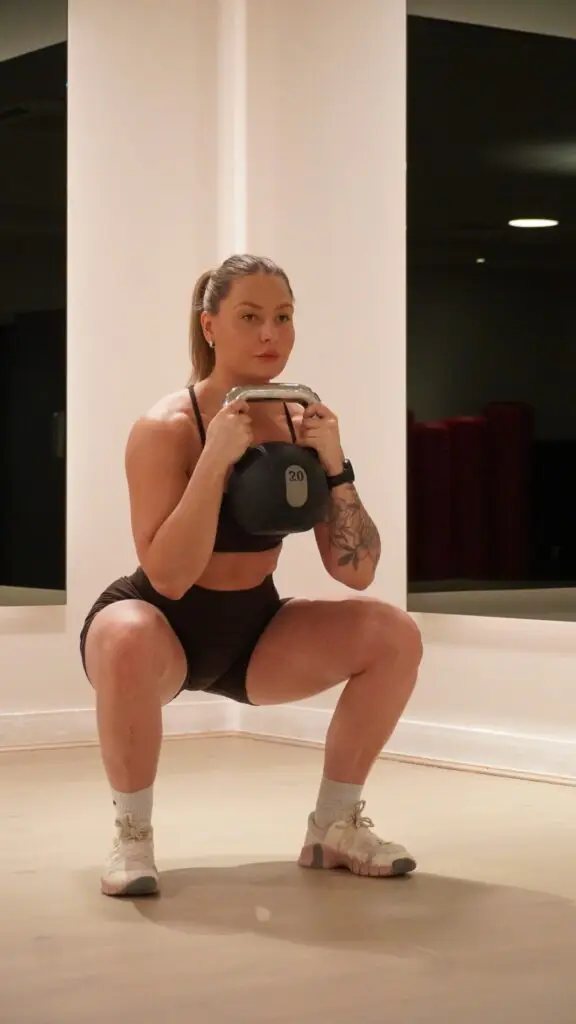
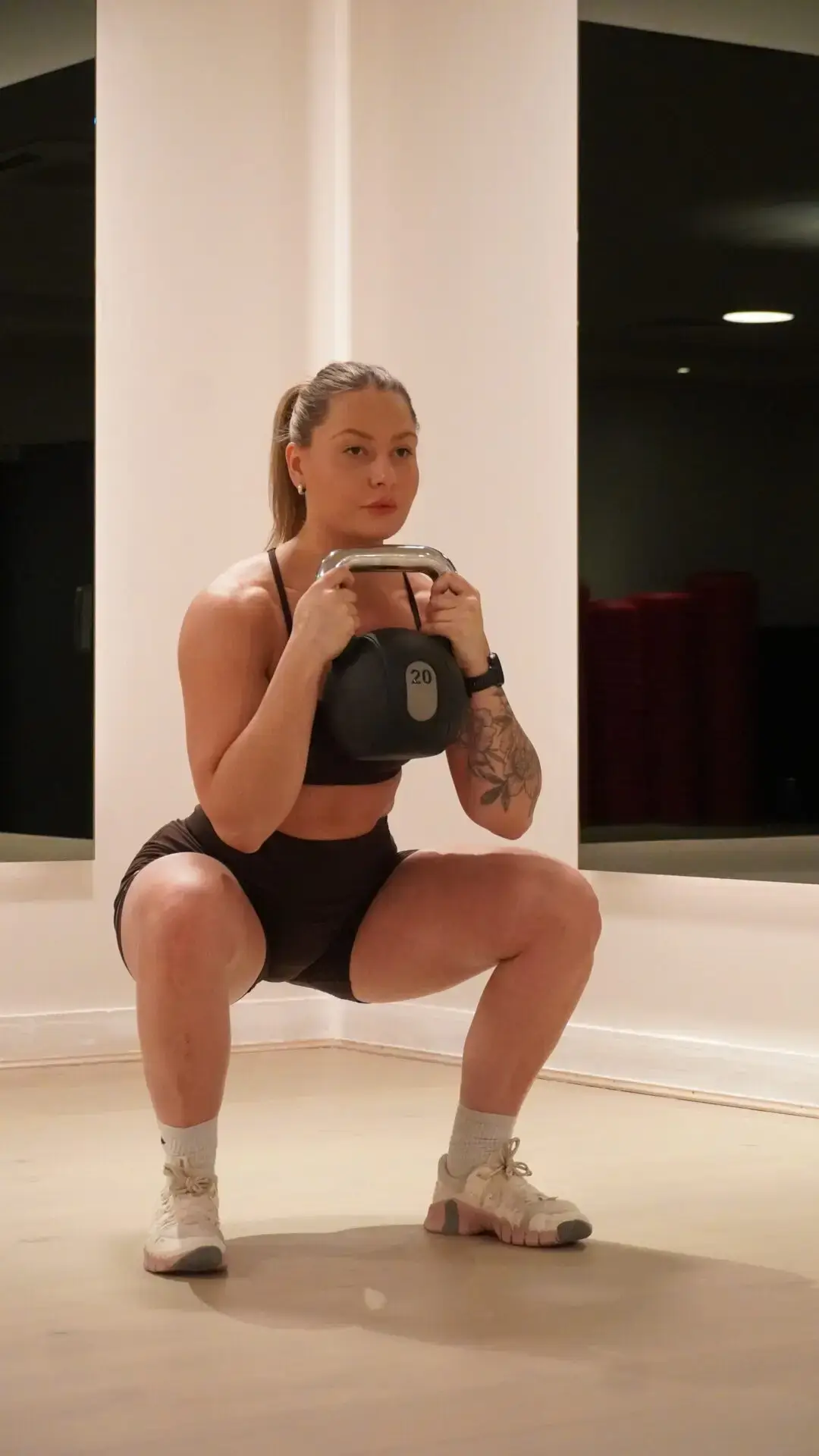
5. Goblet squat

5 sets of 12 reps

How to do it

  1. Hold the bell close to your chest, with your elbows pointing down.
  2. Keep your chest tall and squat as deep as your mobility allows.
  3. Stand back up under control.

Form cues

  • Don’t bounce out of the bottom. Stay in control.
  • Pause at the bottom for more time under tension (the time your muscles work during each set).

Common mistake

Letting your chest drop and the bell pull you forward. Keep the bell tight to your body.

How to progress this workout each week

Repeat this workout weekly, but don’t repeat the same effort. Try to do a little more each time.

This is called progressive overload. The ACSM defines it as a gradual increase in the stress placed on your body during training. Here’s how to apply it:

  • Add 2 to 4 kg every few weeks, once you can finish every rep with good form.
  • Slightly reduce your rest time. The ACSM notes that shorter rest suits muscular endurance, while longer rest suits strength.
  • Add pauses or tempo changes, such as a slower lowering phase.
  • Log each set, so you know the number to beat next week.

Progress doesn’t happen by chance. You need to track your numbers. Our beginner’s guide to progressive overload explains more.

Track every set with 12REPS

In 12REPS, you enter the reps and weight for each set. The app remembers what you lifted, so you always have a number to beat. Every exercise also comes with a trainer demonstration. See how the 12REPS app works and build your kettlebell sessions around your goal and your time.

Sources

Share this article

12Reps Team

The 12reps app is your ultimate fitness companion, crafting tailored workout plans, tracking your progress, and keeping you motivated every step of the way. Whether you’re at home, in the gym, or on the go, our adaptable approach fits seamlessly into your lifestyle — providing the support and guidance you need to crush your goals and stay on track.

Disclaimer: The ideas in this blog post are not medical advice. They shouldn’t be used for diagnosing, treating, or preventing any health problems. Always check with your doctor before changing your diet, sleep habits, daily activities, or exercise.  JUST12REP.COM  isn’t responsible for any injuries or harm from the suggestions, opinions, or tips in this article.
12reps strength training
[instagram-feed feed=1]

Stay in the loop with 12reps

We know how important it is to stay motivated and informed on your fitness journey. That’s why our newsletter is packed with everything you need to succeed:
By submitting your information, you agree to subscribe to the 12reps mailing list in order to receive my free PDF guides plus fitness video tutorials, nutrition plans and tips and exclusive offers.