



Feeling sore after every workout is common when your training is new, harder than usual or includes new exercises. Normal muscle soreness usually starts several hours after a session, peaks around day two or three and fades within about a week. Pain that is sharp, one-sided, getting worse or paired with dark urine is not normal soreness and needs medical advice.
I’m Will Duru, a personal trainer with over 10 years’ experience in London. Almost everyone I coach who is new to lifting asks the same questions. “Is this normal?” “Have I hurt myself?” “Should I train today or rest?” This guide answers them in order.

What is DOMS?
DOMS stands for delayed onset muscle soreness. It is the dull ache and stiffness you feel in a muscle in the days after unfamiliar or harder exercise.
A 2019 review in the journal Sports describes the usual pattern. Soreness commonly begins 6 to 12 hours after exercise, peaks at around 48 to 72 hours and is usually gone within 5 to 7 days. NHS inform says the aching usually stops within 2 to 5 days.
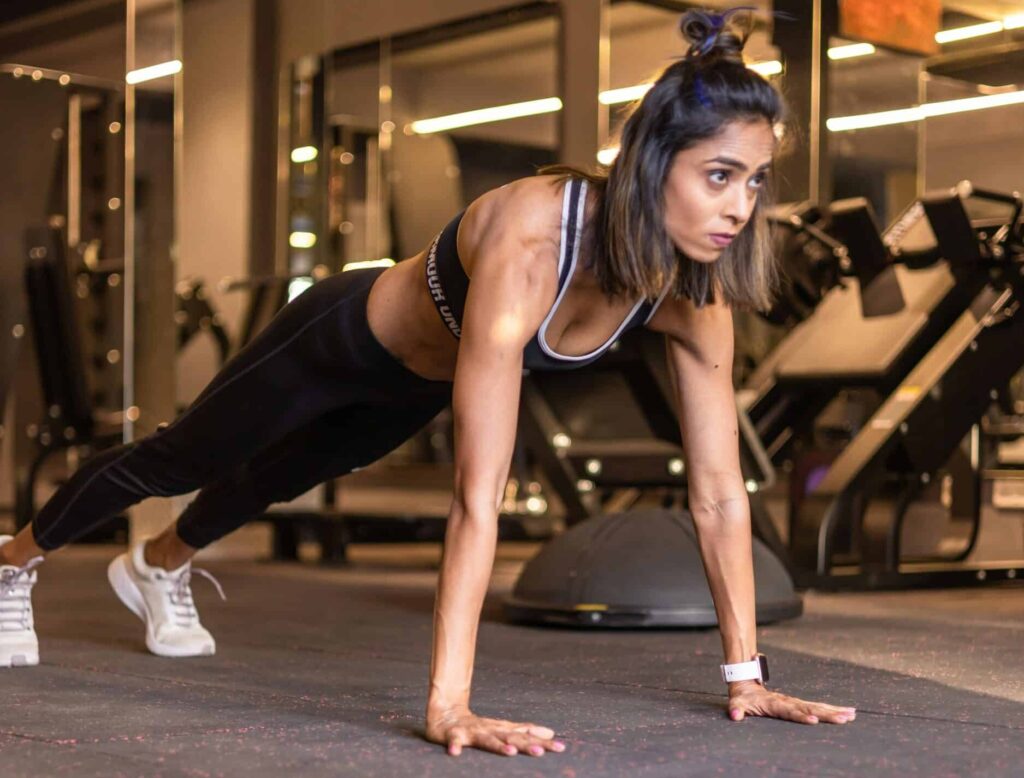
What DOMS usually feels like
- A dull, spread-out ache across the muscle you trained.
- Stiffness and tenderness when you press the muscle.
- Discomfort when you stretch or use the muscle, which often eases once you are moving.
- Feeling a little weaker in that muscle for a day or two.
What causes muscle soreness after a workout?
DOMS is linked to small-scale damage inside the muscle after work it is not used to. The same review notes that the exact cause is still not fully understood.
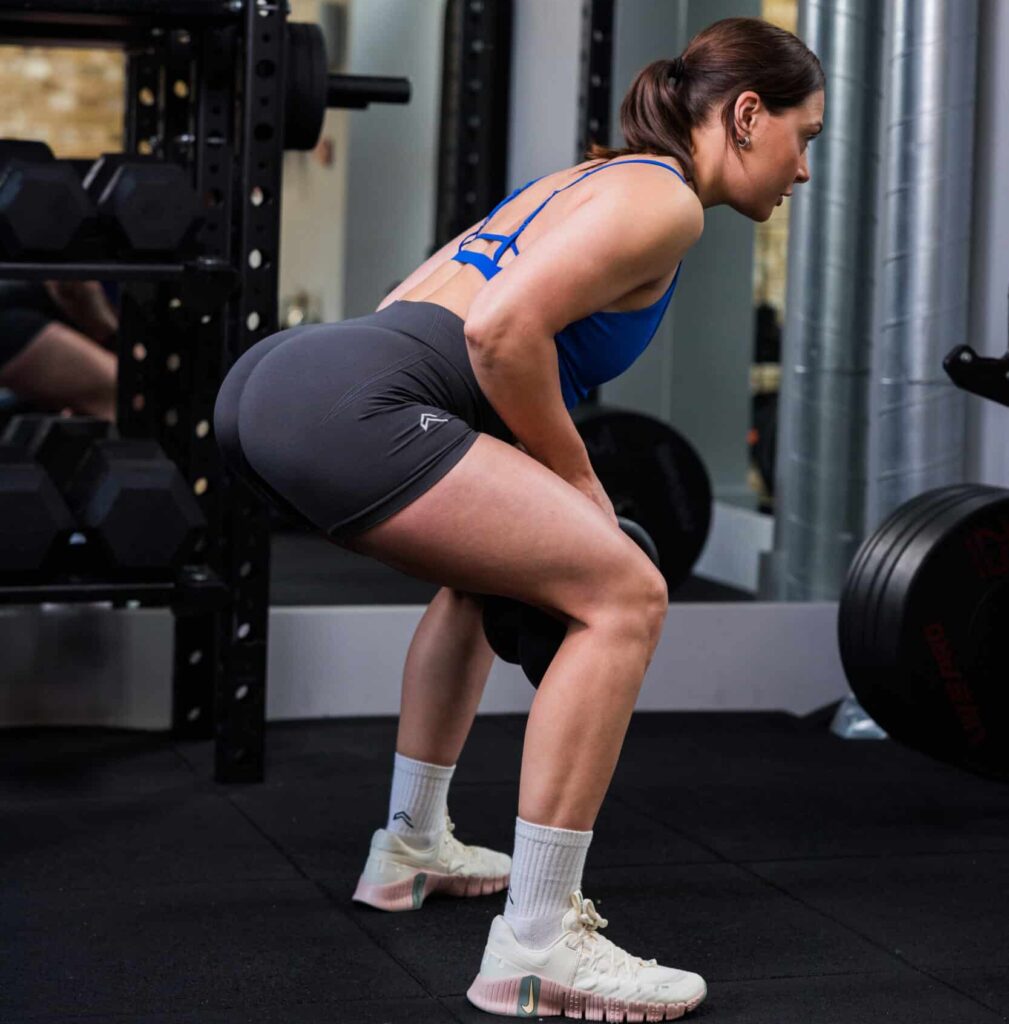
The review notes that the lowering part of a lift has long been thought to play a key role. This is called an eccentric contraction: the muscle lengthens while it is under load. Examples include lowering into a squat, lowering a dumbbell in a curl and the hinge of a Romanian deadlift.
Is it lactic acid?
Probably not. In a 1983 study by Schwane and colleagues, blood lactic acid rose during level treadmill running but not during downhill running. Only the downhill runners developed delayed soreness, and the authors concluded that lactic acid was not related to DOMS. Soreness also builds over the next day or two, long after the burning feeling of a hard set has gone.
Why am I sore after every workout?
Soreness is mostly a response to something new. If you feel sore after every session, one of these is usually the reason:
- You are new to strength training. Almost every exercise is unfamiliar, so most sessions leave you sore at first.
- You are coming back after a break. After a few weeks off, your first sessions back often feel like starting again.
- Your plan keeps changing. New exercises every session give your muscles a new challenge each time.
- You added a lot at once. A big jump in weight, sets or training days can bring soreness back.
- You trained the same muscles hard again before they recovered.
The good news is that your body adapts. Repeating the same exercise usually causes less soreness the next time. This is called the repeated bout effect, and a 2013 review by Schoenfeld and Contreras describes how soreness drops when a muscle meets the same stimulus again.
Video: What every new gym beginner should know. If you are new and sore after most sessions, this short video covers what to expect in your first weeks.
Normal soreness or injury? How to tell the difference
Use this table as a quick check. It is a general guide, not a diagnosis.
| Usually normal soreness (DOMS) | More likely an injury |
|---|---|
| Starts hours later, often the next day | Starts suddenly during the set or right after it |
| Dull, spread-out ache across the muscle | Sharp or stabbing pain in one spot |
| Similar on both sides if you trained both sides | Clearly worse on one side |
| Eases as you warm up and move | Gets worse as you move, or hurts at rest |
| Improves after day two or three | Swelling, bruising or pain that keeps getting worse |
| You can move through your full range, if stiffly | You cannot bear weight or move the joint normally |
NHS inform notes that with an injury you usually notice symptoms right away, although they sometimes appear a few hours later.
When to see a doctor about muscle pain after exercise
Contact your GP or doctor if pain is not behaving like normal soreness. NHS inform advises contacting your GP if pain lasts more than 5 days or gets worse. Also get advice if you have sharp pain in a joint or tendon, swelling, or you cannot move normally.
Warning signs that need urgent care
Rarely, very hard exercise can cause rhabdomyolysis, often called rhabdo. Damaged muscle releases a protein into the blood that can harm the kidneys. The CDC lists these signs:
- Muscle pain, aches or cramps far worse than the effort would explain.
- Dark urine, often described as tea- or cola-colored.
- Unusual weakness or tiredness, such as not being able to finish a workout you managed before.
The CDC advises seeking medical care right away if you notice these symptoms. MedlinePlus also lists decreased urine output and general weakness. If in doubt, get checked rather than training through it.

Does soreness mean the workout worked?
No. Soreness tells you the session was unfamiliar. It does not tell you how much muscle or strength you gained.
The Schoenfeld and Contreras review concluded that soreness is a poor gauge of muscle growth. People who rarely get sore still build muscle. The authors also warn that a lot of soreness can get in the way of your next sessions.
What matters more is that your training gets slightly harder over time. This is called progressive overload: adding a little weight, a rep or a set as you get stronger. Read the beginner’s guide to progressive overload to see how this works week to week. If you are unsure how hard to push, see how to know if you’re training hard enough.
Video: Why you’re not gaining muscle. Watch this for the factors that drive progress, since chasing soreness is not one of them.
What helps sore muscles after a workout?
Soreness goes away on its own. Some options may make it feel better in the meantime, but the evidence for each is modest.
- Massage. A 2018 meta-analysis by Dupuy and colleagues found massage was the most effective of the recovery methods studied for reducing soreness and perceived fatigue.
- Gentle movement. The same review found active recovery, such as easy cycling or walking, also reduced soreness.
- Compression or cold water. Compression garments and water immersion also reduced soreness in that review. They are optional, not essential.
- Sleep and regular meals. These support recovery in general, so keep your normal routine and protein intake.
Does stretching help muscle soreness?
Not much. A Cochrane review found that stretching before or after exercise had very small or no clear effects on later soreness. Stretch if you enjoy it, but do not rely on it to prevent DOMS. For ideas, see 10 post-workout stretches for strength training.
A warm-up will not stop DOMS either, but it prepares you for heavier sets. Our 10-minute warm-up routines for strength training show you how.
If you take painkillers, check with a pharmacist or doctor first, especially if you have a health condition or take other medication.
Should you train when you're sore?
Usually yes, with some changes. NHS inform says you can still exercise with DOMS, but it is usually best to wait a few days until the pain eases.
- Train other muscles. Sore legs do not stop you training your upper body.
- Go lighter. If the sore muscle is mildly stiff and loosens up as you warm up, train it with lighter weights or fewer sets.
- Rest it if form breaks down. If soreness stops you moving well, skip that muscle for a day or two.
- Choose easy cardio. A walk or light cycle is a good option on very sore days.
If you feel sore everywhere, sleep poorly and your lifts are going down, you may need more recovery. Read how many rest days you need and when to take a deload week.

How to stop being so sore after every workout
You do not need to avoid soreness completely. You just want it to stop getting in the way. These habits help most people:
- Repeat the same exercises for a few weeks. Familiar exercises cause less soreness than new ones.
- Increase gradually. Add a little weight or one set at a time, not everything at once.
- Start with fewer sets. When you are new or returning, do less than you think you can.
- Space out hard sessions for the same muscle. Give a very sore muscle time to settle before you load it heavily again.
- Log your sessions. A log shows whether soreness follows big jumps. See how to track your workouts.
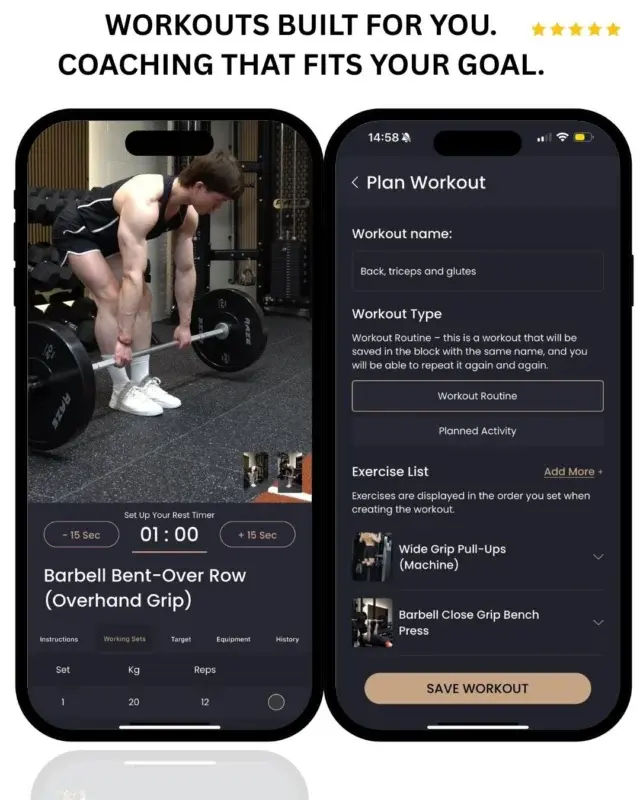
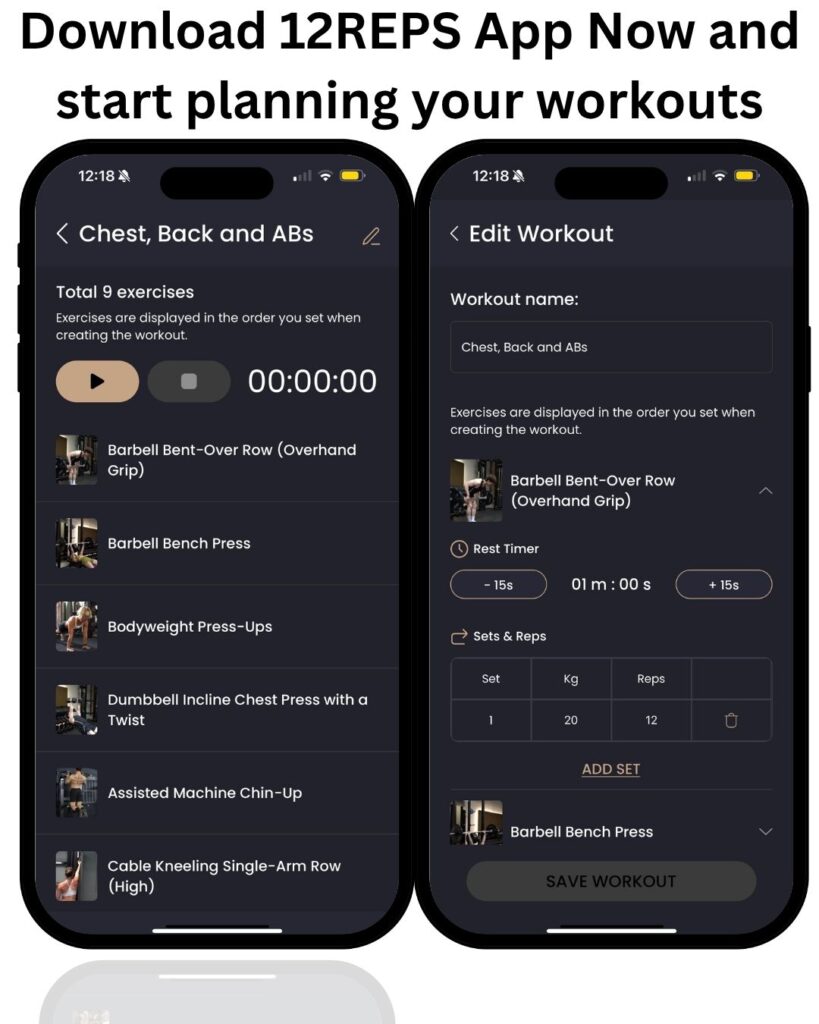
If you want a plan that keeps your exercises steady and shows you what you lifted last time, 12REPS builds each session around your goal, your equipment and your time. It also includes a trainer demonstration for every exercise, so you can see how to do each one.
FAQs about feeling sore after a workout
How long does muscle soreness last?
Usually 2 to 5 days, and rarely more than about a week. Contact your GP if pain lasts more than 5 days or gets worse.
Is it bad to be sore after every workout?
Not usually, especially in your first weeks. If it carries on for months on the same plan, your sessions may be changing too often or increasing too fast.
Why am I not sore anymore? Am I still making progress?
Less soreness usually means your body has adapted. Check your log instead: if your weights or reps are slowly going up, you are progressing.
Can I work out with sore legs?
Yes, you can train your upper body or do easy cardio. Train your legs lightly if the soreness is mild and eases as you warm up.
Sources
- Accelerating Recovery from Exercise-Induced Muscle Injuries in Triathletes: Considerations for Olympic Distance Races. Hotfiel T et al., Sports (MDPI), 2019. https://doi.org/10.3390/sports7060143
- Pain and injuries after exercise. NHS inform, 2024. https://www.nhsinform.scot/illnesses-and-conditions/muscle-bone-and-joints/pain-and-injuries-after-exercise/
- Signs and Symptoms of Rhabdomyolysis. Centers for Disease Control and Prevention (NIOSH), 2024. https://www.cdc.gov/niosh/rhabdo/signs-symptoms
- Rhabdomyolysis. MedlinePlus Medical Encyclopedia, US National Library of Medicine. https://medlineplus.gov/ency/article/000473.htm
- An Evidence-Based Approach for Choosing Post-exercise Recovery Techniques to Reduce Markers of Muscle Damage, Soreness, Fatigue, and Inflammation: A Systematic Review With Meta-Analysis. Dupuy O et al., Frontiers in Physiology, 2018. https://doi.org/10.3389/fphys.2018.00403
- Is Lactic Acid Related to Delayed-Onset Muscle Soreness? Schwane JA, Watrous BG, Johnson SR, Armstrong RB, The Physician and Sportsmedicine, 1983. https://doi.org/10.1080/00913847.1983.11708485
- Stretching to prevent or reduce muscle soreness after exercise. Herbert RD, de Noronha M, Kamper SJ, Cochrane Database of Systematic Reviews, 2011. https://doi.org/10.1002/14651858.CD004577.pub3
- Is Postexercise Muscle Soreness a Valid Indicator of Muscular Adaptations? Schoenfeld BJ, Contreras B, Strength and Conditioning Journal, 2013. https://doi.org/10.1519/SSC.0b013e3182a61820