



By Will Duru, BSc (Hons) Sport and Exercise Science, Award-winning Personal Trainer with over 10 years of experience in strength training and optimising recovery
How long should a workout be? For most people, a strength workout of 30 to 60 minutes is enough. The length depends on how many hard sets you need, how long you rest between them and how many days a week you train. A focused 30-minute session can work well if you train often enough to reach your weekly sets.
As a personal trainer, one of the most common questions I get is “How long should my workouts be?” There is no single number that suits everyone. Your experience, your goal, the type of training and the time you have all play a part.
This guide is about the length of one session. If you are deciding how many sessions to do each week, read how many days a week you should work out alongside it.

Quick answer: workout length by goal
These are general coaching starting points, not hard rules. Use them to plan, then adjust to how you recover and how much time you really have.
| Goal | Typical session | What takes up the time |
|---|---|---|
| Getting started | 20 to 30 minutes | Learning a few key exercises with light loads |
| Maintaining fitness | 20 to 30 minutes | A few hard sets per muscle group |
| Fat loss | 30 to 45 minutes | Strength work, with or without short cardio |
| Building muscle | 45 to 60 minutes | Enough sets per muscle, with 1 to 2 minutes of rest |
| Getting stronger | 60 to 75 minutes | Warm-up sets and longer rests between heavy sets |
What actually sets the length of a workout
A session is mostly sets plus rest. A simple way to estimate it is: number of sets × (time per set + rest) + warm-up.
For example, 15 working sets that take about 45 seconds each, with 2 minutes of rest, come to about 40 minutes. Add 10 minutes of warm-up and you are at about 50 minutes.
Starting out: shorter is fine
If you are new to training, 20 to 30 minutes, 3 to 4 times a week, is a good place to start. Your muscles, joints and coordination need time to adapt. In my experience coaching beginners, shorter sessions are easier to stick with, and sticking with it is what drives progress.
How long a workout should be for each goal
Building muscle: 45 to 60 minutes
Muscle growth depends a lot on weekly training volume, meaning the number of hard sets you do for each muscle across the week. A meta-analysis found a graded dose-response: more weekly sets led to more muscle growth. The authors suggested at least 10 weekly sets per muscle group to maximize gains (Schoenfeld et al., 2017).
Rest time matters too. A 2024 meta-analysis found a small benefit for muscle growth when resting longer than 60 seconds between sets. It found no clear extra benefit beyond about 90 seconds (Singer et al., 2024). With 1 to 2 minutes of rest, a muscle-building session usually lands between 45 and 60 minutes.
For more on choosing sets and reps, see sets, reps and rest for muscle growth and how long to rest between sets.
Getting stronger: 60 to 75 minutes
Strength sessions take longer because heavy sets need more recovery. The American College of Sports Medicine (ACSM) suggests 3 to 5 minutes of rest for heavy loads in intermediate and advanced lifters (ACSM, 2009).
You also need a few warm-up sets before each heavy lift. For example, a powerlifter might rest 3 to 5 minutes between heavy sets of squats. That time is part of the training, not wasted time.
Fat loss: 30 to 45 minutes
Fat loss depends mostly on your calorie balance over weeks, not on the length of one workout. Session length matters less than how active you are across the whole week.
The World Health Organization recommends at least 150 minutes of moderate aerobic activity a week, plus muscle-strengthening on at least 2 days (WHO). A 30 to 45 minute strength session, with walking or cardio on other days, covers that for most people. If you want to combine both in one visit, read cardio and weights on the same day.
Maintaining what you have: 20 to 30 minutes
Keeping strength takes far less work than building it. A review found that, at least in younger adults, strength and muscle size can be kept for up to 32 weeks with 1 strength session a week. That meant 1 set per exercise, as long as the loads stayed heavy. Older adults may need 2 sessions a week with 2 to 3 sets per exercise to keep muscle size (Spiering et al., 2021).
That makes a short session a good option for busy weeks, holidays or a break from harder training.
Do workouts over an hour ruin your gains?
You may read that cortisol rises after 60 minutes and stops muscle growth. Research has not shown a fixed cutoff like this. One study in trained men found that short-term hormone rises after training were not related to gains in muscle or strength (Morton et al., 2016).
The real limit is fatigue and focus. If your last exercises always feel sloppy, the session is probably longer than it needs to be.
How to get more from a shorter workout
If time is tight, a narrative review on time-saving strength training offers clear options (Iversen et al., 2021):
- Pick multi-joint exercises. Prioritize moves that train several muscles at once. The review suggests at least one leg exercise such as a squat, one upper-body pull and one upper-body push.
- Do at least 4 hard sets per muscle group per week. The review gives this as a minimum, using loads you can lift 6 to 15 times.
- Use supersets. A superset means doing two exercises back to back, such as a press and a row, before resting. The review says supersets, drop sets and rest-pause training can roughly halve training time while keeping the same volume. These methods seem better suited to muscle growth than maximal strength.
- Keep the warm-up specific. The review suggests limiting the warm-up to lighter sets of the exercises you are about to do. Stretching is only a priority if flexibility is your goal.
- Plan before you arrive. Knowing your exercises in advance saves a lot of time spent deciding what to do next.
For a ready-made option, try the 30-minute full-body workout or read how to use supersets.
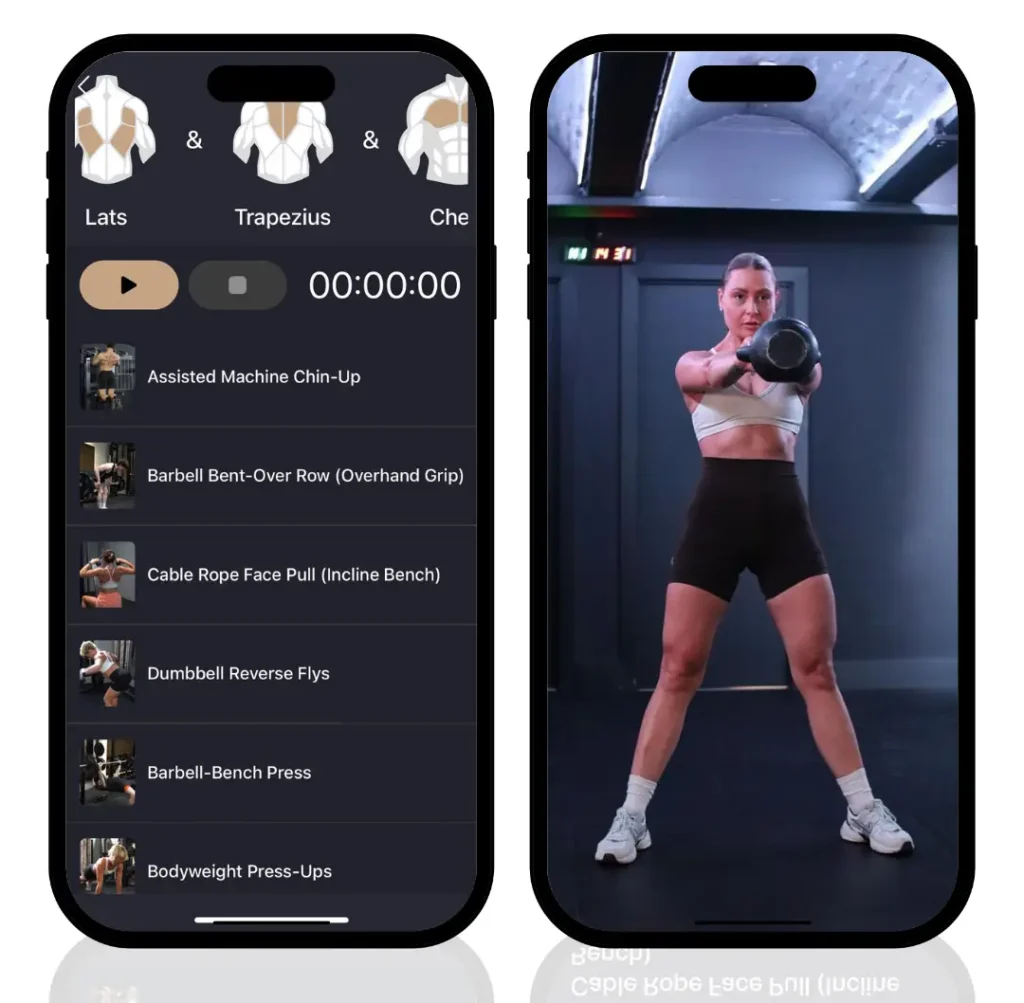
Video: 30-minute kettlebell full-body workout. Watch this to see how a complete full-body session can fit into half an hour with one piece of equipment.
Planning short sessions in 12REPS
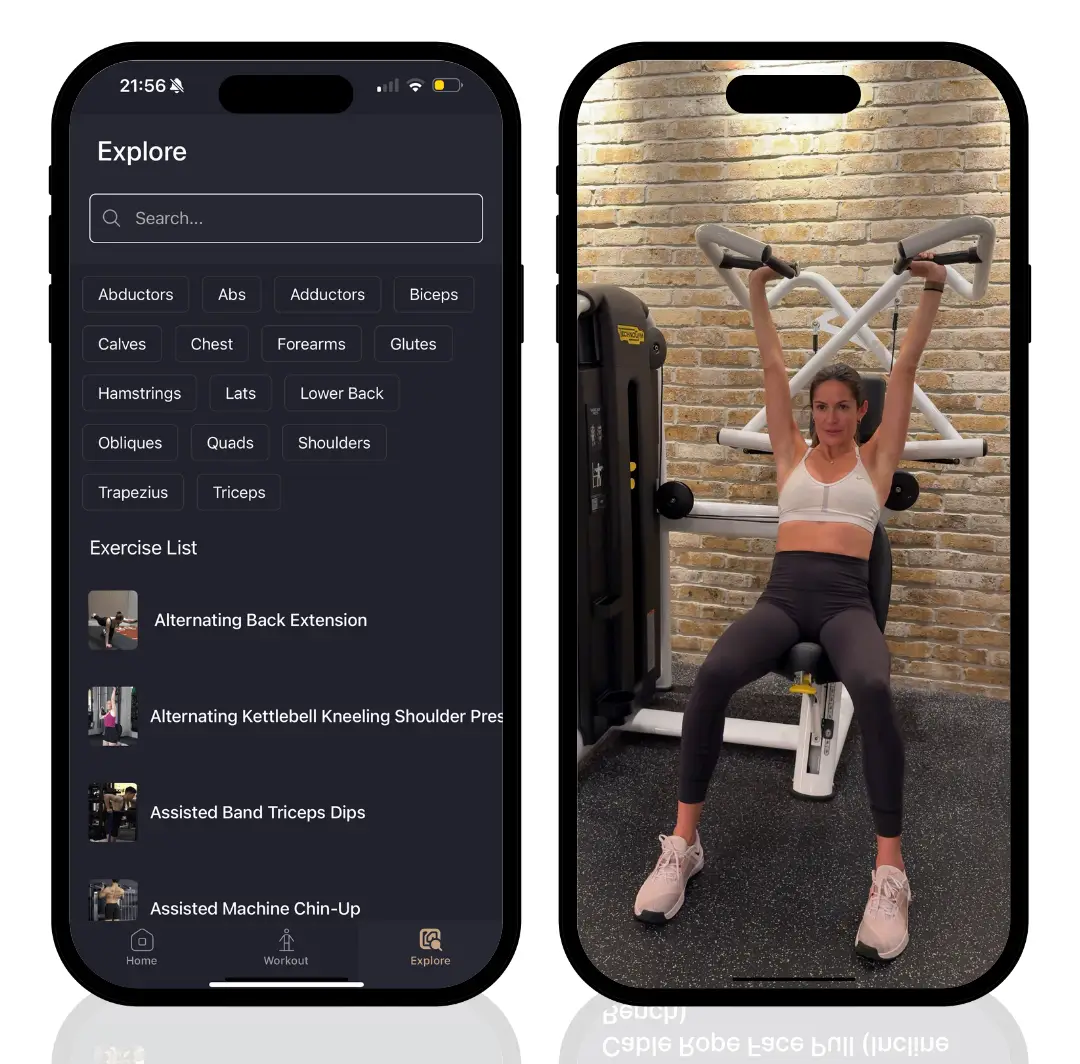
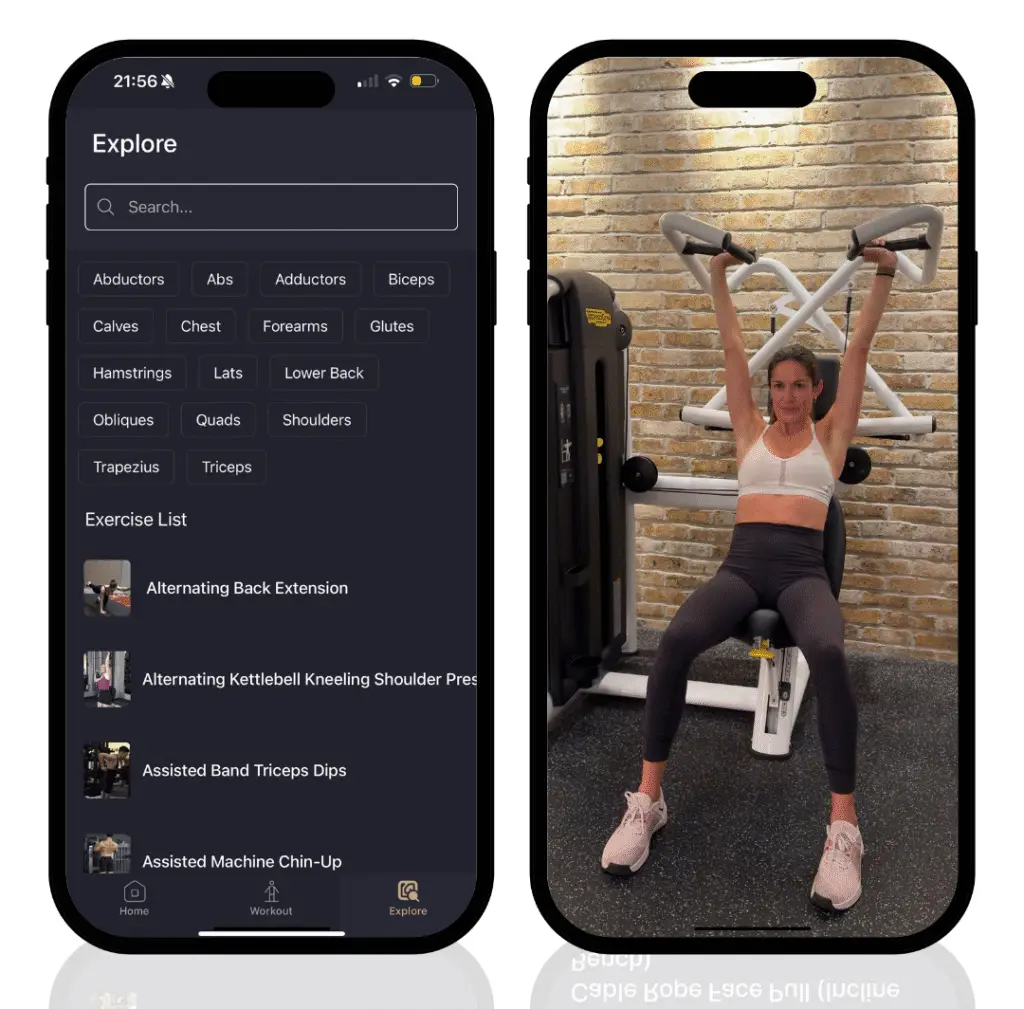
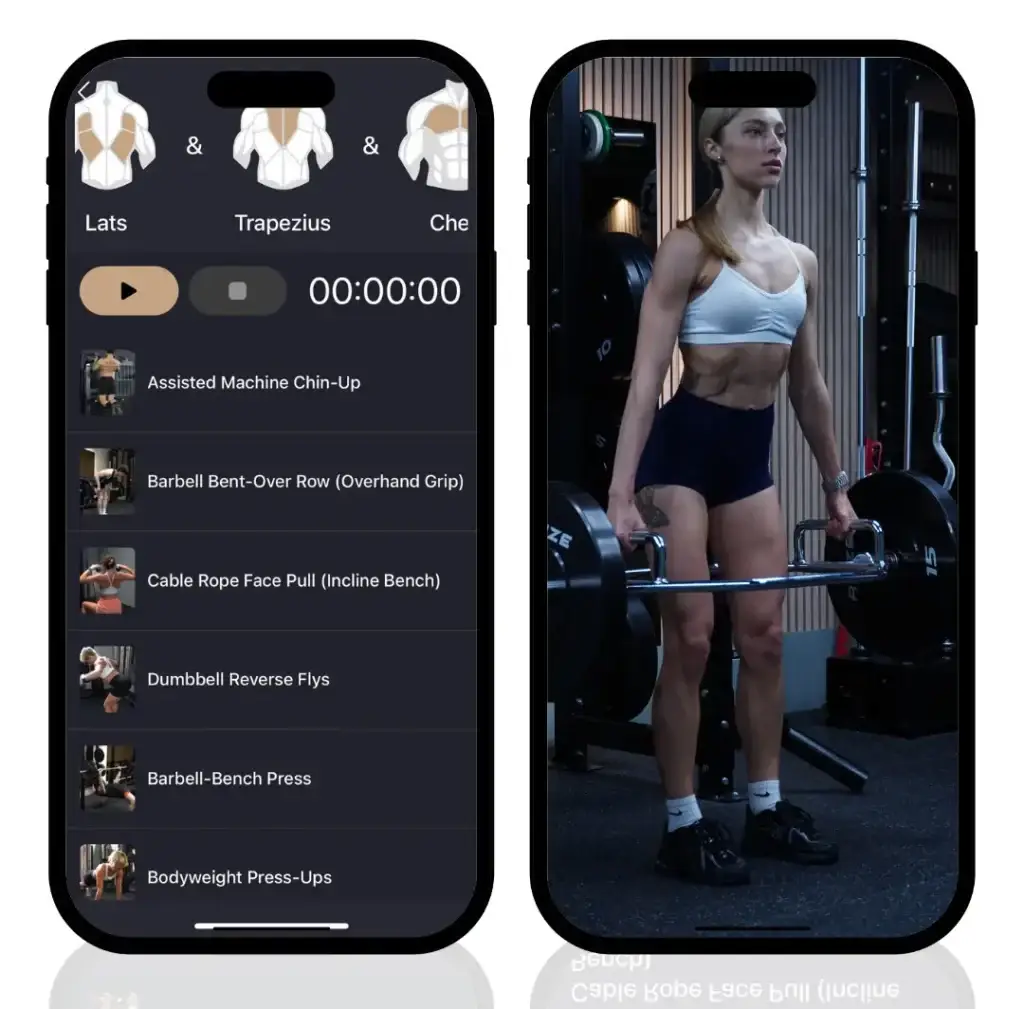
In 12REPS, you open the app and your workout is ready, with the session length shown. With Build your own, you choose the muscle, the equipment and the time you have, and the app builds the session. Each exercise has a trainer demonstration, and you log your reps and weight for each set.

Session length or more days: which matters more?
The Iversen review notes that weekly training volume is more important than training frequency (Iversen et al., 2021). So you can trade session length for days.
- Two 60-minute full-body sessions and four 30-minute sessions can deliver similar weekly sets.
- Shorter, more frequent sessions suit people with busy weekdays.
- Longer, less frequent sessions suit people who can only get to the gym twice a week.
For the research on training days, read strength training frequency. To understand why weekly sets drive growth, see how muscles grow.
Signs your workouts are too long
- You lose focus or start checking your phone between sets.
- Your last exercises feel sloppy or much weaker every week.
- You skip sessions because you cannot find a free hour.
Signs they might be too short
- You rush your rest and cannot keep your reps up from set to set.
- You often skip your warm-up to fit the session in.
- You have stopped making progress and do only a few sets per muscle each week.
The best workout length is the one you can repeat week after week while still making progress. Want each session planned around your goal, your equipment and your time? 12REPS sets it out and remembers what you lifted, so you always have a number to beat.
Frequently asked questions
Is a 30-minute workout enough?
Yes, for many goals. A focused 30 minutes, 3 or 4 times a week, can build strength and muscle, especially if you use multi-joint exercises and supersets.
Does the warm-up count as workout time?
Yes. Plan 5 to 10 minutes for it. Lighter sets of your first exercise are a simple way to warm up without adding much time.
Should I count cardio in my workout time?
Count it if you do it in the same visit. If you add 20 minutes of cardio after lifting, a 45-minute strength session becomes a 65-minute visit. To decide on the order, see cardio or weights first.
What should I eat before a longer session?
A normal meal 1 to 4 hours before usually works well. Read what to eat before and after a workout for timing and examples.
Sources
- Dose-response relationship between weekly resistance training volume and increases in muscle mass: a systematic review and meta-analysis. Schoenfeld BJ, Ogborn D, Krieger JW, Journal of Sports Sciences, 2017. https://doi.org/10.1080/02640414.2016.1210197
- Give it a rest: a systematic review with Bayesian meta-analysis on the effect of inter-set rest interval duration on muscle hypertrophy. Singer A et al., Frontiers in Sports and Active Living, 2024. https://doi.org/10.3389/fspor.2024.1429789
- American College of Sports Medicine position stand. Progression models in resistance training for healthy adults. American College of Sports Medicine, Medicine & Science in Sports & Exercise, 2009. https://pubmed.ncbi.nlm.nih.gov/19204579/
- Maintaining physical performance: the minimal dose of exercise needed to preserve endurance and strength over time. Spiering BA, Mujika I, Sharp MA, Foulis SA, Journal of Strength and Conditioning Research, 2021. https://pubmed.ncbi.nlm.nih.gov/33629972/
- No time to lift? Designing time-efficient training programs for strength and hypertrophy: a narrative review. Iversen VM, Norum M, Schoenfeld BJ, Fimland MS, Sports Medicine, 2021. https://doi.org/10.1007/s40279-021-01490-1
- Neither load nor systemic hormones determine resistance training-mediated hypertrophy or strength gains in resistance-trained young men. Morton RW et al., Journal of Applied Physiology, 2016. https://doi.org/10.1152/japplphysiol.00154.2016
- Physical activity. World Health Organization, n.d.. https://who.int/initiatives/behealthy/physical-activity
