




By Will Duru, personal trainer and founder of 12REPS.
The Short Answer
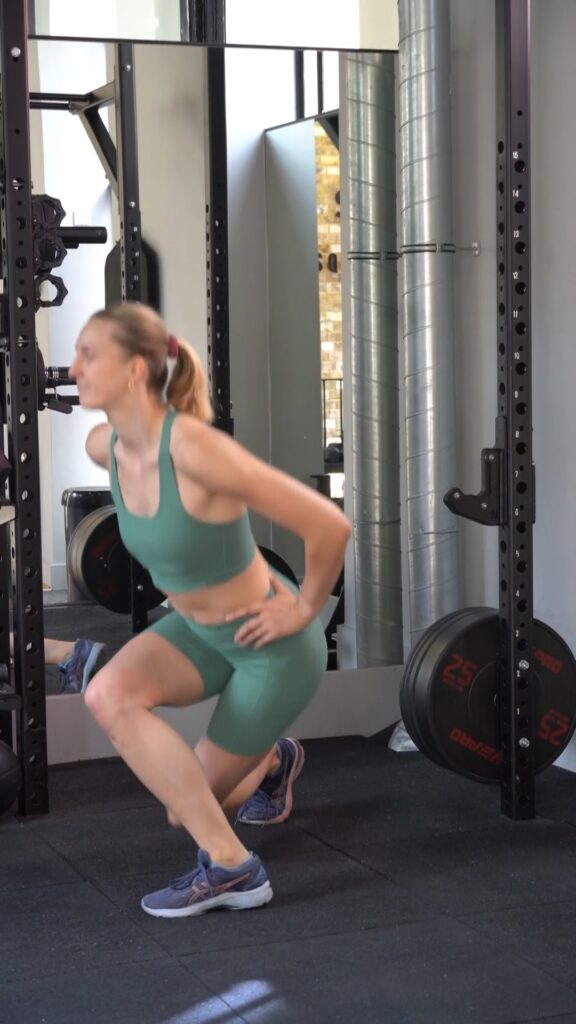
A curtsy lunge is a lunge where you step one leg diagonally behind the other, as if you were curtsying. It works your glutes, quads and inner thighs, and it challenges the muscles on the side of your hip that keep your pelvis level.
It’s a good way to add variety to your leg training and work your hips in a different direction. There’s very little research on the curtsy lunge itself, so treat it as a useful extra alongside proven lunges and squats, not a replacement.
What Muscles Do Curtsy Lunges Work?
- Glutes: your main hip muscle (gluteus maximus) drives you back up to standing.
- Gluteus medius: the muscle on the side of your hip works to stop your knee and pelvis from collapsing inward.
- Quadriceps: the front of your thigh straightens your front knee.
- Adductors: your inner thigh muscles help control the crossed position.
- Core: keeps you balanced as you step back diagonally.
What the Research Says
There’s very little published research measuring muscle activity during the curtsy lunge itself. Related research gives some clues:
- Single-leg exercises work the side of the hip. A 2009 study by Distefano and colleagues found single-leg exercises such as the single-leg squat produced high glute medius activity (about 64% of maximum), well above many two-leg exercises.
- Foot position changes lunge muscle activity, but only a little. A 2026 study by Shin and colleagues in 36 adults found a narrower stance during a forward lunge slightly increased glute medius activity (about 13% vs 12% of maximum), while a wider stance increased quad activity.
So it’s reasonable to expect the curtsy lunge to challenge your glute medius and balance, but the exact differences from other lunges aren’t known. That’s my coaching view, not a research finding.
How to Do a Curtsy Lunge
- Stand tall. Feet about hip width apart, hands on your hips or holding dumbbells at your sides.
- Step back diagonally. Step your right foot behind and across your body to the left, landing on the ball of your foot.
- Lower down. Bend both knees and lower your back knee toward the floor. Keep your chest up and most of your weight on your front leg.
- Keep your front knee in line. Your front knee should point in the same direction as your front toes.
- Stand back up. Push through your front heel to return to standing.
- Switch sides, or finish all your reps on one side first.
Curtsy Lunge Variations
| Variation | How it works | Best for |
|---|---|---|
| Bodyweight curtsy lunge | Hands on hips or in front of you | Beginners and warm-ups |
| Dumbbell curtsy lunge | A dumbbell in each hand | Adding load |
| Goblet curtsy lunge | One dumbbell or kettlebell at your chest | Keeping your torso upright |
| Curtsy lunge on a bench | Front foot on a low bench or step | A deeper range of motion |
| Supported curtsy lunge | Hold a rack or wall | Learning the movement and balance |
Curtsy Lunge vs Other Lunges
| Lunge | Direction | Main focus |
|---|---|---|
| Forward lunge | Step forward | Quads and glutes |
| Reverse lunge | Step straight back | Glutes and quads, easier on the knees for many people |
| Lateral lunge | Step out to the side | Inner thighs and glutes |
| Curtsy lunge | Step back and across | Glutes, side of the hip and balance |
See my guides to forward, reverse and walking lunges, walking vs reverse lunges and lateral lunges.
Common Mistakes
- Crossing too far. Step back diagonally, not directly behind your front foot. Crossing too far twists your hips and knee.
- Front knee caving in. Keep your front knee tracking over your toes.
- Leaning forward too much. Keep your chest up and your torso tall.
- Twisting your hips. Keep your hips facing forward as much as you can.
- Going too heavy too soon. Master the bodyweight version first, as balance is the limiting factor for most people.
If curtsy lunges cause knee or hip pain, switch to reverse or lateral lunges.
How to Add Curtsy Lunges to Your Program
- Sets and reps: 2 to 3 sets of 8 to 12 reps on each leg.
- Placement: use them after your main squat or deadlift, as an accessory for your glutes.
- Pair them: combine them with lateral lunges or the best glute medius exercises for a hip-focused workout.
- Progress: add dumbbells once you can control every rep with good balance.
Warm up first. See my 3-phase warm-up guide.
Summary
- A curtsy lunge steps one leg diagonally behind the other.
- It works your glutes, quads, inner thighs and the side of your hip.
- Research on the curtsy lunge itself is limited, so use it as a variation, not your main leg exercise.
- Step back diagonally, keep your front knee in line with your toes and stay tall.
Train Your Glutes With a Plan
Want lunges and glute work in a plan that fits your week? In 12REPS, tap the muscles you want to train, pick your workout time and equipment, and the app builds your session.
Every exercise has a demo and a coach tutorial from me, and your log shows what you lifted last time, so you know when to add weight.
Download 12REPS and see what you’ll get:
Sources
- Distefano LJ, Blackburn JT, Marshall SW, Padua DA. Gluteal muscle activation during common therapeutic exercises. J Orthop Sports Phys Ther. 2009;39(7):532–540.
- Shin H-J, Kim H-M, Cho H-Y, Kim S-H. Effects of foot progression angle and stance width on lower-limb muscle activation during the holding phase of forward lunge exercises in healthy adults. J Clin Med. 2026;15(14):5567.
Related Reading
- How to do lunges
- Walking lunges vs reverse lunges
- Lateral lunges
- Best glute medius exercises
- Single-leg RDL
I’m Will Duru, a personal trainer and the founder of 12REPS. I hold a BSc (Hons) in Sport and Exercise Science and have more than a decade of experience coaching people in strength training.
