




By Will Duru, personal trainer and founder of 12REPS.
The Short Answer
The single-leg Romanian deadlift (single-leg RDL) is a hip hinge done on one leg. You stand on one foot, tilt your torso forward and let your free leg move back, then drive your hips forward to stand up again.
It works your glutes and hamstrings, and it challenges your balance and the smaller hip muscles that keep your pelvis level. Research suggests it works the side of your glutes (the glute medius) and the hamstrings harder than a regular deadlift, even with much less weight.

What Muscles Does the Single-Leg RDL Work?
- Gluteus maximus: your main glute muscle, which extends your hip as you stand up.
- Hamstrings: the muscles on the back of your thigh, which lengthen as you hinge forward.
- Gluteus medius: a smaller glute muscle on the side of your hip that stops your pelvis from tilting or rotating.
- Lower back and core: keep your spine flat and your torso steady.
- Foot and ankle muscles: help you balance.
What the Research Says
- More glute medius and hamstring work than a regular deadlift. In a 2021 study by Diamant and colleagues, 15 trained men did a barbell single-leg deadlift and a conventional deadlift with their 8-rep max. The single-leg version used much less weight, about 138 lb versus 249 lb on average. It still produced higher glute medius activity (77.6% vs 59.3% of a maximum effort) and higher hamstring activity (82.1% vs 74.2%). Activity in one side of the lower back was lower (67.2% vs 82.7%).
- Among the top exercises for the glutes. A 2009 study by Distefano and colleagues measured 12 exercises in 21 active adults. The single-leg deadlift produced 59% of maximum effort in both the gluteus maximus and the glute medius. Along with the single-leg squat, it was one of the best exercises for the gluteus maximus in that study.
- Which hand you hold the weight in may matter. In a 2023 study by Mo and colleagues of 12 trained men, holding the load in the hand opposite your standing leg increased glute and lower back activity in the flywheel version of the exercise. The dumbbell and flywheel versions worked the muscles similarly.
These studies measured muscle activity with sensors on the skin (electromyography, or EMG). Higher activity doesn’t guarantee more muscle growth over time, and all three studies were small. Still, they agree that the single-leg RDL is a useful glute and hamstring exercise. For more glute medius options, read my guide to the best glute medius exercises.
How to Do a Single-Leg RDL
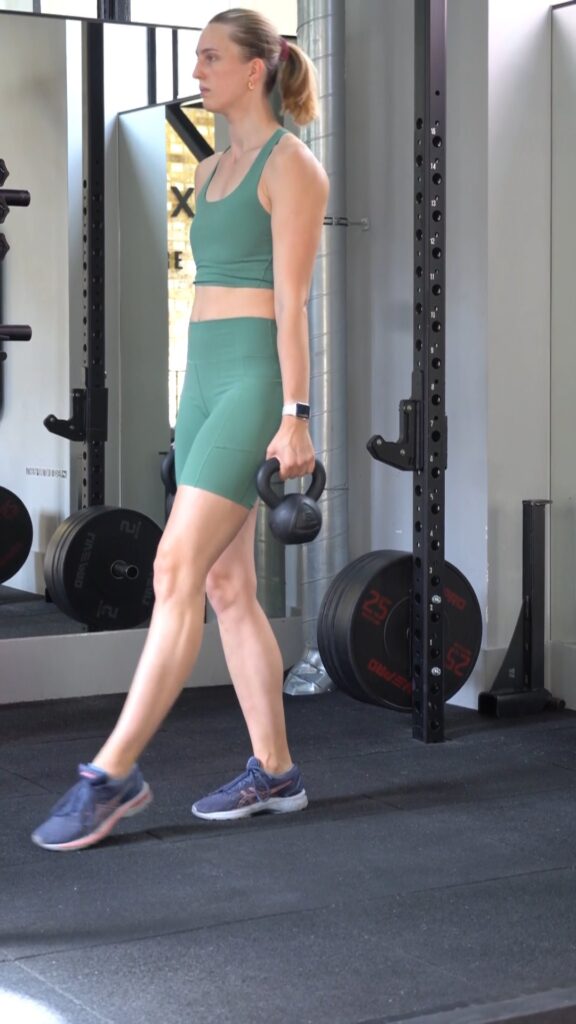
- Stand tall. Hold a dumbbell or kettlebell in the hand opposite your standing leg, or one in each hand. Put your weight on your standing leg with a slight bend in that knee.
- Hinge forward. Push your hips back and tilt your torso forward. Let your free leg move straight back behind you, in line with your body.
- Keep your hips square. Point the toes of your back foot toward the floor so your hips stay level and don’t twist open.
- Lower until you feel a stretch. Go down until you feel a strong stretch in the back of your standing leg, or until your torso is close to parallel with the floor. Keep your back flat.
- Stand up. Drive your hips forward and squeeze your glute to return to standing. Bring your back leg down at the same time.
- Finish all reps on one side, then switch legs.
Single-Leg RDL Variations
| Variation | How it works | Best for |
|---|---|---|
| Bodyweight | No weight. Reach your hands toward the floor. | Learning the movement and balance |
| Supported | Hold a rack, wall or bench with one hand. | Beginners, or loading heavier without losing balance |
| Kickstand (B-stance) | Rest the toes of your back foot on the floor for balance. | Heavier loads with less balance demand |
| One dumbbell or kettlebell | Hold the weight in the hand opposite your standing leg. | Extra glute medius challenge |
| Two dumbbells or kettlebells | One weight in each hand. | Heavier loading once balance is solid |
| Barbell | Hold a barbell with both hands. | Experienced lifters |
If balance is your limiting factor, start with the bodyweight or supported version. Here is the bodyweight version from the 12REPS exercise library:
Common Mistakes
- Twisting your hips open. Keep your back toes pointing down and both hip bones facing the floor.
- Rounding your back. Reach your chest forward and keep your spine long. Stop the rep where you lose a flat back.
- Squatting instead of hinging. Your hips should move back, not down. Keep the bend in your standing knee small.
- Locking your standing knee. A straight, locked knee makes balancing harder and adds strain behind the knee.
- Rushing. Move slowly, especially on the way down. Speed makes balance harder.
Tips to Improve Your Balance
- Fix your eyes on a spot on the floor about 6 feet in front of you.
- Grip the floor with your whole foot, not just your toes or heel.
- Train barefoot or in flat shoes if your gym allows it.
- Use the kickstand version or a support until you can control the bodyweight version for 10 slow reps on each leg.
How to Add Single-Leg RDLs to Your Program
- Sets and reps: 2 to 3 sets of 8 to 12 reps on each leg works well for most people.
- Placement: do them after your main squat or deadlift, or as the main hinge on a lighter day.
- Progression: add weight once you can control every rep on both legs with a flat back and level hips.
- Pair it: combine single-leg RDLs with Bulgarian split squats for a complete single-leg workout.
Warm up first with lighter sets. See my 3-phase warm-up guide.
Summary
- The single-leg RDL is a one-leg hip hinge that works your glutes, hamstrings and balance.
- Research suggests it works the glute medius and hamstrings harder than a conventional deadlift, with less weight.
- Keep your hips square, your back flat and your standing knee slightly bent.
- Start with bodyweight or a support, then add weight once your balance is solid.
Build Stronger Glutes and Hamstrings With a Plan
Single-leg work is easy to skip when you plan your own workouts. 12REPS builds a strength program around your goal, schedule and equipment, with single-leg exercises that suit your level.
Every exercise in the 12REPS exercise library has a demo and a coach tutorial from me, and your log shows what you lifted last time, so you know when to add weight.
Download 12REPS and see what you’ll get:
Sources
- Diamant WP, Geisler S, Havers T, Knicker A. Comparison of EMG activity between single-leg deadlift and conventional bilateral deadlift in trained amateur athletes: an empirical analysis. Int J Exerc Sci. 2021;14(1):187–201.
- Distefano LJ, Blackburn JT, Marshall SW, Padua DA. Gluteal muscle activation during common therapeutic exercises. J Orthop Sports Phys Ther. 2009;39(7):532–540.
- Mo RCY, Ngai DCW, Ng CCM, Sin KHS, Luk JTC, Ho IMK. Effects of loading positions on the activation of trunk and hip muscles during flywheel and dumbbell single-leg Romanian deadlift exercises. Front Physiol. 2023;14:1264604.
Related Reading
- Best glute medius exercises: what the research says
- Dumbbell vs barbell RDL
- Romanian deadlift form guide
- Bulgarian split squats: how to do them
- Nordic hamstring curls
I’m Will Duru, a personal trainer and the founder of 12REPS. I hold a BSc (Hons) in Sport and Exercise Science and have more than a decade of experience coaching people in strength training.
