



Short answer: To do a bodyweight squat, stand with your feet about shoulder-width apart, sit your hips back and down until your thighs are at least parallel to the floor, then push through your whole foot to stand up. Bodyweight squats can build leg strength, especially if you are new to training. But doing more and more easy reps is not enough on its own. To keep improving, you need to make the squat harder over time, for example by slowing it down or moving to single-leg versions.
This guide is for beginners and anyone training at home without weights. I cover how to do a bodyweight squat, common mistakes, what the research says, how many to do and a step-by-step progression.
What muscles do bodyweight squats work?
- Quadriceps: the muscles on the front of your thighs, which straighten your knees as you stand up.
- Glutes: they extend your hips, especially as you squat deeper.
- Adductors: the inner thigh muscles, which also work harder in deeper squats.
- Calves and core: they help keep you balanced and upright.
How to do a bodyweight squat
- Set your stance. Stand with your feet about shoulder-width apart and your toes turned out slightly. Most people feel comfortable somewhere between 15° and 30°.
- Set your arms. Clasp your hands at your chest or reach them forward for balance.
- Brace. Stand tall and tighten your stomach gently.
- Squat down. Bend your hips and knees at the same time. Let your knees travel forward and out in line with your toes.
- Reach your depth. Go down until your thighs are at least parallel to the floor, or as low as you can while keeping your heels down and your back in a neutral position.
- Stand up. Push through your whole foot and stand back up to full height.
- Repeat. Keep a steady rhythm, taking about 2 seconds to go down and 1 second to come up.

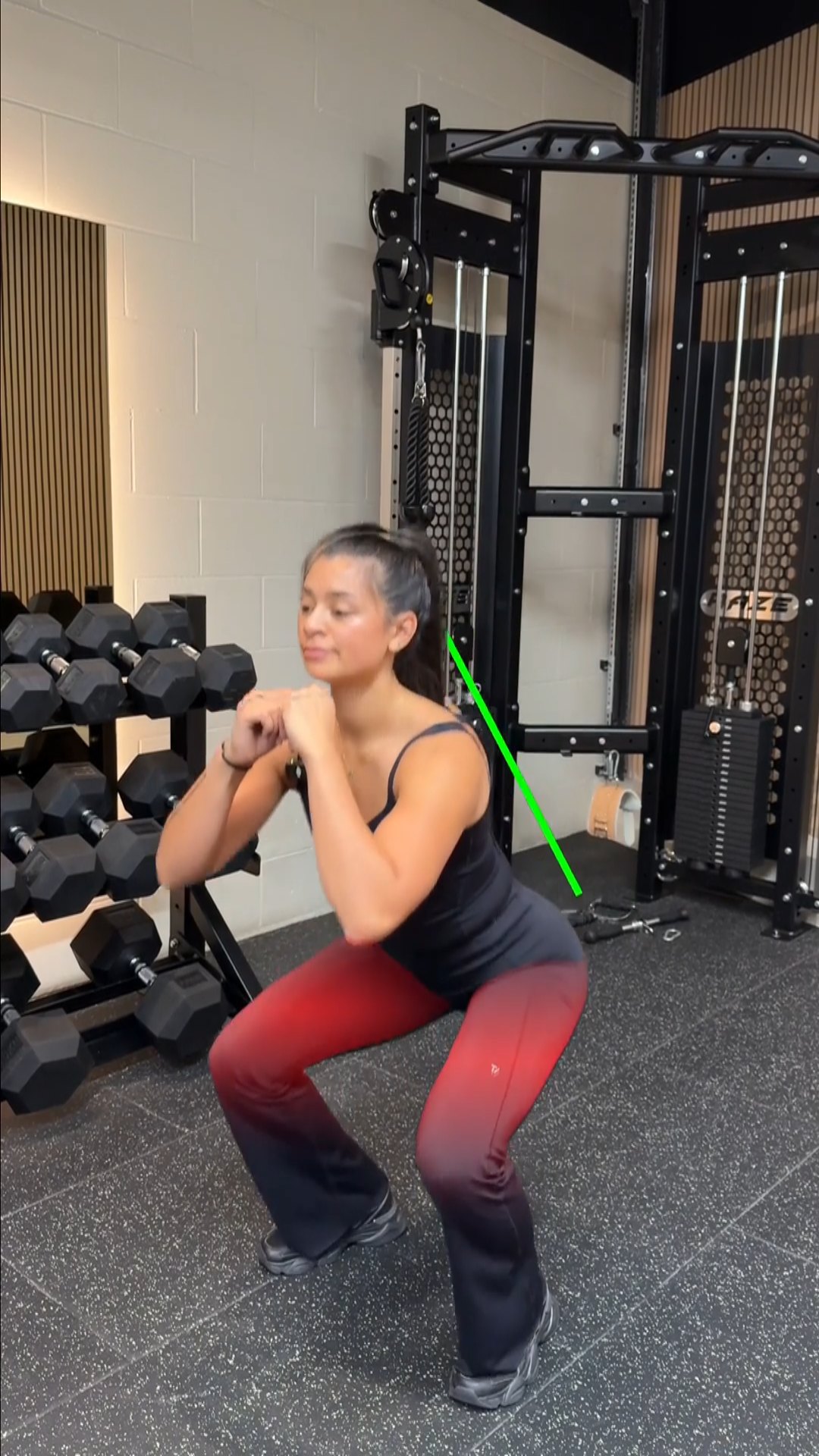
Coaching cues I use
- “Tripod foot.” Keep your weight spread across your big toe, little toe and heel.
- “Knees follow your toes.” Let your knees move in the same direction as your toes rather than caving in.
- “Sit between your heels.” Think about sitting down between your feet, not just backward.
- “Chest proud.” Keep your chest up and facing forward, without overarching your back.
It is fine for your knees to move past your toes if that is how your body squats. I explain why in my article on knees past toes when squatting.
Common bodyweight squat mistakes
| Mistake | What it looks like | The fix |
|---|---|---|
| Heels lifting | Your weight shifts onto your toes at the bottom | Sit back a little more, widen your stance slightly or squat to a box first. |
| Knees caving in | Your knees move toward each other as you stand | Push your knees out in line with your toes. Slow the movement down. |
| Squatting too shallow | You only bend your knees a few inches | Aim for thighs parallel to the floor. Use a box or chair as a depth target. |
| Rounding the back | Your lower back tucks under at the bottom | Stop just above the point where your back rounds and work on depth gradually. |
| Rushing reps | Fast, bouncing reps with little control | Take 2 seconds to lower and pause briefly at the bottom. |
What the research says
- Progressive bodyweight training can build muscle. In 13 sedentary young women, 6 weeks of progressive bodyweight leg training, moving through 10 levels from two-leg to single-leg exercises, increased leg strength and muscle thickness by a similar amount to barbell back squats. The barbell group lost more body fat, though (Wei et al., 2023).
- Lots of easy squats may not be enough. In 25 older adults with an average age of about 78, doing 100 bodyweight squats every day for 4 months did not improve leg strength, muscle thickness or physical function tests compared with a control group (Hirono et al., 2023).
- Deeper squats build more glutes and inner thighs. In a 10-week study of loaded squats, training to a deeper depth increased glute and adductor muscle size more than half squats. Quad growth was similar (Kubo et al., 2019).
- Squat breaks can help when you sit for long periods. In 12 young adults, breaking up 7.5 hours of sitting with short bouts of bodyweight squats or walking every 30 minutes increased how well their muscles used protein from meals compared with sitting the whole time (Moore et al., 2022).
My take: the difference between the first two studies is progression. Squats that stay easy stop challenging your muscles. If you train with bodyweight only, you need to keep making the exercise harder, not just doing more of the same reps.
How to progress bodyweight squats
Work through these levels in order. Move up when you can do 3 sets of 15 to 20 clean reps at your current level.
| Level | Exercise | What makes it harder |
|---|---|---|
| 1 | Box squat to a chair or bench | A target for depth and support at the bottom |
| 2 | Bodyweight squat | Full depth without support |
| 3 | Tempo squat | Lower over 3 to 4 seconds and pause for 2 seconds at the bottom |
| 4 | Split squat | More of your weight goes through one leg |
| 5 | Bulgarian split squat | Back foot raised on a bench, more load on the front leg |
| 6 | Single-leg box squat | All your weight on one leg, with a box as a depth target |
| 7 | Pistol squat | A full single-leg squat with no support |
Box squat
Squatting to a box or chair is a good place to start if full squats feel unsteady. My box squat guide covers it in more detail.
Bodyweight Bulgarian split squat
This is one of the most effective ways to make bodyweight leg training harder. See my Bulgarian split squat guide for setup tips.
Single-leg box squat
This is the step before a full pistol squat. When you are ready, follow my pistol squat progression.
How many bodyweight squats should you do?
These are my coaching suggestions, not research-based targets:
| Goal | What to do | How often |
|---|---|---|
| Learning the movement | 3 sets of 10, using a box if needed | 2 to 3 times a week |
| Building strength at home | 3 to 4 sets of 8 to 20 at the hardest level you can do with good form | 2 to 3 times a week |
| Breaking up sitting | 10 squats every 30 to 60 minutes | Daily, on long desk days |
| Warm-up before lifting | 1 to 2 sets of 10 | Before squats or leg sessions |
If you can easily do more than 20 to 25 reps, the exercise is probably too easy to build much more strength. Move to the next level in the progression rather than adding more reps. If you have access to weights, adding load with a goblet squat is another simple next step.
If your knees or hips hurt
Squat to a box at a height that feels comfortable and lower it gradually. If you have a knee, hip or back injury, check with a doctor or physical therapist before you start, and stop if pain gets worse.
Summary
- Stand with your feet about shoulder-width apart, sit your hips back and down, and push through your whole foot to stand.
- Keep your heels down, your knees in line with your toes and your chest up.
- Research shows progressive bodyweight training can build strength and muscle, but doing lots of easy squats may not.
- Make squats harder over time with tempo, split squats and single-leg versions.
- Short squat breaks are a useful way to interrupt long periods of sitting.
Train at home with a plan that progresses
The hardest part of bodyweight training is knowing when and how to make it harder. Without a plan, it is easy to do the same workout for months without getting much stronger.
That is what I built 12REPS to help with. You set your goal, your available time and your equipment, including bodyweight only, and the app builds your workouts. Every exercise comes with a trainer demonstration, and you can log your sets and reps to see your progress over time.
Download 12REPS and see what you’ll get:
Sources
- Wei W, Zhu J, Ren S, et al. Effects of progressive body-weight versus barbell back squat training on strength, hypertrophy and body fat among sedentary young women. Sci Rep. 2023;13(1):13505.
- Hirono T, Kunugi S, Yoshimura A, et al. Effects of home-based bodyweight squat training on neuromuscular properties in community-dwelling older adults. Aging Clin Exp Res. 2023;35(5):1043–1053.
- Kubo K, Ikebukuro T, Yata H. Effects of squat training with different depths on lower limb muscle volumes. Eur J Appl Physiol. 2019;119(9):1933–1942.
- Moore DR, Williamson EP, Hodson N, et al. Walking or body weight squat “activity snacks” increase dietary amino acid utilization for myofibrillar protein synthesis during prolonged sitting. J Appl Physiol. 2022;133(3):777–785.
Related reading
- How Deep Should You Squat? What the Research Says
- How to Do a Goblet Squat: A Step-by-Step Form Guide
- Jump Squats: How to Do Them and Are They Worth It?
- Box Squats: How to Do Them, Benefits and Box Squat vs Regular Squat
- Knees Past Toes When Squatting: Is It Bad for Your Knees?
- Home Workout Plan to Build Muscle: How to Progress Without a Gym
I’m Will Duru, a personal trainer and the founder of 12REPS. I hold a BSc (Hons) in Sport and Exercise Science and have more than a decade of experience coaching people in strength training.
This article is for general education and isn’t medical advice.

