




By Will Duru, personal trainer and founder of 12REPS.
The Short Answer
A drop set is a set where you lift a weight until you can’t do another good rep, then immediately lower the weight and keep going.
Research suggests drop sets build about as much muscle as regular sets, but in less time. They are a useful tool when you are short on time or want to finish a muscle off at the end of a workout. They are not magic, and they are very tiring, so use them sparingly.
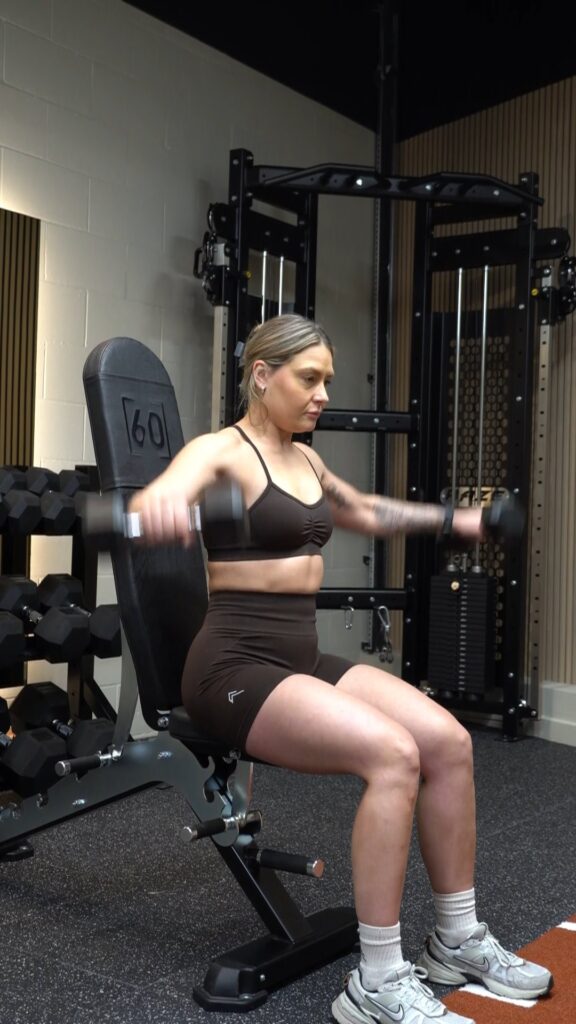
What Is a Drop Set?
Here is a simple example on dumbbell lateral raises:
- Do as many good reps as you can with 10-pound dumbbells, for example 12 reps.
- Put them down and immediately pick up 7.5-pound dumbbells.
- Do as many good reps as you can again, for example 8 reps.
- Drop again to 5-pound dumbbells and do as many reps as you can.
That is one drop set with two drops. You rest only as long as it takes to change the weight.
What the Research Says
- Similar muscle growth to regular sets. A 2023 review by Sødal and colleagues combined five studies with 142 people. Both drop sets and traditional sets increased muscle size, and there was no significant difference between them. The authors noted that some drop set programs took half to one-third of the time.
- A time-saving option. In a six-week study by Fink and colleagues, 16 people trained triceps pushdowns with either one set followed by two drops, or three normal sets with rest. The drop set workout took about half the time and produced at least as much triceps growth. The normal sets group showed a trend toward more strength.
So the evidence supports drop sets as an efficient way to build muscle, not a better one. The studies were small and mostly in young adults.
My view: use drop sets when they save you time or add a little extra work at the end of a session. Don’t build every set around them.
How to Do a Drop Set
- Choose the right exercise. Machines, cables and dumbbell racks let you change the weight in a few seconds.
- Start with a weight you can lift for about 8 to 12 reps. Take it close to the point where you can’t do another good rep.
- Reduce the weight by about 20 to 30%. This is a common guideline, not a fixed rule. The aim is to keep doing reps in a similar range.
- Keep going straight away. Only rest long enough to change the weight.
- Do one or two drops. More than that usually adds fatigue more than benefit.
Best Exercises for Drop Sets
| Exercise | Why it works well |
|---|---|
| Lateral raises | Light weights, easy to switch dumbbells |
| Biceps curls | Easy to switch dumbbells or move a cable pin |
| Triceps pushdowns | Quick weight change on a cable stack |
| Leg extensions | Machine with a pin, low skill needed |
| Machine chest fly or chest press | Stable, quick to change the weight |
| Lat pulldowns | Quick weight change on a cable stack |
Two of the easiest exercises for drop sets, from the 12REPS exercise library:
When Not to Use Drop Sets
- Heavy barbell lifts. Squats, deadlifts and bench presses take time to unload, and form breaks down when you are very tired.
- If you are new to lifting. Learn good technique with regular sets first.
- On every exercise. Drop sets are very tiring and can make it harder to recover for your next session.
- When technique slips. End the set when your form breaks down, not when you can only move the weight with momentum.
For more on how hard to push, read training to failure: should you push every set? and how to know if you’re training hard enough.
Example: Adding Drop Sets to a Workout
| Exercise | Sets | How |
|---|---|---|
| Dumbbell bench press | 3 sets of 8 to 10 | Regular sets, 2 minutes rest |
| Lat pulldown | 3 sets of 10 to 12 | Regular sets, last set as a drop set |
| Lateral raise | 2 sets | One regular set, then one drop set with two drops |
| Triceps pushdown | 1 drop set | One set to near failure, then two drops |
This keeps your main lifts as regular sets and uses drop sets on smaller exercises at the end.
Common Mistakes
- Dropping the weight too little. If you only get one or two reps after the drop, reduce the weight more.
- Resting between drops. The point is to keep going straight away.
- Using them all the time. One or two drop sets per workout is plenty for most people.
- Losing good form. Stop when your technique breaks down.
Summary
- A drop set means lifting to near failure, then lowering the weight and continuing straight away.
- Research shows drop sets build about as much muscle as regular sets, often in less time.
- Use them on machines, cables and dumbbells, not heavy barbell lifts.
- Do one or two drops of about 20 to 30%.
- Save them for the end of a workout and use them sparingly.
Train Smarter With a Plan
Short on time and not sure how to fit in enough work? 12REPS builds a strength program around your goal, schedule and equipment, so every session has a clear plan.
Every exercise has a demo and a coach tutorial from me, and your log shows what you lifted last time, so you always know what to aim for.
Download 12REPS and see what you’ll get:
Sources
- Sødal LK, Kristiansen E, Larsen S, van den Tillaar R. Effects of drop sets on skeletal muscle hypertrophy: a systematic review and meta-analysis. Sports Med Open. 2023;9:66.
- Fink J, Schoenfeld BJ, Kikuchi N, Nakazato K. Effects of drop set resistance training on acute stress indicators and long-term muscle hypertrophy and strength. J Sports Med Phys Fitness. 2018;58(5):597–605.
- American College of Sports Medicine. Progression models in resistance training for healthy adults. Med Sci Sports Exerc. 2009;41(3):687–708.
Related Reading
- The easy guide to supersets
- Training to failure
- How long to rest between sets
- How long should workouts be?
- How to train for muscle growth
I’m Will Duru, a personal trainer and the founder of 12REPS. I hold a BSc (Hons) in Sport and Exercise Science and have more than a decade of experience coaching people in strength training.
