


By Will Duru, BSc (Hons) Sport and Exercise Science Award-winning Personal Trainer with over 10 years of experience in strength training and optimising recovery
How long should women work out? For most women, a strength session of 30 to 60 minutes is enough. The length comes from how many hard sets you do and how long you rest between them, not from your sex. One study suggests women may need a little less rest between sets than men to keep their reps up.
Many of the women I train have packed schedules and limited time. You do not need two hours in the gym. What you do with the time matters far more than how long you are in the building.
This guide shows women how to fit strength training into a busy week, with 30 and 60-minute session layouts. For session length by goal, read our general guide to how long a workout should be.
What decides how long your workout takes
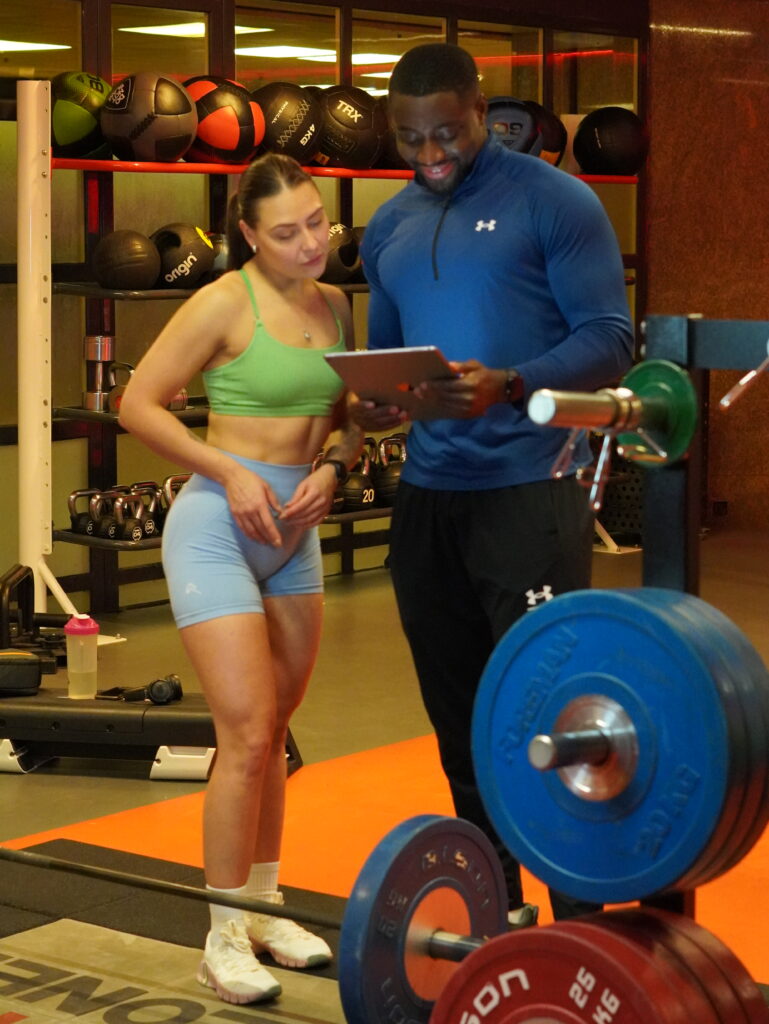
Session length mostly comes down to how many sets you do and how long you rest between them.
How many sets do you need? The American College of Sports Medicine (ACSM) 2026 position stand suggests at least 2 sets per exercise. For strength, it advises training at least twice a week, working all major muscle groups. For muscle growth, it points to about 10 or more sets per muscle group each week (ACSM, 2026). How you split that across the week sets the length of each session.
Do women need less rest between sets?
Rest is usually the biggest part of a strength workout. A time-saving review advises 1 to 2 minutes of rest for untrained people and at least 2 minutes for trained people (Iversen et al., 2021).
Women may manage with the shorter end. In one bench press study, women completed more reps than men with 1, 2 and 3-minute rests. The authors suggested shorter rests may be enough for women to reach a set amount of work (Ratamess et al., 2012). This fits wider research showing women are often less fatigable than men at the same relative effort, though it depends on the task (Hunter, 2014).
It is one study, so treat it as a guide, not a rule. If your reps drop sharply on the next set, rest longer. ACSM’s 2026 review also found that rests under or over 1 minute gave similar strength gains (ACSM, 2026). Read how long to rest between sets for more detail.
Is there a cut-off after 60 minutes?
No. The idea that cortisol spikes after an hour and ruins your progress does not hold up well; our guide to workout length explains why. The real limit is focus.
How to structure a 45 to 60-minute workout
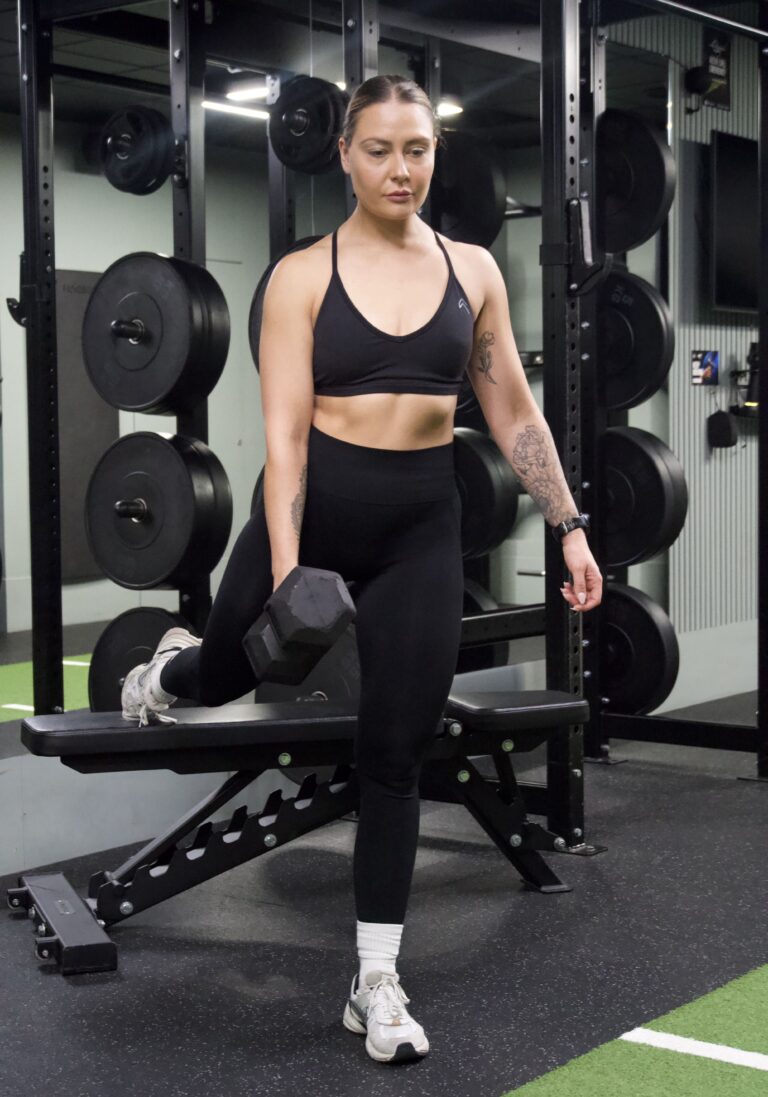
A longer session gives you room for warm-up sets, 4 to 6 exercises and proper rest. Here is a simple layout that works for most women.
Video: Barbell full-body workout with the 12REPS app. Watch it to see how one full-body session moves from exercise to exercise.
The layout
- Warm-up, 5 to 10 minutes: one or two lighter sets of your first exercise. When time is short, an exercise-specific warm-up is the part to keep (Iversen et al., 2021). See how to warm up before lifting.
- Main work, 35 to 45 minutes: start with big compound exercises such as squats, deadlifts, presses and rows. Finish with smaller exercises.
- Cool-down, optional: stretch if you enjoy it. The same review notes that active cool-downs, including stretching, did not appear to improve recovery or reduce soreness.
Ways to save time
- Compound exercises. A squat trains your legs and hips together, so you need fewer exercises than with machines that train one muscle at a time.
- Supersets. Pair two exercises for different muscles, such as a dumbbell press and a row, and rest after both. In short-term studies, this took about half the time of regular sets (Iversen et al., 2021). Learn more in our superset workout guide.
- Timed rests. Use a timer so 90 seconds does not become 4 minutes of scrolling.
Video: 5 tips for ladies new to the gym. If you are still finding your way around the gym floor, watch this before you plan your first sessions.
What if you only have 30 minutes?
Thirty minutes is enough for a real strength workout, especially if you train two or three times a week. Keep it simple and pair your exercises.
- Choose 3 or 4 compound exercises: a squat or lunge, a hinge, a push and a pull covers your whole body.
- Superset them in pairs: for example, goblet squat with a row, then a press with a Romanian deadlift.
- Keep warm-ups specific: one light set of your first exercise in each pair.
- Train with effort: finish most sets with about 2 to 3 reps left, as ACSM suggests (ACSM, 2026).
Video: 30 minutes kettlebell full-body workout. This shows what a complete 30-minute session can look like with a single kettlebell.
For a ready-made plan, try the 12REPS 30-minute full-body workout.
Fitting sessions into a busy week
Choose the pattern you can keep, whether that is more short sessions or fewer longer ones. The WHO minimum is muscle-strengthening work on 2 or more days a week (WHO).
To plan the week itself, read how many days a week women should strength train.
Make every minute count
- Know your exercises and weights before you arrive.
- Set up near the equipment you need for your supersets.
- Time your rests and put your phone down between sets.
- Log each set so you can beat it next time.
Planning is where most time gets lost. 12REPS builds a workout around your goal, your equipment and the time you have, so you open the app and the session is ready. A trainer demonstration plays for every exercise, and your weights and reps are saved for next time.
Workout length FAQs
Is 20 minutes enough?
It can be, if you train more often. Two or three 20-minute sessions of hard compound sets can still add up to useful weekly work.
Is a 90-minute session bad for women?
Not if the extra time is spent on useful sets and rest. Most women simply do not need that long to get good results.
Sources
- Resistance training prescription for muscle function, hypertrophy, and physical performance in healthy adults: an overview of reviews (ACSM position stand). Currier BS et al., American College of Sports Medicine, Medicine & Science in Sports & Exercise, 2026. https://doi.org/10.1249/MSS.0000000000003897
- No time to lift? Designing time-efficient training programs for strength and hypertrophy: a narrative review. Iversen VM, Norum M, Schoenfeld BJ, Fimland MS, Sports Medicine, 2021. https://doi.org/10.1007/s40279-021-01490-1
- The effects of rest interval length on acute bench press performance: the influence of gender and muscle strength. Ratamess NA et al., Journal of Strength and Conditioning Research, 2012. https://doi.org/10.1519/JSC.0b013e31825bb492
- Sex differences in human fatigability: mechanisms and insight to physiological responses. Hunter SK, Acta Physiologica, 2014. https://pubmed.ncbi.nlm.nih.gov/24433272/
- Physical activity. World Health Organization, n.d.. https://who.int/initiatives/behealthy/physical-activity