
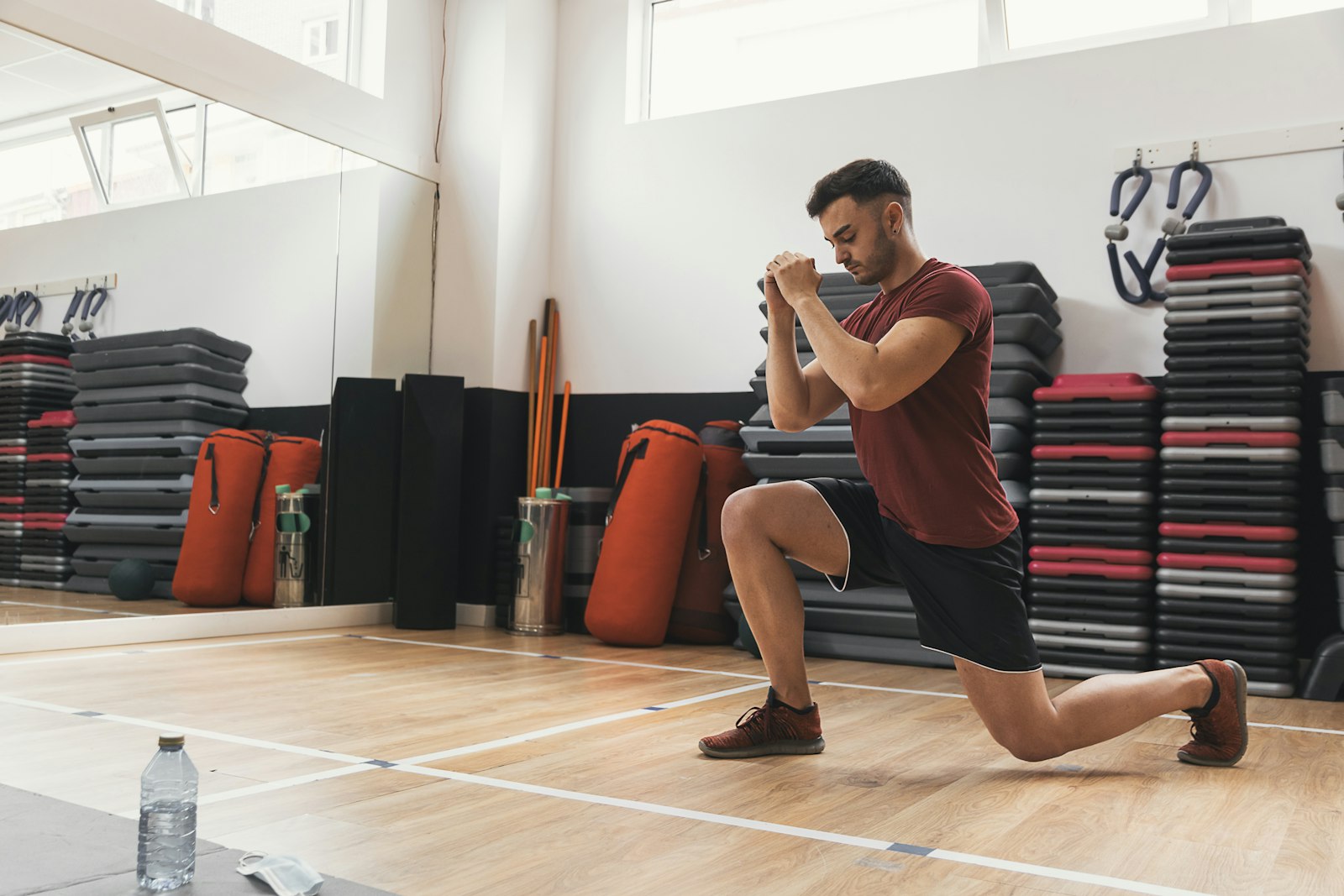



By Will Duru, personal trainer and founder of 12REPS.
What Is a Lateral Lunge?
A lateral lunge, also called a side lunge, is a leg exercise where you step out to the side and sit your hips back over the bent leg, while your other leg stays straight. It trains your quads, glutes and inner thighs, and it stretches the inner thigh of your straight leg.
Most leg exercises move you forward and back. The lateral lunge trains you side to side, which is useful for sports, everyday movement and balanced leg training. This guide shows you how to do it, what the research says, the mistakes to avoid and how to add it to your workouts.

Muscles Worked
| Muscle | What it does |
|---|---|
| Quadriceps | Straighten the bent knee as you push back to standing |
| Glutes | Control your hips as you sit back and drive you back up |
| Adductors (inner thighs) | Work on both legs, and stretch on the straight leg |
| Hamstrings and calves | Help control the movement and keep you stable |
What the Research Says
There is not much research on the lateral lunge, and the studies below are conference reports, not full journal papers. Treat them as useful signals, not final answers.
- A 2006 biomechanics study by Escamilla and colleagues found the side lunge was one of the most effective exercises tested for working the lower body. It produced more activity in the quads, hamstrings, inner thighs, calves and glutes than a short forward lunge or a wall squat.
- A 2017 study by Cerny and Adams tested 29 young adults. The front-thigh muscle worked hardest in the lateral lunge, and the lower glutes were active in the lateral lunge but almost silent in a backward lunge.
My view is that the lateral lunge is a useful addition to your leg training, not a replacement for squats or forward and reverse lunges. It trains a direction of movement that many programs leave out.
How to Do a Lateral Lunge
Setup
- Stand tall with your feet hip width apart and your toes pointing forward.
- Start with body weight. When you are ready, hold one dumbbell at your chest, or a dumbbell in each hand.
- Brace your stomach.
Movement
- Take a wide step out to one side, keeping your toes pointing forward.
- As your foot lands, push your hips back and bend the knee of the stepping leg.
- Keep your other leg straight, with that foot flat on the floor.
- Lower until your thigh is close to parallel with the floor, or as far as you can with your heel down and your back flat.
- Push hard through the bent leg to return to the start.
- Alternate sides, or do all your reps on one side before switching.
Coaching cues
- “Sit back, not down.”
- “Knee over your toes.”
- “Both feet flat, toes forward.”
- “Chest proud.”
Common Mistakes
- Stepping too short. A short step turns it into a squat on one leg. Step wide enough to straighten the other leg.
- Knee caving in. Keep your bent knee in line with your toes.
- Heel lifting. Keep the whole foot of the bent leg on the floor. If your heel lifts, go less deep.
- Rounding your back. Hinge from your hips and keep your chest up.
- Toes turned out a lot. Point both feet forward, or only slightly out, so the movement stays at your hip.
Variations
- Bodyweight lateral lunge: the best place to start and a good warm-up.
- Goblet lateral lunge: hold one dumbbell or kettlebell at your chest. It helps you stay upright.
- Dumbbell lateral lunge: hold a dumbbell in each hand for more load.
- Lateral lunge to balance: push back up and lift your knee to balance on one leg for a second.
- Cossack squat: an advanced version where you sink all the way down to one side and turn the toes of the straight leg up. It needs good hip mobility.
If you want more work for the sides of your hips, see my guide to glute medius exercises.
How Many Sets and Reps?
These are general starting points, not fixed rules.
| Goal | Version | Sets and reps |
|---|---|---|
| Warm-up or mobility | Bodyweight | 1 to 2 sets of 8 reps per side |
| Leg strength and muscle | Goblet or dumbbell | 3 sets of 8 to 12 reps per side |
| Conditioning | Bodyweight or light dumbbells | 2 to 3 sets of 12 to 15 reps per side |
Add lateral lunges to your leg day after your main exercise, such as a goblet squat or Bulgarian split squat. When you can do all your reps with good form, add a rep or use a heavier dumbbell. The American College of Sports Medicine recommends progressing gradually like this.
If your hips or inner thighs feel very tight, start with a shorter step and less depth. If you have hip or knee pain, speak to a qualified professional before adding this exercise.
Summary
- The lateral lunge trains your legs side to side, working your quads, glutes and inner thighs.
- Step wide, sit your hips back and keep your other leg straight.
- Keep both feet flat and your knee in line with your toes.
- Start with body weight, then add a goblet or two dumbbells.
- Use it alongside squats and forward or reverse lunges, not instead of them.
Train Your Legs in Every Direction
Is your leg day all squats and forward lunges? 12REPS builds a strength program around your goal, schedule and equipment, with a mix of exercises that train your legs from every angle.
Every exercise has a demo and a coach tutorial from me, and your log shows what you lifted last time, so you know exactly when to progress.
Download 12REPS and see what you’ll get:
Sources
- Escamilla RF, et al. A biomechanical analysis of squatting and lunging type exercises. Med Sci Sports Exerc. 2006;38(5 Suppl). Abstract.
- Cerny K, Adams J. Impulse and EMG of the leading limb during backward and lateral lunges, also the trailing limb during a forward lunge. World Physiotherapy Congress. 2017. Poster.
- American College of Sports Medicine. Progression models in resistance training for healthy adults. Med Sci Sports Exerc. 2009;41(3):687–708.
Related Reading
- Best glute medius exercises
- Bulgarian split squats: how to do them correctly
- How to do a goblet squat
- How to do a dead bug
I’m Will Duru, a personal trainer and the founder of 12REPS. I hold a BSc (Hons) in Sport and Exercise Science and have more than a decade of experience coaching people in strength training.
