


By Will Duru | Certified Personal Trainer | BSc Sport Science
Your body is talking to you.
Not loudly. Not all at once. Just little signals. The stiffness when you stand up after sitting too long. The belly that appeared without you changing much. The moment you picked something up and thought, “that used to be easy.” The Sunday morning where your back was tight before you even got out of bed.
You have not let yourself go. You have just been busy. Work. Family. Life. The gym stopped being a priority, and somewhere between your 30s and now, your body quietly started to shift underneath you.
Here is what is actually happening. From around your mid-30s, men lose between one and two per cent of their muscle mass every single year. By the time you are in your 40s, that loss is real. Less muscle means a slower metabolism. A slower metabolism means the weight sticks more easily and shifts less easily. Less muscle also means less support around your joints, which is why your knees feel it on stairs and your shoulders talk to you after a long week.
None of this is your fault. But none of it is permanent either.
The men who feel strong, capable, and physically confident in their 40s and 50s are not special. They are not genetic outliers. They just started training with weights and did not stop. That is the whole secret.
You can start today.
Why Strength Training
Forget what you think you know about lifting weights. This is not about getting big. It is not about competing. It is not about the gym selfie or the protein shake or any of the noise that surrounds fitness culture.
Strength training, at its most basic, is telling your body to stay strong. You challenge your muscles against resistance, your body adapts, and you get stronger. Simple as that. Whether you use a barbell, a resistance machine, a kettlebell, or just your own bodyweight, the principle is identical.
Do it consistently, and here is what starts to happen.
Your muscle mass stops declining and starts rebuilding. Muscle is not decoration. It supports your joints, protects your bones, drives your metabolism, and keeps your body functioning well as you age. Every kilogram of muscle you build is an investment in how capable you feel for the next twenty years.
Your body gets better at burning fat. Muscle tissue is metabolically active, meaning it burns energy even when you are doing nothing. More muscle means a higher baseline calorie burn. You do not need to eat less and feel miserable. You just need to give your body more of what it burns.
Your posture improves and your aches reduce. Most men in their 40s spend hours every day sitting. That tightens the hips, weakens the back, and rounds the shoulders forward. Strength training directly targets the muscles that counter all of this. A stronger posterior chain, stronger glutes, and a stronger core pull everything back into alignment. The chronic stiffness you have accepted as normal often starts to fade.
Your joints get more protection, not less. This is the one that surprises people. Men assume that lifting weights will grind their joints down. The opposite is true. Stronger muscles around a joint absorb more of the load and reduce the stress on the joint itself. Properly executed strength training is one of the best things you can do for long-term joint health.
Your head clears. A structured training session is one of the few places in adult life where you can switch off completely. No emails. No decisions. Just the work in front of you. For men carrying significant professional and family pressure, that hour matters. The mental benefit is real and it compounds just like the physical one does.
How to Start Without Getting It Wrong
The most common mistake men over 40 make when they get back into training is trying to train like they did at 25. They go too hard, too soon, get injured, and stop. The whole thing takes about three weeks.
Do not do that.
Three sessions per week is the sweet spot for beginners. Enough to drive real change. Enough space between sessions to recover properly. The programme below uses a push, pull, legs and core split, which means each session targets a different group of muscles. You are never training the same thing two days in a row. Your body gets the work and the recovery it needs.
All you need is a set of dumbbells, a kettlebell, and your own bodyweight. No gym membership required.
Track every session. Write down the weight, the sets, and the reps. This is not optional. It is the whole game. Progress is invisible without a record. With one, you have something clear to beat each week.
Give it six weeks before you judge anything. Most men feel a real shift in strength and energy by week three or four. Body shape takes a little longer. Stay in the room long enough to see it.
Your 6-Week Beginner Programme
How It Works
Three sessions per week. Rest at least one day between each session. A Monday, Wednesday, Friday split works well, but any three non-consecutive days will do.
Weeks 1 and 2: Learn the movements. Keep the weight light. Focus entirely on technique and completing every set.
Weeks 3 and 4: Add a small amount of weight or one extra rep to each exercise where you can. If a set feels comfortable, progress it.
Weeks 5 and 6: Push the effort level up. You should finish each working set feeling like you had one or two reps left in the tank, not five. Keep adding weight gradually.
Rest 60 to 90 seconds between sets throughout the programme.
Day 1: Push (Chest, Shoulders, Triceps)
| Exercise | Sets | Reps |
|---|---|---|
| Press-up | 3 | 10 to 12 |
| Dumbbell shoulder press | 3 | 10 to 12 |
| Dumbbell chest press (floor) | 3 | 10 to 12 |
| Dumbbell lateral raise | 3 | 12 to 15 |
| Kettlebell push press | 3 | 8 to 10 each side |
| Tricep dip (using a chair) | 3 | 10 to 12 |
What this session does: Trains everything that pushes away from the body. Builds shoulder strength and stability, which directly improves posture and reduces upper back tightness.
Day 2: Pull (Back, Biceps, Rear Shoulders)
| Exercise | Sets | Reps |
|---|---|---|
| Dumbbell bent-over row | 3 | 10 to 12 each side |
| Kettlebell deadlift | 3 | 10 to 12 |
| Dumbbell reverse fly | 3 | 12 to 15 |
| Dumbbell bicep curl | 3 | 10 to 12 |
| Kettlebell single-arm row | 3 | 10 each side |
| Band or bodyweight face pull (using a towel around a door handle) | 3 | 15 |
What this session does: Trains everything that pulls towards the body. Strengthens the back and rear shoulders, which counters the rounded posture that builds up from sitting. Most men over 40 are significantly undertrained here.
Day 3: Legs and Core
| Exercise | Sets | Reps |
|---|---|---|
| Goblet squat (kettlebell or dumbbell) | 3 | 10 to 12 |
| Romanian deadlift (dumbbell) | 3 | 10 to 12 |
| Reverse lunge (bodyweight or dumbbell) | 3 | 8 to 10 each leg |
| Kettlebell swing | 3 | 12 to 15 |
| Plank | 3 | 30 to 45 seconds |
| Dead bug | 3 | 8 to 10 each side |
What this session does: Trains the legs, glutes, and core together. Stronger legs and hips improve everything from lifting off the floor to running for a bus. The core work here is functional, meaning it trains your midsection to resist movement rather than just crunch through it.
Progression Over 6 Weeks
| Week | Focus |
|---|---|
| Week 1 | : Learn the exercises. Prioritise technique. Lightweight. |
| Week 2 | : Complete every set. Start to find your working weight. |
| Week 3 | : Add one or two reps or a small amount of weight where the exercise feels controlled. |
| Week 4 | : Hold those increases. Focus on consistency. |
| Week 5 | : Increase weight or reps again. Sessions should feel genuinely challenging. |
| Week 6 | Final push. Each set should feel like you have one or two reps left. Not ten. |
After six weeks, reassess. If you have been consistent, you will be noticeably stronger. At that point, increase the weight across the board and repeat the programme, or move to a more advanced split.
20 Strength, Bodyweight and Cable Exercises From the 12REPS Library
The linked exercises support pressing strength, upper-back stability, shoulder development and triceps strength. Use the recommended sets and repetitions as starting points.
Exercise | Main focus | Sets | Recommended reps | Role in bench training |
Chest and triceps | 3-4 | 6-12 | Primary pressing volume | |
Upper chest and shoulders | 3-4 | 6-12 | Secondary press | |
Triceps and chest | 3-4 | 8-12 | Lockout strength | |
Chest, triceps and core | 3 | 8-20 | Volume and technique | |
Chest and triceps | 3 | 10-20 | Beginner pressing | |
Chest, shoulders and triceps | 3 | 8-15 | Press-up progression | |
Chest | 3 | 10-15 | Chest accessory | |
Chest | 3 | 10-15 | Cable chest accessory | |
Chest | 3 | 10-15 | Controlled chest work | |
Triceps | 3-4 | 10-15 | Triceps volume | |
Triceps | 3 | 10-15 each arm | Single-arm lockout work | |
Triceps | 3 | 8-12 | Heavy triceps work | |
Triceps, chest and shoulders | 3 | 6-12 | Compound accessory | |
Triceps | 3 | 8-15 | Dip progression | |
Lats and upper back | 3-4 | 8-12 | Back stability | |
Mid-back | 3-4 | 8-12 | Bench support | |
Upper back | 3-4 | 8-12 | Upper-back strength | |
Back and biceps | 3-4 | 8-15 | Bodyweight pull | |
Rear shoulders and upper back | 3 | 12-20 | Shoulder balance | |
Shoulders and triceps | 3 | 8-12 | Shoulder strength |
One Question Before You Close This Tab
How much stronger could you feel in six weeks if you started this week?
Not some version of training you cannot sustain. Not six days a week or a programme built for a 25-year-old with no responsibilities. Just three sessions a week, a clear plan, and the discipline to track your progress and keep going.
That is all it takes to start turning things around.
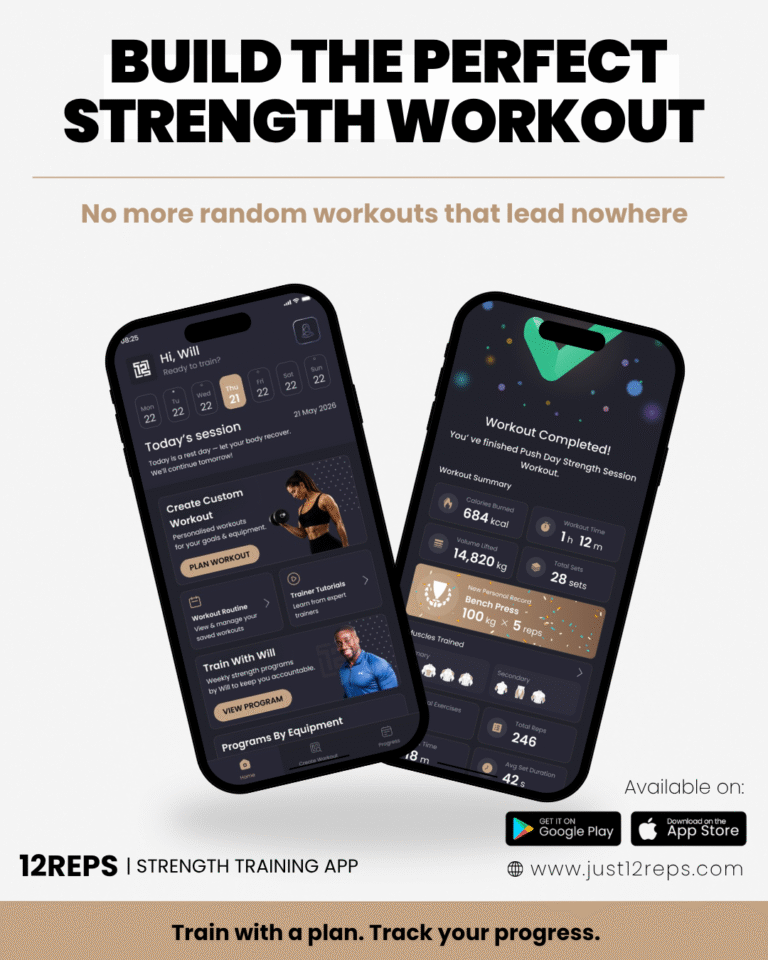
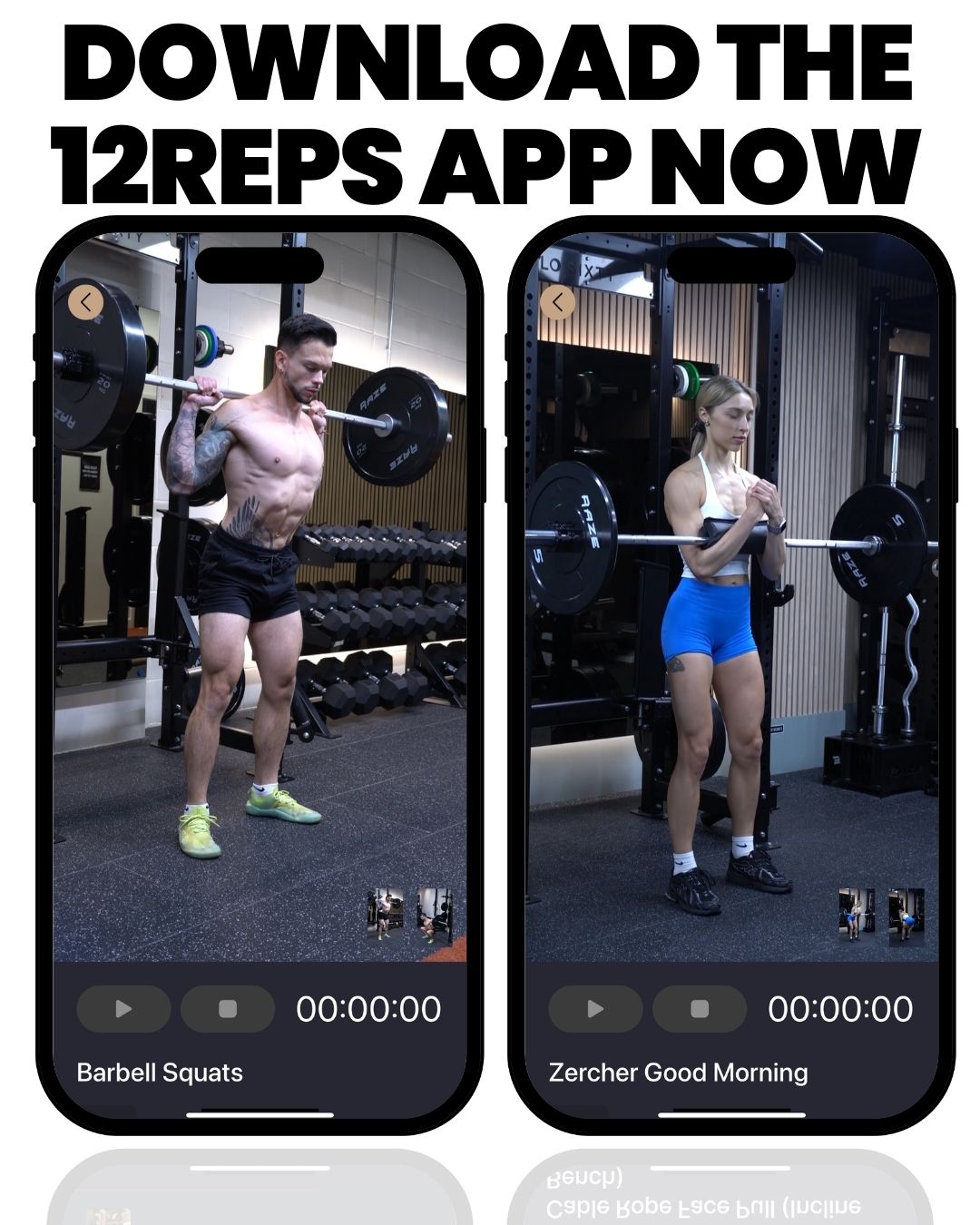
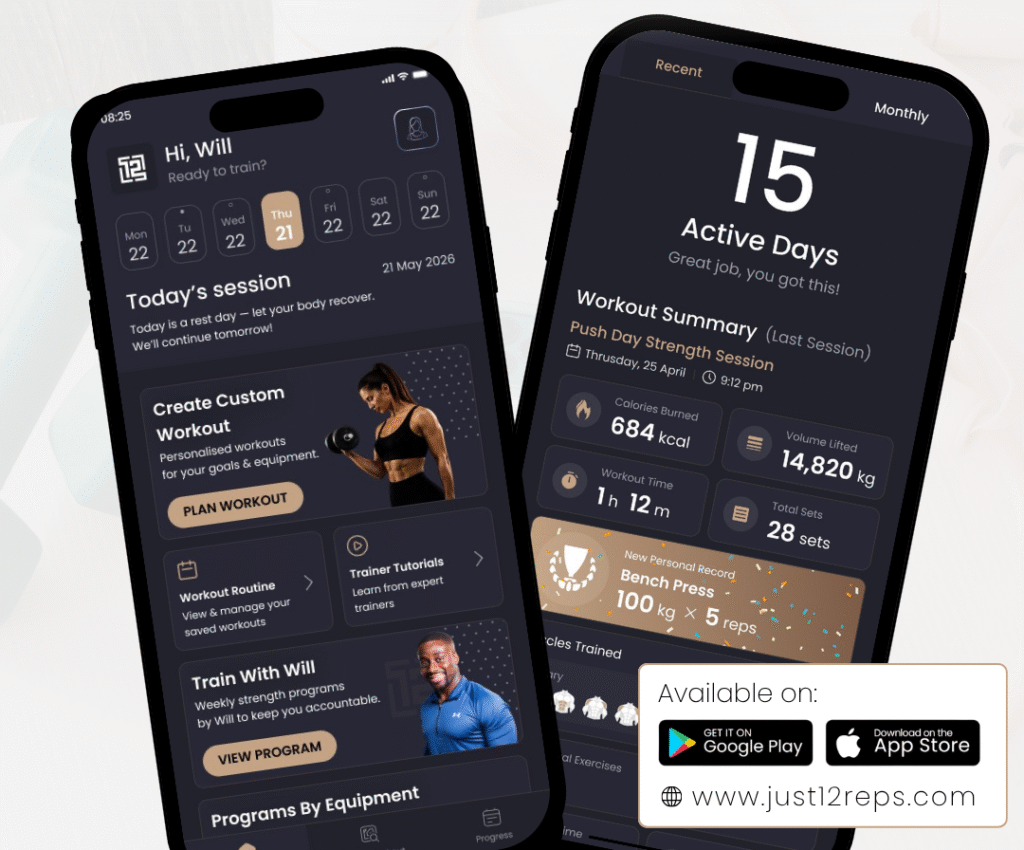
The 12REPS app gives you a structured strength training plan built around your goal, your equipment, and your level. Choose what you want to train, filter by what you have available, follow the session, and track your sets, reps, and weight as you go. No guesswork. No wasted time. Just a clear plan you can repeat.