


You Do Not Need More Time. You Need a Clear Plan.
Work, family and everyday responsibilities can make training feel impossible. You may start the week with good intentions, then miss one session and lose momentum.
The answer is not spending six days in the gym. It uses three focused 45-minute sessions that train your whole body across the week.
This 12-week programme uses a push, pull and legs split. Each workout gives you a clear exercise order, sets, repetitions and rest times. You can enter the gym, follow the plan and get back to your day.
Why This Programme Works for Busy Dads
- Three weekly sessions are easier to protect in a busy calendar.
- Each workout has six exercises, so you avoid wasting time deciding what to do.
- Compound exercises train several muscle groups at once.
- Planned rest periods keep the workout close to 45 minutes.
- Progressive overload gives you a measurable way to build muscle and strength.

Why Traditional Programmes Fail Dads
Your Weekly Training Schedule
Day | Session | Purpose |
Monday | Push | Chest, shoulders and triceps |
Wednesday | Pull | Back, rear shoulders and biceps |
Friday | Legs and core | Quads, glutes, hamstrings, calves and mid-section |
Tuesday, Thursday and the weekend can be used for walking, mobility, sport, family activities or complete rest.
How to Keep Each Workout Within 45 Minutes
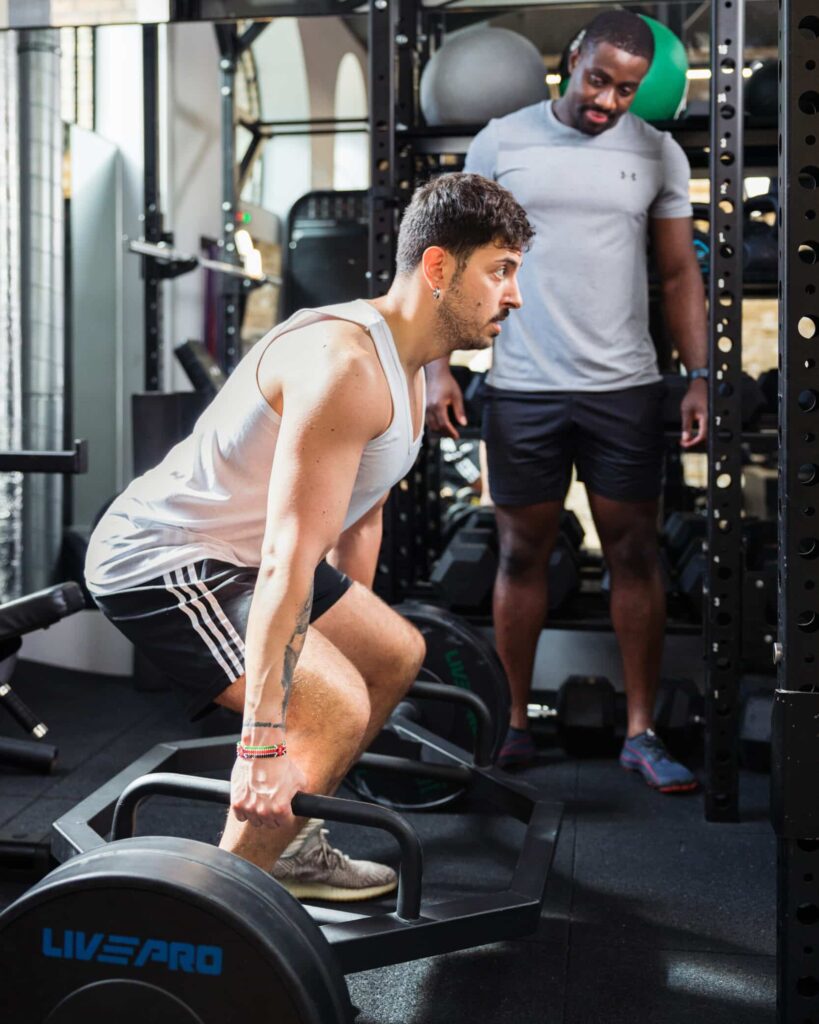
Spend five minutes warming up. Complete the first three exercises with controlled rest. Pair the final three exercises as supersets, as shown. Keep your phone away unless you are recording your workout.
The 12-Week Programme
Phase One: Build the Habit and Learn the Movements
Weeks 1 to 4 focus on technique, control and consistency. Leave two to three good repetitions in reserve.
Day One: Push
Exercise | Sets | Reps | Rest | Main focus |
3 | 10-12 | 75 sec | Chest | |
3 | 10-12 | 75 sec | Chest and triceps | |
3 | 10-12 | 60 sec | Triceps and chest | |
3 | 8-12 | 60 sec | Chest and core | |
3 | 12-15 | 45 sec | Chest | |
3 | 12-15 | 45 sec | Shoulders |
Day Two: Pull
Exercise | Sets | Reps | Rest | Main focus |
3 | 10-12 | 75 sec | Lats | |
3 | 10-12 | 75 sec | Upper back | |
3 | 10-12 | 60 sec | Mid-back | |
3 | 12-15 | 45 sec | Rear shoulders | |
3 | 10-15 | 45 sec | Biceps | |
3 | 8-12 | 45 sec | Mid-section |
Day Three: Legs and Core
Exercise | Sets | Reps | Rest | Main focus |
3 | 10-12 | 90 sec | Quads and glutes | |
3 | 10-12 | 90 sec | Hamstrings and glutes | |
3 | 8-10 each leg | 75 sec | Single-leg strength | |
3 | 12-15 | 60 sec | Glutes | |
3 | 12 each leg | 45 sec | Glutes | |
3 | 15-20 | 45 sec | Calves |
Phase Two: Build Muscle and Increase Training Volume
Weeks 5 to 8 increase the workload. Complete four sets of the first three exercises and three sets of the remaining exercises.
Day One: Push
Exercise | Sets | Reps | Rest | Main focus |
4 | 8-12 | 90 sec | Chest | |
4 | 8-12 | 90 sec | Chest and triceps | |
4 | 8-12 | 75 sec | Triceps and chest | |
3 | 8-12 | 60 sec | Chest and core | |
3 | 12-15 | 45 sec | Chest | |
3 | 12-15 | 45 sec | Shoulders |
Day Two: Pull
Exercise | Sets | Reps | Rest | Main focus |
4 | 8-12 | 90 sec | Lats | |
4 | 8-12 | 90 sec | Upper back | |
4 | 8-12 | 75 sec | Mid-back | |
3 | 12-15 | 45 sec | Rear shoulders | |
3 | 10-15 | 45 sec | Biceps | |
3 | 10-15 | 45 sec | Mid-section |
Day Three: Legs and Core
Exercise | Sets | Reps | Rest | Main focus |
4 | 8-12 | 90 sec | Quads and glutes | |
4 | 8-12 | 90 sec | Hamstrings and glutes | |
4 | 8-10 each leg | 75 sec | Single-leg strength | |
3 | 12-15 | 60 sec | Glutes | |
3 | 12-15 each leg | 45 sec | Glutes | |
3 | 15-20 | 45 sec | Calves |
Phase Three: Get Stronger Without Making Workouts Longer
Weeks 9 to 12 use heavier weights on the first three movements. Keep your technique controlled and stop before form breaks down.
Day One: Push
Exercise | Sets | Reps | Rest | Main focus |
4 | 6-10 | 120 sec | Chest | |
4 | 6-10 | 90 sec | Chest and triceps | |
4 | 8-10 | 90 sec | Triceps and chest | |
3 | 8-12 | 60 sec | Chest and core | |
3 | 10-15 | 45 sec | Chest | |
3 | 10-15 | 45 sec | Shoulders |
Day Two: Pull
Exercise | Sets | Reps | Rest | Main focus |
4 | 6-10 | 120 sec | Lats | |
4 | 6-10 | 90 sec | Upper back | |
4 | 8-10 | 90 sec | Mid-back | |
3 | 10-15 | 45 sec | Rear shoulders | |
3 | 10-15 | 45 sec | Biceps | |
3 | 10-15 | 45 sec | Mid-section |
Day Three: Legs and Core
Exercise | Sets | Reps | Rest | Main focus |
4 | 6-10 | 120 sec | Quads and glutes | |
4 | 6-10 | 120 sec | Hamstrings and glutes | |
4 | 8 each leg | 90 sec | Single-leg strength | |
3 | 10-15 | 60 sec | Glutes | |
3 | 10-15 each leg | 45 sec | Glutes | |
3 | 15-20 | 45 sec | Calves |
How to Progress
Use double progression. Start with a weight you can control at the lower end of the repetition range. Keep the same weight until you reach the top of the range across every set. Then increase the weight slightly.
Phase | Weeks | Main goal | Typical sets | Rep range |
Foundation | 1-4 | Technique and routine | 3 | 8-15 |
Muscle building | 5-8 | More volume | 3-4 | 8-15 |
Strength | 9-12 | Heavier controlled work | 3-4 | 6-15 |
Time-Saving Supersets
Pair the final exercises when you need to save time:
- Push day: Dumbbell chest fly with dumbbell lateral raises.
- Pull day: Cable face pulls with cable biceps curls.
- Leg day: Cable glute kickbacks with standing calf raises.
References
- Schoenfeld, B.J., Ogborn, D., Krieger, J.W. (2016). Effects of Resistance Training Frequency on Measures of Muscle Hypertrophy: A Systematic Review and Meta-Analysis. Sports Medicine, 46(11), 1689-1697. https://doi.org/10.1007/s40279-016-0543-8
- Schoenfeld, B.J., Grgic, J., Ogborn, D., et al. (2017). Strength and Hypertrophy Adaptations Between Low vs. High Load Resistance Training: A Systematic Review and Meta-Analysis. Journal of Strength and Conditioning Research, 31(12), 3508-3523. https://doi.org/10.1519/JSC.0000000000002200
- Grgic, J., Schoenfeld, B.J., Davies, T.B., et al. (2018). Effect of Resistance Training Frequency on Gains in Muscular Strength: A Systematic Review and Meta-Analysis. Sports Medicine, 48(5), 1207-1220. https://doi.org/10.1007/s40279-018-0872-x
- Colquhoun, R.J., Gai, C.M., Aguilar, D., et al. (2018). Training Volume, Not Frequency, Indicative of Maximal Strength Adaptations to Resistance Training. Journal of Strength and Conditioning Research, 32(5), 1207-1213. https://doi.org/10.1519/JSC.0000000000002414